

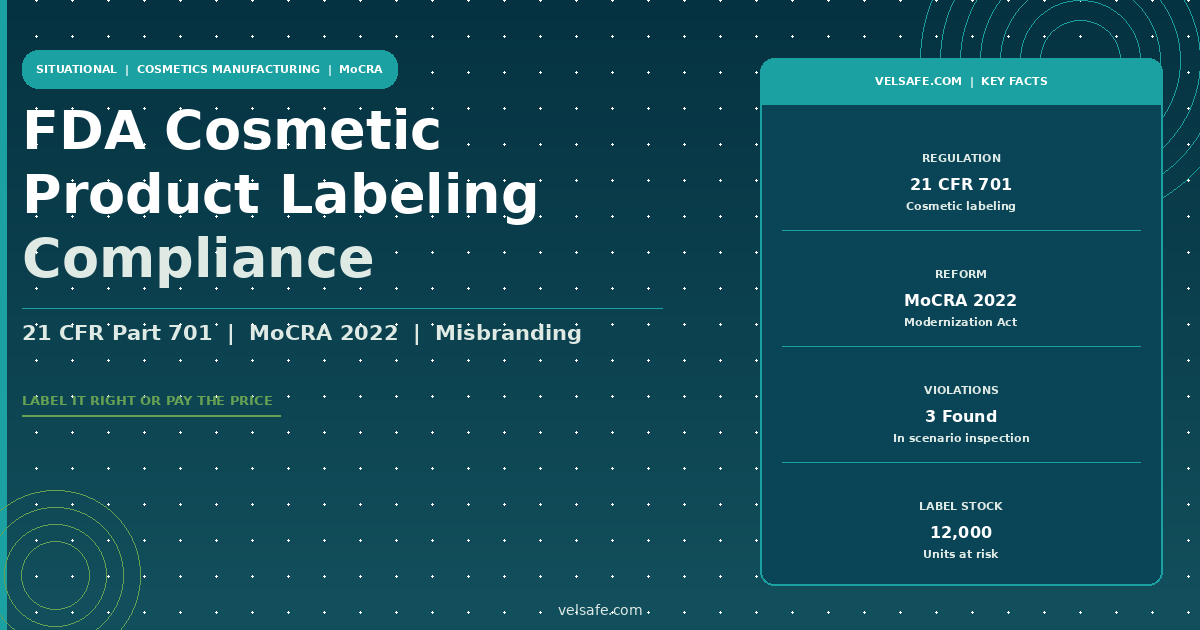
A product label is the first place FDA inspectors look, and the most common place cosmetic manufacturers get it wrong. Under 21 CFR Part 701 and the Modernization of Cosmetics Regulation Act of 2022 (MoCRA), the rules are specific, and the consequences for missing them are significant.
This scenario walks through a real-world labeling compliance situation, examines where the manufacturer went wrong, and lays out the correct path forward.
Scenario Introduction
A mid-size cosmetics company is preparing to launch a new line of high-strength chemical exfoliant products. The line includes a 30% glycolic acid peel and a professional-grade keratin smoothing treatment. Both products are intended for use by licensed estheticians and salon professionals.
The brand’s marketing team has designed elegant minimalist packaging. The quality team has signed off on the ingredient list. The products are about to ship to fulfillment centers for distribution to both licensed salons and a consumer-facing e-commerce store.
Two weeks before launch, an FDA inspector arrives at the manufacturing facility for a routine inspection and requests to review product labels for the upcoming line.
Situation Details
The 30% glycolic acid peel label includes the product name, a decorative ingredient list in stylized script font, and the company name. The net weight appears on the back panel in small text near the top of the label. There is no warning about professional use. The contact information listed is the brand’s Instagram handle and website URL only, with no street address.
The keratin treatment label is similarly minimal. It contains no advisory about formaldehyde content, despite the formulation releasing formaldehyde when heat is applied during the salon process. The ingredient list is technically present but uses trademarked ingredient blend names rather than INCI (International Nomenclature of Cosmetic Ingredients) names. The label does not state that the product is intended for professional use only.
Both labels are visually polished. Neither is compliant.
People involved: The brand’s quality assurance manager, the packaging design lead, the regulatory affairs consultant (engaged only at product development stage, not label review), and the FDA inspector.
Available resources at the time of inspection: The facility has the product formulation records, SDS sheets, and the original design files for packaging. The regulatory consultant is reachable by phone. Label stock has already been printed for 12,000 units.
Decision Point
The inspector flags three violations and asks the QA manager to explain how the company intends to address them before distribution. The QA manager must decide how to respond and what to do about the already-printed label stock.
The options:
Ship the products and submit a corrective action plan after launch. Argue that the products haven’t caused harm and that relabeling is planned for the next production run.
Halt shipment, engage the regulatory consultant, correct all label violations, reprint affected stock, and document corrective actions before any product leaves the facility.
Analysis
Violation 1: Missing “For Professional Use Only” statement. Under MoCRA, products intended exclusively for use by licensed professionals must bear a label stating they are for professional use only. The FDA considers this statement a safety requirement, not a marketing designation. High-concentration chemical exfoliants and formaldehyde-releasing keratin treatments sold without this warning can cause chemical burns and severe reactions when used by untrained consumers. Distributing them without the statement renders both products misbranded under FD&C Act Section 602.
Violation 2: Incomplete contact information. FDA regulations require that the label of a cosmetic product specify the name and place of business of the manufacturer, packer, or distributor, including a street address. A social media handle and website URL do not satisfy this requirement. The FDA uses this information to locate the responsible party in the event of a safety incident. Missing or incomplete contact information is one of the most frequently cited cosmetic labeling deficiencies and is a standalone misbranding violation under 21 CFR 701.12.
Violation 3: Non-INCI ingredient nomenclature. Under 21 CFR 701.3, cosmetic ingredient names on the label must follow the naming conventions established in the International Cosmetic Ingredient Dictionary. Using proprietary blend names or trade names in place of INCI names is a labeling violation regardless of how complete the underlying ingredient list is. Consumers and inspectors cannot verify product safety or identify potential allergens from trade-named blends.
Net weight placement is also non-compliant. FDA regulations specify that net quantity of contents must appear in the bottom third of the principal display panel, in bold lettering, in a type size proportionate to the panel area. Text placed at the top of a back panel in small script does not satisfy this placement and formatting requirement.
Option B is the only defensible choice. Holding shipment costs the company money on reprinting approximately 12,000 units of label stock. A cosmetic labeling attorney familiar with the Bustos Law Group analysis of real-world enforcement cases notes that a relabeling cost of roughly $12,000 for 5,000 units is a fraction of what a warning letter response, a product seizure, or a reputation-damaging public enforcement action costs.
The Correct Path Forward
The QA manager calls the regulatory consultant and engages legal counsel the same day. A written corrective action response is prepared for the inspector documenting: (1) the hold on all distribution; (2) the specific label errors identified; (3) the corrective actions being taken for each violation; and (4) the anticipated timeline for relabeling.
New label designs are developed with the regulatory consultant reviewing every element before files go to the printer. The revised labels include: the complete business name and street address; the “For Professional Use Only” statement displayed prominently on the principal display panel; ingredient names in full INCI nomenclature; net weight in the bottom third of the PDP in bold type; and a contact information section compliant with MoCRA’s requirement for the responsible person to receive adverse event reports.
Learning Points
Aesthetics and compliance are separate sign-off gates. A label can be visually excellent and legally non-compliant at the same time. Design review and regulatory review must be independent steps, not one combined approval. Many brands conflate the two, especially early-stage companies without a dedicated regulatory function.
MoCRA changed the risk profile permanently. Before MoCRA, FDA’s authority over cosmetic labeling was largely limited to warning letters and injunctions. The 2022 law granted the agency mandatory recall authority for misbranded products that pose health risks, access to safety records, and a strengthened framework for enforcement. The surge in cosmetic labeling violations cited through 2025 and 2026 reflects both increased inspection activity and manufacturers underestimating how significantly the regulatory environment shifted.
Professional-use products require extra care in labeling and distribution. Selling high-strength professional cosmetics through consumer-facing e-commerce without professional-use labeling creates dual exposure: a labeling violation and a potential safety liability if a consumer is harmed by improper use.
Regulatory consultants belong in the label review stage, not just product development. A formulation can be flawless while its label is misbranded. Engage qualified regulatory support at every stage where consumer-facing information is being finalized, including packaging design, label copy, and marketing claim review.
“Our launch was delayed by three weeks for relabeling. We were frustrated at the time. Six months later, a competitor in the same product category received a public warning letter and a mandatory recall. The cost difference was enormous.”
Related Resources
For further guidance on FDA cosmetic compliance requirements, the following topics are covered on velsafe.com and provide useful context for this scenario:
- Failure Investigations for Cosmetic Manufacturers (CAPA process when labeling non-conformances are identified)
- FDA 483s: Inspectional Observations (what happens after an inspection flags a violation)
- EU In Vitro Diagnostic Regulations and Inspection Readiness (parallel regulatory preparedness for manufacturers operating in multiple markets)
Sources
- Summary of Cosmetics Labeling Requirements, FDA
- 21 CFR Part 701: Cosmetics Labeling Regulations, FDA
- Modernization of Cosmetics Regulation Act of 2022 (MoCRA), FDA
- Key Terms for Cosmetics Regulation: Adulterated and Misbranded, FDA
- Cosmetic Labeling FDA Requirements 2025, FDA Inspections
- Cosmetic Labeling Compliance: Avoid FDA Warning Letters, Bustos Law Group
- MoCRA Compliance: Key Legal Issues for Fashion Houses with Cosmetics, ArentFox Schiff