

Training is not a checkbox activity in FDA-regulated manufacturing. It is a documented, audited, and enforceable obligation that sits at the foundation of every quality system the agency inspects.
This guide covers the regulatory basis for training requirements across pharmaceutical and medical device manufacturing, what inspectors look for, where companies consistently fall short, and how to build a program that holds up under scrutiny.
The Regulatory Foundation
Two primary regulations govern personnel training in FDA-regulated manufacturing. For pharmaceutical companies, 21 CFR 211.25 sets the standard. For medical device manufacturers, training requirements were historically defined in 21 CFR 820.25(b) under the Quality System Regulation (QSR). As of February 2, 2026, the QSR has been replaced by the Quality Management System Regulation (QMSR), which amends 21 CFR Part 820 to incorporate ISO 13485:2016 by reference. The intent of the training obligation remains the same across both sectors: personnel must be competent to perform their assigned functions, and that competency must be demonstrable.
Under 21 CFR 211.25, every person engaged in the manufacture, processing, packing, or holding of a drug product must have the education, training, and experience to perform their assigned functions. The regulation does not specify a single format for training; it specifies a result: a qualified employee who can execute their role within cGMP requirements.
Three categories of personnel fall within scope. First, those involved in manufacturing, warehousing, or packaging must receive training specific to their operations and in the CFR requirements governing those operations. Second, supervisors and managers in production and quality functions must have academic credentials or practical experience sufficient to supervise regulated work. Third, personnel in quality control must have the education, training, and experience required to test and release regulated product.
The regulation also requires that training be in GxP practices as they apply to each employee’s duties, not merely in internal SOPs. Reading the procedure once and signing a form does not satisfy this standard. The FDA expects companies to assess whether learning actually occurred and whether the employee can apply it correctly.
The QMSR, effective February 2, 2026, harmonizes FDA’s device manufacturing requirements with ISO 13485:2016. Under ISO 13485 Clause 6.2, organizations must determine the necessary competency for personnel performing work affecting product quality, provide training where needed, evaluate the effectiveness of that training, and maintain records as evidence. The FDA has now incorporated these requirements directly into US regulatory enforcement.
The prior QSR under 21 CFR 820.25(b) required manufacturers to establish procedures for identifying training needs and ensure that all personnel are appropriately trained. The QMSR extends this by requiring competency evaluation, not simply task-level instruction. Device manufacturers who trained staff by distributing SOPs for signature must now demonstrate that personnel understood, internalized, and can apply the requirements of those procedures.
A specific obligation under the device framework is that personnel performing verification and validation activities must be able to identify defects through proper performance of their roles. This places a higher bar on V&V teams, who must demonstrate technical judgment, not just procedural familiarity.
What Inspectors Actually Check
FDA investigators approach training as evidence, not paperwork. During an inspection, the standard sequence involves requesting training records for employees observed performing regulated tasks, comparing the training documentation against the SOPs those employees are executing, and assessing whether training predated the activity or followed it.
Beyond the records themselves, investigators look for evidence that training translated into correct execution. Batch record errors, deviations, and out-of-specification results that trace back to personnel actions may prompt a review of whether those individuals were adequately trained and qualified. Training is routinely identified as the root cause of cascading quality system failures.
Inspectors also evaluate whether the training system is structured. A list of completed training courses is not a training program. The FDA expects to see a defined process for identifying who needs to be trained, on what, at what frequency, and how competency is verified.
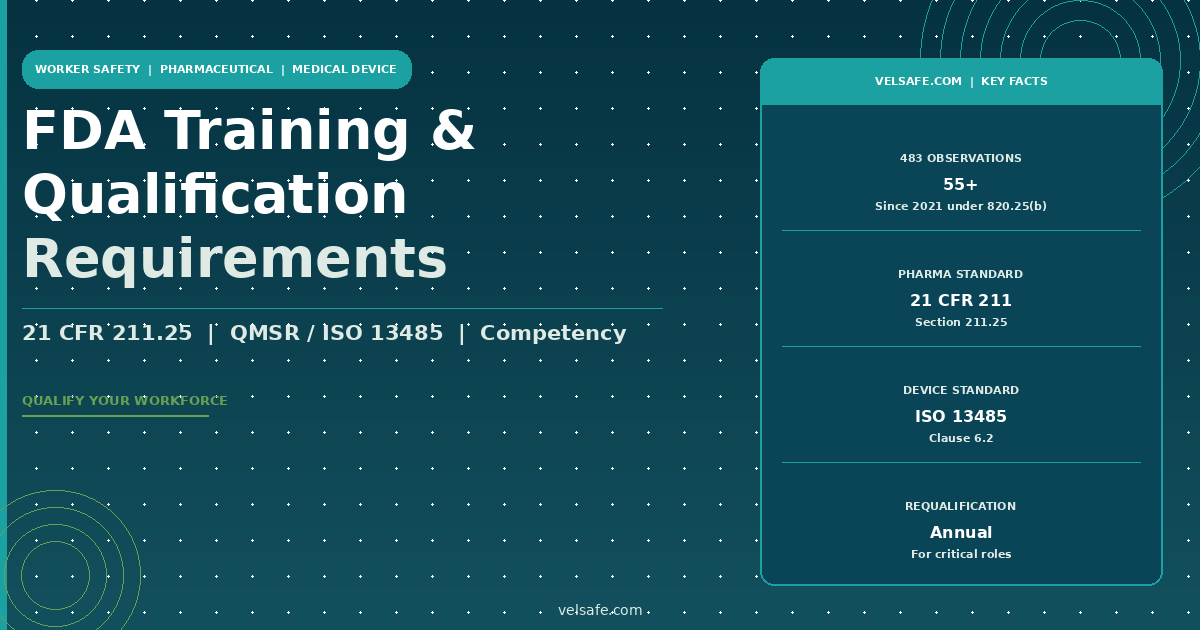
Training-related deficiencies appear with regularity across both drug and device inspections. Under 21 CFR 820.25(b), inadequate or absent training procedures have generated 55 observations since 2021 according to FDA enforcement data, making it a persistent and trackable citation category. Pharmaceutical inspections under 21 CFR 211.25(a) show an equivalent pattern, with inadequate personnel training consistently ranking among the most cited observations in FDA 483s.
The specific failure modes observed include: no training records for employees performing regulated activities; training records that exist but do not cover the specific procedures being executed; no competency assessment following completion of training; no retraining triggered by SOP revisions or deviations; and no procedure for identifying which roles require which training.
In one documented case, a manufacturer’s own training procedure required all employees to be trained to perform their assigned responsibilities and required records to be maintained. During inspection, the company could produce no training records at all for three employees who had performed design control activities. The FDA found the firm’s corrective response inadequate because it acknowledged the gap but did not demonstrate that interim controls were in place while remediation was underway.
Building a Training Program That Withstands Inspection
A compliant training program is built on four structural elements: a training matrix, role-based curriculum, documented competency assessment, and a system for tracking status and triggering retraining.
A training matrix maps job functions to the SOPs, regulations, and processes each role must be trained on. It serves as the master record of what is required versus what has been completed, and it drives the identification of training gaps. Without a matrix, a firm cannot systematically demonstrate that all personnel in a given function are current on all relevant procedures.
Matrices should be living documents. When a new SOP is approved, the matrix should automatically identify who needs to be trained and by when. When an employee changes roles, the matrix should identify the gap between their existing training and the requirements of the new function. The FDA expects this kind of systematic approach, not ad-hoc assignment of training when problems arise.
Training must align directly with approved SOPs so that employees follow consistent procedures in daily operations. Pharmaceutical companies assign training based on each employee’s specific role to ensure accurate task execution, and they assess employee qualification to confirm that each individual meets regulatory and operational standards.
Competency assessment is the element most commonly missing from manufacturer programs. Reading a document and signing an acknowledgment form is not assessment. The FDA expects evidence that training was understood and can be applied. Assessment methods include written tests, practical demonstrations, direct observation by a qualified supervisor, and documented sign-off by a trainer confirming observed competency.
For verification and validation personnel under the QMSR, competency expectations are higher. These individuals must demonstrate the technical judgment to identify defects and non-conformances through the execution of their role, which requires more than procedural review.
Training Records: The Audit Trail the FDA Expects
Records are the proof. Without them, training did not happen as far as an FDA investigator is concerned. Records must show the name of the trainee, the date training was completed, the specific document or procedure covered, the training method used, the outcome of any assessment, and the identity of the trainer or supervisor who confirmed competency.
The QMSR Change and What It Means for Training Programs
The February 2026 transition from the QSR to the QMSR marks the most significant shift in medical device quality requirements in nearly three decades. For training specifically, the incorporation of ISO 13485:2016 adds two dimensions that were less explicit under the old QSR.
First, ISO 13485 Clause 6.2 requires that the organization evaluate the effectiveness of the training it provides. This is not a documentation requirement in the conventional sense: it means that the training program itself must be assessed for whether it produces competent people. A company that trains hundreds of employees and sees ongoing deviations rooted in human error should be asking whether the training content, method, or frequency is adequate. The QMSR now makes that question a regulatory expectation.
Second, ISO 13485 requires that personnel be aware of the relevance and importance of their activities and how they contribute to the achievement of quality objectives. This moves training beyond task instruction toward understanding. Employees should know why GMP matters to product quality, not simply what steps to follow.
Qualification vs. Training: A Distinction That Matters
Training and qualification are often used interchangeably in manufacturing environments, but they are not the same thing. Training refers to the instruction provided. Qualification is the verified state of competency that follows. A person can complete training and still not be qualified to perform a task if they have not demonstrated they can apply the training correctly and consistently.
This distinction matters during inspections. If an investigator asks whether an employee was qualified to perform a task they were observed doing, the answer requires more than a training completion record. It requires evidence that the employee demonstrated the ability to perform the task to the required standard. For roles with significant quality impact, such as laboratory analysts, process operators, and V&V personnel, qualification typically involves a structured practical demonstration and sign-off by a qualified trainer.
Initial qualification is not permanent. Regulatory expectations require that companies address changes that may affect competency, including SOP revisions, process changes, new equipment, and prolonged absence from a task. The most effective approach is implementing structured role-based training with documented assessments and continuous requalification cycles, according to current GMP practice.
Many companies establish annual requalification cycles for critical roles and event-driven requalification for deviations or changes. Whatever the trigger, requalification must be documented with the same rigor as initial qualification.
Training Failures as Root Causes in Quality Events
FDA investigators and quality professionals consistently find that training gaps operate as root causes that ripple outward. Batch record errors, contamination events, failed CAPA implementations, and data integrity issues frequently trace back to personnel who were not trained, were trained inadequately, or whose training did not cover the specific task performed.
The enforcement consequences of training failures can be severe. Inadequate personnel training under 21 CFR 211.25(a) consistently ranks among the most common observations in FDA 483s. Where training failures are systemic rather than isolated, the risk of warning letters increases materially. At the extreme end of the enforcement spectrum, consent decrees that restrict manufacturing operations often include training failures among the underlying violations.
The cost calculus is clear: building a robust training program requires investment in systems, time, and qualified trainers. But that investment is a fraction of the cost of a warning letter response, an import alert, or a consent decree. Training is not overhead. It is risk management at the workforce level.
“Training gaps are often the root cause of broader quality failures, reaffirming that training must exist, be documented, and be assessed.”
Practical Steps for Compliance
Building or strengthening a training program does not require starting from scratch. For most manufacturers, the highest-leverage actions are closing the gap between what the training procedure says and what is actually happening.
Sources
- 21 CFR 211.25 – Personnel Qualifications, FDA
- Quality Management System Regulation (QMSR), FDA
- QMSR Frequently Asked Questions, FDA
- Training and the FDA: What Do They Require? – 360Factors
- FDA Warning Letters Reveal Training Gaps in Life Sciences – GxP Training
- The Most Common FDA 483 Observations – Ideagen
- GMP Training in 2026: FDA Inspection Requirements – Pharmuni
- QMSR: What You Need to Know – AAMI
- Designing Compliant GxP Training Programs – FDAGuidelines.com