
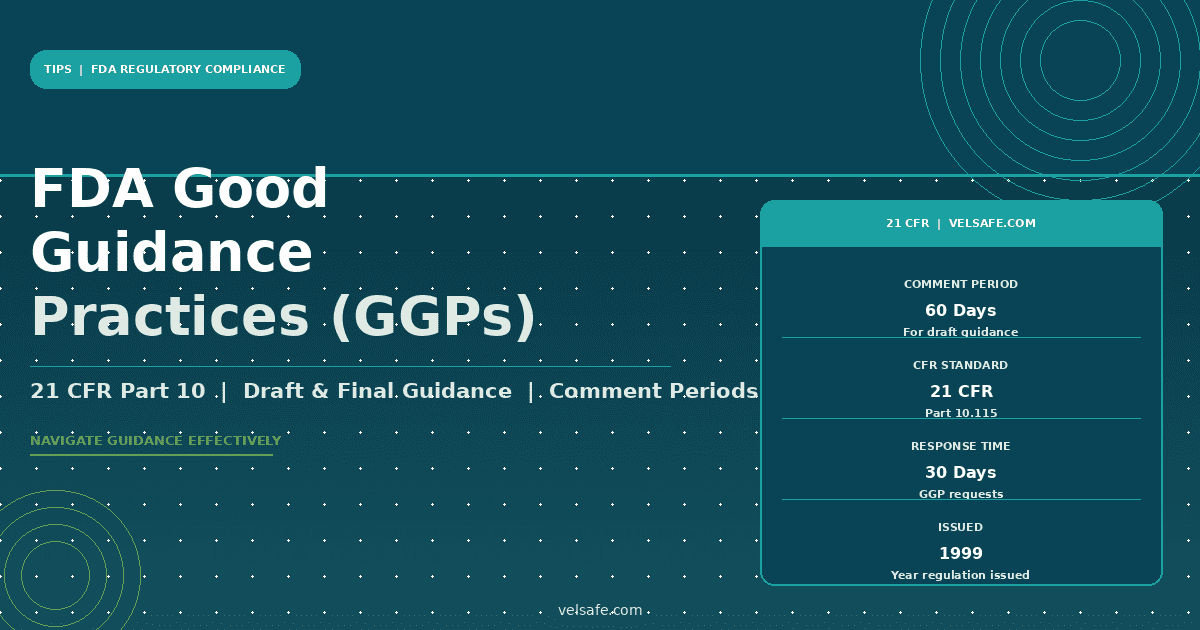
FDA guidance documents shape how regulated industry operates day-to-day, yet they are among the most misunderstood tools in the regulatory toolkit. Per 21 CFR 10.115, guidance documents represent the agency’s current thinking — they do not create binding obligations. Knowing how to work with that distinction, rather than around it, separates practitioners who use guidance effectively from those who either ignore it or over-comply with it.
Tip 1: Know the Difference Between Guidance and Regulation Before You Act
Guidance is not regulation. Per 21 CFR 10.115(d)(1), a guidance document does not establish legally enforceable responsibilities. It describes what the FDA currently believes represents the best approach to a particular issue. You can choose an alternative approach — but if you do, FDA expects you to be able to demonstrate that your approach meets the applicable statutory or regulatory requirements.
The obligation sits in the underlying regulation, not the guidance. Treating guidance language as if it were a CFR citation in a compliance program creates unnecessary constraints and can lead to over-engineering of systems and controls.
Tip 2: Track the Guidance Lifecycle — Draft to Final to Revised
Guidance documents move through a lifecycle that changes their status and your obligations. A draft guidance issued for comment does not represent final FDA thinking. A final guidance may later be revised or withdrawn. Treating a 2018 final guidance as current when FDA issued a 2023 revision creates submission and inspection risk.
Tip 3: Submit Comments on Draft Guidance — It Is More Effective Than You Think
Most regulated companies read draft guidance and do nothing. Those that submit comments during the 60-day comment period shape the final document. FDA must consider all comments received and often substantively revises draft language in response to well-reasoned industry input. Trade associations, individual companies, and academic institutions all participate — and their comments are public record.
For guidance documents affecting your product areas, treat the draft comment period as a regulatory intelligence opportunity, not a bureaucratic notice to file.
Tip 4: Document Your Departures from Guidance in the Decision Record
Departing from guidance is legal. Not documenting why you departed is a risk. When an FDA inspector sees your approach differs from guidance, their next question is: what is the scientific or regulatory rationale? If you cannot produce a documented decision record that answers that question, the departure becomes an observation regardless of whether your approach is technically sound.
In regulatory compliance reviews, the guidance departure documentation gap appears more frequently than the departure itself. Companies have well-reasoned technical approaches that differ from guidance language — but the rationale exists only in the memory of the person who made the decision three years ago. When that person leaves, the undocumented departure becomes an unexplained deviation. Decision records that survive personnel turnover are what close this risk.
Tip 5: Build a Guidance Monitoring Process That Does Not Depend on Luck
Tip 6: Apply Final Guidance Conservatively in Submissions and Protocols
When FDA reviewers evaluate a submission, they reference current final guidance for their product area. A submission that diverges from guidance without explanation will generate questions. A submission that follows guidance closely requires less justification and typically moves through review with fewer information requests.
This does not mean following guidance blindly where a better scientific approach exists. It means that when you do follow guidance, document it explicitly, and when you depart, document the departure as described in Tip 4. Reviewers are looking for a coherent rationale — following or departing, either is acceptable; unexplained divergence is not.
Tip 7: Know When to Request a Pre-Submission Meeting with FDA
Guidance represents FDA’s general thinking. Your specific product, indication, or manufacturing approach may present questions that guidance does not fully address. FDA offers formal pre-submission meeting programs (Pre-Sub for devices, Type B meetings for drugs, Formal Meetings for biologics) that allow you to get specific FDA input before committing resources to a development path.
Tip 8: Use Guidance to Anticipate What Inspectors Will Assess
FDA inspectors use guidance documents as reference frameworks during inspections — particularly the guidance documents most applicable to the product area, operation type, and type of inspection being conducted. Reading the guidance an inspector is likely to carry into your facility is one of the most practical inspection preparation tools available.
Where your operations differ from guidance language, prepare the documented rationale in advance. Inspectors who encounter a well-documented departure with clear scientific justification move on. Inspectors who encounter an undocumented departure spend additional time investigating.
In preparation for regulatory inspections, we consistently find that teams are better prepared for questions about their operations than for questions about their departures from guidance. The most effective inspection readiness exercises specifically test whether documented rationales for non-standard approaches can be retrieved and explained by anyone who might be in the room — not just the person who wrote them.
Tip 9: Train Staff on Guidance vs. Regulation — They Are Not the Same Document
Most quality and regulatory staff conflate guidance and regulation in their day-to-day work. This is understandable — guidance often shadows regulation closely — but it produces compliance programs that cite guidance as the source of an obligation when the actual source is a CFR section. When an inspector challenges the basis for a control, “because the guidance says so” is a weaker answer than “because 21 CFR [section] requires it, and the guidance describes our approach to meeting that requirement.”
Tip 10: Review Guidance References After Any Product or Process Change
When a product formulation changes, a manufacturing process is modified, or a new indication is added, the guidance documents applicable to the new configuration may differ from those that governed the original. A post-change regulatory impact assessment that does not include a guidance review misses one of the most likely sources of new compliance questions.