

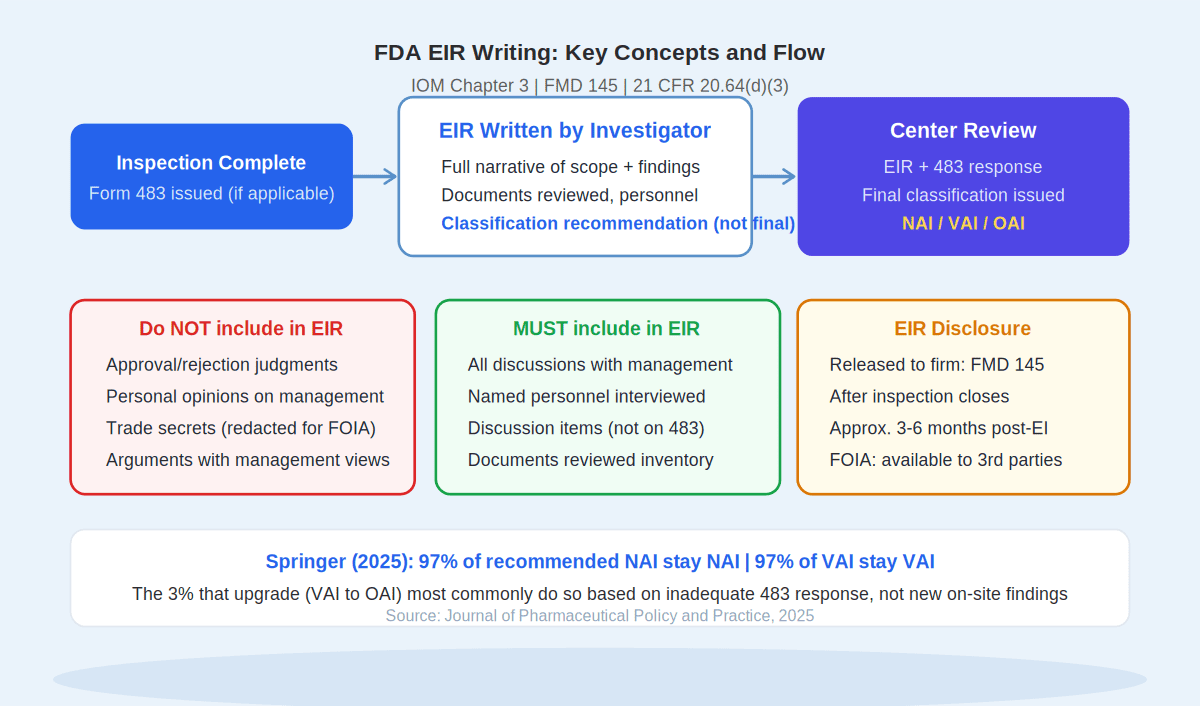
The Establishment Inspection Report (EIR) is the FDA investigator’s official record of an inspection: a comprehensive internal narrative that documents everything observed, reviewed, and discussed during a facility visit, and recommends how the inspection should be classified. Unlike Form 483, which lists objectionable conditions in a standardised format, the EIR tells the full story behind those conditions.
This practice test covers EIR structure and content, the relationship between the EIR and Form 483, classification recommendation standards, investigator conduct requirements, disclosure obligations under Field Management Directive 145 and FOIA, and how the EIR’s narrative affects subsequent enforcement decisions. Questions are drawn from FDA’s Investigations Operations Manual (IOM), Field Management Directive 145, CBER SOPP 8504, 21 CFR Part 20, and regulatory practice literature.
Section 1: EIR Fundamentals
Question 1 | Beginner
What is the primary purpose of the Establishment Inspection Report (EIR)?
- A) To notify the inspected firm of the final inspection classification before it is publicly released
- B) To serve as the FDA investigator’s official internal record of the inspection, documenting findings, observations, firm responses, and the recommended classification
- C) To replace Form 483 when no objectionable conditions were found
- D) To document only the conditions that were not included on Form 483
According to Assyro AI’s EIR guide and FDA’s own IOM Chapter 3, the EIR is the comprehensive internal document prepared by FDA field investigators that summarises their findings, observations, regulatory violations, firm responses, and recommended inspection classification. It provides narrative context beyond what the Form 483’s standardised citation format conveys.
Why the others are incorrect:
A: The EIR is an internal FDA document. The final classification is communicated separately, and the EIR narrative is released under FMD 145 after the inspection is closed, not before the classification is issued.
C: The EIR is prepared after every inspection, regardless of whether a Form 483 was issued. An NAI inspection still produces an EIR.
D: The EIR documents the full scope of the inspection, including conditions on the 483, discussion items not on the 483, documents reviewed, personnel interviewed, and the investigator’s overall analysis.
Knowledge expansion: FDA’s IOM explicitly distinguishes between “discussion items” and Form 483 observations. Discussion items are concerns raised that do not rise to the level of an objectionable condition warranting placement on the 483. Both are reported in the EIR. The firm should document all discussion items for their own records, since they can inform the EIR’s narrative and, by extension, the classification recommendation.
Question 2 | Beginner
An FDA investigator completes an inspection during which no objectionable conditions were found and no Form 483 was issued. Is an EIR still required?
- A) No, the EIR is only required when a Form 483 is issued
- B) No, for NAI inspections the inspector files a simplified summary instead
- C) Yes, an EIR is prepared after every inspection regardless of outcome
- D) Only if the inspection lasted more than one day
An EIR is prepared after every FDA establishment inspection. The EIR documents the scope of the inspection, what was reviewed, who was interviewed, what the investigator found, and the classification recommendation, regardless of whether that recommendation is NAI, VAI, or OAI. An NAI EIR is an important record demonstrating that the facility was inspected and found to be in an acceptable state of compliance.
Why the others are incorrect: All three incorrect options introduce qualifications that do not exist. The requirement for an EIR is not conditioned on whether a 483 was issued, on the inspection outcome, or on the inspection’s duration.
Knowledge expansion: NAI EIRs can be valuable intelligence documents for the inspected facility. Areas the investigator spent significant time examining but did not cite are worth reviewing internally, since a future inspection under a different investigator or different conditions could yield a different outcome in the same area.
Section 2: EIR Content and Structure
Question 3 | Intermediate
Which of the following is NOT a standard component of an FDA EIR?
- A) A list of documents reviewed during the inspection
- B) The names and titles of personnel interviewed
- C) A final determination that the facility is approved or not approved
- D) A narrative description of the facility’s quality systems and manufacturing processes
FDA’s IOM Chapter 3 is explicit: investigators do not have authority to tell management their firm is approved or not approved. Because the EIR is releasable under FOIA, investigators must refrain from making acceptability judgments in the EIR. The EIR contains a classification recommendation (NAI, VAI, or OAI), not a final approval determination. The final classification is made by the Center and District Office after reviewing the EIR and any 483 responses.
Why the others are correct EIR components: The EIR includes: scope and facilities/processes reviewed; comprehensive inventory of documents reviewed; names and titles of all personnel interviewed; detailed narrative of quality systems and deviations observed; references to all Form 483 observations; samples collected; and the investigator’s classification recommendation.
Knowledge expansion: The IOM instruction that investigators must “determine and report the full legal name and title of persons interviewed, who supplied relative facts” reflects the EIR’s evidentiary function. In enforcement proceedings, the EIR serves as documentary evidence of what the investigator was told, by whom, and when.
Question 4 | Intermediate
What is the relationship between the Form 483 and the EIR?
- A) The Form 483 replaces the EIR when the inspection results in a VAI classification
- B) The EIR elaborates on and provides narrative context for the conditions listed on the Form 483, and also documents additional discussion items and investigator analysis not included on the 483
- C) The Form 483 and EIR are identical documents with different distribution channels
- D) The EIR supersedes the Form 483 and the 483 is discarded after the EIR is finalised
The Form 483 is a standardised list of objectionable conditions issued at the closeout meeting. The EIR is a comprehensive narrative that places those conditions in context: it explains why the investigator considered each condition objectionable, how they relate to regulatory requirements, what documentary evidence was reviewed, and what management stated in response. The EIR also includes discussion items and areas reviewed that did not generate 483 observations.
Knowledge expansion: Reading the EIR after receiving a Form 483 is a different, richer experience than reading the 483 alone. The EIR often reveals whether the investigator viewed an observation as isolated or systemic, what additional areas they examined without issuing an observation, and what they were told by facility management during the closeout discussion.
Section 3: Classification Recommendations
Question 5 | Intermediate
An investigator recommends VAI in the EIR after issuing a Form 483 with two observations. The Center reviews the EIR and the firm’s 483 response and determines the response was inadequate. What can the Center do?
- A) Accept the VAI recommendation without modification, since the EIR is the investigator’s determination
- B) Upgrade the classification to OAI based on the inadequate 483 response, without requiring a follow-up inspection
- C) Downgrade the classification to NAI if the firm’s response addressed most of the observations
- D) Issue a second Form 483 with additional observations
The investigator’s EIR contains a classification recommendation, not a final determination. The Center and District Office review the EIR and any 483 response before issuing the final classification. A Springer (2025) study found that recommended VAI classifications were upgraded to OAI in a small percentage of cases, most commonly based on the inadequacy of the firm’s 483 response. This upgrade can occur without a follow-up on-site inspection.
Why the others are incorrect:
A: The investigator recommendation is not final. The Center has authority to upgrade, downgrade, or maintain the recommended classification.
C: Downgrading VAI to NAI is possible but requires the Center to conclude findings were minor or fully addressed — not merely that most observations were addressed.
D: A second Form 483 is not issued at this stage. The 483 is issued at the closeout of the on-site portion of the inspection only.
Question 6 | Beginner
FDA’s Inspections Classification Database shows final classifications of NAI, VAI, and OAI. What does a VAI classification indicate?
- A) The facility was not inspected and the classification is based on prior records
- B) Objectionable conditions or practices were found, but FDA has determined the facility can voluntarily correct them without mandatory regulatory action
- C) FDA plans to issue a warning letter within 30 days
- D) The facility must be re-inspected within 90 days
Per FDA’s Inspection Classification Database definition, VAI means objectionable conditions or practices were found, but the agency has determined the facility can voluntarily correct its deficiencies and will not recommend any regulatory action. A Form 483 was usually issued at the conclusion of the inspection.
Why the others are incorrect: A is incorrect because VAI results from an actual inspection. C is incorrect because VAI does not automatically trigger a warning letter; warning letters are associated with OAI. D is incorrect because there is no mandatory 90-day re-inspection timeline for VAI, though FDA does monitor VAI commitments and may schedule a follow-up inspection if corrections are not believed to have been implemented.
Section 4: EIR Disclosure and FOIA
Question 7 | Intermediate
Under Field Management Directive 145, when is the EIR narrative released to the inspected establishment?
- A) Immediately after the closeout meeting, before the final classification is issued
- B) Within 5 business days of the inspection ending
- C) After the inspection is deemed “closed” under 21 CFR Section 20.64(d)(3), typically 3 to 6 months post-inspection
- D) Only upon request through FOIA, with no proactive release obligation
FMD 145 mandates release of the EIR’s narrative portion to inspected entities once the inspection is “closed” as defined by 21 CFR Section 20.64(d)(3). An inspection is generally deemed closed when the final classification is issued. The EIR is then sent to the firm, typically within 3 to 6 months of the inspection’s conclusion. The narrative is redacted before release to remove information protected under FOIA exemptions.
Why the others are incorrect: A is incorrect because the EIR is completed after the on-site portion and is not released until the inspection is closed. B is incorrect because 5 business days is not the EIR release timeline (15 business days is the 483 response deadline). D is incorrect because FMD 145 creates a proactive release obligation; firms do not need to make a FOIA request for their own EIR.
Question 8 | Advanced
A competitor pharmaceutical company requests copies of five EIRs from inspections at another manufacturer via FOIA. Which statement best describes this situation?
- A) EIRs cannot be requested through FOIA by third parties
- B) EIRs are available through FOIA from other facilities, but portions will be redacted to protect confidential commercial information and personal privacy
- C) EIRs from foreign inspections are available through FOIA but domestic EIRs are not
- D) The requesting company must demonstrate a direct regulatory interest before FOIA access is granted
EIRs are public documents available through FOIA. Portions are redacted before release to protect information exempt under FOIA, particularly confidential commercial information (trade secrets, confidential process details) and personal privacy (employee names beyond senior management). The narrative content describing inspection findings and regulatory analysis is generally released.
Knowledge expansion: Many regulatory intelligence services and consultancies maintain libraries of EIRs obtained through FOIA, analysing them for trends in what inspectors examine, how they frame findings, and what conditions lead to OAI. Reading EIRs from peer companies or from facilities that manufacture similar products is among the highest-value inspection preparation activities available to regulatory teams.
Section 5: Investigator Conduct Standards
Question 9 | Intermediate
FDA’s IOM instructs investigators to conduct themselves with “honesty, diplomacy, tact, and persuasiveness.” At the closeout meeting, facility management disagrees with one of the Form 483 observations. What should the investigator do?
- A) Remove the disputed observation from the Form 483 to avoid conflict
- B) Argue with management to establish the correctness of the observation
- C) Note the disagreement without arguing, and report the management’s different view in the EIR
- D) Issue a second Form 483 with the disputed observation restated in stronger terms
The IOM Chapter 3 is explicit: “Do not argue if management voices a different view.” The investigator should note the disagreement, be responsive and courteous, and report all discussions in the EIR. Management’s stated disagreement becomes part of the EIR’s narrative and is available to the Center when making the final classification determination. This is also why firms should always provide their disagreement in writing at the closeout meeting and in the 483 response, not just verbally.
Why the others are incorrect: A is incorrect because the investigator’s judgment, not management preference, determines what appears on the 483. B is incorrect because the IOM explicitly prohibits arguing. D is incorrect because there is no mechanism for issuing a “second” 483 to counter disagreement.
Question 10 | Beginner
During an inspection, the facility’s quality director tells the investigator verbally that a CAPA for a previously cited deviation was completed two months ago. How should this be handled?
- A) The verbal statement is sufficient; the investigator records it in the EIR and no further documentation is needed
- B) The investigator should request documentary evidence of the CAPA completion and review it during the inspection
- C) Verbal confirmation from a quality director is equivalent to documentation under ALCOA principles
- D) The investigator cannot review CAPA records without a prior written request submitted 30 days before the inspection
The core principle of GxP documentation (“if it isn’t documented, it didn’t happen”) applies during an inspection as much as during manufacturing. A verbal statement that a CAPA was completed is not evidence that it was completed. The investigator should request the CAPA documentation, review it, and determine whether it adequately addresses the prior deviation. This reflects the IOM’s instruction to collect and document evidence, not accept oral representations.
Knowledge expansion: Facilities preparing for inspections should ensure that completed CAPAs are fully documented, that verification of effectiveness has been conducted and recorded, and that this documentation is readily retrievable. A CAPA that was genuinely effective but poorly documented will not hold up under inspection scrutiny any better than one that was not completed.
Section 6: Scenario-Based Questions
Question 11 | Advanced — Scenario
A pharmaceutical manufacturer receives its EIR six months after a VAI inspection. Reading the EIR narrative, the quality director notices that the investigator documented reviewing 15 batch records across three product lines and found no issues with any of them, but also noted spending two full inspection days examining the firm’s environmental monitoring data, ultimately not issuing any 483 observations in that area. What should the quality director conclude from this?
- A) Environmental monitoring is clearly not an area of regulatory concern since no observations were issued
- B) The investigator’s focus on environmental monitoring for two days, without an observation, suggests this area is under significant scrutiny and should be proactively reviewed and strengthened
- C) The batch records are the higher-risk area because the investigator reviewed 15 of them
- D) EIR narratives describing areas with no observations have no practical value for the inspected firm
A two-day focus on environmental monitoring during an inspection is a signal even in the absence of a 483 observation. It indicates either that the investigator was applying a detailed examination to that area because they had intelligence suggesting concern, or that FDA is currently emphasising environmental monitoring as an inspection priority (which it has been, particularly for sterile manufacturers). The VAI classification and no 483 observation in that area means the investigator did not find a citable violation, not that the area is risk-free under a more critical review or under different inspectors.
Why the others are incorrect: A misreads an absence of citation as absence of concern. C misreads the significance of batch record count; reviewing 15 and finding no issues suggests the batch record area was acceptable. D is incorrect; EIR areas with no observations contain valuable intelligence about what inspectors scrutinise and what satisfied them.
Question 12 | Advanced — Scenario
During an inspection, the FDA investigator asks to photograph a manufacturing process. The facility’s legal counsel, who is present, advises that photographs should not be permitted without more clarity on how they will be used. The investigator proceeds to document the same conditions through written notes instead. How should this situation be handled going forward?
- A) Refusing photography is a legal right and the investigator cannot include written descriptions of the same conditions in the EIR
- B) The facility should have a documented inspection procedure that addresses photography and recording device policies before an inspection begins, to manage such requests consistently
- C) Once the investigator substitutes written notes, the photographed conditions cannot be cited in any 483 observation
- D) Refusing photography automatically triggers an OAI classification
The Western Growers Association’s FDA inspection Q&A confirms that facilities should have policies for photography and recording device use before an inspection begins. Improvising in the moment introduces inconsistency and potential escalation. The appropriate approach is a pre-established, documented position on photography that is applied consistently and that balances legitimate compliance interests with the need to maintain a cooperative relationship with FDA investigators.
Why the others are incorrect: A is incorrect because the investigator can document conditions through written narrative regardless of photography; the EIR does not depend on photographs. C is incorrect for the same reason. D is incorrect because policy-consistent refusal of photography does not automatically trigger OAI, though uncooperative conduct more broadly can affect how an inspection proceeds.
Section 7: Advanced Topics
Question 13 | Advanced
What distinguishes a “for-cause” inspection from a “surveillance” (routine) inspection in terms of the EIR?
- A) For-cause EIRs are shorter because they focus only on the specific cause that triggered the inspection
- B) For-cause EIRs are not subject to FOIA release
- C) The EIR format is the same, but for-cause inspections typically result in more focused scrutiny of specific processes or systems, and the EIR’s narrative may document investigative findings not typical of a routine surveillance report
- D) For-cause inspections do not produce an EIR unless the classification is OAI
The EIR format and legal basis are the same for all inspection types. What differs is the focus and intensity of the on-site review. A for-cause inspection triggered by a complaint, recall, or adverse event will concentrate investigative activity on the specific concern that generated the trigger, alongside a broader assessment of relevant quality systems. For-cause inspections have a higher rate of OAI outcomes than routine surveillance, reflecting that they are triggered when there is reason to expect compliance problems.
Knowledge expansion: Facilities that experience a product recall, receive a significant adverse event report, or receive a complaint that reaches FDA should anticipate a potential for-cause inspection and treat the interim period as a readiness window. Completing outstanding CAPAs, updating documentation, and conducting a focused internal audit on the area at issue before the inspection begins is both legally appropriate and practically sound.
Question 14 | Intermediate
True or False: An investigator writing an EIR should include their personal opinion about whether the firm’s management is committed to quality.
- True
- False
FDA’s IOM Chapter 3 instructs investigators not to include acceptability or non-acceptability judgments in the EIR because it is releasable under FOIA. Personal opinions about management commitment are not appropriate EIR content. The EIR documents factual observations, documented evidence, verbal statements made during the inspection (attributed to named individuals), and the investigator’s recommended classification based on those facts.
Knowledge expansion: An EIR that includes subjective management assessments is more likely to be challenged in an enforcement proceeding. The evidentiary strength of the EIR rests on documented, attributed, factual observations. The IOM’s instruction to maintain “honesty, diplomacy, tact, and persuasiveness” reflects the dual requirement of rigour and professionalism that governs both the on-site inspection and the EIR’s written record.
Question 15 | Advanced
A firm receives a Warning Letter citing failures to address observations from a previous inspection. The Warning Letter references the EIR. What does this indicate about how the EIR was used in the enforcement process?
- A) The EIR was used as the sole basis for the Warning Letter, without a review of the 483 response
- B) The EIR, alongside the 483 and the firm’s response, was used by the Center in determining that the firm’s corrective actions were inadequate and that official action was warranted
- C) The Warning Letter’s citation of the EIR means the EIR is no longer releasable through FOIA
- D) The citation of an EIR in a Warning Letter means the inspection was reclassified from VAI to NAI
The EIR is one element of the enforcement documentation package reviewed by the Center. When a Warning Letter is issued, FDA has reviewed the inspection findings (as documented in the EIR), the Form 483, and the firm’s 483 response, and concluded that the response was inadequate or that the violations are serious enough to warrant official action. Pharmaceutical Online’s analysis of FY2024 warning letters noted that FDA is increasingly instructive on a point-by-point basis, explaining exactly why a 483 response failed, drawing directly on the narrative detail in the EIR.
Knowledge expansion: Warning Letters are public documents. Reading recent Warning Letters in your product area and cross-referencing them with available EIRs from those inspections (obtained via FOIA) reveals the full arc: what the investigator documented, what the firm committed to in its 483 response, and where FDA concluded the commitment was not met. This is one of the most instructive analytical exercises available for regulatory intelligence.
Quick Reference: Key Concepts Tested
Supporting Resources
- A comprehensive guide to FDA establishment inspections, covering all four phases, the three classification outcomes, and preparation strategies, is available in the Guides section.
- An Insights analysis of FDA 483 observation trends in FY2024, including the top citation categories and enforcement pattern shifts, is available in the Insights section.
- FDA Investigations Operations Manual Chapter 3: Establishment Inspections
- FDA Inspection Classification Database
- ORA FOIA Electronic Reading Room (published 483s and EIRs)
Sources
- FDA, “Chapter 3: Establishment Inspections” (IOM)
- Assyro AI, “FDA EIR: How to Get Your Inspection Report” (May 2026)
- InvestigationsQuality.com, “Understanding the FDA Establishment Inspection Report (EIR)”
- Atlas Compliance AI, “Understanding FDA EIR: Key Insights and Readiness”
- Advarra, “FDA Inspection Readiness: After the Inspection”
- ECA Academy, “FDA Inspection Reports: What is What”
- PharmaGuru, “Form 483, Form 482, Form 484, EIR, OAI, NAI and VAI”
- Springer, “GCP inspection classification analysis” (2025)
- Western Growers Association, “Q&A: What You Need to Know About FDA Regulatory Inspections” (2025)
- Pharmaceutical Online, “Trends in FDA FY2024 Inspection-Based Warning Letters”