
An FDA establishment inspection (EI) is a careful, critical, official examination of a facility to determine its compliance with laws enforced by the FDA. For any pharmaceutical manufacturer, medical device maker, biologics producer, or other FDA-regulated entity, an EI is not a one-time event to survive: it is a recurring feature of operating in a regulated industry, and the outcome of each inspection shapes the FDA’s future treatment of the facility.
This guide covers everything an establishment needs to understand about the FDA inspection process: the types of inspections FDA conducts, how inspectors select sites, what happens from the first day to the Establishment Inspection Report (EIR), the three classification outcomes, the rights facilities have during and after an inspection, and how to prepare a quality system that holds up under scrutiny.
Types of FDA Establishment Inspections
FDA conducts several categories of establishment inspections. Understanding which type is being conducted shapes how the facility should prepare and what areas are likely to receive the most scrutiny.
FDA’s Office of Regulatory Affairs (ORA) uses a risk-based site selection model to prioritise facilities for surveillance inspections. Key factors include inspection history, product risk, time since last inspection, and supply chain significance.
Key Forms: 482, 483, and 484
Three FDA forms structure the formal documentation of any establishment inspection. Understanding each one clarifies what happens at each stage.
The Four-Phase Inspection Process
FDA investigators present their credentials and issue Form 482. The opening meeting introduces the investigators, outlines the scope and purpose, and requests initial documents (quality manuals, organisational charts, batch records, deviation logs). The facility should have a designated inspection team and a primary point of contact ready to escort investigators professionally throughout.
The core of the inspection involves document review, facility walkthrough, personnel interviews, and sample collection. Investigators examine records relevant to CAPA systems, batch records, complaint handling, equipment qualification, environmental monitoring, data integrity controls, and training documentation. Inspectors are escorted at all times. All document requests should be responded to promptly; unexplained delays attract scrutiny.
At the conclusion of the on-site portion, the investigator holds a closeout meeting with facility management. If objectionable conditions were observed, Form 483 is presented and discussed. This is an opportunity to provide immediate clarifying information: if a 483 observation reflects a misunderstanding, or if a corrective action is already in progress, that information should be provided at the closeout meeting, documented in writing, and referenced in the formal 483 response.
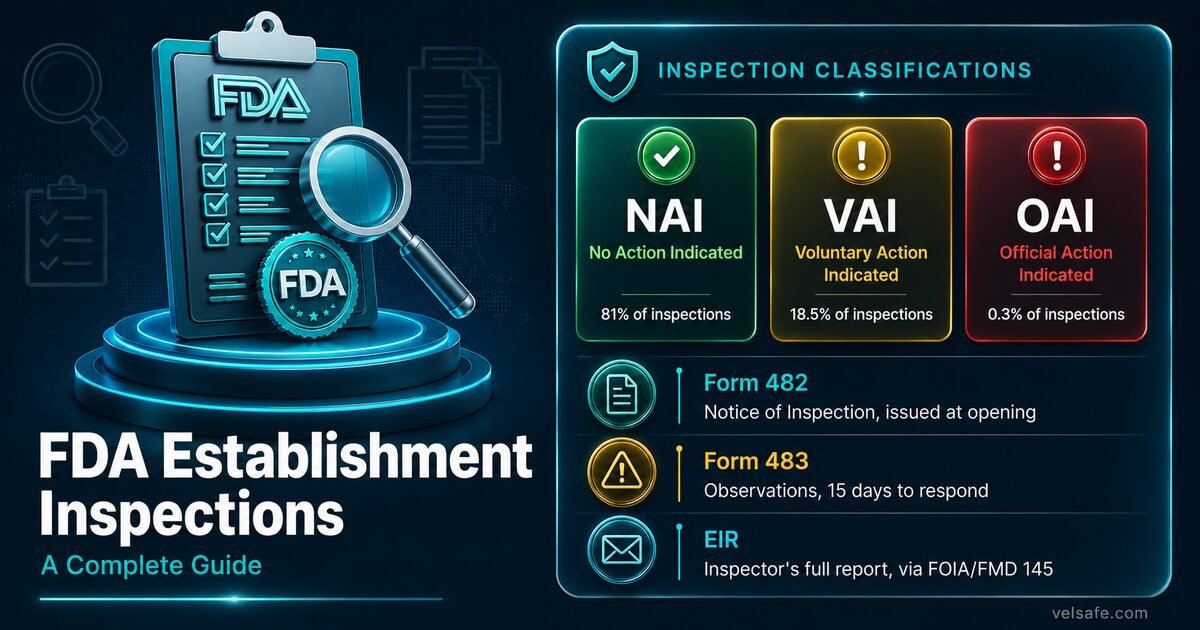
The facility has 15 business days to submit a written response to any Form 483 observations. The investigator then writes the Establishment Inspection Report (EIR) and submits a classification recommendation. After review by the relevant Center and District Office, the final inspection classification is issued: NAI, VAI, or OAI.
Inspection Classifications: NAI, VAI, and OAI
After the EIR is reviewed, FDA issues a final inspection classification. Each outcome has specific consequences and regulatory implications.
No significant violations found. Facility is in an acceptable state of compliance. Usually no Form 483 issued. 81% of inspections. No further regulatory action.
Objectionable conditions found, but FDA determined voluntary correction is acceptable. Form 483 usually issued. 18.5% of inspections. Facility response and follow-through are tracked.
Serious violations requiring FDA enforcement action. May lead to Warning Letter, import alert, seizure, injunction, or consent decree. 0.3% of inspections.
A 2025 published analysis in Springer found that approximately 97% of investigator recommendations of NAI were upheld as NAI in the final classification, and 96% of VAI recommendations held as VAI. The Center and District review does upgrade some classifications, most commonly when the facility’s 483 response is deemed inadequate — which is how a recommended VAI becomes a final OAI without new on-site evidence. This means the 483 response itself is the most consequential document the facility will produce after the inspection.
The Establishment Inspection Report (EIR)
The EIR is the FDA investigator’s internal report summarising the inspection’s scope, findings, observations, and classification recommendation. Unlike the Form 483 (which lists objectionable conditions) or the Warning Letter (which is a formal enforcement communication), the EIR provides a comprehensive narrative of what the investigator saw, reviewed, and concluded.
For regulatory professionals, EIRs from peer companies are among the most instructive documents available for anticipating what FDA inspectors will examine. EIRs from facilities that received OAI or Warning Letters describe in narrative detail what conditions the investigator found, how the facility’s management responded, and what commitments were made or missed.
Your Rights During an FDA Inspection
Common Mistakes
Leads to disorganised response, delayed document production, and inconsistent statements from different personnel — all visible to investigators.
Signals evasion; may escalate investigator attention to that area regardless of whether there is an actual problem.
A vague or generic 483 response is the most common way a VAI becomes an OAI without a follow-up inspection. The response window is where the classification is decided.
Missed commitments are cited in follow-up inspections and warning letters as evidence of systemic failure. Realistic timelines with verification of effectiveness are better than aggressive timelines that slip.
Missing advance intelligence about what inspectors are currently focused on. EIRs available through FOIA or the FDA reading room are among the highest-value preparation resources available.
Advanced Considerations
Writing a 483 Response That Changes the Classification Outcome
The 15-business-day response window is where many inspections are decided. A strong response does three things: it quotes each observation verbatim before addressing it (showing the facility understood the finding exactly as written), it presents documented evidence of root cause analysis rather than a summary, and it provides specific CAPA commitments with realistic timelines that include verification of effectiveness.
Using EIRs from Other Facilities as Intelligence
EIRs available through FOIA or the FDA reading room describe in narrative detail what an investigator found at a comparable facility. For quality teams preparing for a pre-approval inspection at a site that manufactures similar products to ones that have received OAI findings elsewhere, reading those EIRs is among the highest-value preparation activities available.
Foreign Site Inspections and MRA Partner Inspections
Over 62% of drug quality inspections in FY2024 were at foreign sites. Facilities outside the US cannot assume that geographic distance reduces inspection probability. FDA’s growing use of Mutual Recognition Agreement (MRA) partner inspections — 198 in FY2024, the highest ever — means European regulators may inspect a facility on FDA’s behalf, with findings shared directly with FDA enforcement. A facility operating to a standard adequate for EU GMP but not for 21 CFR requirements may find that gap surfaces through an MRA-based inspection.
Remote Regulatory Assessments
FDA expanded its use of remote regulatory assessments (RRAs) during the pandemic and has maintained them as a tool for lower-risk situations. RRAs typically involve electronic submission of records, videoconference facility walkthroughs, and structured Q&A sessions. They do not replace on-site inspections for high-risk situations but represent a category of FDA oversight activity that facilities may encounter between formal EIs.
Frequently Asked Questions
Yes. Under Section 704 of the FD&C Act, FDA has the statutory authority to inspect regulated facilities during regular business hours. The investigator presents Form 482 as official notice. Refusing or significantly impeding an inspection can result in additional enforcement action. However, you have the right to confirm credentials and to have legal counsel present.
Disagreement should be stated in writing during the closeout meeting and in the formal 483 response, with supporting rationale and documentation. Investigators may note disagreements in the EIR. The classification review at the Center/District level may consider documented disagreement, particularly if the facility provides evidence that the observed condition was not, in fact, non-compliant.
This varies widely based on facility size, product complexity, and inspection type. A routine surveillance inspection of a straightforward manufacturing site may last one to two days. A pre-approval inspection or for-cause inspection at a complex facility may last a week or more. Inspectors determine the duration based on what they find during the review.
The EIR is the investigator’s internal comprehensive narrative report — it describes what was seen, reviewed, and concluded, and includes the classification recommendation. The Warning Letter is a public enforcement communication issued by FDA when the agency has determined that serious violations require formal response. Not every OAI classification results in a Warning Letter, but every Warning Letter follows an OAI or equivalent finding.
Summary
An FDA establishment inspection is decided not by the investigation itself but by the quality system the investigator finds, and by the 483 response rather than findings alone. The EIR is the inspector’s full narrative report, available approximately 3 to 6 months post-inspection, and is a key intelligence resource for peer facilities. Inspection readiness is not a pre-inspection activity: it is the condition of your quality system every day.
Related Resources
Sources
- FDA, “Inspection Classification Database”
- FDA, “Inspectional Observations and Citations”
- Assyro AI, “FDA EIR: How to Get Your Inspection Report” (May 2026)
- Atlas Compliance AI, “Understanding FDA EIR: Key Insights and Readiness”
- PharmaGuru, “Form 483, Form 482, Form 484, EIR, OAI, NAI and VAI”
- Springer / Journal of Pharmaceutical Policy and Practice, “GCP inspection classification analysis” (2025)
- The FDA Group, “Inside FDA’s FY2024 Quality Report”
- BioBioston Consulting, “Inside the FDA Inspection Process: What to Expect”