

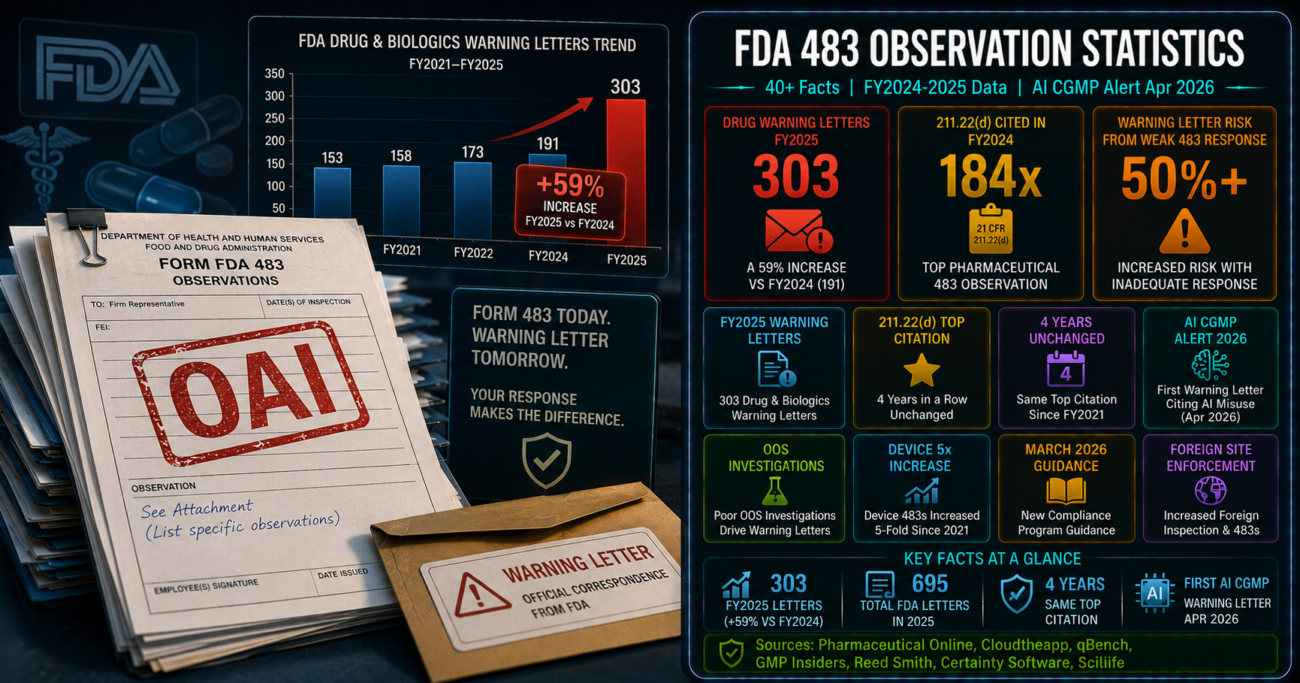
FDA Form 483 data is one of the clearest windows available into where pharmaceutical and medical device quality systems actually fail. Not where companies say they are compliant – but where inspectors standing in manufacturing floors and quality offices found conditions that, in their judgment, may constitute violations of federal requirements. The FY2024 and FY2025 enforcement data makes several things unmistakably clear.
First, warning letter volume has surged: 303 drug and biologics letters in FY2025, up 59% from 190 in FY2024. Second, the finding categories at the top of the 483 list have not meaningfully changed across four consecutive years. 21 CFR 211.22(d) – Quality Unit responsibilities – was cited 184 times in FY2024 and remains the top citation in FY2025. Third, the regulatory landscape shifted materially in 2026: FDA’s March 2026 draft guidance on 483 responses raised the bar on what constitutes an adequate reply, and April 2026 brought the first warning letter specifically citing AI misuse in CGMP documentation. This article compiles 40+ statistics from FY2024-2025 inspection data and 2026 enforcement developments.
Editor's Choice: Key FDA 483 and Enforcement Statistics for 2024-26
1. FY2025 FDA Warning Letters: 59% Surge and What Drove It
- The FDA issued 303 drug and biologics warning letters in FY2025 – a 59% increase from 190 in FY2024, which was itself a five-year high. Of those 303 letters, 135 were inspection-based (44.6%), 73 were for unapproved drug products, and 16 were issued following BIMO (Bioresearch Monitoring) program inspections of clinical investigators or sponsors. (Pharmaceutical Online, March 2026)
- A significant driver of the FY2025 surge was a concentrated enforcement action on September 9, 2025, when FDA launched a crackdown on deceptive drug advertising, issuing over 60 warning letters in a single day. The drug industry recorded 82 more warning letters than the prior year. (Reed Smith, December 2025)
- Total warning letters across all FDA-regulated products reached 695 in 2025, according to RegulatoryIQ’s analysis of 2,804 deduplicated warning letters spanning January 2021 through March 2026. Approximately 54 of those (8%) were directed at medical device manufacturers – a 17% increase from 46 device letters in 2024. (Cloudtheapp, June 2026)
- Of the 470 warning letters analyzed by qBench across all regulated lab environments in 2025, 47% were issued in just three months: July, August, and September. 392 of those letters (85%) targeted U.S.-based companies, with 71 (15%) directed at international manufacturers. (qBench, May 2026)
- Device-specific quality system enforcement letters have surged from 6 in 2021 to 30 in 2025 – a five-fold increase over four years, following the transition to QMSR (Quality Management System Regulation) that changed inspection architecture without reducing the underlying violation patterns that drive enforcement. (Cloudtheapp, June 2026)
2. Top FDA 483 Citation Categories: FY2024 and FY2025 Data
- 21 CFR 211.22(d) – Quality Unit responsibilities – was cited 184 times in FY2024, making it the most-cited pharmaceutical 483 observation for four consecutive years. A review of the FDA’s FY2025 dataset shows this pattern continuing, with the same regulation dominating system-generated observation data. (RAPS; GMP Insiders, February 2026; Certainty Software, 2026)
- 21 CFR 211.192 – failure to investigate discrepancies – was cited 116 times in FY2024, the second most cited observation. In lab-directed warning letters for 2025, OOS investigation failure appeared in 34% of letters (50 of 148), making it the top single citation category in lab enforcement. (RAPS; qBench, May 2026)
- The FY2025 inspection data from GMP Insiders’ analysis shows the same four citation categories dominating: 211.22(d), 211.192, 211.100(a), and 211.160(b). These four provisions have been unchanged at the top of pharmaceutical 483 rankings since 2021, representing persistent structural deficiencies rather than cyclical inspection priorities. (GMP Insiders, February 2026)
- In lab-directed 2025 warning letters analyzed by qBench: missing or inadequate written procedures appeared in 43 letters (29%); method or process validation failures in 40 letters (27%); CAPA not initiated or inadequate in 19 letters (13%) – confirming the same underlying quality system gaps that dominate 483 data. (qBench, May 2026)
- The consistency of top citations reflects a structural dynamic: these are governance and procedure failures, not technical failures. A 21 CFR 211.22(d) citation means the quality function is not exercising the independence and oversight that regulation requires. A 211.192 citation means investigations are not being completed – or not being initiated at all. These are management system failures, not isolated quality events. (GMP Insiders, 2026; Scilife.io, April 2026)
3. The Quality Control Unit Finding: Why the Same Citation Leads for Four Years
- The four-year consecutive run of QCU responsibilities as the top pharmaceutical citation means that across hundreds of inspections annually, FDA investigators are consistently finding that the quality function is not operating as the check on manufacturing operations that regulation requires. This is not a finding about a single regulation or activity. It is a finding about governance. (GMP Insiders, February 2026; Scilife.io, April 2026)
- Quality units at many manufacturers – particularly mid-sized companies and contract manufacturing organizations – are chronically under-resourced relative to production volumes. The pressure to release product under commercial and supply chain constraints places the QCU in a position where independence is compromised in practice even when it exists on paper. (Scilife.io; regulatory compliance literature)
- A warning letter cited in Pharmaceutical Online identified FDA explicitly noting the ineffectiveness of the executive management team in addressing quality system failures – signaling that FDA now traces QCU deficiencies upward to senior leadership accountability, not just the quality department. (Pharmaceutical Online; Scilife.io, April 2026)
- FDA’s approach to repeat citations has evolved: where historically a corrective action plan and adequate 483 response would close the loop, inspectors now look for evidence that root cause was correctly identified and that systemic corrective actions are actually implemented and sustained – not just documented. (GMP Insiders, 2026)
4. Data Integrity: The Four Recurring Failure Modes
- Data integrity failures consistently appear in the top pharmaceutical 483 citation categories under 21 CFR 211.68 (automated data systems), 211.180 (record completeness and retention), and 211.194 (laboratory records). The four recurring failure modes – attribution, legibility, accuracy, and transformation – are systemic gaps, each requiring system-level remediation rather than individual retraining. (IntuitionLabs analysis; existing article data)
- In April 2026, FDA issued the first warning letter specifically citing AI misuse in CGMP documentation – the first documented instance of FDA enforcement action directly targeting AI-generated content in quality records. The finding: AI output requires authorized human review before it can become a controlled record. Quality teams using AI tools without documented review and approval steps are creating an uncontrolled data source. (Certainty Software, 2026)
- The AI warning letter represents a new compliance frontier: the use of generative AI in writing batch records, deviation reports, SOPs, or CAPA documents creates records that must be reviewed and authorized by a qualified human before they enter the quality management system. Organizations that have not yet addressed AI use in quality documentation workflows should treat this warning letter as a de facto enforcement signal. (Certainty Software, 2026)
- A Springer Nature Biologics inspection study (2025) analyzing FDA Form 483 observations from 2010 to 2025 found that data governance failures have been a persistent area of regulatory concern across the full 15-year window – predating electronic batch record adoption, surviving the COVID-19 period, and continuing through 2025 with no indication of structural improvement. (Journal of Pharmaceutical Innovation, January 2026)
5. Foreign Site Enforcement: Geography of FDA Inspection Pressure
- Foreign sites now account for more than 62% of drug quality inspections – an all-time high in FY2024, driven by FDA clearing pandemic-era backlogs and intensifying international manufacturing oversight. Inspection volume rose 27% from 776 in FY2023 to 989 in FY2024. (FDA FY2024 State of Pharmaceutical Quality Report)
- Despite the high inspection volume, 93% of inspected sites achieved a NAI (No Action Indicated) or VAI (Voluntary Action Indicated) classification in FY2024 – meaning enforcement action was recommended in a minority of inspections, though those that did result in OAI (Official Action Indicated) classifications drove the warning letter surge. (FDA FY2024 Quality Report)
- Of the 470 warning letters analyzed in 2025 across lab environments, 71 (15%) targeted international manufacturers. India and China remain the most frequently cited foreign manufacturing hubs in enforcement data, consistent with their dominant share of API and generic drug production for the U.S. market. (qBench, May 2026; industry data)
- FDA’s ORA (Office of Regulatory Affairs) reorganized into the Office of Inspections and Investigations (OII) on October 1, 2024 – a structural change specifically designed to sharpen focus on inspections, investigations, and import oversight, signaling continued or intensified inspection pressure through 2025 and 2026. (Pharmaceutical Online, March 2026)
- All four regulated industries – drugs, devices, biologics, food and cosmetics – experienced heightened FDA oversight in 2025 whether through increased warning letters, expanded inspection activity, or both. The food and cosmetics industries recorded 1,540 more inspections from 2024 to 2025. (Reed Smith, December 2025)
6. The 483 Response Challenge: March 2026 Draft Guidance and the 50% Warning Letter Risk
- Research in the International Journal of Medical and Pharmaceutical Research found that firms with inadequate 483 responses have a greater than 50% chance of receiving a warning letter. From an open warning letter, the escalation path includes consent decrees, import alerts, or injunctions. The 483 response is the most critical controllable risk factor in post-inspection enforcement. (IJMPR, cited in Certainty Software, 2026)
- FDA issued draft guidance on Form 483 responses in March 2026, setting explicit expectations on timing, the depth of investigation required, how risk should be assessed and framed, and what constitutes effective CAPA. The guidance raises the floor on what “adequate” means and signals that responses that previously might have closed the inspection will now be held to a higher standard. (Certainty Software, 2026; GMP Insiders, 2026)
- The pattern documented across multiple 2025 warning letters is that companies with known, identified quality issues that were “quietly allowed to stall” without resolution are a primary enforcement target. Having SOPs is not sufficient – FDA expects documented evidence that known issues are being actively driven to closure. (The FDA Group, December 2025)
- 2026 warning letters to Signature Formulations, Bio-Medical, OraLabs, and Cohance all reflect failures that internal audits and CAPA programs should have identified and remediated before an inspection – reinforcing that the 483 citation is rarely a surprise to the quality team; the failure is typically in the corrective action system rather than the detection system. (Certainty Software, 2026)
7. 2026 Enforcement Outlook: AI Documentation, QMSR, and Biologics Inspection Trends
- The April 2026 AI warning letter is the first enforcement signal that FDA is actively monitoring how AI tools are used in CGMP quality systems. Organizations using generative AI to draft SOPs, batch records, deviation reports, or CAPA documentation without a documented human review and authorization step are at risk of the same citation. (Certainty Software, 2026)
- The QMSR (Quality Management System Regulation) transition for medical devices – which FDA positioned as harmonizing with ISO 13485 – has not reduced the device enforcement rate; it has changed the regulatory language while the underlying violation patterns persist. CAPA deficiencies, complaint handling failures, and supplier control gaps remain the top three device 483 categories into Q1 2026. (Cloudtheapp, June 2026)
- A Springer Nature study analyzing 15 years of biologics Form 483 data (2010-2025) found that contamination prevention, process validation, and sterility assurance have been persistent areas of regulatory concern across the full study period, with no sustained improvement trend despite regulatory pressure and industry investment. (Journal of Pharmaceutical Innovation, January 2026)
- The pace of enforcement in early 2026 shows no sign of deceleration, according to Cloudtheapp’s analysis. With the OII reorganization sharpening inspection focus, the March 2026 draft guidance raising 483 response standards, and the AI enforcement signal from April 2026, the risk environment for quality teams is materially higher than it was in FY2024. (Cloudtheapp, June 2026; Reed Smith, December 2025)
Key Takeaways for Pharmaceutical and Device Quality Teams
Sources
FDA and Government Sources
- FDA FY2024 State of Pharmaceutical Quality (CDER OPQ) – 989 inspections (+27%), 62% foreign sites, 105 drug warning letters, 93% NAI/VAI rate
- 21 CFR 211.22 – Responsibilities of quality control unit (eCFR)
Industry Analysis and Research Sources
- Pharmaceutical Online (March 2026) – FY2025 trends: 303 drug/biologics warning letters (+59%), 135 inspection-based, 73 unapproved drugs, BIMO program letters
- Certainty Software (2026) – FY2025 warning letters: 184x 211.22(d) citations, 116x 211.192, top 4 unchanged since 2021, AI CGMP warning letter April 2026, 50%+ warning letter risk for inadequate 483 responses
- Cloudtheapp (June 2026) – Q1 2026 enforcement: 695 total letters, 303 drug/biologics (+59%), device letters 5x increase 2021-2025, CAPA/complaint/supplier top three device citations
- qBench (May 2026) – 470 warning letters 2025: 148 lab-directed, 34% OOS failures, 29% missing procedures, 27% validation failures, 47% issued Jul-Sep 2025
- GMP Insiders (February 2026) – FY2025 inspection observations: top four unchanged 211.22(d), 211.192, 211.100(a), 211.160(b); system vs. individual failure framing
- Journal of Pharmaceutical Innovation / Springer Nature (January 2026) – 15-year analysis FDA biologics Form 483 observations 2010-2025: persistent contamination, validation, and data governance concerns
- Reed Smith (December 2025) – FDA inspections 2025: heightened rigor, September 9 advertising crackdown (60+ letters in one day), all four industries at higher oversight
- Scilife.io (April 2026) – FDA Warning Letters 2025 outlook: QCU governance failures, executive management accountability, data integrity patterns