

Disclaimer: This article provides general information about OSHA fall protection rescue requirements and is not legal advice. Requirements may vary based on specific work conditions, industry, and state-level regulations. Consult a qualified safety or legal professional for guidance on your specific situation.
A personal fall arrest system stops the fall. It does not get the worker to safety. The period between a successful fall arrest and the worker’s return to a stable surface is the rescue window, and OSHA requires employers to plan for it before anyone works at height.
The legal obligation is specific: under 29 CFR 1926.502(d)(20) for construction and 29 CFR 1910.140(c)(21) for general industry, employers must provide for prompt rescue of each employee in the event of a fall. This guide covers what the law requires, why suspension trauma makes rescue minutes critical, and what a compliant rescue plan must include.
What the Law Requires
Why Minutes Matter: Suspension Trauma
Suspension trauma (orthostatic intolerance) occurs when a motionless worker hangs vertically in a harness after a fall arrest. The harness straps compress the femoral arteries and veins, restricting blood return from the legs to the heart. Blood pools in the lower extremities. Cardiac output drops. Without intervention, the worker progresses from discomfort to unconsciousness to cardiac arrest.
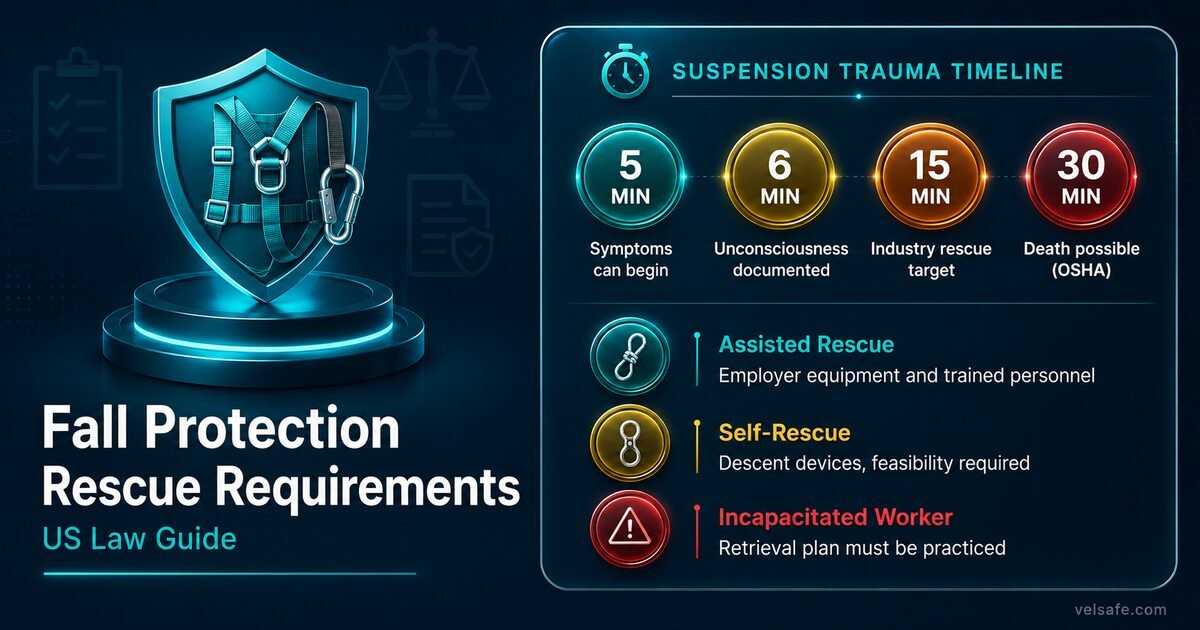
According to OSHA’s Safety and Health Information Bulletin on suspension trauma, suspension in fall arrest equipment can result in unconsciousness and death in less than 30 minutes. Research cited by TRADESAFE documents that symptoms can begin in as little as 5 minutes, and subjects have lost consciousness after just 6 minutes of motionless suspension. Industry standards generally interpret OSHA’s “prompt” requirement as rescue within 15 minutes of the fall. This is not a regulatory ceiling but a widely adopted planning target based on the medical evidence.
Rescue Plan: What the Law Requires
OSHA requires the rescue plan to be site-specific. A generic template that does not account for actual site conditions, heights, anchor locations, and available rescue equipment is not compliant. The rescue plan must address three scenarios.
Equipment, trained personnel, and procedures for reaching and retrieving a suspended worker. This may involve aerial lifts, rope rescue systems, portable ladders, or davit/crane-based retrieval.
Equipment (descent devices, rope ladders, ascenders) and training that allow the worker to descend or ascend to safety independently after a fall arrest. The employer must demonstrate that self-rescue is feasible for the specific conditions.
Self-rescue devices are useless if the worker cannot activate them. The plan must address how an incapacitated worker will be retrieved, and this scenario must be practiced.
For each scenario, the plan must specify the rescue equipment to be used, where the equipment is stored, how to use and inspect it, and who is responsible for performing the rescue. All rescue personnel must be trained, and drills should confirm workers know the procedures before they are needed.
Works for all scenarios, including unconscious workers. Requires trained personnel, equipment, and practice. Higher cost and coordination. Must be site-specific.
Fastest option when the worker is conscious and able. Requires descent devices or rope ladders plus training. Does not cover unconscious or injured workers. Must still have an assisted rescue backup.
Self-Rescue: What OSHA Has Clarified
OSHA has addressed self-rescue in standard interpretation letters with several important clarifications. When performing self-rescue after an arrested fall, the employee may rely on the self-rescue device (descent control device, rope ladder, ascender) for the period of time it takes to effect the rescue and is not required to use additional fall protection during that period. This is a practical acknowledgment that connecting to a second fall protection system while performing self-rescue may be impossible.
If a worker uses an ascender to return to the original working surface, the worker must return to the ground as soon as safely possible because the fall protection equipment that arrested the fall is no longer acceptable for continued use. A self-rescue plan is not a substitute for an assisted rescue plan. If the worker is unconscious, injured, or the self-rescue device malfunctions, the employer must have an alternative rescue method available.
Compliance Requirements
Penalties and Consequences
OSHA does not define “prompt rescue” with a specific number of minutes, which means an employer cannot be cited solely for exceeding a particular time threshold. However, if negligence can be proven after an incident, citations can and are issued. The absence of a rescue plan, the absence of rescue equipment, or a plan that relies exclusively on calling 911 without on-site capability are all citable conditions.
Where the employer knew the requirement and disregarded it, carry penalties of up to $163,939 per violation (2024 adjusted maximum). Repeat violations carry the same maximum.
Carry a maximum of $16,394 per violation. A roofing company was fined $90,000 for having no guardrails and no rescue plan.
A fall arrest system that worked as designed, paired with no rescue plan, creates a clear negligence argument: the employer made no provision for the period after arrest, which is where the worker died.
Practical Implementation
Rescue is not a standalone document filed in a binder; it is part of the pre-task hazard assessment for any job that involves personal fall arrest. The JSA should identify the specific rescue method for each fall-exposure location, the equipment required, and the trained personnel assigned.
Many modern harnesses include built-in suspension relief straps (trauma straps) that the worker can deploy after a fall arrest. These allow the worker to place their feet in loops and push upward, reducing pressure on the femoral arteries and buying time during the rescue window.
A rescue plan that lists equipment stored in a building 500 feet from the work site has not solved the prompt-rescue problem. Equipment must be accessible within the rescue timeline at the actual location where a fall could occur.
A rescue procedure that has been planned but never practiced is a plan on paper, not a capability. Drills identify gaps: equipment that doesn’t reach, personnel who can’t operate the retrieval system under stress, access routes that are blocked. Practice annually at a minimum, and after any change to the work configuration.
The rescue plan should include EMS notification procedures, site access instructions for emergency responders, and first aid protocols for suspension trauma, particularly the critical instruction not to lay a rescued worker flat immediately.
Rescue Plan Completeness Checklist
Frequently Asked Questions
No. The regulation requires “prompt” rescue without defining a specific number of minutes. However, medical evidence on suspension trauma (symptoms at 5 minutes, death possible at 30 minutes) and industry practice (15-minute planning target) establish the practical standard. In electric utility work under 1910.269, a 4-minute requirement applies after electric shock at fixed locations.
No. OSHA expects the employer to have on-site rescue capability. Emergency services response times in many locations exceed the suspension trauma window. Including 911 in the plan is appropriate as part of the medical response, but it cannot be the entire rescue plan.
No. OSHA has clarified in interpretation letters that during self-rescue (using a descent device, rope ladder, or ascender), the worker may rely on the self-rescue device and is not required to maintain connection to a separate fall protection system.
No. Both the construction standard (1926.502(d)(21)) and the general industry standard (1910.140(c)(18)) require that personal fall arrest systems subjected to the forces of a fall arrest be removed from service and not used again until inspected and determined by a competent person to be safe for reuse. In practice, most manufacturers recommend full retirement of the harness.
No. Factors including harness fit, the worker’s pre-existing cardiovascular health, body weight, ambient temperature, and whether the worker is conscious and able to move their legs all affect the speed of onset. Motionless suspension is the highest risk. Workers who can deploy trauma straps and shift their weight have more time, though the underlying mechanism still progresses.
References
Sources
- OSHA, “1926.502: Fall protection systems criteria and practices”
- OSHA, “1910.140: Personal fall protection systems”
- OSHA, “Standard Interpretation: Rescue of a suspended worker following a fall event” (2004)
- TRADESAFE, “Fall Protection PPE: OSHA 1910.140 and 1926.104”
- Mazzella Companies, “Suspension Trauma in Fall Protection: What Safety Managers Must Know”