

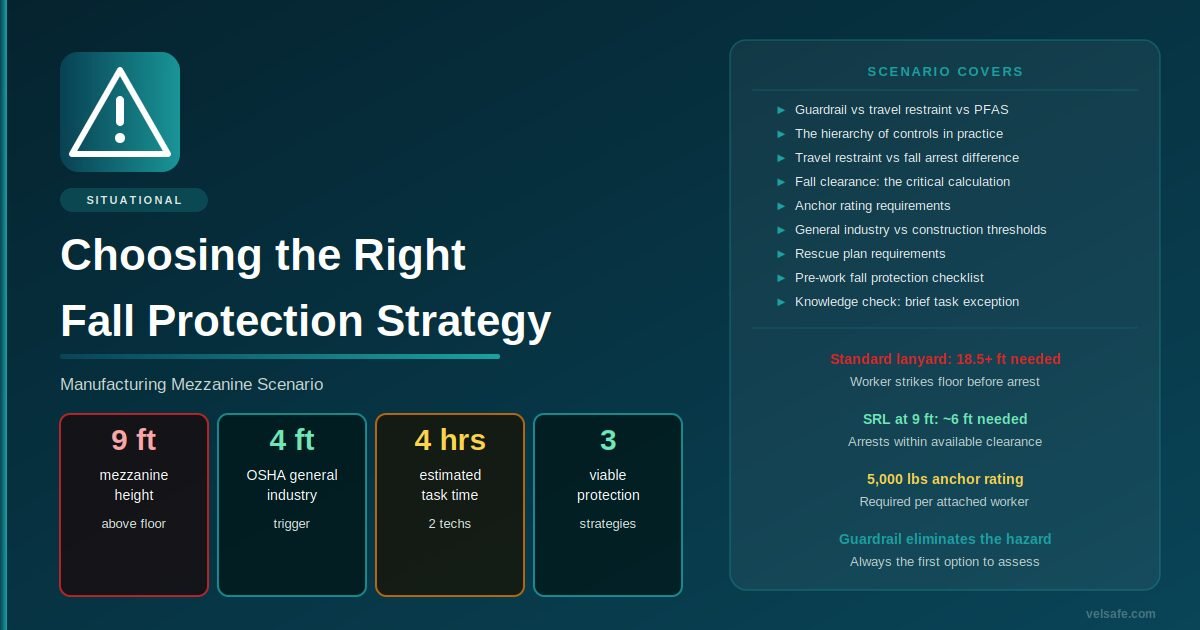
A maintenance supervisor at a food packaging plant is planning a Saturday shutdown task: replacing a worn drive motor on a conveyor system that sits on an elevated steel mezzanine, roughly 9 feet above the production floor. The mezzanine has guardrails on three sides, but the fourth side, where the conveyor extends out over the floor for product transfer, is open. The motor that needs replacing is mounted right at that open edge.
Two maintenance technicians are assigned. The job will take about four hours. The supervisor needs to decide how the technicians will be protected from the fall hazard at the open edge, and the decision needs to be made before the shutdown begins Saturday morning. This is a general industry setting, so OSHA’s 29 CFR 1910 Subpart D standard applies, not the construction standard. That distinction matters for the decision ahead.
The Scenario
Decision Point
How should the supervisor protect the technicians working at the open edge?
Install a temporary or permanent guardrail across the open fourth side before the work begins, removing the fall hazard entirely for the duration of the task.
Use a travel restraint system: harnesses and fixed-length lanyards attached to the rated roof beam, adjusted so the technicians physically cannot reach the open edge.
Use a personal fall arrest system (PFAS): harnesses and self-retracting lifelines attached to the rated roof beam, allowing the technicians to work at the edge with the system arresting any fall that occurs.
Have the technicians work quickly and carefully without fall protection, since the job is short and they are experienced.
Analysis: Why Option A or Option C Is Correct
Experience and care do not substitute for fall protection. Brief, routine tasks at height are statistically overrepresented in fall fatalities precisely because of the reasoning embedded in Option D. OSHA 1910.28 requires fall protection at 4 feet in general industry regardless of task duration or worker experience.
The hierarchy of controls prioritises engineering controls, which remove or isolate the hazard, over personal protective equipment, which protects the worker after exposure to the hazard. A guardrail across the open edge eliminates the fall hazard for everyone, for the duration of the task and beyond, without requiring any individual worker to wear, inspect, attach, or correctly use equipment. The complication: the motor is mounted right at the open edge, and the conveyor extends through that edge for product transfer. A standard guardrail might physically obstruct the motor replacement. If a guardrail can be installed without preventing access to the motor (for example, a removable or gated section), this is the best option. If the guardrail would make the task physically impossible, the supervisor moves to the next option.
Travel restraint works beautifully when the work is set back from the edge; it does not work when the work is at the edge. Because the motor needs to be accessed right at the open edge, a travel restraint system that physically prevents the technicians from reaching the edge would also prevent them from doing the job. This option is not inferior in general; it simply does not fit this specific task.
Personal fall arrest is the appropriate choice when work must be performed at the edge itself. Because the motor is mounted at the open edge and must be accessed there, the technicians need a system that protects them while working at the edge. A PFAS attached to the engineer-rated roof beam allows them to do exactly that. If selected, several conditions must be met: the anchor must support 5,000 pounds per attached worker (or be part of an engineered system with a safety factor of two); fall clearance must be calculated to ensure the worker does not strike the floor before the system arrests the fall; and a rescue plan must be in place before work begins.
Travel Restraint vs Fall Arrest: The Key Distinction
Uses a fixed-length connection that physically prevents the worker from reaching the edge. The worker cannot fall because they cannot get to the hazard.
Best when: work is set back from the edge.
Allows the worker to reach the edge and arrests the fall after it begins. The worker is protected during the fall, not prevented from reaching the hazard.
Required when: work must be performed at the edge itself.
Fall Clearance: The Calculation That Decides Everything
This is exactly the kind of technical detail that determines whether a fall arrest system actually protects the worker or merely appears to.
Fall clearance needed: 18.5+ ft
Worker strikes the floor before the system arrests the fall.
Fall clearance needed: ~6 ft
Arrests the fall within the available 9 ft of clearance.
The Correct Decision
If yes, install it. This eliminates the fall hazard entirely.
Use self-retracting lifelines attached to the rated beam.
A standard lanyard will not work at this height.
Travel restraint (Option B) is ruled out specifically because the work must occur at the edge, not because it is an inferior system in general.
Learning Points
General industry’s flexibility in system selection does not mean all options are equal. Guardrails (an engineering control) should be considered first because they protect everyone without depending on individual worker action. PFAS is the last resort, appropriate when higher-order controls are not feasible.
Myth: either one works for any task. Fact: travel restraint prevents reaching the hazard; fall arrest stops a fall in progress. The choice depends on where the work is relative to the edge.
At lower working heights, a fall arrest system can fail to protect a worker if the total fall distance (lanyard length plus deceleration distance plus harness stretch plus safety margin) exceeds the available clearance. At 9 feet, a standard shock-absorbing lanyard is likely inadequate, and a self-retracting lifeline is necessary. This is a required part of selecting a system, not an optional refinement.
Manufacturing floors, mezzanines, loading docks, and maintenance platforms frequently involve heights between 4 and 6 feet that would not trigger fall protection under the construction standard but do under general industry’s 1910.28. Teams that move between construction and general industry work need to apply the correct threshold for the work being performed.
If the chosen system is fall arrest, the question of how a fallen worker will be retrieved must be answered before the work begins. Suspension trauma can incapacitate a worker hanging in a harness within minutes, and the rescue approach (a nearby aerial lift, a ladder, or a planned manual retrieval) should be identified in advance.
Pre-Work Fall Protection Checklist
Related Resources
- A detailed tips guide on fall protection for construction and general industry, covering OSHA height thresholds, the hierarchy of controls, harness inspection, anchor requirements, and rescue planning, is available in the Tips section.
- A Worker Safety overview of fall fatality statistics and who is most at risk is available in the Worker Safety section.
- OSHA 1910.28: Duty to have fall protection
- OSHA 1910.29: Fall protection systems criteria and practices