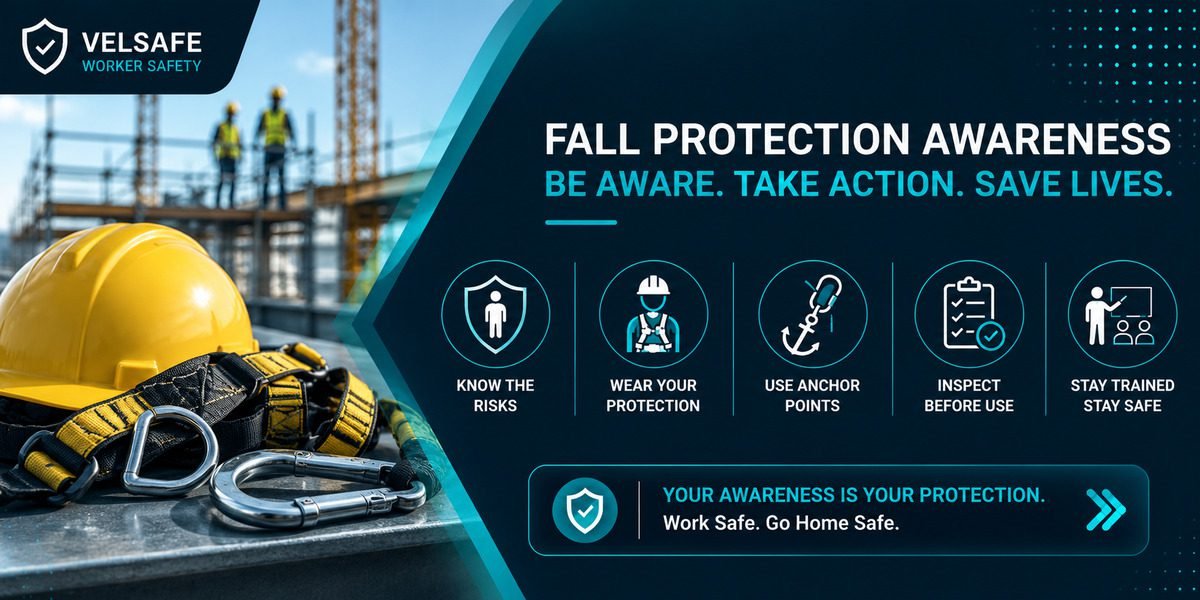
WORKER SAFETY: Fall Protection
844 Workers Died in Falls in 2024
Here Is Who Falls, Where, and Why It Keeps Happening
Falls are the second leading cause of workplace death across all US industries and the leading cause in construction. Fall protection has been OSHA’s most-cited violation for 15 consecutive years. This article examines the data behind who is most at risk, where fatal falls occur, and what the evidence shows about what actually prevents them.
844
Fatal Falls in 2024
844 US workers died in falls in 2024, representing 17% of all workplace deaths across all industries.
National Safety Council, 2024
480K
Injuries Per Year
480,000 workers were injured in falls seriously enough to require time off work in 2024.
National Safety Council, 2024
15
Consecutive Years
Fall protection has been OSHA’s most-cited standard violation for 15 consecutive years in construction.
OSHA Citation Data
The Scope of the Problem
Falls are the second leading cause of workplace fatalities across all US industries and the leading cause in construction. In 2024, 389 construction workers died in falls, accounting for 38% of all construction deaths. Fall protection has been OSHA’s most-cited standard violation for 15 consecutive years.
A critical point on scale: 145 workers were killed in falls on the same level in 2024, according to the National Safety Council. Falls do not require height to be fatal. Slip, trip, and fall incidents on flat surfaces account for a significant share of workplace deaths and injuries across all industries, including manufacturing, healthcare, and retail.
Who Is Most at Risk
Construction workers face a fall fatality rate more than seven times higher than other industries. In 2024, construction workers experienced 95% of all fatal falls from elevation and 46% of all fatal occupational slips, trips, and falls across all private industry sectors.
Small firms carry the highest risk
Approximately 70% of fatal falls occur at firms with ten or fewer employees, according to CPWR’s 2024 analysis. Smaller firms tend to have fewer dedicated safety resources, less formal fall protection planning, and more pressure on individual workers and supervisors to manage hazards without specialist support.
High-Risk Roles
Roofers and roofing contractors
Structural iron and steel workers
Construction labourers
Painters working at elevation
HVAC and mechanical trades
Maintenance workers on elevated platforms
High-Risk Situations
Brief or unplanned tasks at height
Work at small firms with 10 or fewer employees
Residential construction with few controls
Unfamiliar or temporary worksites
Post-incident return to work without retraining
Shift handover without fall protection briefing
Where Fatal Falls Happen
Three task categories account for a disproportionate share of fatal construction falls. All three involve controlled, inspectable surfaces where engineering controls are available.
1. Roofing Work
Roofing produces more fall fatalities than any other construction task. The combination of steep surfaces, edge exposure, inadequate or absent anchor points, and production pressure on residential jobs creates conditions where fall protection is consistently under-applied. Residential roofing without fall protection is the single most common scenario in construction fall fatalities.
2. Scaffold Work
Falls from scaffolding account for a significant share of construction fatalities each year. Contributing factors include scaffold planks not fully planked or extending past end supports, missing guardrails on platforms above 10 feet, scaffold not inspected by a competent person before use, and workers accessing scaffolds by climbing the cross-bracing rather than using proper access frames or ladders.
3. Ladder Work
Portable ladders account for a large portion of fall deaths on construction sites. The most common failure modes are: ladder not secured at the top or footed at the base, ladder placed at an incorrect angle, overreaching from a ladder rather than repositioning, using a damaged or inadequate ladder for the task, and carrying tools or materials that prevent maintaining three points of contact.
Beyond these three, falls through fragile roofing materials, falls from loading docks and truck beds, and falls into floor openings and excavations each contribute significantly to the annual total.
Why Fall Protection Violations Keep Happening
The persistence of fall protection as OSHA’s top citation is not primarily a problem of knowledge. Most employers who receive fall protection citations know what the requirements are. The breakdown happens at the point where compliance requires slowing down, spending money, or doing something that feels unnecessary for a task that seems quick and familiar.
No fall protection in place
The most fundamental failure: workers at heights above the applicable threshold with no guardrails, safety nets, or personal fall arrest system. Happens most often on residential construction jobs, smaller sites, and during brief tasks where the employer judges the risk acceptable.
Equipment present but not used
Harnesses are purchased, inspected, and available but not worn. This gap between equipment availability and actual use is one of the most common findings in post-incident investigations. The presence of PPE in the tool room is not compliance. A worker at height without a connected fall arrest system has no more protection than a worker with no equipment at all.
Duration bias: the quick-task exemption that does not exist
The judgment that a task is short enough to skip fall protection is the most dangerous decision made on construction sites. OSHA does not provide a duration exemption. Fatal falls happen during tasks that took five minutes. The time required to put on a harness and connect to an anchor is less than the time required to investigate the incident that follows when the worker does not.
Planning before work starts makes a measurable difference
A Dodge Construction Network study found that 74% of respondents noted increased worker engagement with safety when a health and safety plan was introduced before construction began. Sites with documented fall protection plans before work starts are significantly more likely to have fall protection actually in place during the work.
The Cost Beyond Fatalities
The total cost of workers’ compensation claims in the US construction industry in 2023 was $11.4 billion. OSHA’s maximum penalty for a wilful or repeated violation is $156,259 per violation. A single fatal fall carries costs that extend far beyond the initial claim: OSHA penalties, litigation exposure, project delays, insurance premium increases, and the irreplaceable loss of a trained worker.
$11.4B
Workers Comp Cost
Total US construction industry workers’ compensation claims in 2023
$156K
Max OSHA Penalty
Maximum per-violation penalty for wilful or repeated OSHA violations
6x
ROI on Prevention
OSHA estimates $4-6 saved in indirect costs for every $1 invested in safety programmes
What Actually Prevents Falls
The evidence on what works is not ambiguous. The hierarchy of controls, applied in order from most to least reliable, is the proven framework for fall prevention.
Engineering controls outperform PPE
A guardrail system that prevents workers from reaching the edge is more reliable than a harness that arrests a fall after the worker has already left the surface. Permanent covers over floor openings are more reliable than temporary tags. Engineering controls do not depend on worker behaviour or equipment condition at the moment of the hazard.
Pre-task planning reduces incidents
Sites that identify fall hazards and assign controls before work begins have lower incident rates than sites that rely on workers to recognise and address hazards in real time. A documented fall protection plan for each elevated task, completed before work starts, is the single highest-leverage administrative control available to supervisors.
Do and Do Not: Fall Protection for Every Worker
Do
Inspect your harness before every use, hardware, webbing, stitching, and labels.
Confirm your anchor can support 5,000 lbs per attached worker before connecting.
Calculate your total fall clearance before starting any elevated task.
Report a harness that has arrested a fall immediately, remove it from service.
Know where your rescue plan is and what it requires before you go up.
Do Not
Skip fall protection because the task seems quick. Duration is not an OSHA exemption.
Climb scaffold cross-bracing to access a platform. Use the designed access points.
Anchor to pipes, vents, or roof hatches not rated as anchor points.
Assume a harness is safe because it has been inspected before. Check it yourself.
Work at height without knowing your rescue plan. Suspension trauma can incapacitate within minutes.
Fall Protection Pre-Task Checklist
Before Starting Work at Height
Height threshold confirmed (4 ft general industry / 6 ft construction)
Fall hazards identified for this specific task
Engineering controls applied where practicable
Anchor point rated and confirmed
Harness inspected and correctly fitted
Total fall clearance calculated
Rescue plan in place and communicated
During and After Work
Fall protection remains in place throughout, including brief pauses
Floor openings covered and marked if created during work
Scaffold not modified without competent person inspection
Any near-miss or equipment incident reported immediately
Harness removed from service if it has arrested a fall
Post-task debrief identifies any gaps for next shift
Who Is Responsible
Under OSHA regulations, the employer is responsible for providing fall protection. But the framework of responsibility is broader than that.
Role
Primary Obligation
Employers
Plan the work, provide and maintain equipment, train workers, and enforce compliance at every shift.
Supervisors
Ensure fall protection is in place before work begins, remains in place throughout, and stop work when protection is absent or deficient.
Workers
Use provided fall protection correctly, inspect equipment before use, report hazards, and exercise stop-work authority when conditions are unsafe.
Key Takeaways
70% of fatal falls happen at firms with 10 or fewer employees
Small firms are not less dangerous than large ones, they are more dangerous, because fall protection planning and enforcement resources are thinner. If you work at or manage a small firm, the statistical risk is higher and the responsibility to plan explicitly is greater, not smaller.
Equipment availability is not the same as protection
A harness in the tool room does not protect a worker on the roof. A fall protection plan in a binder does not protect workers who have not been briefed on it. Protection exists only when the right equipment is correctly worn, correctly connected, and actively enforced at the task level.
Falls kill during familiar tasks, not just unusual ones
The data consistently shows that fatal falls happen during tasks workers have performed dozens of times before, roofing, ladder access, scaffold work. Familiarity reduces the perceived risk while the actual risk remains unchanged. The most important thing fall protection awareness can change is the automatic assumption that this particular task, on this particular day, does not need the full procedure.
Frequently Asked Questions
Why is fall protection still the most cited OSHA violation after 15 years?
The persistence is not primarily a knowledge problem. Most employers who receive citations know the requirements. The breakdown occurs at the point where compliance requires slowing down a quick task, spending money on engineering controls, or enforcing rules on workers under production pressure. OSHA’s citation data reflects a compliance failure, not an awareness failure, at the point of execution.
How many construction workers die from falls each year?
In 2024, 389 construction workers died in falls, representing 38% of all construction deaths. Construction workers accounted for 95% of all fatal falls from elevation across private industry that year. The fatality rate for construction workers is more than seven times higher than for workers in other industries, according to the National Safety Council.
Do I need fall protection on the same level, or only when working at height?
Both. Falls on the same level, slips and trips on flat surfaces, killed 145 workers in 2024 and account for a large share of non-fatal lost-time injuries across all industries. OSHA’s walking-working surfaces standard under 29 CFR 1910.22 requires employers to keep walking-working surfaces clean, orderly, and free of hazards that could cause slips and trips.
Why do 70% of fatal falls happen at small firms?
Small firms with ten or fewer employees typically have fewer dedicated safety resources, less formal fall protection planning, and more direct pressure on supervisors and workers to maintain production without specialist support. They are also less likely to have documented fall protection plans, regular safety meetings, or competent persons designated and trained for fall hazard assessment. The risk is structural, not a matter of individual worker behaviour.
What is the financial cost of a single fall fatality to an employer?
A single fatal fall exposes an employer to: OSHA penalties up to $156,259 per wilful or repeated violation, civil litigation from the worker’s family, project shutdown costs, insurance premium increases, reputational damage affecting future contract opportunities, and the cost of recruiting and training a replacement. OSHA estimates that the total cost of a fatal workplace incident, including indirect costs, is typically five to six times the direct claim cost.
Does introducing a safety plan before construction begins actually reduce falls?
Yes. A Dodge Construction Network study found that 74% of respondents noted increased worker engagement with safety when a health and safety plan was introduced before construction began. Sites with documented fall protection plans before work starts are significantly more likely to have fall protection actually in place during elevated work. Pre-task planning converts awareness into action at the point where it matters.
Where can I find OSHA’s free fall prevention resources?
OSHA’s Campaign to Prevent Falls in Construction, co-sponsored with NIOSH and CPWR, provides toolbox talk materials, inspection checklists, and demonstration resources at no cost. The annual Safety Stand-Down each May is the primary public engagement event. OSHA’s falls topic page also links to training materials, the applicable standards, and compliance assistance resources.
Sources
Government and Regulatory Sources
- OSHA: Fall Prevention Campaign: free toolbox talks, inspection checklists, and demonstration resources for fall prevention in construction, co-sponsored with NIOSH and CPWR.
- OSHA FY2024 Most Cited Standards: fall protection general requirements (1926.501) citation data confirming 15 consecutive years as the most cited standard.
- CDC/NIOSH: Construction Falls: federal fall fatality data and prevention guidance for the construction sector.
Industry and Research Sources
- National Safety Council: Injury Facts: 2024 fall fatality and injury data including 844 deaths and 480,000 lost-time injuries.
- CPWR: The Construction Chart Book (2024): analysis showing 70% of fatal falls occur at firms with ten or fewer employees.
Related VelSafe Articles
Tips
12 Fall Protection Tips for Construction and General Industry
OSHA height thresholds, anchor point requirements, PPE fit rules, rescue plan obligations, and the 2025 fit amendment for construction workers.
Worker Safety
How Lockout/Tagout Prevents Electrical Injuries at Work
The six-step LOTO procedure for controlling hazardous energy during maintenance tasks, including elevated work where LOTO and fall protection obligations overlap.
Guides
Choosing the Right Materials for Blocking and Cribbing
Material selection, load capacity, and inspection requirements for blocking and cribbing used to support equipment and structures when working at elevation.
FALL PROTECTION AWARENESS
844 Deaths. 15 Years. The Same Standard Cited Every Year.
Find more worker safety guides, fall protection resources, and OSHA compliance data at VelSafe.
Explore More Worker Safety Guides