

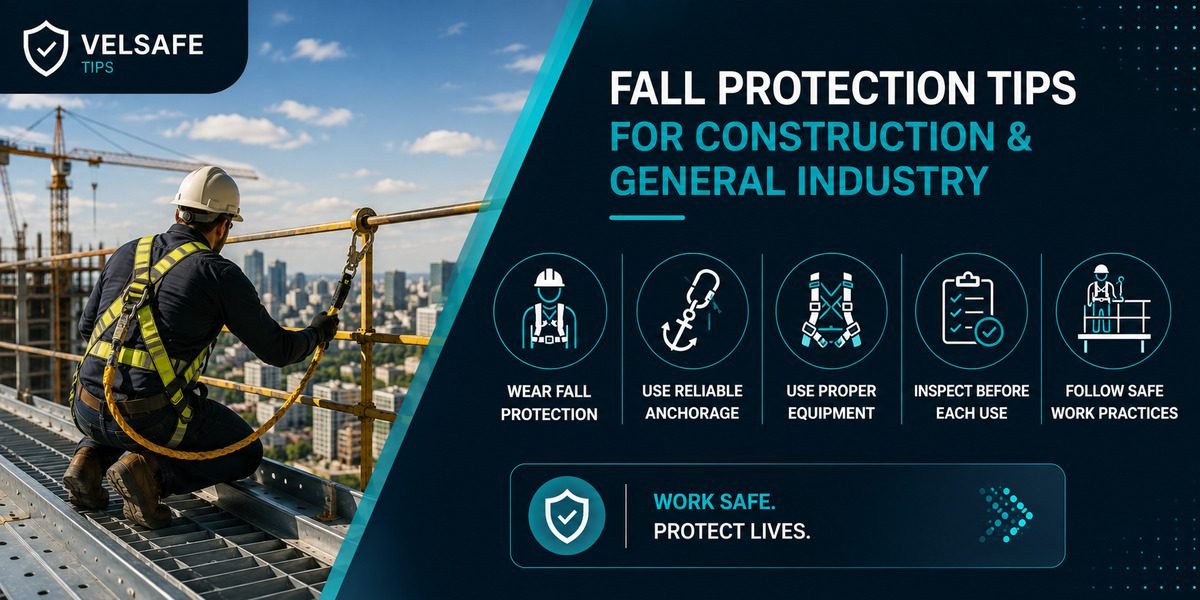
TIPS: FALL PROTECTION
Falls Kill More Construction Workers Than Anything Else
Here Is What 15 Years of OSHA Data Shows You Must Do
Here Is What 15 Years of OSHA Data Shows You Must Do
Fall protection has topped OSHA’s most-cited violations list for 15 consecutive years. In FY2025, OSHA recorded 6,827 violations under 29 CFR 1926.501 alone. These 12 tips cover the controls, the equipment checks, and the planning steps that address the most preventable exposures.
15+
Consecutive Years
Fall protection has been OSHA’s most-cited standard in construction every year for over 15 consecutive years.
OSHA Citation Data
6,827
FY2025 Violations
OSHA recorded 6,827 violations under 29 CFR 1926.501 (fall protection general requirements) in FY2025 alone.
29 CFR 1926.501
70%
Construction Falls
Approximately 70% of construction fall fatalities occur from roofs, scaffolds, and ladders, three controlled, inspectable surfaces.
CPWR Chart Book
Quick Summary: 12 Fall Protection Tips
1. Know your height threshold (4 ft or 6 ft)
7. Match the system to the work configuration
2. Apply the hierarchy of controls before PPE
8. Train workers before the exposure
3. Inspect equipment before every use
9. Develop a rescue plan before work begins
4. Verify anchor points before attaching
10. Address same-level slips and trips
5. Ensure PPE fits every worker
11. Inspect scaffolding and AWPs before each shift
6. Guard every floor hole and opening
12. Enforce fall protection on short tasks equally
Regulatory Framework at a Glance
Industry Sector
Threshold
Regulation
General Industry
4 feet
29 CFR 1910.28
Construction
6 feet
29 CFR 1926.501
Shipyard Employment
5 feet
29 CFR 1915.151
Any height
Always required
When working over dangerous equipment or machinery
The 12 Fall Protection Tips in Detail
1. Know Which Height Threshold Applies to Your Site
The height at which OSHA requires fall protection depends on the industry sector. General industry requires fall protection at 4 feet above a lower level under 29 CFR 1910.28. Construction requires it at 6 feet under 29 CFR 1926.501. Working over dangerous equipment triggers the requirement regardless of height. Contractors who work across both construction and general industry sites must ensure their supervisors know which threshold applies at each location.
2. Apply the Hierarchy of Controls Before Defaulting to PPE
OSHA’s recommended approach to fall hazards follows the standard hierarchy: elimination, substitution, engineering controls (guardrails, safety nets), administrative controls, and finally PPE. Personal fall arrest systems are the most commonly deployed control, but they are also the weakest: they allow the fall to occur and depend on correct fit, correct anchorage, and a functioning rescue plan. Use guardrails wherever practicable. Reserve fall arrest systems for locations where guardrails cannot be installed. Treating PPE as the default, rather than the last resort, is the single most common fall protection programme failure.
3. Inspect Fall Protection Equipment Before Every Use
OSHA requires personal fall arrest equipment to be inspected before each use. Harnesses, lanyards, and self-retracting lifelines degrade from UV exposure, chemical contact, sharp edges, and impact loading. A harness that has arrested a previous fall must be removed from service immediately, even if it shows no visible damage. Pre-use inspection must check: stitching for cuts or fraying, hardware for corrosion or deformation, webbing for wear or chemical discolouration, and labels for legibility. Equipment that fails inspection must be tagged out and removed, not returned to the storage rack.
4. Verify Anchor Points Before Attaching
An anchor for a personal fall arrest system must support at least 5,000 pounds per attached worker, or be part of an engineered system designed with a safety factor of two. Not every structural member on a construction site meets this requirement. Common failures include anchoring to mechanical piping, unsecured roof vents, or roof hatches not designed as anchor points. Anchorage must also provide sufficient clearance for the free-fall distance and the deceleration distance of the lanyard or SRL. Calculate total fall clearance before every elevated task, inadequate clearance can result in the worker contacting the lower level even when the fall arrest system functions correctly.
5. Ensure PPE Fits Every Worker, Including Smaller-Framed Workers
A December 2024 OSHA Final Rule (effective January 13, 2025) amended 29 CFR 1926.95 to require that construction PPE must properly fit each worker. Standard-size harnesses on smaller-framed workers can allow the worker to slide through the harness during a fall arrest, with potentially fatal consequences. Harness inventories must include sizes for the full range of workers on site. Fit checks must be performed before authorising work at height, not just during initial issuance.
6. Guard Every Floor Hole and Opening
OSHA requires every floor hole into which a worker could accidentally walk to be guarded with a railing and toe-board, or covered with a cover strong enough to support the maximum intended load. Covers must be secured against accidental displacement and marked with the word “HOLE” or “COVER” to prevent removal or use as a work platform. Construction sites where floor penetrations are created and closed regularly must establish a standard for hole cover installation, marking, and inspection that keeps pace with the work.
7. Match the Fall Protection System to the Work Configuration
OSHA allows employers to choose from guardrail systems, personal fall arrest systems, safety net systems, controlled access zones, safety monitoring systems, covers, and combinations. The correct system depends on the nature of the work, the physical layout, and proximity to edges. Leading-edge work, roofing, and residential construction each have specific system requirements under 29 CFR 1926.502. Using a one-size-fits-all approach, a single harness and lanyard configuration for every elevated task, often results in systems that technically comply but do not adequately protect against the specific fall geometry of the task.
8. Train Workers Before the Exposure, Not After
OSHA requires fall protection training covering the nature of fall hazards, methods used to minimise them, and proper use and maintenance of fall protection systems. Training must be task-specific: a worker trained on harness use for roofing is not automatically trained for leading-edge work or aerial work platforms. Retraining is required when a worker is observed not using fall protection correctly, when there is reason to believe the training is inadequate, or when the work conditions change in a way that introduces new fall hazards. Training must be documented with the worker’s name, the date, and the trainer’s signature.
9. Develop a Rescue Plan Before Work at Height Begins
A harness arrests a fall; it does not return the worker to safety. Suspension trauma (orthostatic intolerance) can become incapacitating within minutes of a worker hanging in a harness after a fall arrest. OSHA requires a rescue plan to be in place before workers use personal fall arrest systems. The plan must identify how a suspended worker will be retrieved, on-site rescue is almost always faster than 911 response for an elevated worksite. Rescue plans that name 911 as the sole mechanism without on-site retrieval capability do not provide the required protection in most elevated work scenarios.
10. Address Slips, Trips, and Falls at the Same Level
Falls from elevation capture most of the regulatory attention, but same-level falls (slips and trips) account for a large share of lost-time injuries across construction and general industry. Controls for this category are basic but frequently deprioritised: housekeeping standards enforced throughout the shift (not just at clean-up), defined walkways through active work areas, slip-resistant footwear requirements, adequate lighting at 5 foot-candles minimum in walkways and 10 foot-candles at stairways, and prompt repair of uneven surfaces and damaged flooring.
11. Inspect Scaffolding and Aerial Work Platforms Before Each Shift
Scaffolding must be inspected by a competent person before each work shift and after any event that could affect structural integrity, per OSHA 29 CFR 1926.451. Aerial work platforms must be inspected before each use per ANSI/ASSP A92 standards and manufacturer requirements. Both must be inspected after any incident, after rain or wind events, and when the platform has been modified or relocated. A competent person for scaffolding inspection must have the authority to remove the scaffold from service, inspection authority without removal authority is not meaningful.
12. Enforce Fall Protection on Short Tasks as Strictly as Long Ones
Fatal falls are not disproportionately concentrated in complex or unusual tasks. They happen on familiar sites, with experienced workers, during tasks that appeared quick. The judgment that a task is “short enough” to skip fall protection is one of the most dangerous decisions in construction and general industry. There is no regulatory or safety basis for a duration exemption from fall protection requirements. Enforce fall protection for tasks lasting two minutes with the same standard as tasks lasting two days.
Common Fall Protection Mistakes
Skipping fall protection for quick tasks at height
Brief exposures account for a disproportionate share of fatal fall incidents, especially at small firms. Duration is not a legal or practical basis for bypassing fall protection requirements.
Returning a harness to service after a fall arrest
A harness that has arrested a fall must be removed from service immediately, even without visible damage. Internal webbing deformation is not visually detectable and the system’s rated performance cannot be relied upon after impact loading.
No rescue plan for suspended workers
Suspension trauma can incapacitate a worker within minutes. A rescue plan that relies solely on 911 is not adequate when workers are elevated on sites where emergency response time exceeds that window.
One harness size for all workers
Since the January 2025 OSHA amendment, construction PPE must properly fit each worker. A standard harness on a smaller-framed worker may allow the worker to slide through during a fall arrest event.
Key Takeaways
PPE is the last resort, not the first response
Guardrails prevent falls entirely. Fall arrest systems allow the fall to happen and then depend on correct fit, a rated anchor, and a functioning rescue plan. Apply the hierarchy. Install guardrails where practicable. Reserve fall arrest for locations where guardrails cannot go.
A rescue plan is not optional when using fall arrest
OSHA requires a rescue plan before workers use personal fall arrest systems. The plan must provide for prompt retrieval. Suspension trauma can incapacitate a worker in minutes. A plan that names 911 as the only mechanism is not adequate for most elevated construction scenarios.
Duration is never a basis for bypassing fall protection
The judgment that a task is too short to require fall protection is one of the most dangerous decisions on a construction site. There is no OSHA exemption based on task duration. Fatal falls happen during familiar tasks on familiar sites. Enforce the same standard for a two-minute task as for a two-day one.
Frequently Asked Questions
At what height does OSHA require fall protection in general industry?
4 feet above a lower level, under 29 CFR 1910.28. In construction, the threshold is 6 feet under 29 CFR 1926.501. Both standards require fall protection regardless of height when working over dangerous equipment or machinery.
What are the three main types of fall protection systems OSHA permits?
Guardrail systems, personal fall arrest systems, and safety net systems are the three primary types under 29 CFR 1926.502. Controlled access zones, covers, and safety monitoring systems are permitted for specific applications (leading-edge work, roofing, residential construction). Employers choose among these based on site conditions and work configuration.
Does a harness that arrested a fall need to be replaced?
Yes. Any personal fall arrest component that has arrested a fall must be removed from service immediately, even if there is no visible damage. Internal webbing and hardware deformation cannot be assessed visually, and the system’s rated performance cannot be relied upon after impact loading. The equipment must be destroyed or clearly tagged as non-serviceable before disposal to prevent reuse.
What is suspension trauma and why does it matter for rescue planning?
Suspension trauma (also called orthostatic intolerance or harness hang syndrome) occurs when a worker suspended motionless in a fall arrest harness experiences pooling of blood in the legs, reducing blood return to the heart and brain. Symptoms including dizziness, unconsciousness, and cardiac events can develop within minutes. OSHA requires a prompt rescue plan precisely because emergency services may not arrive within the window before suspension trauma becomes life-threatening.
What changed with the 2025 PPE fit requirement?
A December 2024 OSHA Final Rule, effective January 13, 2025, amended 29 CFR 1926.95 to explicitly require that construction PPE must properly fit each worker. Previously, the standard required PPE to be “of safe design” without the explicit fit requirement. The amendment addresses the disproportionate risk to smaller-framed workers issued standard-size harnesses that do not adequately restrain them during a fall arrest.
How often must scaffolding be inspected?
Under 29 CFR 1926.451(f)(3), scaffolding must be inspected by a competent person before each work shift and after any occurrence that could affect structural integrity. The competent person must have the authority to remove the scaffold from service, inspection authority without removal authority is not meaningful under the standard.
Is fall protection training required to be documented?
Yes. Fall protection training must be documented. Records should include the worker’s name, the date of training, the trainer’s name and qualifications, and the specific hazards and controls covered. Retraining is required when a worker’s work conditions change in a way that introduces new fall hazards, when the worker is observed not using fall protection correctly, or when there is reason to believe previous training did not provide adequate knowledge.
Sources
Government and Regulatory Sources
- OSHA 29 CFR 1926.501: Duty to Have Fall Protection (Construction): the primary fall protection standard for construction, requiring protection at 6 feet above a lower level.
- OSHA 29 CFR 1910.28: Duty to Have Fall Protection (General Industry): requires fall protection at 4 feet above a lower level in general industry settings.
- OSHA 29 CFR 1926.502: Fall Protection Systems Criteria and Practices: specifies requirements for guardrail systems, personal fall arrest systems, safety nets, and other fall protection methods.
- OSHA 29 CFR 1926.451: Scaffolds, General Requirements: inspection requirements for scaffolding including pre-shift competent person inspection.
- OSHA FY2025 Most Cited Standards: fall protection general requirements (1926.501) citation data showing 6,827 violations.
Industry and Research Sources
- CPWR: The Construction Chart Book: construction industry fatality and injury data including fall fatality distribution by source.
- OSHA Campaign to Prevent Falls in Construction: annual Safety Stand-Down programme, toolbox talks, and fall prevention resources co-sponsored with NIOSH and CPWR.
Related VelSafe Articles
Tips
Crane Hand Signals: All 19 OSHA-Standard Signals
All 19 standard crane hand signals per OSHA 29 CFR 1926 and ASME B30.5, including who can give them and when Emergency Stop applies to every worker on site.
Guides
Choosing the Right Materials for Blocking and Cribbing
Material selection, load capacity, and inspection requirements for blocking and cribbing used to support equipment and structures at height during maintenance operations.
Worker Safety
How Lockout/Tagout Prevents Electrical Injuries at Work
The six-step LOTO procedure, electrical hazards, Do/Do Not rules, and daily worker checklist for controlling hazardous energy, relevant to maintenance tasks performed at height.
FALL PROTECTION
The Most Cited Standard in Construction Has a Simple Fix: Actually Use It
Find more fall protection resources, OSHA compliance guides, and worker safety tips at VelSafe.
Explore More Tips