

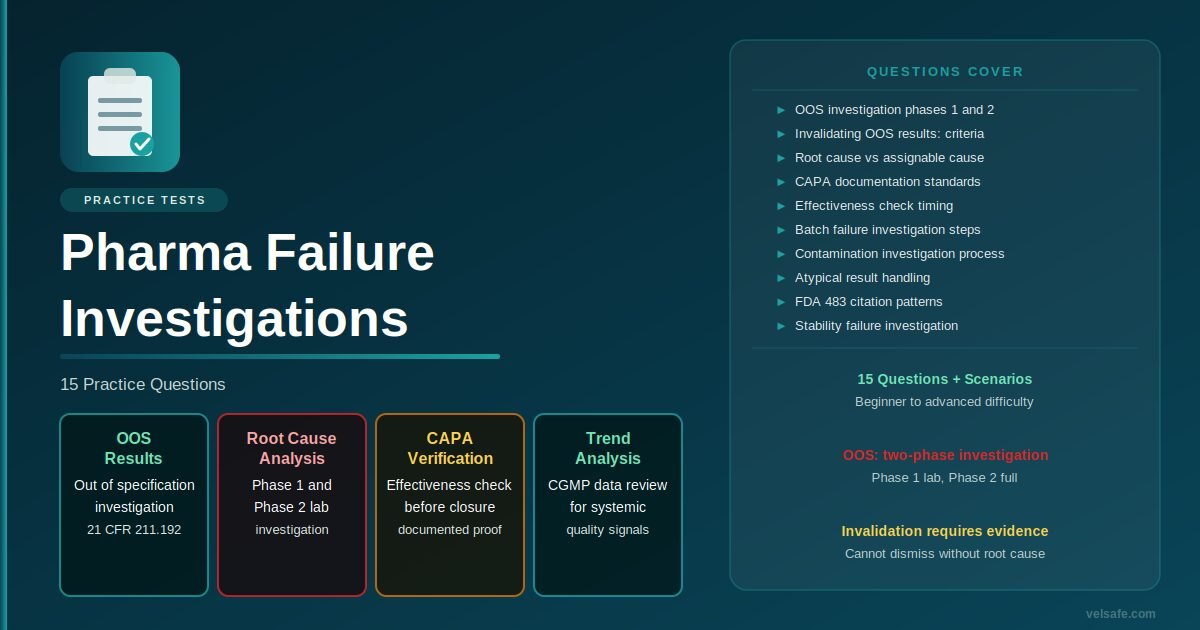
Failure investigations are one of the most consistently cited areas in FDA pharmaceutical GMP inspections. The rules are not complicated, but applying them correctly under batch-release pressure, with incomplete information and competing organisational incentives, is where most manufacturers fall short. This practice test works through the scenarios where those judgements are most likely to go wrong.
Questions are drawn from FDA’s guidance on investigating out-of-specification (OOS) test results, 21 CFR 211.192, ICH Q10, and the pattern of FDA 483 observations and warning letters in pharmaceutical GMP enforcement. Reveal answers only after choosing your own.
Section 1: Fundamentals
Question 1 | Beginner
Under 21 CFR 211.192, when must a pharmaceutical manufacturer investigate a discrepancy or specification failure?
- A) Only before the batch is distributed
- B) Only if the batch has already been recalled
- C) Whether or not the batch has been distributed
- D) Only when requested by FDA
21 CFR 211.192 states that an investigation must occur whether or not the batch has been distributed. This is a deliberate regulatory choice: the obligation to investigate does not depend on the batch’s commercial status. A batch that was distributed and then found to have had an unresolved discrepancy creates both a regulatory violation and a potential recall obligation. The investigation must also extend to other batches of the same product and other products that may have been associated with the specific failure.
Question 2 | Beginner
Which phase of an OOS investigation specifically focuses on whether the OOS result was caused by a laboratory error?
- A) Phase 2 investigation
- B) Phase 1 laboratory investigation
- C) CAPA implementation
- D) Batch disposition review
FDA’s OOS guidance establishes a two-phase framework. Phase 1 is the laboratory investigation: a review conducted by the analyst and the laboratory supervisor to identify whether the OOS result was caused by an identifiable laboratory error (calculation error, instrument malfunction, analyst technique, sample preparation error). Phase 2 is the broader manufacturing or production investigation, opened only when Phase 1 fails to identify an assignable laboratory cause. A common error is initiating Phase 2 before completing Phase 1 with sufficient rigour, or treating Phase 1 as complete based on “no obvious error” without documented review.
Question 3 | Beginner
True or False: A passing retest result can be used to invalidate an original OOS result without a formal Phase 1 investigation.
- A) True
- B) False
FDA’s OOS guidance is explicit: passing retest results alone cannot serve as the basis for invalidating an original OOS result. A passing retest result shows only that a different sample, tested at a different time, passed — it does not explain why the original result was OOS. Invalidation of an OOS result requires identifying a specific, documented, assignable cause in the laboratory (a calculation error, an instrument calibration failure, a documented analyst deviation). “Testing into compliance” — retesting until you get a passing result and then discarding the OOS — is one of the most serious data integrity violations in pharmaceutical GMP and has been cited in numerous FDA warning letters and consent decrees.
Section 2: Compliance Requirements
Question 4 | Intermediate
Phase 1 of an OOS investigation is completed and no assignable laboratory cause is identified. What is the correct next step?
- A) Reject and destroy the batch immediately
- B) Open a Phase 2 production investigation examining manufacturing process, raw materials, equipment, and environment
- C) Retest the sample three more times and average the results
- D) Release the batch if all other batch record entries are satisfactory
When Phase 1 (laboratory investigation) does not identify an assignable laboratory cause, the investigation must proceed to Phase 2: a full manufacturing or production investigation. Phase 2 examines the manufacturing process, raw material lots, equipment records, environmental monitoring data, operator training, and any deviations or non-conformances associated with the batch. Rejection is a disposition decision that may follow the investigation but is not the immediate next step when Phase 1 is inconclusive. Retesting without an investigation plan is “testing into compliance.” Release based on satisfactory batch records while an unresolved OOS result exists is a direct 21 CFR 211.192 violation.
Question 5 | Intermediate
Under 21 CFR 211.192, the investigation of a batch failure must extend to what?
- A) Only the specific batch that failed
- B) Other batches of the same drug product and other drug products that may have been associated with the failure
- C) Only batches manufactured in the same calendar year
- D) Only batches not yet distributed
21 CFR 211.192 is explicit: the investigation shall extend to other batches of the same drug product and other drug products that may have been associated with the specific failure or discrepancy. This is a frequently cited deficiency in FDA 483 observations — manufacturers investigate only the failed batch and do not assess whether the same root cause could have affected other batches or products. The scope assessment should be driven by the identified or suspected root cause. If the root cause is a contaminated raw material lot used in multiple batches, all affected batches must be assessed regardless of distribution status or year of manufacture.
Question 6 | Intermediate
What must be included in the documentation of a pharmaceutical batch failure investigation?
- A) Only the test results and the final batch disposition decision
- B) A clear statement of the reason for investigation, the scope, the root cause, the corrective action, and the effect on other batches and products
- C) Only the CAPA form and the QA signature
- D) A laboratory supervisor’s written opinion that the result was caused by analyst error
FDA’s OOS guidance specifies that investigation documentation must include: a clear statement of the reason for investigation; the scope (which batches and products are included); the Phase 1 laboratory review and findings; if applicable, the Phase 2 manufacturing review and findings; the identified root cause (or documented rationale if no root cause was identified); the corrective action taken or planned; and an assessment of the effect on other batches and products. Test results and disposition alone, a CAPA form alone, or a supervisory opinion alone are individually insufficient. The investigation record must be complete enough that an FDA inspector reviewing it can follow the analytical logic from the initial discrepancy to the final root cause conclusion.
Section 3: Investigation Methodology
Question 7 | Intermediate
What is the most significant problem with concluding that a pharmaceutical batch failure was caused by “human error” without further analysis?
- A) Human error is not an acceptable root cause under FDA regulations
- B) Human error is a symptom or proximate cause, not a root cause — it describes what happened but not why the conditions existed that allowed the error
- C) Human error conclusions always require a consent decree
- D) Human error is only acceptable as a root cause if two analysts independently verify it
“Human error” describes what happened but not why the conditions existed that allowed it to happen. A root cause investigation must ask: why did the analyst make the error? Was the SOP unclear? Was training inadequate? Was the procedure poorly designed for the task? Was the analyst fatigued due to shift length? Were there interruptions? The answer to those questions is the actual root cause. Human error as a final root cause conclusion is not prohibited under FDA regulations — it is insufficient, because it does not lead to corrective actions that will prevent recurrence. FDA investigators specifically look for this pattern and cite it as evidence of an inadequate investigation system.
Question 8 | Advanced
During an OOS Phase 2 investigation, a raw material lot used in the failed batch is also identified in three other released batches. What must the manufacturer do?
- A) No action is needed since the other batches have been released without complaints
- B) Assess all three batches for the same failure mode, review their test results, and determine whether any corrective action including recall is warranted
- C) Notify FDA only if one of the three batches has already reached patients
- D) Place the three batches on hold but take no further action pending the Phase 2 conclusion
21 CFR 211.192 requires the investigation to extend to other batches associated with the failure. The absence of complaints is not a substitute for a quality assessment — complaints are a lagging indicator and many quality failures do not produce patient complaints until significant harm has occurred. The manufacturer must assess all three batches for the failure mode identified in the investigation, review their existing test data, and make a documented disposition decision. If that assessment raises questions about product quality for distributed product, the manufacturer must evaluate whether a field alert report (FAR) or recall is appropriate. Placing batches on hold while taking no further action is not a complete response.
Section 4: Scenario-Based Questions
Question 9 | Advanced
An FDA 483 observation states: “Your firm’s OOS investigation system is deficient in that 70 percent of OOS investigations over the past 24 months were closed with ‘laboratory error, analyst retrained’ as the root cause with no documented Phase 1 analysis.” What does this most likely indicate?
- A) The lab analysts need more training
- B) The investigation system has a structural gap: it accepts “laboratory error” as a final root cause without requiring documented Phase 1 analysis of what the error was and why it occurred
- C) The site has unusually poor laboratory technique compared to industry benchmarks
- D) The site should replace its analysts
A pattern of 70 percent of OOS investigations closing with the same conclusion — particularly one as generic as “analyst error, retrained” — without documented Phase 1 analysis is a systemic investigation system failure. It indicates the site’s investigation process accepts a label for the root cause without requiring the analytical work that would establish whether that label is correct. More analyst training does not address a broken investigation system. The CAPA for this observation must address the investigation procedure itself: what Phase 1 analysis is required, what documentation is expected, and what quality unit oversight is required before an investigation can be closed.
Question 10 | Advanced
A senior analyst retests a batch sample with an OOS microbiological result and obtains a passing result. The QA manager proposes to invalidate the original OOS and release the batch based on the senior analyst’s result. Is this acceptable?
- A) Yes, because a senior analyst’s passing result overrides a junior analyst’s OOS result
- B) No, because an OOS result can only be invalidated if a specific, documented, assignable laboratory cause is identified — not on the basis of a subsequent passing result alone
- C) Yes, if the batch record is otherwise complete and satisfactory
- D) Only acceptable if the senior analyst holds a PhD or equivalent qualification
FDA’s OOS guidance is specific: an OOS result can only be invalidated if a specific, documented, assignable cause is identified in Phase 1. Analyst seniority is not an investigative criterion. A passing retest by a senior analyst shows only that a different sample tested by a different analyst at a different time passed — it does not explain why the original result was OOS. The original OOS result stands until a documented root cause is identified. If no root cause is found in Phase 1, Phase 2 must be opened. Releasing this batch based on the senior analyst’s result without a documented root cause is testing into compliance, a serious GMP and data integrity violation.
Section 5: Advanced Scenarios
Question 11 | Advanced
A pharmaceutical quality unit finds that 35 percent of CAPAs closed in the past 12 months have recurred within that same period. What does this most likely indicate?
- A) The site has unusually high random manufacturing variability
- B) The root cause analysis step is producing conclusions that do not identify the true underlying cause, resulting in corrective actions that do not prevent recurrence
- C) The CAPA effectiveness check process is working correctly by catching recurrences
- D) The site needs to hire more QA staff to process CAPAs faster
A 35 percent recurrence rate within 12 months is a strong signal that root causes are not being correctly identified, and therefore corrective actions are not addressing the actual source of the problem. Random manufacturing variability does not produce a 35 percent systematic CAPA recurrence — that rate reflects a structural failure in how root causes are being determined. The CAPA effectiveness check catching recurrences is a positive function, but catching them at 35 percent means the upstream investigation process is producing inadequate root cause conclusions. CAPA volume and staffing are separate issues from root cause quality. The site’s CAPA system needs a procedural review of how root cause analysis is conducted, reviewed, and approved.
Question 12 | Beginner
Under 21 CFR 211.22, what role must the Quality Control Unit (QCU) play in batch failure investigations?
- A) The QCU is optional for investigation oversight if the production department has sufficient quality resources
- B) The QCU must review and approve all production and control records before batch release, and has the authority and responsibility to approve or reject all decisions related to investigations
- C) The QCU’s role is limited to signing the final investigation report
- D) The QCU only becomes involved if the batch has been distributed
21 CFR 211.22 establishes that the QCU has the authority and responsibility to approve or reject all drug products and all procedures or specifications affecting the identity, strength, quality, and purity of the drug product. In the context of failure investigations, this means the QCU must be involved from initiation, must review and approve the investigation scope and root cause conclusion, and must approve the corrective action and the ultimate batch disposition decision. The QCU cannot delegate this authority to the production department. Limiting QCU involvement to signing the final report is a well-documented compliance deficiency cited in FDA warning letters.
Question 13 | Intermediate
A stability study for a commercial pharmaceutical product shows an OOS result at the 18-month time point. What must the manufacturer do?
- A) Discard the 18-month result and continue the study from the 24-month time point
- B) Investigate the OOS result under 21 CFR 211.192, assess whether the product on the market meets its approved shelf life, and notify FDA if the data suggest the product may not meet its approved specifications
- C) Extend the product’s expiry date to allow more time for the stability program to provide additional data
- D) Retest the same sample and use the average of the original and retest results
An OOS result in a stability study must be investigated under 21 CFR 211.192 in the same way as any other OOS result. Additionally, the manufacturer must assess whether the OOS stability result indicates that product already on the market may not meet its approved shelf life specifications. If the investigation confirms the result is genuine and indicates potential stability failure, the manufacturer must submit a field alert report (FAR) and potentially initiate a recall. Discarding the result, averaging with a retest, or extending expiry without data are all prohibited and have been cited in consent decrees. Stability OOS results are treated with heightened scrutiny by FDA because they directly affect the safety of distributed product.
Question 14 | Advanced
An FDA inspector asks a pharmaceutical manufacturer why an investigation was closed with “no root cause identified” after a Phase 2 investigation. What is the minimum the manufacturer must demonstrate to support this conclusion?
- A) That the batch was eventually released and no complaints were received
- B) That both Phase 1 and Phase 2 were conducted with documented methodology, all plausible causes were evaluated and ruled out with evidence, and the conclusion is supported by the data reviewed
- C) That a senior quality manager approved the investigation closure
- D) That the batch was retested and passed
“No root cause identified” is an acceptable investigation conclusion only when it is supported by documented evidence that all plausible causes were systematically considered and ruled out. The investigation record must show what was examined in Phase 1 (and what was found or ruled out), what was examined in Phase 2 (manufacturing records, raw materials, equipment, environment, operators), and the analytical basis for ruling out each plausible cause. A “no root cause” conclusion without this supporting analysis is not a neutral finding — it is an inadequate investigation. Approval by a senior manager, passing retests, or the absence of complaints cannot substitute for documented analytical rigour.
Question 15 | Advanced
A pharmaceutical manufacturer’s investigation SOP requires all OOS investigations to be closed within 30 business days. The investigation of a complex contamination event is genuinely incomplete at 30 days. What should the QCU do?
- A) Close the investigation at 30 days with the data available and document it as complete
- B) Extend the investigation timeline with documented justification, ensure appropriate interim controls are in place, and complete the investigation to a scientifically sound conclusion
- C) Release the batch at 30 days regardless of the investigation status
- D) Transfer responsibility for the investigation to the production department to meet the deadline
Internal SOPs set timelines to drive operational efficiency, but they cannot override the regulatory requirement that investigations be thorough and scientifically sound. Closing an investigation as complete when it is not complete is a data integrity violation. The correct approach is to extend the timeline with documented justification (the nature of the investigation is complex, specific data are pending), ensure appropriate interim controls are in place (such as holding the batch and preventing distribution), and complete the investigation to a conclusion supported by the evidence. The investigation record should reflect the extension and its rationale. Transferring responsibility to production does not resolve the completeness issue and creates a QCU oversight gap under 21 CFR 211.22.
Quick Reference: OOS Investigation Framework
Sources
- FDA, “Guidance for Industry: Investigating Out-of-Specification (OOS) Test Results for Pharmaceutical Production” (2006)
- 21 CFR 211.192: Production Record Review
- 21 CFR 211.22: Responsibilities of Quality Control Unit
- ICH Q10: Pharmaceutical Quality System
- FDA, “Pharmaceutical Quality/Manufacturing Standards (CGMP)” Enforcement Actions
- FDA, “Enforcement Actions: Warning Letters to Pharmaceutical Manufacturers”