

Legal Disclaimer: This article provides general educational information about OSHA fire prevention requirements. It is not legal advice. Employers with compliance questions specific to their operations should consult a qualified safety professional or legal counsel.
Overview
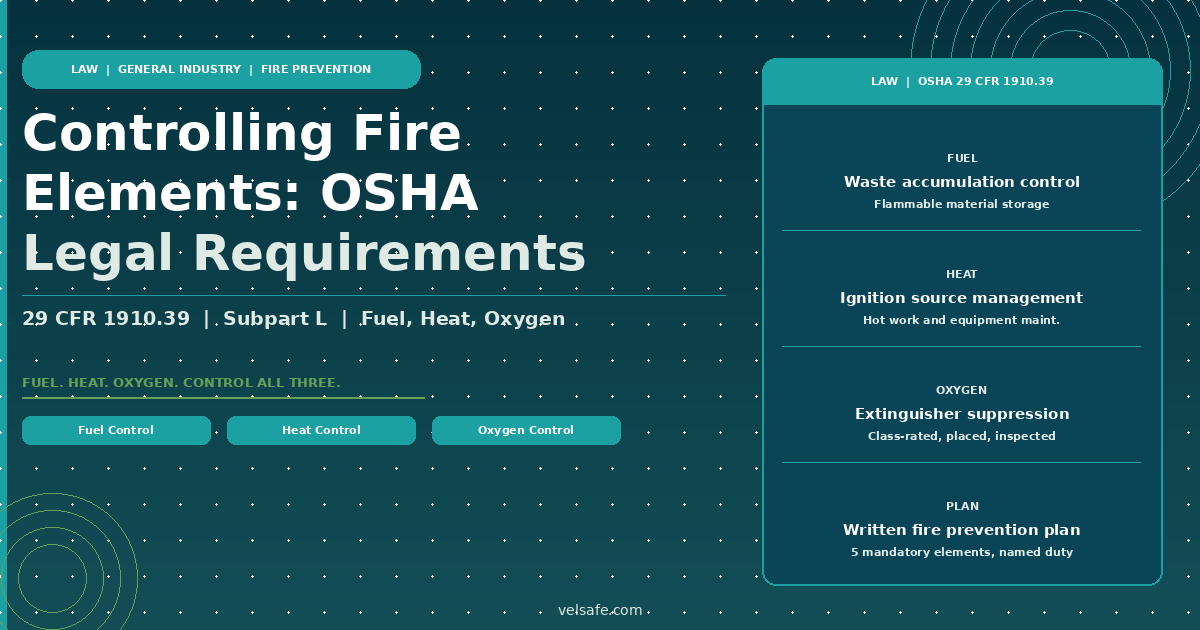
Fire requires three elements to ignite and sustain itself: fuel, heat, and oxygen. Remove any one of them and the fire cannot start or cannot continue. Every fire extinguisher, every fire suppression system, and every aspect of OSHA’s fire prevention regulatory framework is built on this principle. Understanding how the law maps onto each leg of the fire triangle is the foundation of a compliant fire prevention program for any general industry or manufacturing employer.
OSHA’s fire prevention requirements in general industry are concentrated in two standards: 29 CFR 1910.39 (Fire Prevention Plans) under Subpart E, and 29 CFR 1910 Subpart L (Fire Protection), which includes 1910.157 on portable fire extinguishers. Together these regulations translate the fire triangle into employer obligations: identify and control fuel sources, control ignition sources (heat), and ensure that suppression systems and extinguishers are available to remove oxygen or interrupt combustion when prevention fails.
Key Requirements
Fuel control is the most direct way to prevent a fire from ever starting. Under 29 CFR 1910.39(c), a fire prevention plan must include two fuel-related requirements. First, it must contain procedures to control accumulations of flammable and combustible waste materials. Combustible waste, including paper, cardboard, sawdust, oily rags, and packaging materials, is one of the most frequently cited fire hazards in manufacturing and warehouse environments because it accumulates gradually and becomes normalized. The plan must specify how and when these materials are removed, who is responsible, and at what accumulation threshold the hazard is considered unacceptable.
Second, the plan must identify the name or job title of the employee responsible for the control of fuel source hazards. This is not merely an administrative requirement. OSHA uses this provision to establish that fuel control is a named accountability, not a general expectation. When an investigation follows a workplace fire, OSHA will look for this designation and ask whether the named person had adequate authority, training, and resources to fulfill the role.
Beyond waste material accumulation, fuel control under 1910.39 extends to proper handling and storage procedures for hazardous materials. Flammable liquids, combustible gases, and other fire-risk materials must have documented storage and handling procedures that are included in or referenced by the fire prevention plan. OSHA 1910.106 governs flammable and combustible liquid storage more specifically, but the fire prevention plan is where these procedures are formally tied to fire prevention accountability.
Heat control under OSHA fire prevention law requires employers to identify, manage, and document ignition sources. Under 29 CFR 1910.39(c)(1), the fire prevention plan must include a list of all major fire hazards, including potential ignition sources and their control. Ignition sources in general industry include open flames, electrical equipment, engines, motors, friction, compression, cutting and welding operations, static electricity, and smoking.
Under 29 CFR 1910.39(c)(3), the plan must include procedures for regular maintenance of safeguards installed on heat-producing equipment to prevent the accidental ignition of combustible materials. This provision directly addresses one of the most common fire ignition pathways in manufacturing: overheated equipment that contacts accumulated combustible material. Conveyor bearings, electrical motors, drying ovens, and industrial heaters all fall within the scope of this requirement.
The plan must also identify the name or job title of employees responsible for maintaining equipment to prevent or control sources of ignition or fires under 29 CFR 1910.39(c)(4). Like the fuel source accountability requirement, this provision creates a legally identifiable duty holder for heat and ignition control.
For hot work specifically, OSHA 29 CFR 1910.252 requires that fire extinguishing equipment be immediately available during welding, cutting, and heating operations, and that a fire watch be maintained for a sufficient time after completion. This is heat control at the operational level: managing a controlled ignition source to prevent uncontrolled fire.
When fuel and heat combine and a fire starts, the third control point is oxygen removal through suppression. OSHA 29 CFR 1910 Subpart L governs fire protection systems and portable fire extinguishers. Under 1910.157, employers must provide portable fire extinguishers rated appropriately for the hazards present in each area, placed within the required travel distances, inspected monthly, and maintained annually. The extinguisher requirement is the oxygen-control provision of the fire triangle expressed as law: the extinguisher’s job is to displace oxygen from the fire environment or interrupt the chemical chain reaction of combustion.
The fire prevention plan under 1910.39(c)(1) must also specify the type of fire protection equipment necessary to control each major hazard. This creates an explicit legal link between the hazard identification process and the suppression equipment selection. An employer who lists flammable liquid storage as a major fire hazard in their prevention plan, but provides only Class A extinguishers in that area, has a documented compliance gap.
Under 1910.157(a), employers who establish an evacuation-only policy and provide no extinguishers are exempt from extinguisher requirements provided they have a compliant emergency action plan under 1910.38 and a compliant fire prevention plan under 1910.39. This is the only legal pathway to not providing extinguishers in a general industry workplace, and it requires both plans to be in place and compliant.
Compliance Requirements
Fire Prevention Plan: What Must Be in Writing
A fire prevention plan must be in writing, be kept in the workplace, and be made available to employees for review. However, an employer with 10 or fewer employees may communicate the plan orally to employees. At a minimum, the fire prevention plan must include: a list of all major fire hazards, proper handling and storage procedures for hazardous materials, potential ignition sources and their control, and the type of fire protection equipment necessary to control each major hazard; procedures to control accumulations of flammable and combustible waste materials; procedures for regular maintenance of safeguards installed on heat-producing equipment to prevent the accidental ignition of combustible materials; the name or job title of employees responsible for maintaining equipment to prevent or control sources of ignition or fires; and the name or job title of employees responsible for the control of fuel source hazards.
Employee Notification Requirements
Under 29 CFR 1910.39(d), an employer must inform employees upon initial assignment to a job of the fire hazards to which they are exposed. The employer must also review with each employee those parts of the fire prevention plan necessary for self-protection. This is not a one-time general fire safety briefing. It is a job-specific hazard communication requirement that must address the particular fire risks present at that employee’s work location.
Documentation and Retention
The fire prevention plan must be kept at the workplace and made available for employee review. OSHA does not specify a retention period for the plan itself, but inspection records for fire extinguishers must be retained for at least one year after the last entry under 1910.157(e)(4). Records of employee fire hazard notification are good practice to maintain even where not explicitly required, as they become relevant evidence in post-incident investigations.
Penalties and Consequences
OSHA penalties for fire protection violations are among the most frequently issued in general industry. For 2025, the maximum penalty for a serious violation is $16,550 per violation, with willful or repeated violations reaching $165,514 per violation. A single workplace fire investigation commonly produces multiple citations covering the fire prevention plan, extinguisher maintenance records, flammable material storage, ignition source control, and employee training, each carrying separate penalty exposure.
Where a willful violation of a fire safety standard causes an employee’s death, criminal prosecution is available under Section 17(e) of the OSH Act. A first conviction carries up to six months imprisonment and a fine of up to $10,000. A second conviction doubles the potential sentence.
Beyond OSHA penalties, fire-related workplace injuries generate workers’ compensation claims, business interruption losses, property damage liability, and reputational exposure. Insurance carriers increasingly review OSHA fire prevention compliance records during policy renewal and may adjust premiums or deny claims where documented violations existed at the time of a fire.
Practical Implementation
Step 1: Conduct a Fire Hazard Inventory
Walk every area of the facility and document all fire hazards under three categories that map to the fire triangle. For fuel: identify all combustible and flammable materials, including waste accumulation points, storage locations, and materials used in processes. For heat: identify all ignition sources, including electrical equipment, hot surfaces, open flames, friction points, and hot work locations. For oxygen: identify areas where suppression or extinguisher coverage may be inadequate relative to the hazards present.
Step 2: Build or Update the Written Fire Prevention Plan
Using the hazard inventory as the foundation, draft a fire prevention plan that addresses all five minimum elements under 1910.39(c). Assign named individuals or job titles to the accountability roles for ignition control and fuel source hazards. Include the extinguisher types required for each hazard area. Review the plan against 1910.157 extinguisher requirements to confirm placement, ratings, and maintenance schedules are documented.
Step 3: Establish Maintenance and Inspection Schedules
Create a documented schedule for monthly extinguisher visual inspections, annual maintenance checks, and hydrostatic testing cycles. Establish a maintenance schedule for heat-producing equipment with safeguards, including inspection checklists and documentation requirements. Link both schedules to named accountability holders.
Step 4: Brief Employees on Their Specific Fire Hazards
Conduct job-specific fire hazard briefings for new employees at or before their initial assignment. Document that the briefing occurred and which elements of the fire prevention plan were reviewed. Repeat briefings when job assignments change or when new hazards are introduced.
Compliance Checklist
FAQs
Does every general industry employer need a written fire prevention plan?
A written fire prevention plan is required under 29 CFR 1910.39 only when another specific OSHA standard in Part 1910 requires one. However, employers with recognized fire hazards have obligations under the General Duty Clause regardless of whether a specific standard triggers the written plan requirement. Employers in general industry should treat a written fire prevention plan as baseline good practice.
Can an employer avoid providing fire extinguishers altogether?
Yes, under 29 CFR 1910.157(a), an employer may opt out of providing extinguishers if they establish a written policy of total employee evacuation upon any fire alarm, and if they have a compliant emergency action plan (1910.38) and fire prevention plan (1910.39) in place. The employer must also not be subject to any specific Part 1910 standard that independently requires extinguishers to be present.
What is the role of the fire triangle in OSHA compliance?
OSHA does not use the term “fire triangle” in regulatory text, but the framework of controlling fuel, heat, and oxygen maps directly onto the three categories of employer obligation in fire prevention law: controlling fuel sources (waste accumulation, flammable material storage), controlling ignition sources (heat-producing equipment maintenance, hot work management), and providing suppression capability (fire extinguishers, suppression systems). Understanding the fire triangle makes OSHA’s fire prevention requirements more intuitive and easier to audit systematically.
How often must fire prevention plan elements be reviewed with employees?
OSHA 1910.39(d) requires employee notification upon initial assignment to a job. There is no specific periodic retraining interval mandated by 1910.39 itself, but when new fire hazards are introduced, when job assignments change, or when the plan is updated, the affected employees must be briefed. Many employers combine fire prevention plan review with annual general safety training as a best practice.
References
- 29 CFR 1910.39: Fire Prevention Plans, OSHA
- 29 CFR 1910 Subpart L: Fire Protection, OSHA eCFR
- 29 CFR 1910.157: Portable Fire Extinguishers, OSHA
- Fire Prevention Plan Requirements eTool, OSHA
- OSHA Fire Safety Rules and Requirements, Dura Label
- Fire Prevention in the Workplace: OSHA 1910.39, Creative Safety Supply
- Fire Safety Standards, OSHA