


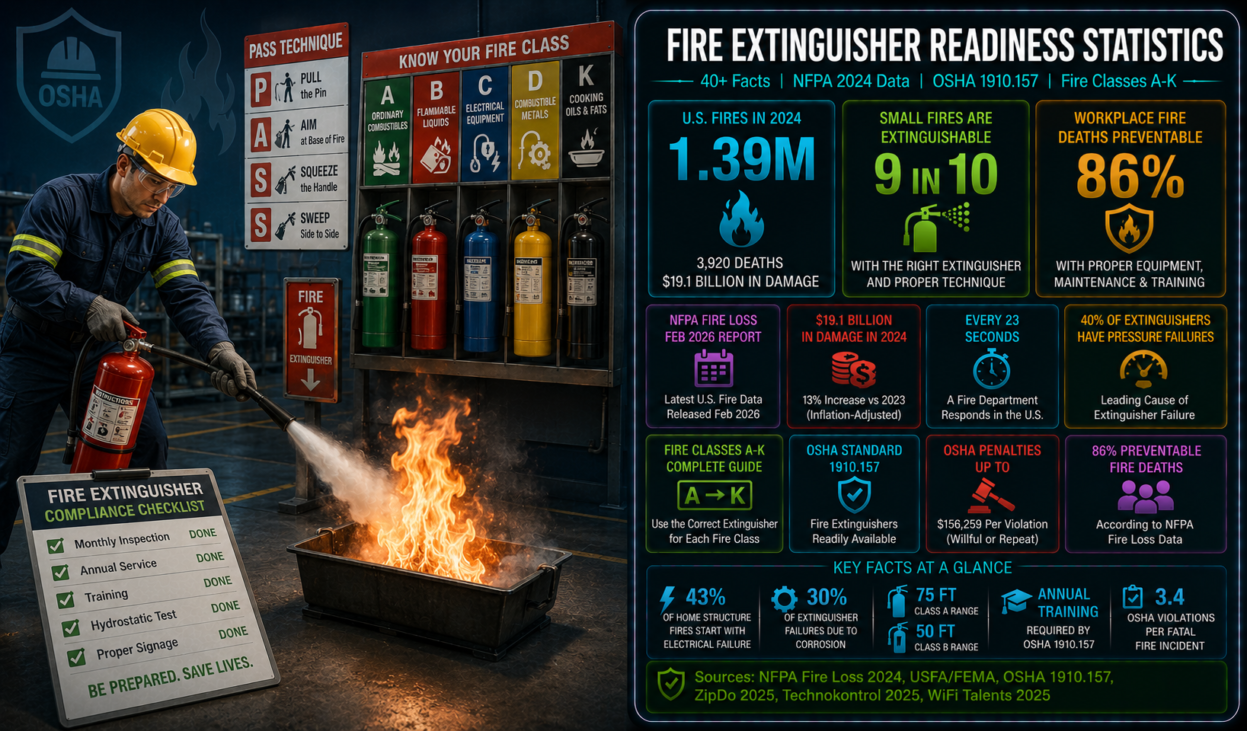
Fire extinguishers are one of the most visible workplace safety tools in any facility – and one of the most frequently misunderstood, misused, and inadequately maintained. A properly selected, maintained, and deployed fire extinguisher can contain 9 out of 10 small fires and reduce fire damage by up to 80%. But the operating word is “properly.” Improper pressure accounts for approximately 40% of fire extinguisher failures. Corrosion from poor storage causes 30% more. Wrong extinguisher class used on a fire can escalate the fire rather than suppress it. And a training requirement that exists on paper but has not been delivered to the employees expected to respond means that the extinguisher on the wall is not actually an asset in a fire emergency – it is a compliance exhibit.
NFPA’s February 2026 fire loss report for 2024 records 1.39 million U.S. fires, 3,920 civilian deaths, and $19.1 billion in direct property damage. OSHA’s annual top 10 most-cited standards consistently includes fire protection and fire extinguisher violations. In 2025, non-compliance with fire safety standards carries penalties of $15,625 per serious violation and $156,259 per willful or repeated violation. This article compiles 40+ statistics on the U.S. fire loss landscape, workplace fire causes, extinguisher effectiveness and failure modes, OSHA requirements, fire class selection, and what effective extinguisher readiness programs do differently.
Editor's Choice: Key Fire Extinguisher and Workplace Fire Statistics for 2024-25
1. U.S. Fire Loss in 2024: The NFPA Baseline
- NFPA’s February 2026 report on U.S. fire loss in 2024 recorded 1.39 million fires, 3,920 civilian deaths, approximately 13,000 civilian injuries, and $19.1 billion in direct property damage. Home fires accounted for 75% of civilian fire deaths and a similar share of civilian injuries. (NFPA Fire Loss in the United States During 2024, Shelby Hall, February 2026; NFPA Research Summary February 12, 2026)
- The $19.1 billion direct property damage figure excludes indirect losses. Business interruption, temporary relocation, lost inventory, and litigation costs substantially exceed the direct property damage total. The Insurance Information Institute notes that indirect fire losses are routinely 3-5x direct damages in commercial and industrial settings – making the actual economic burden of 2024 fires substantially higher than the NFPA figure alone captures. (Insurance Information Institute; NFPA, 2025)
- U.S. fire departments responded to a fire every 23 seconds in 2025, per National Safety Council data. This response frequency is the practical benchmark against which workplace extinguisher readiness must be measured: the average fire department response time in urban areas is 4-7 minutes, while the average time for a small fire to escalate beyond portable extinguisher control is approximately 30-60 seconds to 3 minutes depending on fuel type. (NSC; SC Training, March 2025)
- The non-residential fire loss category covers public assembly, educational, institutional, retail, office, manufacturing, and industrial or utility properties. NFPA data consistently shows that manufacturing and industrial/utility properties are among the top contributors to large-loss fires due to high equipment values, combustible process materials, and concentrated energy systems. (NFPA Fires by Occupancy; OSHA.com, April 2026)
- USFA (U.S. Fire Administration) reports a national fire death rate of 13.1 per million population and a fire injury rate of 39.9 per million population in 2023 – the most recent full-year demographic rates available. These figures establish the population-level baseline against which workplace fire prevention effectiveness is measured. (USFA FEMA Statistics, 2025)
2. Workplace Fire Causes: What Is Starting the Fires
- Electrical equipment failures cause 43% of workplace fires, making them the single largest cause category. For EHS managers, this means that the fire extinguisher selection in areas with electrical equipment must prioritize Class C or CO2 capability – water-based and foam extinguishers are contraindicated for live electrical fires because they conduct electricity and can electrocute the person using them. (Technokontrol, August 2025)
- In 2023, USFA data shows that cooking was the leading cause of fires in nonresidential spaces at 30.3%, followed by intentional acts, electrical malfunctions, and heat from unidentified sources. Commercial cooking fires in break rooms, cafeterias, and food service operations are a distinct risk category requiring Class K extinguishers – not the standard dry chemical units often found in office environments. (USFA 2023 nonresidential fire data; SC Training, March 2025)
- The BLS reports that fires and explosions remain a leading cause of fatal occupational injuries in certain industrial sectors – specifically manufacturing, chemicals, petroleum, and utilities. These sectors also carry the highest concentration of Class B (flammable liquid), Class C (electrical), and Class D (combustible metal) fire risks that require specific extinguisher types not adequately covered by all-purpose ABC units. (BLS; OSHA.com, April 2026)
- Nearly 86% of fire-related deaths in workplaces could be prevented with proper fire safety equipment and training, per NFPA data. The preventability gap – between what is theoretically preventable and what is actually prevented – reflects the intersection of inadequate training, wrong extinguisher class, poor maintenance, and delayed response. (NFPA; WiFi Talents, June 2025)
3. Fire Classes and Extinguisher Selection: The Most Critical Decision in Fire Response
- Using the wrong extinguisher class on a fire is not just ineffective – it can be actively dangerous. Water applied to a Class B (flammable liquid) fire spreads the burning fuel. Water on a Class C (live electrical) fire electrocutes the user. Water on a Class D (combustible metal) fire causes violent steam explosions. These are not theoretical risks – they are documented fatality mechanisms. Fire extinguisher training that does not specifically cover class selection is not completing the training objective. (OSHA.com; OSHA Community, 2025)
- ABC-rated dry chemical extinguishers are the most widely deployed type in general industry because they cover Classes A, B, and C simultaneously. However, ABC dry chemical is contraindicated for commercial cooking areas (Class K) and for sensitive electronic equipment, where dry chemical residue causes irreversible damage. CO2 extinguishers are the preferred option for data centers and electronics-rich environments – CO2 leaves no residue and does not damage sensitive equipment. (OSHA 1910.157; industry guidance)
- CO2 extinguishers are used in approximately 70% of data centers for electrical fire response, per industry analysis. The growth of data center infrastructure across manufacturing, logistics, and healthcare environments means that an increasing share of facilities have both general combustible (Class A) and sensitive electrical (Class C) fire risks that require different extinguisher solutions in different zones. (ZipDo, 2025)
- OSHA’s placement requirements under 29 CFR 1910.157 are class-specific: Class A extinguishers must be within 75 feet of any work area; Class B extinguishers must be within 50 feet. These are not suggestions – they are enforceable requirements. A facility with flammable liquids present where the nearest Class B extinguisher is 75 feet away is out of compliance regardless of how many extinguishers are on the wall. (OSHA 29 CFR 1910.157; Technokontrol, 2025)
4. Extinguisher Effectiveness and Failure Modes: Why Equipment Readiness Matters
- Fire extinguishers in industrial facilities prevent over 600,000 major injuries and save thousands of lives annually, per NFPA data. The scale of the preventive effect is possible only when extinguishers are properly selected, maintained, accessible, and operated by trained users. Any one of these conditions failing negates the others. (NFPA / ZipDo, 2025)
- The two leading failure modes for fire extinguishers are entirely preventable through inspection and storage: improper pressure (approximately 40% of failures) and corrosion from poor storage (approximately 30% of failures). Together these account for 70% of documented extinguisher failures. Both are detectable through monthly visual inspections required under OSHA and NFPA 10. (ZipDo, May 2025; WiFi Talents, June 2025)
- About 15% of fire extinguishers are improperly stored – in humid environments, without secure mounting, or in locations that expose them to temperature extremes. Improper storage accelerates both corrosion and pressure loss, which are the leading failure mechanisms. A mounted extinguisher in a dry, temperature-stable location is the minimum storage requirement. (WiFi Talents, June 2025)
- The average lifespan of a portable fire extinguisher is 5 to 15 years depending on type, usage, and maintenance history. Extinguishers that have been used (even partially), have been dropped, show visible damage, or fail pressure gauge inspection must be serviced or replaced. Extinguishers on the wall that are out of date, discharged, or corroded are not assets – they are liabilities. (ZipDo, May 2025)
- The PASS technique (Pull, Aim, Squeeze, Sweep) is the standard operating method for portable fire extinguishers. Panic during a fire emergency causes misuse in workers who have not practiced the technique – aiming too high, holding too far from the base of the fire, or releasing before the fire is fully out. Training that includes hands-on practice with an extinguisher, not just video or classroom instruction, significantly improves effective deployment rates. (OSHA Community, March 2025; fire safety training research)
5. OSHA 29 CFR 1910.157: The Full Compliance Framework for Portable Fire Extinguishers
- OSHA’s 29 CFR 1910.157 requires that employers who provide portable fire extinguishers for employee use must: provide annual training to employees expected to use them; maintain extinguishers in full operating order; visually inspect them monthly; and have them professionally inspected and serviced annually by a qualified person. Employers who choose an evacuation-only policy and do not expect employees to use extinguishers are exempt from the training requirement but must still post the policy. (OSHA 29 CFR 1910.157; OSHA.com, April 2026)
- Training must be provided within 30 days of hire for new employees who are expected to use extinguishers. Annual refresher training is required for all covered employees. The training must include the general principles of fire extinguisher use and the hazards associated with incipient stage fire fighting – not just classroom awareness, but practical knowledge of how and when to use an extinguisher. (OSHA 29 CFR 1910.157; Technokontrol, August 2025)
- Documentation requirements: OSHA requires that inspections be recorded including date, name of the inspector, and any deficiencies identified. For annual professional service, the servicing company must attach a tag to the extinguisher. Employers who cannot produce inspection records during an OSHA investigation are unable to demonstrate compliance regardless of the actual state of the equipment. (OSHA 1910.157; NFPA 10)
- 29 CFR §1910.38 requires employers to have an Emergency Action Plan (EAP) that covers fire procedures, and §1910.157’s training requirement is specifically tied to employees’ role in the EAP. Employers must align their extinguisher training program with the EAP: whether employees are expected to fight incipient fires before evacuating, or are expected to evacuate immediately, determines both the training content and the extinguisher deployment strategy. (OSHA §1910.38; OSHA.com, April 2026)
- The penalty structure for non-compliance in 2025: serious violations carry up to $15,625 per citation; willful or repeated violations carry up to $156,259 per citation. Fire extinguisher-related violations – missing extinguishers, blocked access, outdated equipment, undocumented inspections, and absent training records – are individually citable. A facility inspection that identifies four extinguisher violations can generate $62,500 in serious violation citations in a single visit. (OSHA 2025 Annual Penalty Adjustments; Technokontrol, August 2025)
6. Inspection and Maintenance: The Three-Level System Under NFPA 10
- 80% of businesses comply with the annual professional inspection requirement – meaning 20% are currently out of compliance with this basic requirement. The monthly visual inspection has a lower compliance rate: approximately 15% of extinguishers are improperly stored, suggesting that regular inspection is not occurring at a meaningful share of facilities. (ZipDo, May 2025; WiFi Talents, 2025)
- The most commonly missed inspection item in monthly checks is blocked access. Fire extinguishers that are present and operational but blocked by stored materials, equipment, or furniture are not accessible in a fire emergency – and are citable under OSHA 1910.157. The extinguisher must be mounted, marked, and accessible within the response time framework built into OSHA’s placement distance requirements. (OSHA 1910.157; fire safety inspection data)
- For employers managing large facilities, fire extinguisher tracking systems that provide a digital record of monthly inspections, tag expiration dates, and service history are the most reliable mechanism for demonstrating OSHA compliance during inspections. Paper logs that are not systematically maintained cannot produce the complete inspection record that OSHA investigators request. (fire safety management best practices)
- Cal/OSHA’s inspection record retention requirement of 48 months establishes a useful benchmark for all employers: maintain at least 4 years of extinguisher inspection and service documentation. This duration covers the time period that is most likely to be relevant in a post-incident investigation or OSHA enforcement proceeding. (Cal/OSHA; OSHA inspection record guidance)
7. What Effective Workplace Fire Extinguisher Programs Do Differently
- The most operationally important decision in fire extinguisher program design is not which extinguisher to buy – it is whether employees are expected to fight incipient fires or evacuate immediately. OSHA’s framework is built around this choice. If the answer is “evacuate,” no extinguisher training is required but the evacuation policy must be posted. If the answer is “fight incipient fires,” training, placement, class selection, maintenance, and EAP integration all become mandatory. Programs that have extinguishers on the wall but have not made this decision explicitly are not equipped for either scenario. (OSHA 1910.157; OSHA.com, 2026)
- Hazard-based class selection by zone is the characteristic that separates effective programs from minimum-compliance programs. An office break room with a Class ABC dry chemical unit and a commercial fryer has an extinguisher coverage gap for the most likely fire in that area. A loading dock with electrical equipment and flammable liquids needs both Class C and Class B coverage. Mapping each area’s fire risk profile to the required extinguisher class is the engineering step that most facilities skip in favor of universal ABC deployment. (OSHA 1910.157 class-specific placement; fire risk assessment)
- Training that includes hands-on practice with the PASS technique – either on a live fire trainer or a simulated training unit – produces measurably better performance in fire emergencies than video-only or classroom-only training. In an actual fire emergency, the stress response reduces motor skill accuracy significantly, making practiced muscle memory the only reliable mechanism for correct extinguisher deployment. (fire safety training research; NFPA training guidance)
- Monthly inspection accountability must rest with a named individual, not a general requirement. Programs where “someone” is supposed to inspect the extinguishers monthly produce incomplete inspection records because the responsibility is diffused. Effective programs assign specific extinguisher units to specific supervisors or team leads, with a completion checklist that flows to a safety coordinator. The inspection takes 30 seconds per unit. The accountability structure is what makes it happen consistently. (fire safety program design; OSHA inspection documentation requirement)
Key Takeaways for Safety Managers and Facility Operations Teams
Sources
Government and NFPA Sources
- NFPA Research Summary (February 12, 2026) – Fire Loss in the United States During 2024: 1.39 million fires; 3,920 deaths; $19.1B property damage; home fires 75% of civilian deaths
- Insurance Information Institute – Facts and Statistics: Fire: NFPA 2024 fire loss data reproduced with permission; large-loss fires data; property use breakdown for non-residential fires
- USFA/FEMA Statistics – National fire death rate 13.1 per million; fire injury rate 39.9 per million (2023); 2024 cooking leading cause of home fires; nonresidential fire causes
- OSHA 29 CFR 1910.157 – Portable Fire Extinguishers: annual training requirement; monthly inspection; professional annual service; placement distances; employee policy requirements
- OSHA 29 CFR 1910.38 – Emergency Action Plans: fire procedures integration; relationship to 1910.157 training requirements; fight vs. evacuate decision documentation
Industry and Research Sources
- ZipDo (May 2025) – Fire Extinguisher Statistics: 600K+ industrial injuries prevented; 80% damage reduction; 9 in 10 small fires; 40% improper pressure failures; 5-15 year lifespan; 80% businesses comply with annual inspection; CO2 70% of data centers
- WiFi Talents (June 2025) – Fire Extinguisher Statistics: 86% workplace fire deaths preventable; 30% corrosion failures; 15% improperly stored; $10-$25 annual inspection cost; market growth $1.93B from 2023
- Technokontrol (August 2025) – OSHA Workplace Fire Safety Guide 2025: 43% electrical equipment fires; 22% heating; 18% cooking; Class A 75ft / Class B 50ft placement; $15,625 serious / $156,259 willful penalties; 30-day new hire training; annual inspection mandate
- SC Training / SafetyCulture (March 2025) – Fire Safety Statistics 2025: fire department responds every 23 seconds; 30.3% nonresidential fires from cooking (2023 USFA); NFPA market growth data; smoke alarm effectiveness
- OSHA Community (March 2025) – Fire Extinguisher Safety: NFPA 1.3M annual fires; fire class identification; wrong class dangers; PASS technique; mandatory workplaces; selection and maintenance guidance
- OSHA.com (April 2026) – Industrial Fire Safety Training: NFPA/FEMA non-residential fire statistics; BLS fires and explosions fatal occupational injuries; 1910.157 and 1910.38 training requirements; comprehensive fire program components