

Introduction
In 2024, US fire departments responded to an estimated 1,388,000 fires, causing 3,920 civilian deaths, 11,780 civilian injuries, and $19 billion in direct property damage. Manufacturing and industrial properties were consistently among the top contributors to large-loss incidents. According to NFPA data, an average of 37,000 fires occur in industrial and manufacturing facilities annually.
Fire prevention is not a reactive discipline. Every fire that occurs in a workplace represents a failure of controls that could have been in place before the ignition. This guide covers the regulatory framework for workplace fire prevention under OSHA 29 CFR 1910.39, the practical requirements of a compliant fire prevention plan, and the specific hazard control measures that make the difference between a near-miss and a major loss.
Fundamental Concepts
The Fire Triangle and Prevention Logic
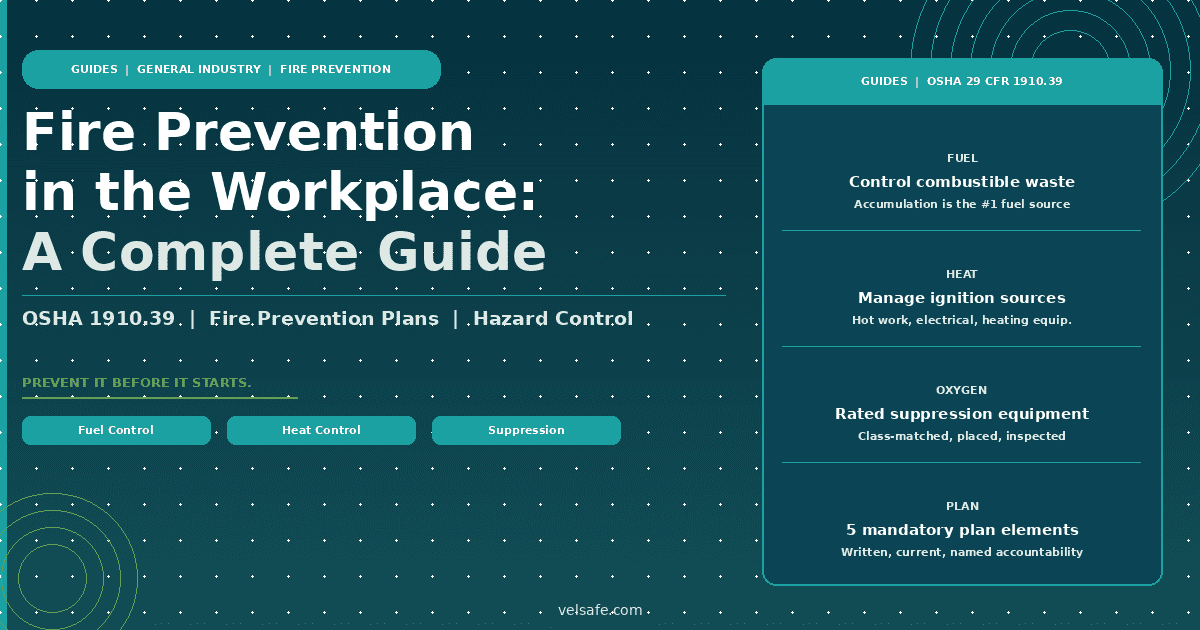
Every fire requires three elements: fuel, heat, and oxygen. Remove any one of them and combustion cannot be sustained. This is not just chemistry and it is the organizing principle of every fire prevention regulation OSHA has written. Fuel control means managing combustible materials and flammable liquids. Heat control means managing ignition sources, from hot work to overheating equipment. Oxygen control is addressed at the suppression stage, when prevention has already failed.
Effective fire prevention addresses all three legs of the triangle simultaneously. Programs that focus exclusively on suppression equipment while neglecting fuel accumulation or ignition source management are addressing only the last line of defense.
OSHA's Regulatory Framework
OSHA 29 CFR 1910.39 states that an employer must have a fire prevention plan when an OSHA standard in this part requires one. Key subparts of 1910 that independently trigger the written plan requirement include those covering hazardous materials, flammable liquids, spray finishing, dipping and coating, and grain handling. Beyond these specific triggers, employers with recognized fire hazards face General Duty Clause obligations under Section 5(a)(1) of the OSH Act regardless of whether a specific standard applies.
A fire prevention plan must be in writing, kept in the workplace, and made available to employees for review. However, an employer with 10 or fewer employees may communicate the plan orally.
Step-by-Step: Building a Compliant Fire Prevention Plan
At a minimum, a fire prevention plan must include: a list of all major fire hazards with proper handling and storage procedures, potential ignition sources and their control, and the type of fire protection equipment necessary to control each major hazard; procedures to control accumulations of flammable and combustible waste materials; procedures for regular maintenance of safeguards installed on heat-producing equipment to prevent the accidental ignition of combustible materials; the name or job title of employees responsible for maintaining equipment to prevent or control sources of ignition or fires; and the name or job title of employees responsible for the control of fuel source hazards.
Step 1: Conduct a Fire Hazard Inventory
Walk every area of the facility and document hazards in three categories. For fuel: identify all combustible materials, flammable liquids, gas supplies, and waste accumulation points. For heat: identify all ignition sources including electrical equipment, motors, open flames, welding and cutting operations, friction points, and hot surfaces. For oxygen: identify areas where suppression coverage may not match the hazard class present.
The inventory should be documented on a facility plan showing the location of each hazard type, associated storage and handling procedures, and the class of fire protection equipment required in each zone. This document becomes the foundation of the written fire prevention plan.
Step 2: Establish Waste Accumulation Controls
Combustible waste is among the most common and most preventable fire fuels in general industry. Oily rags, paper, cardboard, sawdust, packaging materials, and textile scraps all represent significant fire load when allowed to accumulate.
The plan must include specific procedures for waste removal: how frequently it occurs, where materials are collected, how they are disposed of, and who is responsible for compliance in each area. Flammable waste such as solvent-soaked rags must be stored in approved, self-closing metal containers between removal cycles. The removal schedule should match the rate of accumulation in each area and a packaging operation generates different waste volumes than a machining shop.
Step 3: Document Ignition Source Controls
Along with each identified hazard, the plan must include instructions for how these hazards should be handled and stored, how the hazards could ignite, and what fire protection is needed when working with them.
For electrical equipment: document the inspection and maintenance schedule for motors, switchgear, wiring, and panel boards. For heating equipment: document the safeguard maintenance procedures that prevent contact between heat sources and combustible materials. For welding and cutting operations: document the hot work permit process, fire watch requirements, and clearance zones.
Each ignition source control must be assigned to a named person or job title. OSHA requires this designation to exist within the plan and not just as a general management expectation.
Step 4: Specify Fire Protection Equipment by Zone
The plan must identify the type of fire protection equipment necessary to control each major hazard. This is where the fire hazard inventory connects directly to equipment selection. A zone with flammable liquid storage requires Class B-rated extinguishers within 50 feet. A zone with electrical equipment requires non-conductive agents (CO2 or clean agent). A commercial kitchen requires a Class K wet chemical unit within 30 feet of cooking appliances.
Step 5: Establish Maintenance Schedules
Heat-producing equipment with safeguards requires documented maintenance procedures under 1910.39(c)(3). This includes conveyor systems with friction bearings, drying ovens, industrial heaters, and any process equipment that generates or transfers heat near combustible materials. The maintenance schedule must specify the inspection interval, the safeguard elements to be checked, and the corrective action required when a deficiency is found.
Link these schedules to your preventive maintenance system. When a heat-producing equipment safeguard is overdue for inspection, the flag should be visible before an ignition occurs, not after.
Step 6: Notify Employees at Initial Assignment
Under 29 CFR 1910.39(d), employers must inform employees of the fire hazards to which they are exposed upon initial assignment to a job and review with each employee those parts of the fire prevention plan necessary for self-protection.
This is a job-specific requirement, not a one-time general orientation. A worker assigned to a chemical storage area needs to understand the flammable liquid hazards in that area, the storage procedures, and the location and class rating of the fire protection equipment. A worker assigned to a machining area needs to understand the ignition risks associated with cutting fluids, metal shavings, and electrical equipment. Document each notification in the employee’s onboarding record.
Hot Work Fire Prevention
Hot work and welding, cutting, grinding, and any operation that produces sparks or open flame and is one of the highest-risk ignition sources in general industry. Electrical equipment caused 23% of nonresidential fires in 2021, and smoking materials caused 5% of industrial fires annually, but hot work-related ignitions frequently occur in the smoldering window after operations conclude and well after the obvious ignition source has been removed.
Hot work permit system. Before any welding, cutting, or open-flame operation begins, a hot work permit must be issued that identifies the location, the nature of the work, the fire hazards present, the protective measures in place, and the fire watch requirements. The permit authorizes the work for a specific time and location only.
Pre-work area preparation. Combustible materials must be removed or protected within a 35-foot radius of the hot work area. Floors must be swept clean of combustible dust. Flammable liquid containers must be removed or sealed. Wall and floor openings through which sparks could travel must be covered.
Fire watch assignment. Under OSHA 29 CFR 1910.252, a fire watch must be stationed during and after hot work. The fire watch must be trained in extinguisher use, familiar with the alarm system, and dedicated to fire watch duties only and not performing other work simultaneously.
Post-work monitoring. The fire watch must remain posted for at least 30 minutes after hot work concludes. Smoldering ignitions in insulation, wall cavities, and structural framing frequently do not produce visible flame or smoke until 30 to 60 minutes after the ignition source is removed.
Flammable and Combustible Liquid Handling
Flammable liquids caused 8% of manufacturing fires from 2016 to 2020. OSHA 29 CFR 1910.106 governs flammable and combustible liquid storage and handling in general industry. The key prevention requirements include:
- Store flammable liquids only in approved containers and approved storage cabinets rated for the volume stored.
- Limit quantities kept in work areas to the minimum needed for that day’s operations.
- Bond and ground metal containers when transferring flammable liquids to prevent static spark ignition.
- Post No Smoking and No Open Flame signage at all flammable liquid storage and use areas.
- Provide mechanical ventilation in areas where flammable vapors may accumulate to prevent explosive atmospheres.
- Maintain a minimum clearance between flammable liquid storage and potential ignition sources including motors, electrical panels, and heating equipment.
The fire prevention plan must document specific storage and handling procedures for all flammable and combustible liquids present on site, referenced by the hazard inventory map and assigned to a named responsible person.
Common Mistakes
The plan exists but is not maintained. A fire prevention plan written three years ago that has not been updated to reflect new processes, new equipment, new chemicals, or new layout changes is not a compliant plan. It is a document that creates a false sense of protection. Plans must be living documents reviewed whenever the facility changes.
Accountability roles are not named. OSHA requires that specific individuals or job titles be named as responsible for ignition source control and fuel source hazard control. Plans that say “all supervisors are responsible” or “the safety department is responsible” do not satisfy this requirement. One person. One role. One accountability.
Waste accumulation is treated as a housekeeping issue, not a fire hazard. Combustible waste that accumulates gradually becomes normalized. The oily rag bucket that sits in the corner, the cardboard that stacks up against the wall, the sawdust that collects under equipment and each represents a fuel source that the fire prevention plan is supposed to control.
Employee notification happens once, at hire. Workers who change job assignments, transfer to new areas, or take on new tasks have new fire hazard exposures. The notification requirement under 1910.39(d) applies at initial assignment to a job and which includes reassignment, not just first hire.
Requirements and Considerations
FAQs
Does every employer need a written fire prevention plan?
Not automatically. A written plan is required when a specific OSHA standard in Part 1910 requires one. However, employers with recognized fire hazards have General Duty Clause obligations regardless. Employers in general industry with any of the hazardous processes listed in Subpart H, Subpart I, or Subpart Z should assume the requirement applies and seek qualified guidance.
How often does the fire prevention plan need to be updated?
OSHA does not specify a mandatory review interval for the fire prevention plan itself. However, the plan must remain accurate. Any change that affects fire hazards and new processes, new chemicals, new equipment, layout changes, or changes in personnel with named accountability roles and should trigger a review and update. Annual review is a widely adopted best practice that meets OSHA’s expectation of an accurate, current plan.
What is the penalty for not having a fire prevention plan?
OSHA can cite the absence of a required fire prevention plan as a serious violation, with penalties up to $16,550 per citation in 2025. Where the absence contributes to a fire that results in worker injury or death, willful violation citations can reach $165,514 per violation. Criminal prosecution is available where a willful violation causes a fatality.
Is a fire prevention plan the same as an emergency action plan?
No. These are two separate OSHA requirements. The fire prevention plan under 1910.39 addresses hazard identification and control to prevent fires from starting. The emergency action plan under 1910.38 addresses what employees should do when a fire or emergency occurs and evacuation procedures, assembly points, alarm systems, and rescue responsibilities. Most facilities need both.
Related Resources
For content that complements this guide, velsafe.com covers the legal framework for controlling the elements of fire under OSHA 1910.39 (Law category), fire extinguisher classification for general industry (Worker Safety), hot work and fire watch requirements for construction under 29 CFR 1926.352 (Tips), and fire extinguisher safety awareness (Practice Tests). Together these resources cover the full spectrum from fire prevention planning through emergency response.
Sources
- 29 CFR 1910.39: Fire Prevention Plans, OSHA
- Fire Prevention Plan eTool, OSHA
- Fire Loss in the United States During 2024, NFPA Research
- Large-Loss Fires in the United States 2024, NFPA Research
- OSHA 1910.39 Fire Prevention Plans, Creative Safety Supply
- Fire Prevention in the Workplace, Spencer-SHE
- OSHA Fire Prevention Plan Requirements, Solutus Group
- Top Workplace Fire Safety Statistics 2025, SC Training
- Fire Safety Training Guide for Industrial Workers, OSHA.com