

Scenario Introduction
A maintenance technician is conducting routine equipment checks in a mid-size manufacturing facility outside Chicago. The facility processes aluminum components, operates a small commercial kitchen for the employee cafeteria, and houses a chemical storage room with solvents and cleaning agents. At 2:47 PM on a Tuesday, the technician hears a fire alarm and smells smoke coming from two locations simultaneously: the chemical storage room down the corridor and the cafeteria kitchen around the corner.
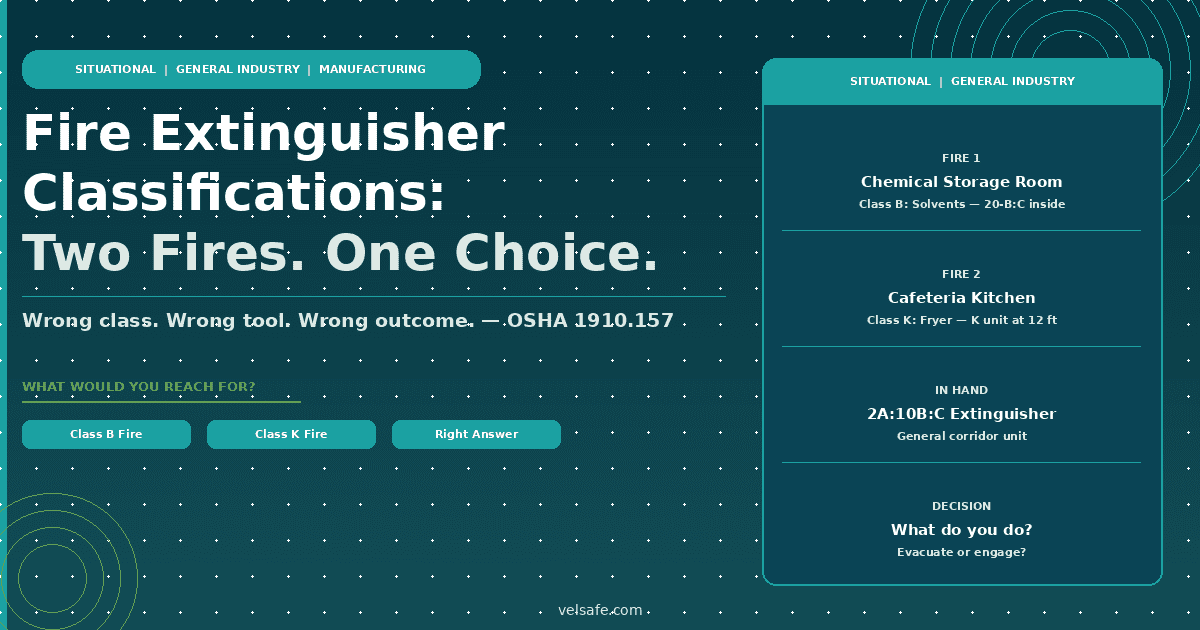
The technician looks at the wall-mounted fire extinguisher three feet away. The label reads: 2A:10B:C.
Situation Details
Chemical storage room (down the corridor): Smoke visible under the door. The room contains industrial solvents, degreasers, and isopropyl alcohol stored in approved containers. A small fire has started near a shelf of solvent containers. The room’s dedicated extinguisher is a 20-B:C unit mounted inside the room.
Cafeteria kitchen (around the corner): A deep fryer has overheated and the cooking oil has ignited. Flames are approximately 18 inches above the fryer surface. A staff member is standing nearby, frozen. The kitchen has a Class K wet chemical unit mounted near the exit, 12 feet from the fryer.
Technician’s current location: Main corridor, between both incidents. Has the 2A:10B:C extinguisher immediately at hand. Is OSHA-trained in fire extinguisher use and aware of fire classes. Escape routes behind are clear in both directions.
Additional context: The facility has an active fire alarm. The emergency response procedure calls for immediate evacuation and 911 notification for any fire that cannot be controlled within 30 seconds. The cafeteria staff member is not trained in fire extinguisher use.
People involved: The maintenance technician, one untrained cafeteria staff member near the kitchen fire, the facility safety coordinator (currently in a meeting on the second floor), and the building’s other occupants who are beginning to evacuate.
Resources available: The 2A:10B:C extinguisher in the corridor, the Class K unit in the kitchen, the 20-B:C unit inside the chemical storage room (not yet accessible without entering the room), and a pull-station alarm that has already been activated.
Decision Point
The technician must make an immediate decision. Both fires are at an incipient stage. The technician has a 2A:10B:C extinguisher in hand. What is the correct course of action?
Use the 2A:10B:C extinguisher on the chemical storage room fire, then use the Class K unit for the kitchen fryer.
Use the 2A:10B:C extinguisher on the kitchen fryer fire, since it is the larger immediate threat to a person.
Direct the cafeteria staff member to use the Class K unit, then enter the chemical storage room to retrieve and use the 20-B:C unit.
Evacuate immediately, call 911, and direct all nearby personnel to exit the building. Do not attempt to fight either fire.
Analysis
Option A and Wrong on both counts. The 2A:10B:C unit in the corridor is rated for Class B fires (flammable liquids) and could be used on the chemical storage room fire. However, the scenario involves two simultaneous fires and one person. Using the corridor extinguisher on the solvent fire first requires entering or approaching the chemical storage room, which is a confined space with a developing solvent fire and a life safety risk. More critically, even if successful there, the kitchen fryer fire is a Class K fire. The Class K extinguisher in the kitchen is the correct tool, and the technician should use it directly rather than approaching a solvent fire first.
Option B and Catastrophic error. Using a 2A:10B:C dry chemical extinguisher on a cooking oil fire is one of the most dangerous mistakes in fire response. Modern commercial deep fryers use high-temperature vegetable oils that burn at temperatures standard dry chemical agents cannot reliably suppress. Discharge of a pressurized ABC unit into a burning fryer can cause a flash of burning oil, injuring or killing the user and spreading the fire. The Class K wet chemical unit 12 feet away in the kitchen is specifically designed for this scenario. Using the wrong extinguisher here is not just ineffective and it is potentially fatal.
Option C and Partially sound but critically flawed. Directing the cafeteria staff member to use the Class K unit appears logical, but the staff member is described as untrained in fire extinguisher use. Under OSHA 29 CFR 1910.157(g), only employees who have received specific training, including hands-on practice with discharge, are qualified to operate extinguishers in an emergency. Directing an untrained person to engage an active fire violates this principle and introduces additional injury risk. Entering the chemical storage room to retrieve the 20-B:C unit also exposes the technician to a developing solvent fire without proper PPE or a clear exit path.
Option D and Correct response given the full circumstances. Two simultaneous incipient fires in different locations, one involving a high-temperature cooking oil hazard requiring a specialized extinguisher, and one involving flammable solvents in a confined storage area, exceed what a single trained responder with one general-purpose extinguisher can safely address. The facility’s emergency procedure already calls for evacuation and 911 for any fire that cannot be controlled within 30 seconds. Evacuating all personnel and calling emergency services is the correct decision. The technician should direct the cafeteria staff member to exit, activate the nearest pull station if not already done, and leave the building.
Learning Points
Class rating is not a universal permission slip. A 2A:10B:C extinguisher is the most versatile unit for general industry areas, but it is not appropriate for Class K fires under any circumstances, and approaching a confined solvent fire without proper setup is a tactical error regardless of the extinguisher rating. Workers must understand not just what their extinguisher can do, but when the situation exceeds its appropriate use.
An untrained person is not a resource in a fire emergency. Directing an untrained staff member to operate an extinguisher shifts the injury risk rather than eliminating it. OSHA’s training requirement exists for this reason. Facilities with commercial kitchens must ensure that all kitchen staff are specifically trained in Class K extinguisher use, not just generally aware that the unit exists.
Multiple simultaneous fires change the calculus entirely. Fire response training for individuals is built around a single incipient-stage fire with a clear escape route, the right extinguisher in hand, and the ability to control the situation in under 30 seconds. Two fires simultaneously is a multi-unit fire department response scenario, not an individual extinguisher response scenario. Recognising this threshold is itself a critical safety competency.
Know the right tool before you need it. The Class K unit in the kitchen and the 20-B:C unit in the chemical storage room were both correctly placed per NFPA 10 requirements. The failure point in this scenario is not equipment availability and it is that the technician would need to know, under stress, which tool was appropriate for which fire and whether the situation was within individual response capacity. That judgment comes from training, not instinct.
Related Resources
Fire extinguisher classification knowledge underpins every scenario involving fire response decisions. Companion content on velsafe.com covering this topic area includes the Fire Extinguisher Classifications worker safety guide (covering all five fire classes, rating systems, and selection guidance for general industry), the Fire Extinguisher Safety Awareness practice test (15 questions on OSHA 1910.157 requirements), and the Fire Extinguisher Safety for Construction tips series covering hot work, fire watch duties, and construction site placement requirements.