

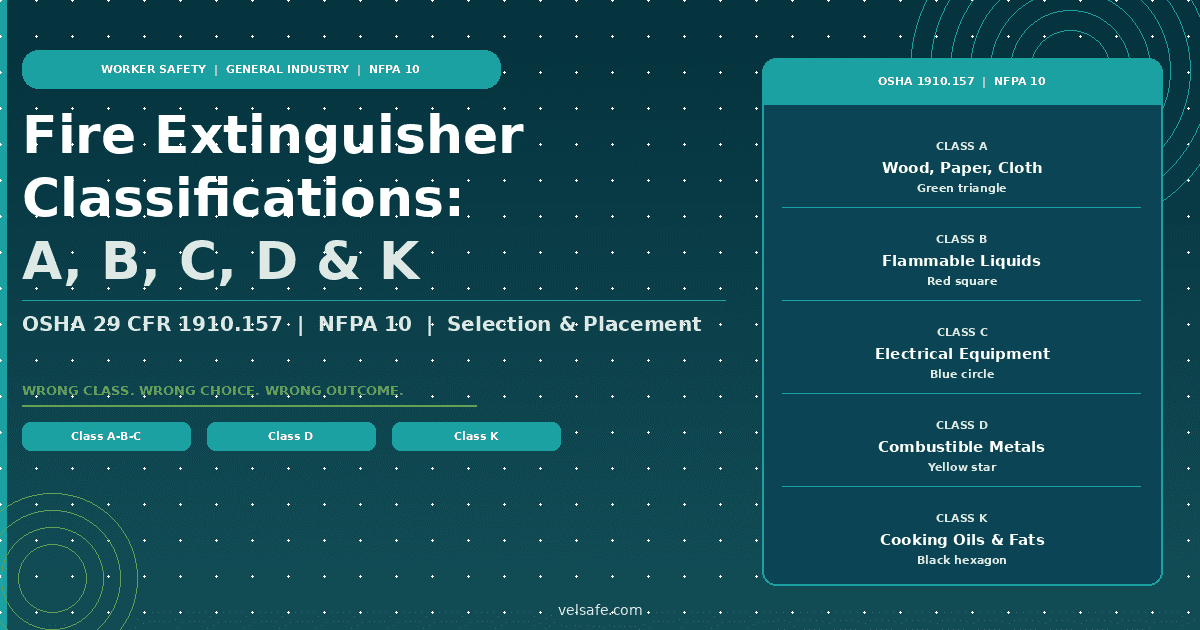
Reaching for the wrong fire extinguisher in an emergency does not just fail to stop the fire. It can spread it, cause an explosion, or electrocute the person holding it. Understanding fire extinguisher classifications is not a technicality for safety officers alone. It is a fundamental competency for every worker in general industry and manufacturing.
This guide covers the five fire classes and their corresponding extinguisher types under OSHA 29 CFR 1910.157 and NFPA 10, explains the numerical rating system, and provides practical selection guidance for manufacturing, warehouse, laboratory, and commercial kitchen environments.
The Regulatory Framework
OSHA 29 CFR 1910 Subpart L mandates fire protection measures in general industry workplaces, including the provision, placement, maintenance, and use of portable fire extinguishers. The standard references NFPA 10 as the technical basis for extinguisher selection, installation, and maintenance. Together, these two frameworks define not just how many extinguishers a facility must have, but which types must be present in each area based on the specific fire hazards present there.
NFPA 10 organizes fire extinguishers by the class of fire they are designed to suppress. The classification system exists because different materials require fundamentally different suppression approaches. Water that extinguishes a paper fire will cause a violent steam explosion on a grease fire. CO2 that is safe on an electrical fire will have no lasting effect on burning wood. Matching the extinguisher class to the fire hazard is the starting point of every fire protection plan.
The Five Fire Classes and Their Extinguishers
What burns: Wood, paper, cardboard, cloth, rubber, and most plastics. These are the most common fuels in offices, warehouses, packaging areas, and general manufacturing settings. Class A fires are fueled by ordinary combustible materials and are typically the baseline hazard in virtually every workplace.
NFPA symbol: Green triangle with the letter A.
Extinguishing agents: Water, water mist, foam, and multipurpose dry chemical (ABC). Water-based agents work by cooling the burning material below its ignition temperature. Foam adds a smothering layer. ABC dry chemical interrupts the chemical chain reaction of combustion.
Placement: Under OSHA 1910.157, Class A extinguishers in general industry must be located within 75 feet of travel distance from any point in the workplace. One extinguisher rated at minimum 2A per 3,000 square feet of floor area is the general rule, though NFPA 10 provides more detailed sizing tables based on hazard level.
What burns: Gasoline, diesel, solvents, alcohols, oil-based paints, propane, and other flammable or combustible liquids and gases. Class B fires are common in maintenance shops, paint booths, fueling areas, chemical storage rooms, and manufacturing processes using flammable solvents.
NFPA symbol: Red square with the letter B.
Extinguishing agents: CO2, dry chemical (BC or ABC), foam (AFFF), and clean agent. These agents work by smothering the fire and cutting off its oxygen supply, or by interrupting the combustion chain reaction. Water must never be used on Class B fires because it can spread the burning liquid and intensify the fire.
Placement: Class B extinguishers must be within 50 feet of travel distance from any high-hazard area where flammable liquids are stored or used. NFPA 10 requires strategic placement in fuel storage rooms, near vehicle maintenance areas, and in any area where more than 5 gallons of flammable liquid is present.
What burns: Fires involving energized electrical equipment, including wiring, circuit breakers, motors, transformers, switchgear, computers, and appliances. Class C does not describe the fuel itself; it describes the presence of live electrical current as a hazard in the fire environment.
NFPA symbol: Blue circle with the letter C.
Extinguishing agents: CO2 and clean agent extinguishers are preferred because they are non-conductive and leave no residue, protecting sensitive electronic equipment. Dry chemical (ABC) can also be used but leaves a corrosive powder residue that damages electronics. Water and foam must never be used because they conduct electricity and will cause electrocution.
Important note: No extinguisher carries a standalone Class C rating. Class C indicates non-conductivity of the agent and is always combined with a Class A and/or B rating. An extinguisher labeled 2A:10B:C covers ordinary combustibles, flammable liquids, and energized electrical fires in a single unit. If power can be safely shut off before suppression, a Class C designation is no longer necessary since the electrical hazard has been removed.
What burns: Combustible metals including magnesium, titanium, zirconium, sodium, potassium, and lithium. Class D fires occur almost exclusively in industrial settings: metalworking shops, aerospace manufacturing, chemical research laboratories, and facilities handling lithium battery materials. These fires burn at extremely high temperatures and react violently with water, standard dry chemicals, and CO2.
NFPA symbol: Yellow five-pointed star with the letter D. Class D is the only class that does not have a standard NFPA pictogram.
Extinguishing agents: Specialized dry powder agents formulated for the specific metal involved. Common agents include sodium chloride, graphite, and copper-based powders. The agent forms a crust over the burning metal, cutting off oxygen without reacting with the metal itself. A standard ABC extinguisher used on a Class D fire can cause a violent, potentially fatal reaction. Per OSHA 1910.157, Class D extinguishers must be within 75 feet of travel distance from combustible metal working areas.
Selection requirement: Class D extinguishers are not interchangeable across metals. A unit designed for magnesium fires may be ineffective or dangerous on a sodium fire. The specific extinguishing agent must be matched to the specific metal present in the facility.
What burns: Fires involving cooking oils, animal fats, and vegetable oils in commercial kitchen equipment. Class K was added to the NFPA classification system specifically to address modern commercial cooking hazards. High-temperature commercial fryers using vegetable oils burn at temperatures that standard ABC dry chemical extinguishers cannot reliably suppress.
NFPA symbol: Black hexagon with the letter K.
Extinguishing agents: Wet chemical agents, typically potassium acetate or potassium citrate. These agents react with burning oils through a process called saponification, creating a soapy foam layer that cools the fire and seals the oil surface to prevent reignition. NFPA 10 requires Class K extinguishers in all commercial kitchens with cooking appliances that use cooking oil. The maximum travel distance to a Class K unit in a commercial kitchen is 30 feet.
Critical warning: Using a water extinguisher on a Class K fire causes a violent steam explosion that instantly spreads burning oil across the kitchen. This is one of the most dangerous fire response errors in food service and manufacturing environments with cooking operations.
Understanding the Numerical Rating System
The letter designating the fire class is accompanied by a number that indicates the relative extinguishing capability of the unit. Understanding this rating helps safety managers select appropriately sized units for their specific hazard levels.
Selection Guide by Workplace Type
Office areas: ABC multipurpose dry chemical (2A:10B:C minimum). Covers paper, furniture, and electrical equipment. Standard for any office or administrative area within a manufacturing facility.
Warehouse and storage: ABC multipurpose, sized up based on total floor area and combustible load. NFPA 10 provides hazard classification tables (light, ordinary, extra) that determine the required rating for high-rack storage and large-footprint warehouses.
Maintenance and machine shops: ABC for general areas. BC-rated CO2 or clean agent near electrical panels, CNC equipment, and sensitive electronics. If the shop handles combustible metals, dedicated Class D units must be present in that specific area.
Paint booths and solvent areas: BC or ABC units rated for the flammable liquid volume present. NFPA 10 Table 6.3.1.1 provides sizing guidance based on square footage of flammable liquid fire the unit must be capable of suppressing.
Commercial kitchen within a facility: Class K wet chemical unit required by NFPA 10 within 30 feet of all commercial cooking appliances, supplemented by an ABC unit for non-cooking fire hazards in the same space.
The Most Dangerous Mismatches
Spreads burning liquid and can cause a fireball. Never use a water or foam extinguisher on a gasoline, solvent, or oil fire.
Water conducts electricity. Using a water extinguisher on an energized electrical fire creates an immediate electrocution hazard for the user.
Standard dry chemical reacts violently with some combustible metals. Using an ABC unit on a Class D fire can cause an explosion.
Water on burning high-temperature cooking oil causes a steam explosion that instantly disperses burning oil over a wide area.
Worker Training Requirements
Under OSHA 29 CFR 1910.157(g), employers must provide a fire extinguisher training program that familiarizes employees with the general principles of fire extinguisher use, the hazards of incipient-stage firefighting, and when to fight versus when to evacuate. For workers in general industry and manufacturing, this training should specifically cover the classes of fire they are likely to encounter in their work area, the class rating of the extinguishers available to them, and what not to do if the wrong extinguisher type is all that is immediately available.
The most important training outcome for classification knowledge is this: workers should be able to identify the class rating on the label of any extinguisher in their work area in under five seconds. During a fire emergency, there is no time to read the fine print.
Sources
- OSHA 29 CFR 1910.157: Portable Fire Extinguishers, OSHA
- NFPA 10 Fire Extinguisher Guide: Placement and Inspection, US Made Supply
- Classification of Fire Extinguishers NFPA, 119 Fire Control
- Classes of Fire and Fire Extinguisher Placement, TRADESAFE
- Fire Extinguisher Types Explained: Classes A B C D and K, USFireDept
- Portable Fire Extinguisher Classes: OSHA Classifications, Fire Service Pro
- Understanding NFPA 10 Regulations: Types of Fire Extinguishers, eSafety Supplies
- Classes of Fire as per NFPA 10 Standard, HSE Study Guide