
Hospital fires are uncommon, but when they occur, they unfold in an environment full of patients who cannot self-evacuate, oxygen lines that accelerate combustion, and staff who must make the right decisions under pressure in seconds. The USFA estimates that medical facilities experience roughly 5,800 fires per year in the US, and electrical malfunction remains the leading ignition source across all facility types.
This article covers the core fire safety requirements for healthcare workers: the RACE and PASS protocols, the fire hazards unique to clinical environments, and the regulatory framework under NFPA 101, NFPA 99, and CMS that governs how healthcare facilities must respond.
Why Healthcare Fire Safety Is Different
Healthcare facilities operate under fire safety rules that differ from almost every other workplace, and the difference is structural. In most buildings, evacuation is the primary fire response strategy: when the alarm sounds, everyone moves toward an exit. In hospitals, that approach is often not possible.
Patients on mechanical ventilation, sedated post-surgical patients, and non-ambulatory residents cannot descend stairwells. Moving a patient on a ventilator through a stairwell requires multiple staff, is physically dangerous, and creates bottlenecks that slow evacuation for everyone.
NFPA 101 addresses this through the Defend in Place strategy: rather than evacuating the building, staff move patients horizontally into adjacent smoke compartments behind fire-rated doors, where they remain protected while the fire is confined and suppressed. The building’s compartmentalization does the work that evacuation would do in any other occupancy.
CMS has adopted the 2012 edition of NFPA 101 as the baseline fire safety standard for all Medicare and Medicaid-certified facilities, including hospitals, skilled nursing facilities, ambulatory surgery centers, and hospice inpatient settings. The Joint Commission incorporates NFPA 101 requirements into its accreditation surveys. Non-compliance risks both citations and accreditation consequences.
The RACE Protocol: What Every Healthcare Worker Must Know
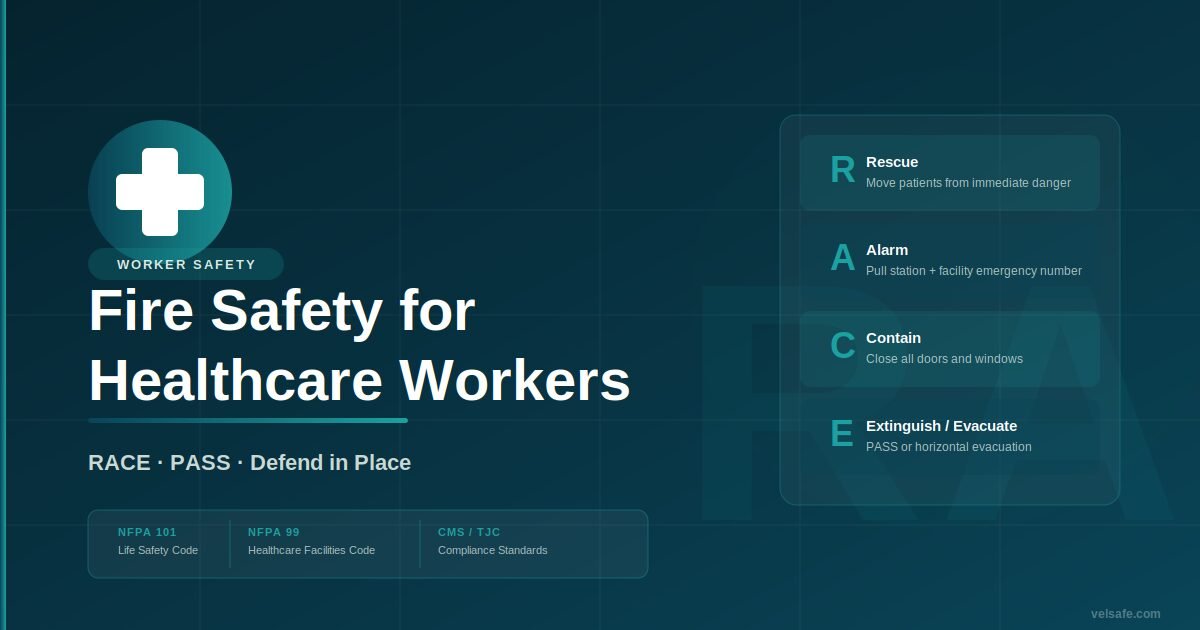
RACE is the fire response sequence used in healthcare facilities throughout the US. It is covered in nursing fundamentals, tested on the NCLEX, and required by Joint Commission-accredited facilities as the basis for fire drill training.
Remove any patients or staff in immediate danger. In a hospital, this means patients closest to the fire first, starting with those who cannot self-evacuate. Ambulatory patients should be directed to walk to the safe side of the nearest fire door. Non-ambulatory patients require direct physical assistance, using horizontal transfer techniques appropriate to the patient’s condition.
Activate the nearest fire alarm pull station and call the facility’s emergency number. Do not assume another person has already called. Early alarm activation is the single most time-sensitive step in the sequence because it triggers the suppression systems, alerts the fire department, and starts the countdown on patient safety timelines.
Close all doors and windows in and near the fire area. Fire-rated doors in healthcare facilities are designed to withstand heat for 20 to 90 minutes depending on their rating, giving staff, patients, and fire suppression systems time to work. A closed fire door is one of the most effective passive fire controls available. Do not prop doors open during a fire event.
If the fire is small and contained, use a fire extinguisher (see PASS below). If the fire is spreading, not accessible, or the smoke is significant, do not attempt suppression. Follow the facility’s evacuation plan and move patients horizontally into the adjacent smoke compartment. Vertical evacuation down stairwells is a last resort.
PASS: How to Use a Fire Extinguisher
If the fire is small, contained, and not between you and the exit, a fire extinguisher may be appropriate. PASS describes the correct operating sequence.
Fire Hazards Unique to Clinical Environments
Healthcare settings combine ignition sources, oxygen-enriched atmospheres, and abundant fuel in ways that most workplaces do not. Understanding where these hazards concentrate is the foundation of prevention.
A fire requires three elements: an oxidizer, an ignition source, and a fuel. Healthcare environments have all three in unusually close proximity.
Supplemental oxygen in patient rooms, ICUs, and ORs. When oxygen concentrations exceed 23%, materials that would not normally ignite can burn, and those that do burn will burn faster and at higher temperatures. Oxygen-enriched atmospheres are involved in approximately 75% of surgical fires.
Electrosurgical units (ESUs) and electrocautery devices are the most common ignition source in surgical fires. Lasers and fiber-optic cables are secondary sources. Electrical malfunction in biomedical equipment is the leading ignition source for fires across the broader facility.
Surgical drapes are the most common fuel in OR fires. Alcohol-based skin preparation solutions that have not been allowed to fully dry before draping are a frequent factor. Patient hair, gauze, sponges, and oxygen delivery tubing are additional fuels present in virtually every OR setup.
Research published in the Journal of Global Health found approximately 600 surgical fires occur annually in the US, with the majority associated with head and neck procedures where electrocautery is used near an oxygen-enriched airway. The Joint Commission recorded 85 sentinel events related to surgical fires between January 2018 and March 2023.
Facility-Wide Fire Hazards and Prevention
Outside the OR, electrical failure is the primary fire initiator across healthcare facilities. The density of powered biomedical equipment in ICUs and patient care areas creates a concentrated ignition risk that requires active management.
Extension cords and power strips used in patient rooms as a substitute for adequate outlet capacity are a persistent violation. NFPA 99 restricts the use of extension cords in healthcare settings. Equipment with frayed cords or signs of overheating must be removed from service and reported to biomedical engineering before the next use.
NFPA 101 requires healthcare corridor widths of at least 8 feet clear of obstructions. Supply carts, portable equipment, and linen trolleys left in corridors reduce egress capacity and can block horizontal patient movement during a fire event. This is among the most frequently cited NFPA 101 deficiencies during CMS and Joint Commission surveys.
Flammable liquids (alcohol-based hand sanitizers and cleaning solutions) in quantities exceeding NFPA 30 limits must be stored in approved flammable liquid storage cabinets, not in open utility rooms or at nursing stations. Large quantities of cardboard in receiving and storage areas also create fire load in spaces that may not be sprinklered to the same standard as patient care areas.
Cooking equipment remains the statistically most common cause of fires across all medical facility types, per USFA data. Kitchen hood suppression systems require semi-annual inspection under UL 300. Dryer lint accumulation in laundry areas is a secondary but consistent fire cause that building maintenance teams should address on a documented schedule.
Fire Drills and Training Requirements
Joint Commission-accredited facilities must conduct fire drills at least once per shift per quarter, meaning each unit runs a minimum of four drills per year across all three shifts. The purpose is not to test the alarm system; it is to verify that staff respond correctly under conditions that approximate a real event.
In facility safety reviews, fire drill documentation consistently shows drills conducted on day shift at times predictable to staff, with night shift and weekend drills conducted less frequently and with less rigor. When drills are scheduled rather than unannounced, staff performance reflects preparation for the drill rather than readiness for an actual event. The Joint Commission evaluates drill quality, not just drill frequency.
Effective fire safety training in healthcare must cover more than RACE and PASS. Staff should be able to locate all fire extinguishers, alarm pull stations, and smoke barrier doors on their assigned unit before any drill is conducted. The location of the nearest smoke compartment for horizontal evacuation, the procedure for moving a non-ambulatory patient horizontally, and the facility’s specific “Code Red” response protocol must all be practiced, not just recited.
Corridor Compliance and Building Compartmentalization
The physical structure of the building is the foundation of healthcare fire safety. Smoke compartments, fire-rated walls, and self-closing fire doors create the containment system that makes Defend in Place possible.
In pre-survey readiness assessments, two deficiencies appear on virtually every site: fire doors that have been propped open with doorstops or supply carts, and penetrations through fire-rated walls (typically from cable pulls for IT or telecom equipment) that have not been fire-stopped. Both are easy to identify on a walkthrough and both directly compromise the compartmentalization the Defend in Place strategy depends on.
What Compliance Surveyors Look For
CMS Life Safety inspectors and Joint Commission surveyors examine fire safety through a combination of document review, building walkthrough, and staff interview. The practical items that consistently generate findings include:
Key Takeaways
Sources
- USFA/FEMA, “Data Snapshot: Medical Facility Fires”
- NCBI/StatPearls, “OSHA Fire Safety” (Bookshelf)
- Journal of Global Health, “Causes and preventive measures for fire-related injuries in intensive care units” (2025)
- American College of Surgeons, “New Sentinel Event Alert Updates Guidance on Preventing Surgical Fires” (2024)
- NursingSchoolsNearMe, “RACE and PASS mnemonic in nursing: fire safety for healthcare settings”
- CMS, “Life Safety Code and Health Care Facilities Code Requirements”
- NFPA, “Resources for Health Care Facility Safety” (NFPA 101, 99, 72)
- PMC, “Fire safety status and evacuation of medical facility considering elevated oxygen concentrations” (2024)