

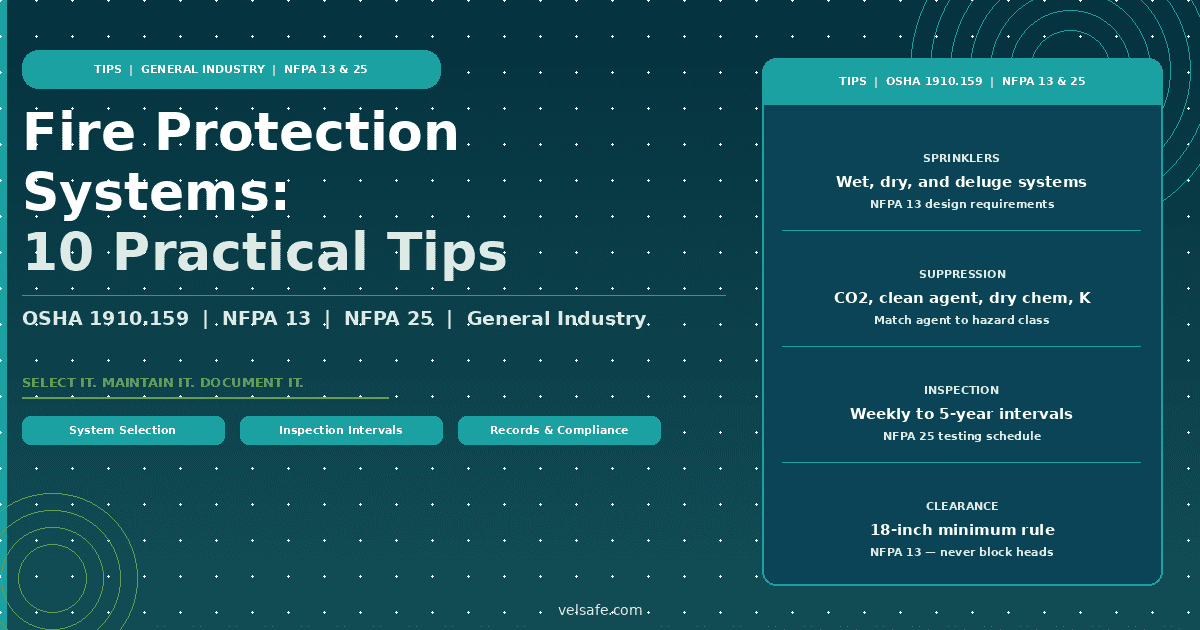
US fire departments respond to approximately 36,784 industrial and manufacturing fires annually, resulting in 22 fatalities, 211 injuries, and $1.5 billion in property damage. Fire protection systems serve as the final barrier when prevention measures fail, making proper selection, maintenance, and inspection critical for workplace safety and compliance.
Fire protection systems are governed by two separate compliance frameworks. Understanding both is essential for inspection readiness.
Tip 1: Prevention, Protection, and Suppression Are Not the Same
EHS auditors regularly find facilities with excellent sprinkler systems that still receive fire safety citations. The reason is almost always a gap in the prevention plan, not the equipment. These three functions operate independently and are each governed by different OSHA provisions.
Tip 2: Match the Suppression Agent to the Hazard Class
In 2023, a warehouse fire in Chicago required hundreds of firefighters partly because the storage configuration had exceeded what the existing suppression system was designed to handle. The system was present. It was maintained. But it was not matched to the hazard. That distinction matters more than most facilities realize.
In facility reviews we conduct across general industry, the suppression agent mismatch in Tip 2 is one of the most frequently recurring gaps. Facilities typically expand hazard areas incrementally, a server room here, a spray area there, and the suppression system design documents are never updated to reflect the change. The equipment looks fine on the floor. The compliance gap only becomes visible when you compare what is installed to what the current hazard map actually requires.
Tip 3: Understand OSHA 1910.159 Requirements
OSHA 1910.159 applies to automatic sprinkler systems installed specifically to meet OSHA requirements. It does not apply to voluntarily installed systems, but that exception trips up more facilities than it helps.
The practical trap here is the voluntary system exemption. Many facilities install sprinklers to satisfy their insurer or local building code, not because OSHA specifically required them. Those systems are exempt from 1910.159, but they are still subject to NFPA 25 inspection and maintenance obligations, and OSHA can still cite the General Duty Clause if a known hazard goes unaddressed.
Tip 4: Follow NFPA 25 Inspection Intervals in Full
Ask most safety managers when their sprinkler system was last inspected and they say “annually.” Ask them when it was last visually checked and the answer is usually silence. NFPA 25 requires activity at six different intervals, not one. Missing the shorter cycles is where most facilities fall short.
When we review inspection programs, the weekly control valve check is almost universally missing from the schedule. Facilities hand it to contractors who visit annually, assume the obligation is covered, and never establish an internal process for the shorter intervals. We have seen cases where a valve drifted partially closed for months between annual visits without anyone noticing. The fix is simple: add weekly and monthly checks to whoever runs the facilities walkthrough, not the inspection contractor.
Tip 5: Never Obstruct Sprinkler Heads
Tip 6: Know Your Wet Pipe vs Dry Pipe System
One of the more common facility errors happens when a heated storage area is converted to a cold-use dock or unheated annex without anyone reviewing the sprinkler system. Wet pipe systems will freeze in unheated spaces. That is not a maintenance issue, it is a system compatibility issue that requires engineering review before the conversion happens, not after the pipes burst.
Tip 7: Evaluate ESFR Sprinklers for High-Rack Warehouse Storage
ESFR stands for Early Suppression, Fast Response. These heads deliver a high-volume water discharge quickly enough to suppress a fire at the point of origin in high-challenge storage environments, something standard sprinkler heads cannot do when rack storage exceeds certain heights and commodity densities.
The catch is that ESFR systems are calibrated for specific storage heights and commodity classifications. If you add a rack, change what you store, or push storage higher than the design parameters, the system becomes inadequate with no visible change to the hardware. This is one of the most common compliance gaps in warehouse operations, and it is almost never caught by routine inspections because the issue is a mismatch between the system design and the current use, not a mechanical failure.
During warehouse safety reviews, we frequently find storage configurations that have evolved well beyond the original sprinkler design assumptions, even though the suppression equipment itself is in good working order and passes every inspection. New product lines, taller racking, different commodity classes, these changes accumulate over time without triggering a formal engineering review. The sprinkler system was never updated because no one recognised that a storage change is also a fire protection change.
Tip 8: Test Alarm Systems Separately from Suppression Systems
It happens more often than it should: the sprinkler system passes its annual inspection, but the fire alarm system that is supposed to trigger occupant evacuation before suppression activates has dead batteries in its backup power supply. Both systems need to work. Testing them together in the same contractor visit does not automatically mean both are tested to their own standard.
Tip 9: Address Special Hazard Areas with Dedicated Systems
General industry facilities often have five or six different hazard environments under one roof. The sprinkler system covering the main floor is appropriate for that floor. It is not appropriate for the electrical room, the spray booth, the commercial kitchen in the breakroom wing, or the solvent storage cabinet. Each of these areas needs its own suppression approach.
Tip 10: Keep Documentation Inspection-Ready
After any significant fire event, investigators ask two questions first: was the system inspected, and where are the records? Facilities that can produce organized inspection logs, contractor reports, and corrective action records consistently fare better in both OSHA proceedings and insurance claims than those that completed the same work but cannot demonstrate it.
One thing that trips facilities up is the impairment program. When any section of the system is taken out of service, even briefly for maintenance, a formal impairment procedure should activate: additional fire patrols, notification to the building owner, and in many jurisdictions, notification to the local fire department. Most facilities handle impairments informally and have no record that they occurred or how quickly they were resolved.
Common Mistakes to Avoid
Sources
- OSHA 29 CFR 1910.159: Automatic Sprinkler Systems, OSHA
- NFPA 25: Standards for Fire Protection Systems, Creative Safety Supply
- NFPA 13 and NFPA 25 Sprinkler Systems, Brothers Fire and Security
- Fire Suppression and Sprinkler System Requirements 2026, FireTron
- NFPA Compliance for Warehouse Fire Sprinkler Systems, Relay Safety
- OSHA Fire Safety Regulations Guide, Sitemate
- OSHA Requirements for Fire Suppression Systems, Intelligent Fire