

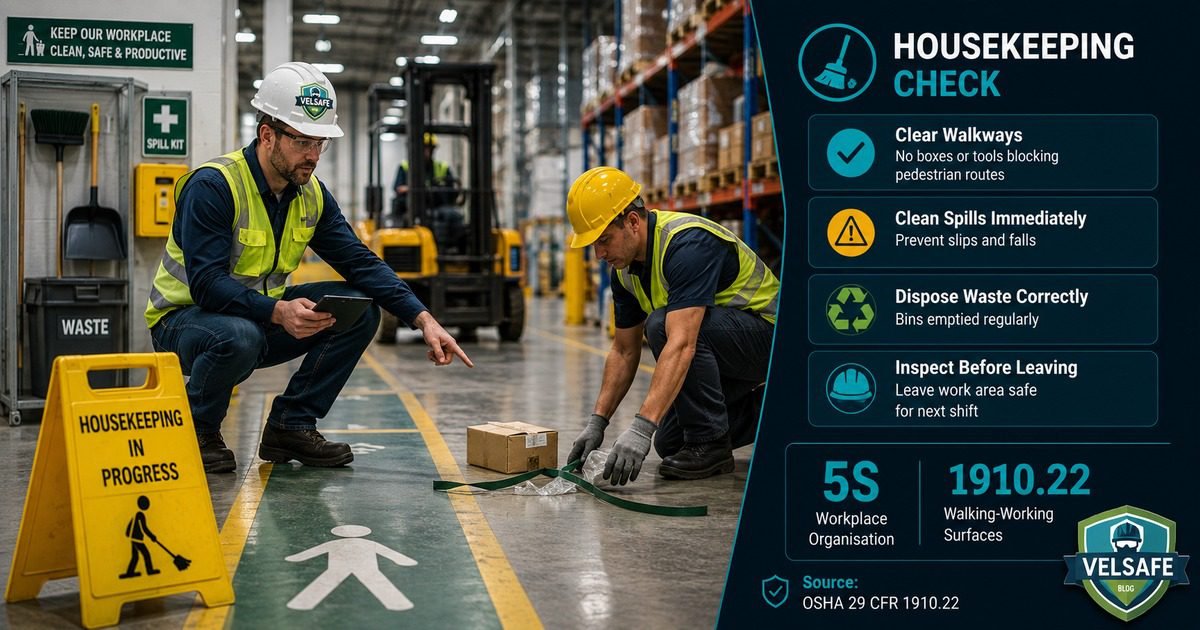
WORKER SAFETY: Housekeeping on the Job
Workplace housekeeping is one of the most cited categories in OSHA inspections and one of the most preventable sources of workplace injuries. Cluttered walkways, spilled liquids, disorganised storage, and poor waste management cause slips, trips, falls, and fires every day across every industry. This guide explains what good housekeeping actually looks like, what your specific responsibilities are, and what to do when conditions are not safe.
Why This Matters to You
Slips, trips, and falls are the second leading cause of workplace fatalities in the United States and the leading cause of non-fatal injuries across general industry. Most of them are caused by conditions that could have been prevented with basic housekeeping: a wet floor that was not cleaned up or marked, a cord that was run across a walkway, a pallet left in an aisle. You are not responsible for conditions you did not create, but you are responsible for reporting them and for not adding to them. Every worker on a job site contributes to the housekeeping environment, whether they intend to or not.
Source: OSHA | OSHA Slips, Trips, and Falls
Hazard Overview: What Poor Housekeeping Creates
Poor housekeeping is not just untidiness. It creates specific physical hazards that cause injuries. Each of the following hazard categories is directly linked to housekeeping failures that show up in injury reports and OSHA citations every year.
Slip and trip hazards
Most Common
Wet floors, spilled liquids, loose materials on walkways, cords across traffic paths, uneven floor surfaces, and clutter in aisles. This category generates more OSHA citations and injury reports than any other housekeeping hazard type.
Fire hazards
High Risk
Accumulation of combustible waste materials, cardboard, paper, oily rags, and flammable liquids stored in unapproved containers or quantities near ignition sources. Fire exits and suppression equipment blocked by stored materials.
Struck-by and caught-in hazards
Common
Improperly stored materials that can fall or shift, tools left in elevated positions, unsecured items on shelving, and materials stacked in ways that can topple. In warehousing and manufacturing, poor storage organisation contributes directly to forklift and equipment incidents.
Health hazards from waste and dust
Ongoing
Accumulated dust from grinding, cutting, or sanding that creates respiratory hazards and explosive dust conditions in some industries. Biological waste from food processing, healthcare, or animal handling that creates infection risk. Chemical waste from spills or improper disposal.
Signs of Danger You Should Report Immediately
Blocked emergency exits or fire suppression equipment
A fire extinguisher you cannot reach in an emergency is not a safety control. An exit route blocked by stored materials, equipment, or pallets is a life-safety hazard. Report immediately and do not wait to see if someone else deals with it. OSHA requires that exit routes be kept clear at all times.
Wet or slippery floor without a warning sign
If you see a wet floor without a wet floor sign or barrier, place a warning immediately if materials are available to you, then report it so it can be cleaned or properly marked. The person who falls on an unmarked wet floor is usually not the person who created the hazard. They are just the one who found it.
Oily rags or combustible waste accumulating near heat sources
Oil-soaked rags can self-ignite through spontaneous combustion if left piled together. They must be stored in approved metal containers with self-closing lids or removed from the work area at the end of each shift. A pile of oil rags near a heat source is not a minor issue.
Materials stacked or stored unsafely
Stacks that lean, reach excessive heights without proper racking, or are placed near walkway edges where they can be struck by equipment and topple are struck-by hazards. If you see storage that looks unstable, report it. Do not attempt to rearrange heavy or unstable loads without the proper equipment and training.
Safe Work Practices: Your Housekeeping Responsibilities
Good housekeeping is not a separate task that happens at the end of the shift. It is part of every task throughout the shift. The following practices describe what it looks like in action.
1
Clean as you go, not just at the end
Deal with spills, scraps, and waste as they occur. A spill cleaned immediately takes 30 seconds. A spill that has been walked through, spread across the floor, and hardened takes ten minutes and a scraper. More importantly, the spill that sits for an hour causes a fall before it gets cleaned. The same principle applies to debris from cutting, grinding, sawing, and fabrication: clean it up before it becomes a walking surface hazard.
2
Keep walkways and aisles clear at all times
Walkways and aisles must remain clear of tools, materials, cords, hoses, and any other obstruction throughout the work shift. OSHA’s general industry standard at 29 CFR 1910.22 requires that walking-working surfaces be kept clean and free of hazards. Cords and hoses that must cross a walkway should be run through cord covers or elevated above the walking surface, not left on the floor for people to step over.
3
Store materials and tools properly after use
Tools left on work surfaces, machines, or elevated areas can fall and injure workers below. Materials left in aisles create trip hazards and block emergency egress. Return tools to their designated storage location when they are no longer in use during the current task. Materials awaiting processing should be stored in designated staging areas, not placed wherever they are convenient at the moment.
4
Dispose of waste correctly
Different waste types require different disposal methods. Ordinary solid waste goes in standard bins. Oily rags and flammable waste go in approved self-closing metal containers. Hazardous waste from chemicals, solvents, or regulated materials must be disposed of according to your facility’s hazardous waste procedures, not placed in regular waste bins. If you are unsure how to dispose of a material, ask your supervisor before disposing of it incorrectly.
PPE for Housekeeping Tasks
Cleaning Spills
Chemical-resistant gloves appropriate to the spilled material (check SDS)
Safety glasses or goggles where splash risk exists
Non-slip footwear on wet surfaces
Respiratory protection if the spilled material generates harmful vapours
Dust and Debris Removal
N95 respirator minimum where sweeping or blowing generates airborne dust
Safety glasses to protect from debris
Work gloves for handling sharp or rough materials
Never use compressed air to blow dust off surfaces or clothing in occupied areas
Waste Handling
Appropriate gloves for the waste type (general waste: work gloves; hazardous waste: chemical-resistant gloves)
Steel-toed boots where heavy waste containers are being moved
Eye protection when handling containers that could splash
Oily Rag Handling
Nitrile or chemical-resistant gloves; avoid skin contact with oil-soaked materials
Store in designated approved self-closing metal containers immediately after use
Never pile oily rags in corners, under benches, or near any heat source
Source: OSHA | OSHA Personal Protective Equipment
Do and Don’t: Housekeeping on the Job
DO
DO NOT
Clean up spills immediately and mark wet areas until dry
Do not leave spills for the next person to deal with or assume someone else will clean them
Return tools to their designated storage location after each use
Do not leave tools on elevated surfaces, machines, or in walkways where they can fall or be tripped over
Report blocked exits, fire extinguishers, or emergency equipment immediately
Do not store materials, equipment, or waste in front of emergency exits, eyewash stations, or fire suppression equipment
Store oily rags in approved self-closing metal containers
Do not pile oily or solvent-soaked rags in corners, bins, or near heat sources
Use cord covers or elevated routing to manage cords and hoses across walkways
Do not run cords or hoses across walkways where workers or vehicles travel
Source: OSHA | 29 CFR 1910.22 Walking-Working Surfaces
Emergency Response
Large Chemical Spill
Alert others in the area immediately. Do not attempt to clean up a spill of a hazardous material you are not trained to handle. Contain the spread if safe to do so without contacting the material. Evacuate the area if vapours are present. Contact your supervisor and emergency response team. Do not re-enter until cleared by someone with appropriate training and PPE.
Fire from Combustible Waste
Activate the fire alarm. Evacuate following your facility’s emergency egress plan. Do not attempt to fight a fire that has grown beyond a small, contained waste container fire. Call the fire department. Only attempt to use an extinguisher on a small, contained fire if you have been trained, the fire is not between you and the exit, and you have a clear escape path.
Slip or Trip Injury
Do not move an injured worker unless they are in immediate danger from an additional hazard. Call for first aid assistance. Secure the area to prevent additional people from being injured in the same hazard. Report the incident to your supervisor immediately. Document the conditions that caused the fall before they are changed, if possible.
Supervisor Tips
Making Housekeeping Part of the Work, Not an Add-On
Build clean-up time into task estimates
When workers are scheduled right up to the end of a shift without time to clean up, they will not clean up. If housekeeping is expected to happen, it needs to be part of the task schedule, not something squeezed in after the official work is done.
Conduct walkthrough inspections at consistent intervals
Housekeeping conditions that are good at the start of a shift can deteriorate significantly by mid-shift. Brief periodic walkthroughs, even ten minutes, catch accumulating hazards before they cause incidents and signal to workers that housekeeping standards are actively enforced.
Address housekeeping issues immediately and specifically
A general comment about the area being messy is less effective than a specific instruction: “That spill on aisle four needs to be cleaned up now, and the pallet blocking the fire door needs to be moved before anyone starts the next shift.” Specific, immediate instructions produce specific, immediate results.
Provide adequate waste disposal resources
Workers will not carry waste to a bin that is inconveniently located or already full. Adequate bin placement, frequent emptying, and designated containers for different waste types make compliance with housekeeping standards easier. If the infrastructure does not support good housekeeping, the standards will not be followed regardless of how clearly they are communicated.
Worker Checklist
During Your Shift
Clean up spills immediately when they occur
Keep your work area and surrounding walkways clear of debris and materials
Return tools to storage when not actively in use
Place waste in the correct designated container as you generate it
Things to Report
Blocked exits, fire extinguishers, or emergency equipment
Wet or slippery surfaces without warning signs
Oily rags or combustible waste accumulating near heat
Unsafe or unstable material storage
End of Shift
Work area left clean and clear for the incoming shift
All waste disposed of in appropriate containers
Oily rags stored in approved self-closing metal containers
Any unresolved housekeeping hazards reported to supervisor before leaving
Key Takeaways
Good housekeeping is a continuous part of the job, not a separate end-of-shift task
Injuries from housekeeping hazards happen during the shift, not just when the area is being cleaned up. Cleaning as you go, returning tools to storage between uses, and clearing aisle obstructions as they appear are the practices that prevent incidents. The end-of-shift cleanup matters too, but it cannot compensate for eight hours of accumulated hazards.
Reporting a hazard you did not create is part of your job
You are not responsible for conditions that existed before you arrived or that were created by someone else. But you are responsible for reporting them. A wet floor with no sign, a blocked exit, or an oily rag pile that you walk past without reporting is a hazard you had the opportunity to prevent. OSHA’s hazard reporting provisions protect workers who report safety concerns in good faith.
Frequently Asked Questions
What does OSHA require specifically about workplace housekeeping?
29 CFR 1910.22 requires all workplaces, passageways, storerooms, and walking-working surfaces to be kept clean, orderly, and in a sanitary condition. The standard applies to all general industry workplaces. Construction has equivalent requirements under 29 CFR 1926.25. The standard does not prescribe specific cleaning frequencies but requires that conditions be maintained continuously, meaning that accumulations of debris, liquid, or materials that create slip, trip, or fire hazards must be addressed promptly.
Am I required to clean up a spill of a hazardous chemical if I did not cause it?
That depends on your training and your facility’s procedures. OSHA requires that spill cleanup be performed by workers who are trained for the specific hazard. If you are not trained to handle the spilled material, your obligation is to isolate the area, warn others, and report the spill immediately. Untrained workers who attempt to clean up hazardous spills may expose themselves and others to harm and may violate procedures designed to ensure proper cleanup.
Can I be disciplined for not cleaning up a mess that someone else made?
Workplace housekeeping policies typically require all workers to maintain orderly conditions in shared spaces. If your employer’s policy requires you to clean up hazards you encounter regardless of who created them, failure to do so may constitute a policy violation subject to discipline. That said, discipline must be applied consistently and not used as a pretext. Workers who raise housekeeping concerns and are disciplined for doing so may have protections under OSHA’s whistleblower provisions.
What is the risk from oily rags and why do they need special storage?
Oil-soaked rags, particularly those containing linseed oil, tung oil, or other drying oils, can self-ignite through spontaneous combustion as the oil oxidises. The oxidation reaction generates heat; if the rags are bunched together, the heat cannot dissipate and the material can reach ignition temperature without an external flame. Oily rags must be stored in self-closing, listed metal containers or in water. They must not be left in piles, stored in non-approved containers, or discarded in ordinary waste bins.
How does poor housekeeping contribute to fire risk?
Accumulated combustible waste, improperly stored flammable materials, blocked fire suppression equipment, and obstructed emergency exits all increase fire risk and worsen outcomes. Combustible dust accumulation is a particularly serious hazard in manufacturing environments: suspended dust at concentrations within the explosive range can ignite from a spark or heat source and produce a deflagration. OSHA’s combustible dust National Emphasis Programme specifically targets facilities with dust accumulation on elevated surfaces.
What are an employer’s obligations when a worker slips on a wet floor?
Following a slip incident, the employer must provide or arrange for first aid or medical treatment, investigate the cause to identify corrective actions, and record the incident if it results in days away from work, restricted work, or medical treatment beyond first aid. The employer should also assess whether the conditions that caused the incident represent a recognised hazard requiring abatement. Repeated slip incidents in the same area without corrective action may constitute a general duty clause violation.
Does OSHA require employers to provide cleaning supplies and equipment?
OSHA does not have a specific standard requiring employers to supply particular cleaning equipment, but the general duty clause requires employers to provide a workplace free from recognised hazards. If inadequate cleaning supplies contribute to a recognised hazard, the employer’s failure to supply adequate equipment may be citable. In practice, employers are expected to provide the tools necessary to maintain the housekeeping standards required by applicable standards.
Government and Regulatory Sources
Government and Regulatory Sources
- OSHA. 29 CFR 1910.22: Walking-Working Surfaces: general industry housekeeping and walking-working surface requirements.
- OSHA. Slips, Trips, and Falls: OSHA guidance on preventing slip, trip, and fall hazards in the workplace.
- OSHA. Personal Protective Equipment: PPE requirements applicable to housekeeping tasks involving chemical or biological hazards.
- OSHA. 29 CFR 1910.106: Flammable Liquids: storage and handling requirements including rag and waste storage.
Research and Industry Sources
- National Safety Council (NSC): data on slip, trip, and fall injury rates and prevention programme effectiveness.
Related VelSafe Articles
Related VelSafe Articles
VelSafe
Build a Safer, Cleaner Workplace
Good housekeeping is a foundation of workplace safety, reducing slip, trip, fall, and fire risk every day. Find more worker safety resources at VelSafe.
Explore VelSafe Resources