SITUATIONAL: Drug Retention and Stability Testing
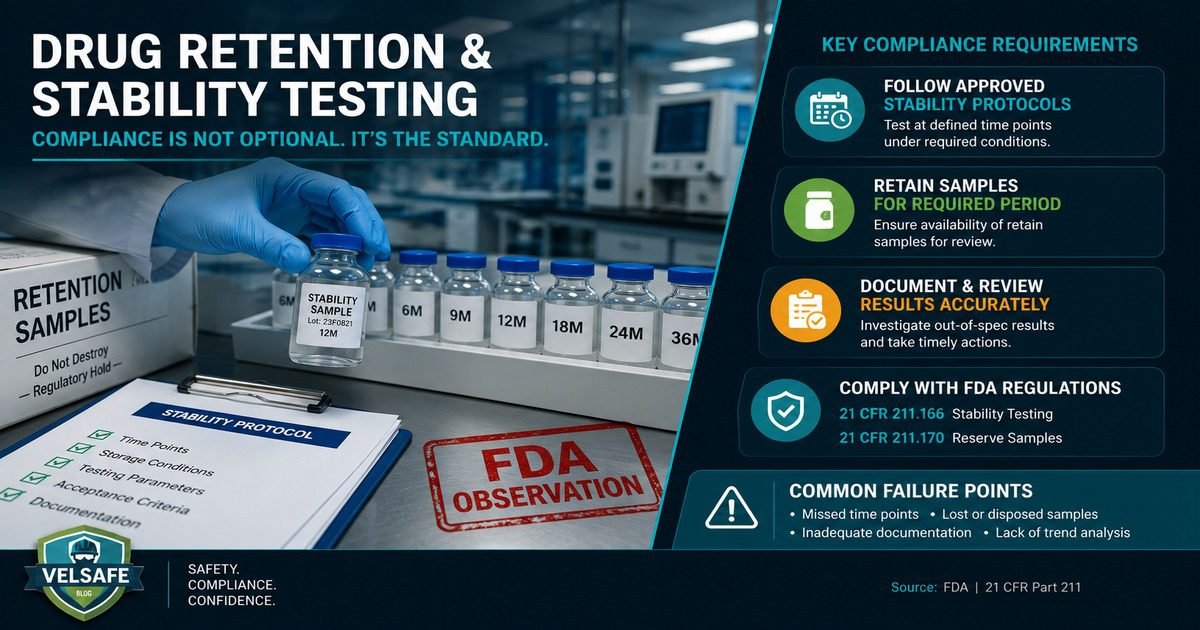
Pharmaceutical manufacturers and contract laboratories are required to maintain retain samples and conduct ongoing stability testing under FDA regulations at 21 CFR 211.170 and 211.166. When these programmes fail, the consequences reach from product recalls to Warning Letters and consent decrees. This article walks through a composite illustrative scenario showing how a stability programme can collapse incrementally, and what the investigation revealed about where the controls should have held.
Note: Illustrative Scenario
The organisation, personnel, and specific events described in this article are fictional and created for educational purposes. The regulatory requirements, inspection findings, and corrective action frameworks described are drawn from real FDA guidance, Warning Letters, and 21 CFR Part 211. Any resemblance to a specific company or investigation is coincidental.
21 CFR
211.166 and 211.170
The two FDA GMP regulations that govern stability testing programmes and retention sample requirements for finished pharmaceuticals. Both are among the most frequently cited sections in FDA Warning Letters to drug manufacturers.
Source: FDA | 21 CFR 211.166
Top 5
Most Cited GMP Section
Stability programme deficiencies consistently appear among the most frequently cited observations in FDA Form 483 inspectional observations and Warning Letters to pharmaceutical manufacturers. The complexity of multi-product, multi-storage-condition programmes creates persistent gaps between written procedures and actual practice.
Source: FDA | FDA Warning Letters Database
1 Year
Minimum Retention Period
21 CFR 211.170 requires retain samples to be kept for one year after the product’s expiration date. For prescription drugs without expiration dates, the retention period is three years after distribution. Retain samples must be stored under conditions consistent with the product label and must be in sufficient quantity to perform two full sets of release tests.
Source: FDA | 21 CFR 211.170
The Organisation
A mid-size contract pharmaceutical manufacturer producing solid oral dosage forms for multiple branded and generic clients. The facility operates under a site master file and holds multiple drug master files. Stability testing is conducted on-site in a stability chamber suite with four walk-in chambers and twelve benchtop units.
The Trigger
An FDA routine surveillance inspection covering three products found that stability time points had been missed for two products and that retain samples for a third product could not be located. The inspector issued a Form 483 with four observations, all related to the stability and retention sample programme.
The Scope
The inspection covered the previous 24 months of stability programme activity. Review of the stability master schedule showed that 14 time points across six products had not been completed within the protocol-specified testing windows. Five retain sample sets could not be accounted for in the storage inventory.
The Outcome
FDA issued a Warning Letter four months after the inspection. The Warning Letter cited inadequate stability testing, failure to maintain retain samples, and inadequate written procedures. Remediation required hiring a third-party consultant, implementing a new stability management system, and completing a comprehensive retrospective review of all active stability protocols.
The stability department at this facility was staffed by three analysts and one supervisor at the time the deficiencies began accumulating. The department had grown its product portfolio from 18 active stability protocols to 34 over a 30-month period following the award of three new contract manufacturing agreements. The written stability programme procedure had not been revised since the portfolio expansion. The stability master schedule was maintained in a spreadsheet that required manual updating by the stability supervisor each time a time point was completed or a new protocol was initiated.
Stability chamber qualification was current, and temperature and humidity excursion logs showed no out-of-specification conditions during the review period. The physical storage conditions were not the problem. The programme management infrastructure had not kept pace with the portfolio growth, and the manual scheduling system had no automated alerts or escalation triggers for approaching or missed time points.
Key Background Factor
The stability supervisor who had designed and maintained the spreadsheet-based scheduling system left the organisation 14 months before the inspection. Her replacement had not received formal training on the scheduling system and was not aware of which fields required updating and at what frequency. The transition had been managed informally with a one-day handover, with no knowledge transfer documentation and no system orientation checklist.
No formalised knowledge transfer process for critical programme owners
The stability supervisor position held tacit knowledge about how the scheduling system worked that was not documented anywhere. When she left, that knowledge left with her. A one-day informal handover is not a knowledge transfer process for a role with direct GMP compliance responsibility.
Stability master schedule lacked automated alerting or independent oversight
A spreadsheet managed by a single person with no automated alert capability, no read-access for the quality unit, and no periodic audit requirement is a single point of failure for the entire programme. The tool was not designed to support a 34-protocol portfolio.
Retain sample relocation was not managed as a controlled activity
Moving retain samples is a documented GMP activity requiring inventory reconciliation before and after the move. The relocation was treated as a facilities task rather than a quality-controlled activity, and no one with responsibility for the retain sample inventory was involved in directing or verifying it.
Quality unit oversight of the stability programme was insufficient
21 CFR 211.22 requires the quality control unit to have the responsibility and authority to approve or reject all procedures and specifications. Periodic quality review of the stability master schedule would have detected the accumulated missed time points long before the FDA inspection.
Finding
Root Factor
Regulatory Reference
14 missed stability time points across 6 products
Manual scheduling system; no alerting; inadequate post-transition training
21 CFR 211.166(a)
5 retain sample sets unaccounted for in inventory
Undocumented relocation; no inventory reconciliation after move
21 CFR 211.170(b)
Written stability procedure not updated after portfolio expansion
No procedure review trigger linked to portfolio size changes
21 CFR 211.68 / 211.192
No quality unit periodic review of stability programme status
Quality oversight responsibility not operationalised in quality management schedule
21 CFR 211.22(a)
Source: FDA | 21 CFR Part 211 Current Good Manufacturing Practice
Contributing Factors by Weight
Inadequate knowledge transfer at supervisor transition
Primary
The transition from the experienced supervisor who designed the system to an untrained replacement without documented procedures or formal handover was the initiating failure from which all subsequent deficiencies flowed.
Manual scheduling system unfit for programme scale
Primary
A spreadsheet-based system without alerting, audit trail, or multi-user access does not scale reliably to a 34-protocol portfolio managed by a team of three analysts. The tool was a contributing factor because the organisation did not reassess its fitness as the portfolio grew.
Absence of quality unit periodic oversight
Contributing
Periodic quality review of the stability master schedule would have detected the accumulating missed time points within one or two review cycles. The quality unit’s failure to exercise this oversight allowed 14 months to pass before the FDA inspection triggered discovery.
Retain sample relocation treated as a facilities task
Contributing
The absence of a written procedure for managing retain sample relocations meant that when the facilities team moved samples, no one with quality responsibility was involved. The inventory discrepancy could have been caught immediately with a documented pre- and post-move reconciliation.
1
Implemented a validated stability management software system
The spreadsheet was replaced with a validated electronic stability management system with automated time point alerts, configurable escalation notifications, audit trail functionality, and quality unit read access. The system sends alerts at 60 days, 30 days, and 7 days before each scheduled time point.
2
Created a formal stability supervisor transition procedure
A written procedure now governs all transitions in the stability supervisor role, including a documented 30-day parallel operation period, a knowledge transfer checklist covering all scheduling system functions, and a qualification assessment before the outgoing supervisor is released from the role.
3
Established quarterly quality unit stability programme review
The quality unit now conducts a documented quarterly review of the stability master schedule, including verification that all due time points have been completed, all overdue time points have open CAPAs, and all retain sample inventories are reconciled. The review is documented and approved by the quality director.
4
Written procedure for retain sample relocations
Any movement of retain samples now requires a completed relocation form with pre-move inventory count, documented movement log with responsible person signature, and post-move inventory reconciliation verified by quality. Facilities cannot move retain samples without a quality-approved relocation order.
Programme infrastructure must scale with programme scope
A scheduling system designed for 18 protocols will not reliably manage 34 protocols. When a programme doubles in scope, the organisation must ask whether the tools, staffing, and oversight mechanisms that supported the original scope are adequate for the expanded one. In this case, the answer was clearly no, and that question was never formally asked.
Tacit knowledge in GMP systems is a compliance risk
When one person is the sole source of knowledge about how a critical GMP programme operates, the departure of that person creates a compliance gap that written procedures alone cannot fill if those procedures have not been kept current. Critical programme knowledge must be documented, tested, and verified through cross-training and periodic demonstrations of competence, not assumed to be transferable through brief handovers.
The quality unit’s oversight function is not optional in high-risk programmes
21 CFR 211.22 exists because self-assessment by operational departments is insufficient to ensure GMP compliance. The stability programme in this scenario had no independent quality oversight for 14 months. The deficiencies that accumulated during that period were discoverable by any periodic review. The quality unit’s failure to schedule and conduct that review was a systemic failure that FDA correctly identified as a CGMP violation independent of the operational failures in the stability department itself.
Programme Design
Stability management system validated and fit for current portfolio size
Automated time point alerts with escalation at 60, 30, and 7 days
Quality unit has read access to stability master schedule
Written stability procedure reviewed when portfolio changes materially
Oversight and Review
Quarterly quality unit review of stability programme status documented
All missed time points escalated as deviations with CAPA
Annual retain sample inventory reconciliation conducted and documented
Stability data trends reviewed at each product annual review
People and Knowledge
Formal transition procedure for stability supervisor role with documented handover
Written procedure for any retain sample relocation requiring quality approval
Cross-training ensures at least two staff can manage stability scheduling
Stability staff training records current and include system-specific qualification
What does 21 CFR 211.166 require for a stability testing programme?
21 CFR 211.166 requires that there be a written testing programme designed to assess the stability characteristics of drug products and that the results be used to determine appropriate storage conditions and expiration dates. The programme must include test intervals based on statistical criteria for each attribute, storage conditions with specific reference to the drug’s labelling, and a testing schedule that includes long-term, intermediate, and accelerated conditions as applicable. ICH Q1A(R2) provides the internationally harmonised framework most FDA-regulated manufacturers follow.
What are the retain sample requirements under 21 CFR 211.170?
21 CFR 211.170 requires reserve samples to be retained for each lot of drug product distributed. For most products, retain samples must be kept for one year after the expiration date of the last lot from the batch distributed. The retain sample must be stored under conditions consistent with the product’s labelling and in quantity sufficient to perform all required tests. Retain samples must be examined annually for evidence of deterioration unless visual examination is not possible due to container design.
How should a pharmaceutical organisation manage the risk of missed stability timepoints?
The core controls are a validated electronic scheduling system with automated alerting, a quality unit review of upcoming timepoints at defined intervals, and a procedure specifying the acceptable sampling window for each timepoint. ICH Q1A(R2) defines acceptable pulling windows: the general guidance is plus or minus 5% of the scheduled timepoint. Missed timepoints must be investigated under the CAPA system to determine root cause, assess impact on data integrity, and implement corrective actions to prevent recurrence.
What should an organisation do when FDA issues a Form 483 observation for stability programme deficiencies?
A Form 483 response must be submitted within 15 business days and should be factual, specific, and demonstrate that the organisation has identified the root cause and implemented or is implementing corrective actions. Responses should include evidence of immediate corrections already made, a CAPA plan with milestones and responsible parties, and a commitment to notify FDA of completion. Vague commitments to improve procedures without demonstrating root cause analysis are routinely criticised in subsequent warning letters.
How does ICH Q1A(R2) differ from FDA’s stability testing requirements?
ICH Q1A(R2) is an internationally harmonised guideline adopted by FDA that specifies storage conditions, testing intervals, and statistical approaches for generating stability data to support registration dossiers. FDA’s 21 CFR 211.166 sets the regulatory minimum for marketed products. In practice, manufacturers following ICH Q1A(R2) satisfy the regulatory requirements of 21 CFR 211.166, but ICH guidance is more prescriptive on storage conditions and bracketing and matrixing study designs.
What triggers a warning letter for stability testing deficiencies?
Warning letters for stability deficiencies typically follow patterns of missed timepoints without investigation, lack of a written programme, failure to use stability data to set expiration dates, retain samples stored under incorrect conditions, or systematic data integrity failures in stability testing records. Single isolated failures that are properly investigated and corrected rarely escalate to warning letters; recurring failures or failures combined with data integrity concerns are more likely to trigger escalated enforcement.
How should stability data gaps be handled when a product is already on the market?
Data gaps must be evaluated under the CAPA system for their impact on product quality, patient safety, and regulatory compliance. If gaps are significant enough to affect confidence in the assigned expiration date or storage conditions, the quality unit should conduct a formal risk assessment. Depending on the scope, the organisation may need to consider product recall or market withdrawal, regulatory notifications, and accelerated testing to fill the gap. Legal counsel and regulatory affairs should be involved in decisions with potential regulatory reporting obligations.
VelSafe
Keep Your Stability Programme FDA-Ready
Drug retention and stability testing failures are among the most cited cGMP deficiencies in FDA inspections. Find practical compliance guidance at VelSafe.
Explore VelSafe Resources