

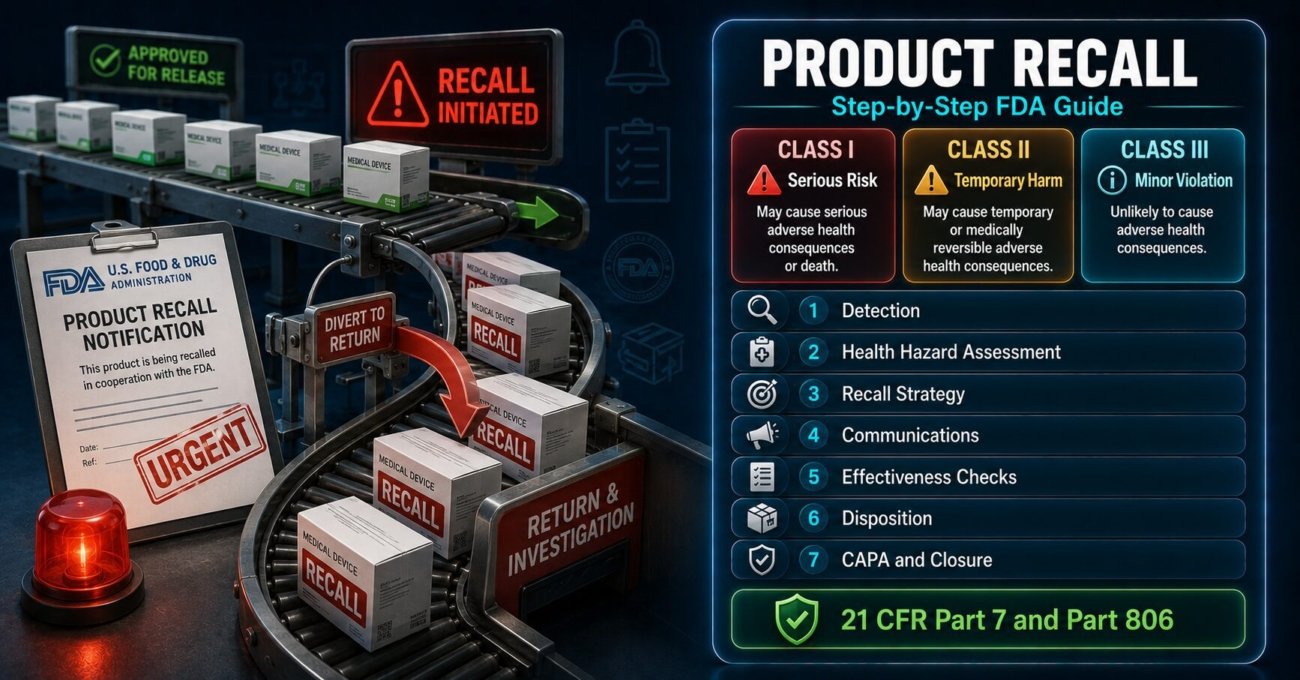
A Complete Step-by-Step Guide
An FDA product recall requires a manufacturer to remove or correct a violative product before it reaches or continues to harm patients. Under 21 CFR Part 7 for pharmaceuticals and 21 CFR Part 806 for medical devices, the process runs from internal risk assessment through FDA notification, customer communication, product retrieval, effectiveness checks, and CAPA closure. This guide covers each step with documentation requirements and reporting timeframes that pharmaceutical and medical device firms must meet.
Recalls are not optional responses to complaints. FDA expects firms to identify violative conditions through their quality system, determine whether a recall is warranted, and initiate one proactively. Waiting for FDA to request action is a corrective posture, not a compliant one. The firms with the cleanest recall records are those with documented recall procedures embedded in their quality management system before any problem arises.
This guide applies to pharmaceutical manufacturers regulated under 21 CFR Parts 210 and 211, and medical device manufacturers regulated under 21 CFR Parts 820 and 806. Where procedures differ between the two regulated product types, the distinction is noted in each section.
Why FDA Recall Management Is a Core GMP Obligation
Product recalls are not standalone crisis events. They are the downstream consequence of quality system failures. Under the current Good Manufacturing Practice (cGMP) framework, pharmaceutical firms operating under 21 CFR Parts 210 and 211 and medical device firms under 21 CFR Part 820 are required to have procedures for receiving, evaluating, and handling complaints and deviations that may require a recall. The absence of a written recall procedure is itself a cGMP violation.
FDA distinguishes between three types of market actions that affect distributed products. Understanding which applies to your situation determines the regulatory pathway, the required notifications, and the scope of your obligations.
Key Distinction: A firm that removes a product citing a “quality concern” but fails to classify the action as a recall when regulatory criteria are met may face an FDA enforcement action for failing to report. When in doubt, contact your FDA recall coordinator before characterising the action as a market withdrawal.
Recall Classifications: Class I, II, and III
FDA assigns every recall a class designation based on the relative degree of health hazard presented by the product being recalled. The manufacturer proposes a classification, but FDA makes the final determination. Do not assume your proposed class will be accepted: FDA may upgrade it based on their assessment.
For medical devices, FDA uses the same Class I, II, and III designations, but the assessment framework also considers whether the device was already implanted or in active use at the time of recall initiation. Explanted or in-use devices require a different communication approach and may require coordination with healthcare providers rather than distributors only.
Correction versus removal is also a meaningful distinction for medical devices under 21 CFR Part 806. A correction addresses a device problem at the device’s current location (such as a software update or label correction). A removal takes the device out of service and returns it to the manufacturer. Both are reportable events. Corrections that address serious risks are treated with the same urgency as removals.
Before You Begin: Prerequisites and Recall Readiness
A recall should never be the first time your quality team encounters the process. The following elements must be in place before a recall situation arises. FDA inspectors reviewing your recall response will assess whether these systems existed and functioned correctly before the problem was identified.
Written Recall Procedure (SOP)
Distribution Records
Recall Contact List
Health Hazard Evaluation Capability
The Seven-Step FDA Recall Management Process
The following process applies to voluntary recalls initiated by the firm. Each step is required for a compliant recall under 21 CFR Part 7 (pharmaceuticals) and 21 CFR Part 806 (medical devices), with regulatory distinctions noted where the two pathways differ.
Step 1: Conduct an Internal Investigation and Risk Assessment
The recall process begins when your quality system identifies a potential product defect, a complaint cluster, a stability failure, a supplier deviation, or another quality signal that suggests a distributed product may be violative or harmful.
Convene a cross-functional recall team immediately. This team typically includes Quality, Regulatory Affairs, Medical Affairs, Legal, and Operations. The team’s first task is to assess the nature of the defect, the lots affected, the distribution scope, and the health hazard potential.
Key Documents to Prepare at Step 1
- Health hazard evaluation (written assessment of health risk posed by the defect)
- Lot or batch list with manufacturing and distribution dates
- Complaint and deviation records related to the issue
- Root cause hypothesis (preliminary, to be confirmed during CAPA)
- Recall decision memo documenting the rationale for initiating a recall
Step 2: Notify the FDA
Notification timing and format differ for pharmaceuticals and medical devices.
Pharmaceuticals (21 CFR Part 7): Contact the FDA district office in your geographical area and inform them of the recall initiation. There is no fixed statutory deadline for voluntary pharmaceutical recalls, but FDA expects notification promptly upon the decision to recall. FDA will assign a recall number and may request your recall strategy, health hazard evaluation, and press release for review before public communication.
Medical Devices (21 CFR Part 806): Submit a written report to FDA within 10 working days of initiating a correction or removal. The report must be submitted to the FDA district office responsible for your facility and must include the elements listed at 21 CFR 806.10(c). For devices with MedWatch or MDR implications, coordinate with your MDR reporting obligations simultaneously.
Step 3: Develop Your Recall Strategy
The recall strategy is a written plan defining how the recall will be conducted. Under 21 CFR 7.46, the strategy must address the following elements. FDA will review and may comment on or request revisions to your strategy before approving it.
Step 4: Issue Recall Communications to Consignees
Recall communications must go to all consignees at the depth specified in your recall strategy. A consignee is any person or firm that received the recalled product directly from you or from a sub-distributor. The communication must reach them in writing, and you must document proof of receipt.
Under 21 CFR 7.49, the recall communication must:
- Identify the product, including lot or serial numbers
- State the recall reason clearly and without minimising the risk
- Specify whether the product should be returned, destroyed, or corrected
- Provide instructions for returning or disposing of the product
- Request confirmation of receipt and a response within a specified timeframe
- Identify your recall contact and their direct contact information
For consumer-level recalls, a press release or public notice may be required. FDA will indicate whether a press release is required based on the class and consumer exposure risk. For Class I recalls with wide consumer distribution, a press release is standard. FDA must review and approve the press release before it is issued.
Step 5: Execute the Recall and Track Returns
Once communications have been issued, your recall team must track the return of recalled product against the complete consignee list. Assign a unique recall reference number to every consignee response. Log the date of communication, the quantity recalled, the quantity returned or confirmed destroyed, and any consignees who have not responded.
Maintain a running reconciliation spreadsheet that shows, for each consignee: quantity shipped, quantity returned or disposed, and outstanding balance. This reconciliation is the primary document FDA will review during the recall audit. It must be current and accurate at all times during the recall.
Recalled product must be physically segregated from compliant product at all receiving locations, including your facility. Place recalled product under quarantine hold in your inventory management system. Do not release quarantined product for any purpose until FDA confirms the disposition method.
Step 6: Conduct Effectiveness Checks
Effectiveness checks verify that the recall communication reached its intended recipients and that they took the appropriate action. The level of effectiveness checking required is stated in your recall strategy and assigned or confirmed by FDA.
Document each effectiveness check contact: date, consignee name, method of contact, confirmation of receipt, and quantity confirmed returned or disposed. Submit effectiveness check results to FDA with each status report as required under 21 CFR 7.53.
Step 7: Close the Recall and Implement CAPA
A recall is formally terminated when FDA determines that the company has taken all reasonable efforts to remove or correct the violative product. To support termination, submit a final status report to FDA showing the complete reconciliation of recalled product, the results of all effectiveness checks, and the disposition records for all returned product.
Recall closure is not the end of your obligations. A corrective and preventive action (CAPA) addressing the root cause of the recall must be initiated and tracked to completion. FDA will request evidence of the CAPA and its effectiveness during any subsequent inspection. For medical devices, the CAPA must be documented in your quality management system under 21 CFR 820.100 and may be subject to review as part of your next Quality System inspection.
The recall file, including all communications, consignee responses, effectiveness check records, product disposition records, and CAPA documentation, must be retained per your applicable regulatory requirements. For pharmaceuticals, this is typically three years under 21 CFR 211.180. For medical devices, the Device History Record and associated quality records must be retained under 21 CFR 820.180.
Recall Management Compliance Checklist
Use the following three-phase checklist to manage your recall from initiation to closure. Each item corresponds to a documented obligation under 21 CFR Part 7 or Part 806. Record the completion date and responsible party for every item.
Phase 1: Immediate Actions (Days 1-3)
- Convene the recall team and assign the recall manager
- Identify all affected lot/serial numbers
- Quarantine remaining on-hand stock of affected product
- Complete the health hazard evaluation (written)
- Pull distribution records for all affected lots
- Prepare the consignee master list
- Notify FDA (pharmaceutical: district office; device: written report initiated)
- Initiate root cause investigation
Phase 2: Active Recall (Days 4-30+)
- Submit FDA-reviewed recall strategy (if required)
- Issue written recall communications to all consignees
- Issue press release (if FDA-required for Class I)
- Log all consignee responses in recall reconciliation
- Begin and document effectiveness checks
- Submit status reports to FDA at required intervals
- Receive and quarantine all returned product
- Follow up with non-responsive consignees
Phase 3: Closure (After Reconciliation Complete)
- Final reconciliation: 100% of recalled product accounted for
- Complete and document all effectiveness checks
- Obtain FDA disposition authorisation for recalled product
- Execute destruction or reconditioning with documentation
- Submit recall termination request to FDA
- Receive FDA recall termination letter
- Initiate or confirm status of CAPA addressing root cause
- File complete recall record per retention requirements
Common Recall Management Failures and How to Avoid Them
Most recall management failures are not failures of intent. They are failures of preparation: incomplete distribution records, untested SOPs, and health hazard evaluations completed under pressure with no scientific support. The following failures most commonly result in FDA observations, Warning Letters, or consent decrees related to recall management.
Key Takeaways
Recall Readiness Is a Quality System Obligation
Medical Device and Pharmaceutical Recall Timelines Differ
Effectiveness Checks and CAPA Determine Whether the Recall Was Adequate
Frequently Asked Questions
What is the difference between a voluntary recall and an FDA-requested recall?
Does FDA publicly announce all product recalls?
What content must be included in a medical device recall report under 21 CFR 806?
Can recalled pharmaceutical product be re-released to market after reconditioning?
How long does an FDA recall remain open?
What is the difference between a device correction and a device removal under 21 CFR Part 806?
What happens if we do not report a correction or removal to FDA when one was required?
How should a firm handle recalled product that is already implanted in patients?
Sources
Government and Regulatory Sources
- FDA. 21 CFR Part 7: Enforcement Policy: The primary regulatory framework governing product recalls, market withdrawals, safety alerts, and recall strategy requirements for all FDA-regulated products.
- FDA. 21 CFR Part 806: Medical Devices; Reports of Corrections and Removals: Establishes the 10-working-day reporting requirement for medical device corrections and removals and defines the required content of each report.
- FDA. Recalls, Market Withdrawals, and Safety Alerts Database: Public-facing database of all classified FDA recalls, including class, product description, recall reason, and status.
- FDA. Recalls, Corrections, and Removals (Devices): FDA guidance page for medical device recall procedures, including guidance documents and reporting templates.
- FDA. 21 CFR Part 820: Quality System Regulation (Medical Devices): Sets CAPA, complaint handling, and distribution record requirements that underpin a compliant recall programme for device manufacturers.
Research and Industry Sources
- FDA. Guidance for Industry: Product Recalls, Including Removals and Corrections: FDA’s guidance document outlining the agency’s expectations for voluntary recall procedures, recall strategy elements, and effectiveness check standards.
- RAPS. FDA Product Recalls: What You Need to Know: Regulatory Affairs Professionals Society overview of recall classification, communication, and CAPA requirements for pharmaceutical and medical device manufacturers.