

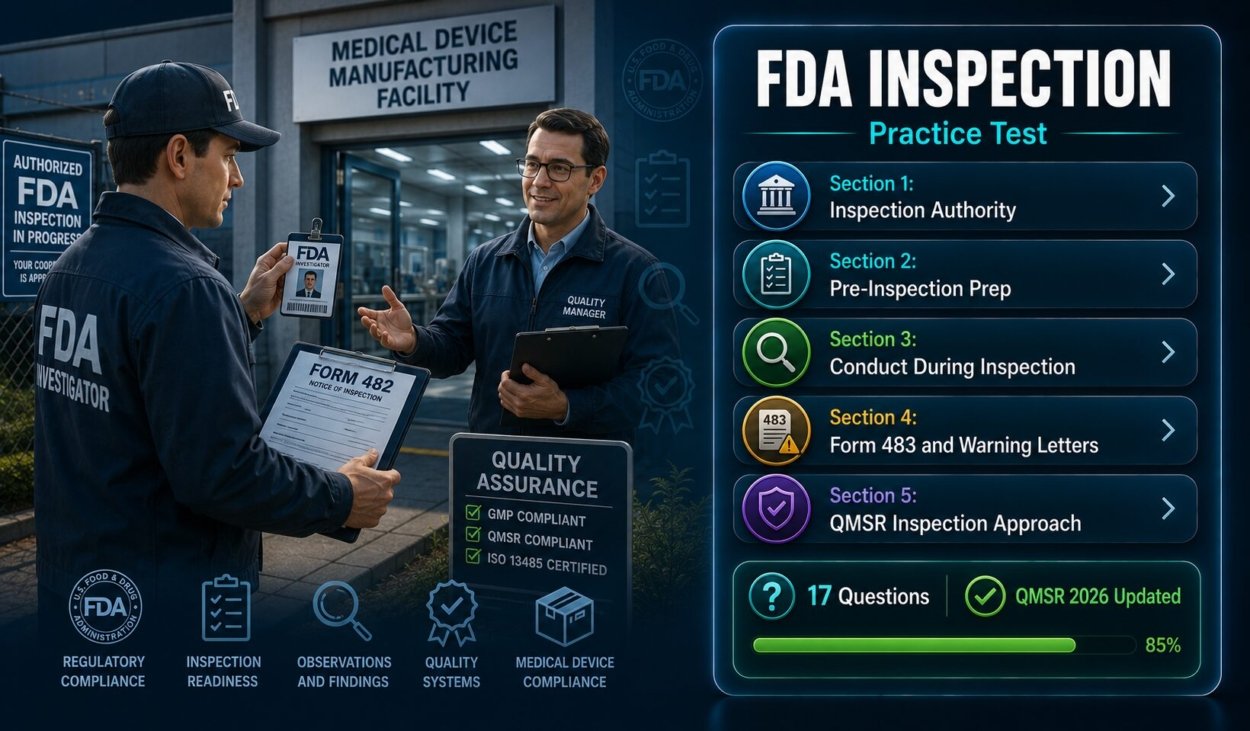
This practice test assesses your knowledge of FDA inspection procedures, rights, and obligations for pharmaceutical and medical device manufacturers. Questions cover inspection authority, pre-inspection preparation, conduct during inspections, FDA-483 responses, warning letters, and the new QMSR inspection approach under Compliance Program 7382.850. Each answer includes a detailed explanation.
Applicable regulations and guidance: 21 CFR Part 820 / QMSR (effective February 2, 2026), 21 CFR Part 211, Section 704 of the FD&C Act, FDA Regulatory Procedures Manual.
Section 1: Inspection Authority and Rights
Answer: Yes, the facility must admit the investigator.
Explanation: Under Section 704(a) of the FD&C Act, FDA investigators are authorised to enter and inspect any factory, warehouse, or establishment in which drugs or medical devices are manufactured, processed, packed, or held. Admission cannot be conditioned on the availability of a particular employee. The facility must designate an appropriate representative to accompany the investigator. Refusing entry or delaying admission without legal justification is a refusal to permit inspection, which constitutes a prohibited act under Section 301(f) of the FD&C Act and can result in enforcement action.
Answer: Yes, for records required by GMP regulations.
Explanation: Under Section 704(a) of the FD&C Act, FDA investigators may inspect and copy records required under the Act. GMP regulations under 21 CFR Parts 211 and 820 require manufacturers to maintain training records demonstrating that employees are qualified for their assigned functions. These records are required by regulation and therefore subject to FDA inspection. However, FDA’s access to records is not unlimited. Internal audit records have historically been protected under a specific FDA policy, though this protection has been narrowed under the new QMSR inspection approach for medical devices.
Answer: Form 482 is the official notice of FDA inspection. The facility should acknowledge receipt, designate an inspection host and team, and begin the inspection process.
Explanation: FDA Form 482, Notice of Inspection, is the document investigators present at the start of an inspection. It identifies the investigator’s credentials, the regulatory authority for the inspection, and the scope of the inspection if specified. Upon receiving Form 482, the facility should acknowledge receipt in writing, assemble the inspection team (typically quality management, regulatory affairs, and operations), notify senior management, and begin accompanying the investigator. The facility should not attempt to delay the start of the inspection or restrict the investigator’s access to required areas and records.
Answer: A routine surveillance inspection is scheduled based on FDA’s inspection cycle. A for-cause inspection is triggered by a specific complaint, adverse event, recall, or other signal. Both require the same level of cooperation, though for-cause inspections typically focus on specific areas.
Explanation: Routine inspections occur as part of FDA’s regular facility monitoring programme. For-cause inspections are initiated in response to a specific trigger such as a complaint, an MDR or MedWatch report, a recall, or information suggesting a compliance problem. During a for-cause inspection, investigators typically focus their review on the area of concern that triggered the inspection. However, if they identify additional issues during the inspection, they may expand their review. The facility’s obligation to cooperate fully applies equally to both inspection types.
Section 2: Pre-Inspection Preparation
Answer: Removing or destroying records that might be unfavourable to the facility.
Explanation: Destroying, altering, or concealing records that are subject to FDA inspection constitutes obstruction and may constitute criminal conduct. Appropriate pre-inspection activities include conducting internal audits, training staff on inspection protocol, confirming that required records are complete and accessible, reviewing the status of open CAPAs, and ensuring that the facility operates in the same manner during an inspection as it does at all other times. Facilities should never attempt to improve their apparent compliance by removing evidence of non-compliance.
Answer: Management Controls, Design Controls, Corrective and Preventive Action (CAPA), Production and Process Controls, Records/Documents/Change Controls, and Material Controls.
Explanation: Compliance Program 7382.850, effective with the QMSR on February 2, 2026, organises device inspections around six QMS Areas derived from ISO 13485:2016 and the QMSR. Investigators select which areas to inspect based on risk and previous inspection history. CAPA is typically inspected in every device inspection because it is the system that demonstrates whether the quality management system self-corrects. Facilities should ensure that all six areas are maintained in an inspection-ready state at all times, not just during active inspections.
Answer: A mock inspection is an internal audit that simulates an FDA inspection. Annual mock inspections identify compliance gaps before an actual inspection, train staff on inspection protocol, and provide documentation of proactive quality system oversight.
Explanation: Mock inspections mirror the FDA inspection process: an internal or external auditor presents credentials, reviews areas of the facility, requests and reviews records, interviews employees, and issues observations. The resulting report allows the facility to address gaps before an FDA investigator identifies them. Mock inspections also familiarise employees with the inspection experience, reducing the risk of inadvertent disclosures or inappropriate responses during an actual inspection. Facilities that conduct regular mock inspections consistently perform better during actual FDA inspections than those that do not.
Section 3: Conduct During Inspection
Answer: The operator should answer only what they know with certainty, say they do not know if they are uncertain, and offer to have a knowledgeable colleague provide the information.
Explanation: Employees interviewed during FDA inspections should answer questions honestly and directly. They should not guess, speculate, or provide information they are not certain about. If an employee does not know the answer to a question, the correct response is to say so and direct the investigator to the person with the relevant knowledge. Attempting to answer questions that the employee is not qualified to answer can produce inaccurate information that the investigator records and references in the inspection report. All employees who may interact with FDA investigators should be trained on this principle.
Answer: Photographs may generally be permitted at the facility’s discretion, but the facility is not required to allow photography. The quality manager should consult with management or legal counsel before allowing or refusing.
Explanation: FDA investigators do not have an automatic right to photograph facility interiors under the FD&C Act. The facility may permit photography as a courtesy or as a practical means of documenting observations. If the facility allows photography, it should document what was photographed. If the facility declines to allow photography, it should do so respectfully and offer to provide written descriptions or other documentation of what the investigator wishes to record. Refusing photography that would not reveal confidential commercial information may create an adversarial dynamic that is generally not in the facility’s interest.
Answer: Respectfully explain the correct interpretation with supporting documentation. Do not argue, and do not dismiss the concern.
Explanation: When investigators identify potential issues, the facility’s first response should be to listen, understand exactly what the investigator has identified, and then provide context and documentation if the concern is based on a misunderstanding. If the investigator’s concern is valid, acknowledging it promptly and offering to investigate demonstrates a positive quality culture. If the facility believes the investigator has reached an incorrect conclusion, the correct approach is to respectfully provide clarifying information with documentation, not to argue. Disputes about findings that cannot be resolved during the inspection can be raised through the FDA’s post-inspection dispute resolution process.
Answer: The facility has lost the opportunity to monitor and clarify what was communicated to FDA, and the employee’s statements about undocumented deviations may result in inspection findings that would not otherwise have been identified.
Explanation: Best practice during FDA inspections is to have a quality or regulatory affairs representative accompany the investigator throughout the inspection, including during employee interviews where possible. This allows the facility to understand what information was conveyed to the investigator, provide clarifying context where needed, and take notes for the inspection record. When employees are interviewed without a representative present, statements that are incomplete, inaccurate, or that reveal previously undisclosed compliance issues may significantly affect the inspection outcome. Training all employees on what to say and how to say it reduces this risk.
Section 4: FDA Form 483 and Warning Letters
Answer: Submit a written response to FDA within 15 business days addressing all five observations, including a respectful explanation of the facility’s position on the two disputed observations with supporting documentation.
Explanation: A Form 483 is a list of inspectional observations, not a final regulatory determination. The facility has the opportunity to respond in writing, ideally within 15 business days. The response should address every observation with specific corrective actions, timelines, and responsible parties. For observations the facility disputes, the response should explain the facility’s position clearly and provide documentation supporting the alternative interpretation. FDA will review the response and determine whether the observations are adequately addressed. A well-documented response that provides substantive corrective actions and, where appropriate, well-reasoned challenges to specific observations, can prevent observations from escalating to Warning Letter citations.
Answer: Repeat violations significantly increase enforcement risk, including import alert, consent decree, product seizure, and criminal referral.
Explanation: When FDA cites the same or substantially similar violations in multiple consecutive inspections, it signals to the agency that the facility’s quality system is not self-correcting. Repeat violations are a significant escalation factor in FDA’s enforcement decision making. After a Warning Letter for repeat violations, FDA may place the facility on import alert (preventing distribution of its products into the United States), seek a consent decree of permanent injunction requiring court supervision of the facility’s operations, initiate product seizure, or refer the matter for criminal prosecution. Responding to a Warning Letter for repeat violations requires demonstrating not just that the specific violation was corrected, but that the quality system is fundamentally improved.
Answer: FDA typically expects a response within 15 working days of receipt. Failure to respond, or an inadequate response, increases the likelihood of escalated enforcement action.
Explanation: FDA Warning Letters request a written response within 15 working days, though this timeline may vary. The response must address every violation cited in the Warning Letter with specific corrective actions and timelines. An inadequate response, one that is vague, promises future action without specifics, or does not address all cited violations, carries similar risk to no response. FDA publishes Warning Letters publicly, and an unresolved Warning Letter affects the facility’s ability to pursue regulatory submissions, obtain new product approvals, and maintain customer and investor confidence. Engaging experienced regulatory counsel to assist with Warning Letter responses is common practice for complex enforcement situations.
Section 5: QMSR and the New Inspection Approach
Answer: The new approach evaluates the quality management system as an integrated whole rather than as separate sub-systems, with emphasis on whether the QMS is effective at identifying and correcting problems rather than whether individual procedures exist.
Explanation: The QSIT approach evaluated four subsystems in sequence. Compliance Program 7382.850 evaluates six QMS Areas with a focus on systemic effectiveness rather than procedural existence. Investigators under the new approach ask not only whether a CAPA procedure exists but whether the CAPA system is actually identifying problems, investigating root causes, implementing effective corrections, and verifying effectiveness. This represents a shift from compliance-by-documentation to compliance-by-evidence-of-effectiveness. Facilities whose quality systems function only on paper will face greater scrutiny under this approach than those where the systems operate as intended in practice.
Answer: This is increasingly uncertain under the QMSR. The historical FDA policy not to routinely review internal audit records has been narrowed, and under Compliance Program 7382.850, internal audit reports may be subject to review.
Explanation: The FDA’s Compliance Policy Guide Sec. 130.300 historically stated that FDA would not routinely request or review internal quality audit records during inspections. However, under the QMSR and the new Compliance Program, FDA’s position on internal audit records has evolved. The new programme explicitly includes evaluation of whether the internal audit system functions effectively, which may require review of audit outputs. Facilities should consult with regulatory counsel on their specific position regarding internal audit records before an inspection, rather than making categorical assertions that may be challenged by the investigator.
Answer: CAPA is the highest-priority focus area under the new inspection approach. Future preparation should prioritise CAPA system maturity: root cause analysis quality, investigation completeness, corrective action effectiveness verification, and trend analysis across CAPA records.
Explanation: Under Compliance Program 7382.850, CAPA is inspected in virtually every device inspection because it is the primary mechanism by which FDA evaluates whether a quality management system is self-correcting. An investigator who reviews 12 CAPA records is evaluating the consistency and quality of root cause analysis, whether corrective actions address the root cause or only the symptom, whether effectiveness checks were completed and documented, and whether the organisation trends CAPA data to identify systemic issues. A facility preparing for QMSR inspections should ensure that every CAPA record demonstrates thorough root cause investigation, specific and measurable corrective actions, documented effectiveness verification, and linkage to the broader quality system.
Knowledge Summary
FDA investigators must be admitted promptly under Section 704 of the FD&C Act. Refusal to permit inspection is a prohibited act.
All employees who may interact with investigators must be trained: answer only what you know, say you do not know if uncertain, never speculate.
Respond to Form 483 observations in writing within 15 business days with specific corrective actions, timelines, and responsible parties.
Repeat violations in consecutive inspections significantly increase enforcement risk, including import alert and consent decree.
Under Compliance Program 7382.850, CAPA is the highest-priority focus area. Ensure root cause analysis quality and effectiveness verification are documented in every CAPA.
Never remove, destroy, or conceal records in anticipation of an inspection. This constitutes obstruction and is potentially criminal.
Recommended Study Areas
If any questions in this practice test were challenging, focus review on these areas.
Inspection Authority: Section 704 of the Federal Food, Drug, and Cosmetic Act defines FDA’s inspection authority and the facility’s obligation to admit investigators.
QMSR and Compliance Program 7382.850: Review FDA’s new risk-based inspection approach, the six QMS Areas, and how it differs from the legacy QSIT approach.
Form 483 and Warning Letter Response: Understand the difference between an observation and a violation, the timeline for response, and the elements of an effective written response.
CAPA System Maturity: Under the new inspection approach, CAPA is inspected in every device inspection. Ensure root cause analysis, corrective action specificity, and effectiveness verification are consistently documented.
Sources
- FDA Investigations Operations Manual
- FDA Quality Management System Regulation (QMSR), effective February 2, 2026
- 21 CFR Part 211: Current Good Manufacturing Practice for Finished Pharmaceuticals
- FDA Regulatory Procedures Manual
- Ropes and Gray: FDA Adopts New Inspection Approach for Medical Devices (February 2026)