

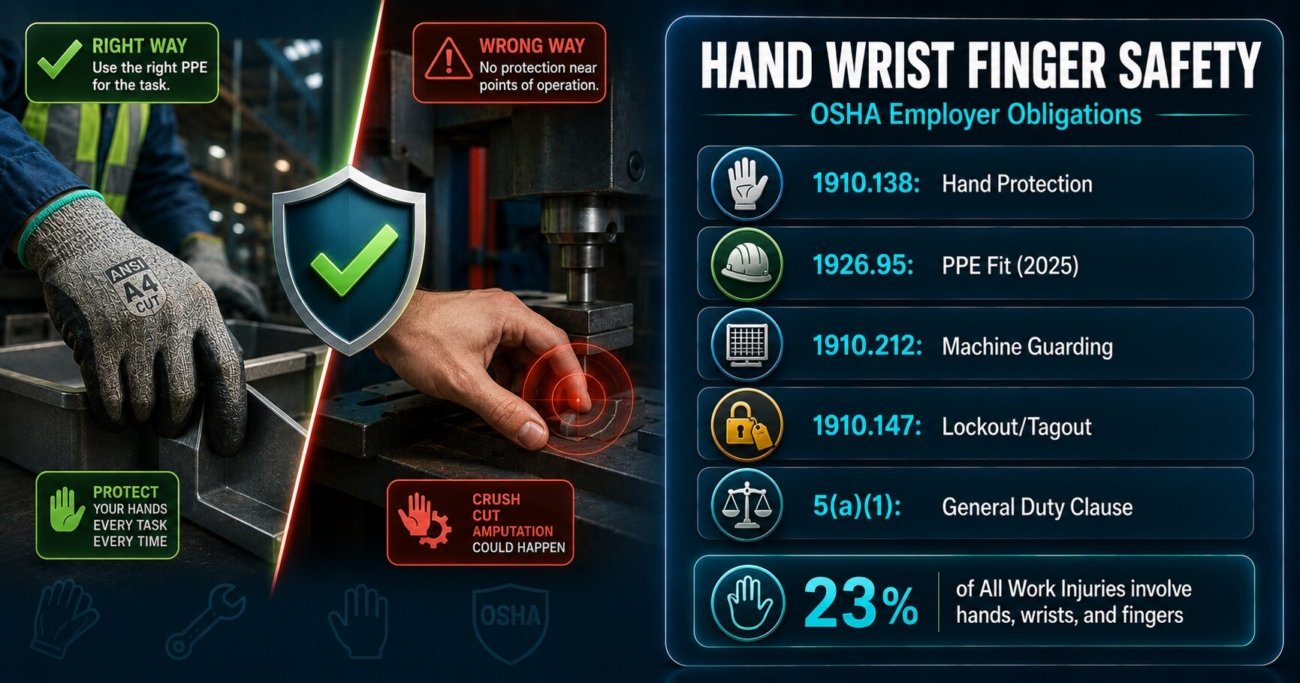
A warehouse picker reaches into a bin without looking. A metal edge inside the bin cuts across three fingers. He has not worn the cut-resistant gloves issued to him because they make it difficult to handle small parts quickly.
An ergonomics consultant reviewing the injury report identifies that the same bin has caused four hand lacerations in eighteen months. The bin edge was flagged in an employee survey two years ago. No corrective action was taken.
This combination, a recognised hazard, available protective equipment not worn, and documented prior notice, places the employer in a difficult compliance position under multiple OSHA requirements.
Understanding what OSHA requires for hand, wrist, and finger safety is not complicated. What the regulation requires, what it means in practice, and where inspectors look when injuries occur are all clearly defined.
The Regulatory Framework
OSHA does not have a single regulation specifically titled hand, wrist, and finger safety. Protection for these body parts flows from several interlocking requirements depending on the industry, the hazard, and the nature of the work.
Hand Protection: What 29 CFR 1910.138 Actually Requires
The requirement under 29 CFR 1910.138 is straightforward: employers shall select and require employees to use appropriate hand protection when employees’ hands are exposed to hazards such as those from skin absorption of harmful substances, severe cuts or lacerations, severe abrasions, punctures, chemical burns, thermal burns, and harmful temperature extremes.
The employer’s obligation has three distinct components that inspectors evaluate separately.
1. Hazard Assessment
Before selecting hand protection, the employer must assess the workplace to determine if hazards are present or likely to be present that necessitate the use of hand protection. This assessment must be documented. A verbal acknowledgment that cutting hazards exist is not sufficient. A written hazard assessment that identifies the specific hazards, the tasks that expose workers to them, and the basis for the glove selection is what the regulation expects.
During inspections following hand injuries, OSHA investigators frequently request the written hazard assessment required under 29 CFR 1910.132(d). If no documented assessment exists, the employer cannot demonstrate that the glove selection was based on an analysis of the actual hazards present. The absence of documentation supports a citation even where gloves were available and provided.
2. Appropriate Glove Selection
The regulation requires hand protection appropriate for the hazards. This means the glove must be matched to the specific hazard. A leather work glove provides abrasion and minor cut protection but offers little protection against chemical exposures. A chemical-resistant nitrile glove does not provide cut resistance equivalent to a cut-resistant glove rated for the blade hazard present.
Glove selection must account for: the hazard type (cut, chemical, thermal, puncture, crush); the severity of the hazard; the duration of exposure; whether the glove impairs dexterity in ways that create secondary hazards; and whether the glove can snag on moving machinery. The last point is critical. In some operations near rotating machinery, a glove that catches on equipment can pull the hand into a hazard more effectively than no glove. The hierarchy of controls places engineering controls above PPE for this reason.
3. Proper Fit Requirement (Updated January 2025)
A December 2024 revision to 29 CFR 1926.95, effective January 13, 2025, added explicit language requiring that PPE properly fit each employee. OSHA’s position has long been that improperly fitting PPE fails to provide required protection and may create additional hazards, but this revision makes the fit requirement explicit for construction. General industry employers are held to the same standard under 29 CFR 1910.132.
In practice, this means employers cannot satisfy hand protection requirements by providing one size of glove for a workforce with varying hand sizes. Multiple sizes must be available. Employers providing gloves at no cost under 29 CFR 1910.132(h) must ensure the available sizes actually fit the workers they employ.
Wrist and Ergonomic Hazards: Where the General Duty Clause Applies
OSHA withdrew its ergonomics standard in 2001. No specific ergonomics regulation currently exists under 29 CFR Parts 1910 or 1926. However, the absence of a specific standard does not eliminate employer obligations for wrist and repetitive motion hazards.
The General Duty Clause, Section 5(a)(1) of the OSH Act, requires employers to provide a workplace free from recognised hazards that are causing or likely to cause death or serious physical harm. OSHA has used this clause to cite employers for ergonomic hazards including carpal tunnel syndrome, tendinitis, and other musculoskeletal disorders where the hazard was recognised and feasible corrective measures were available but not implemented.
A recognised hazard for General Duty Clause purposes is one that is generally known in the industry, or one that the employer knew about. If a supervisor has reported that workers are experiencing wrist pain from a repetitive assembly task, and the employer took no action, the hazard was recognised by the employer. OSHA can cite the employer even without a specific ergonomics standard.
When workers report wrist pain, hand fatigue, or numbness associated with work tasks, those reports constitute notice of a potential recognised hazard. Routing these complaints exclusively through HR without a safety assessment and engineering controls review creates exactly the documentation trail that supports a General Duty Clause citation if a musculoskeletal injury follows.
Machine Guarding and Lockout/Tagout: The Amputations Connection
Finger and hand amputations are among the most serious injuries recorded in OSHA’s inspection database. The majority involve one of two failure modes: inadequate machine guarding under 29 CFR 1910.212, or inadequate lockout/tagout procedures under 29 CFR 1910.147 during servicing and maintenance.
Under 29 CFR 1910.212(a)(1), one or more methods of machine guarding shall be provided to protect the operator and other employees in the machine area from hazards such as those created by point of operation, ingoing nip points, rotating parts, flying chips, and sparks. The guarding method chosen must prevent the worker’s hand from reaching into the danger zone during normal operations.
Under 29 CFR 1910.147, no employee shall perform servicing or maintenance on a machine or equipment where the unexpected energisation, start-up, or release of stored energy could occur and cause injury, unless the machine or equipment is locked out or tagged out in accordance with the standard. The requirement applies whenever a worker must place their hands in a position where they could be caught by a machine if it started unexpectedly.
OSHA’s National Emphasis Programme on amputations targets industries with high rates of amputation injuries. Manufacturers, food processors, and other employers in these target industries should expect more frequent inspections and closer scrutiny of machine guarding and LOTO procedures. Machine guarding and lockout/tagout are consistently among the top ten most frequently cited OSHA standards across all industries.
Common Violations Identified During Inspections
29 CFR 1910.132(d) requires a documented hazard assessment before selecting PPE. Many employers provide gloves without completing or retaining this assessment. Without documentation, the employer cannot demonstrate the selection was appropriate for the identified hazards.
Providing gloves is necessary but not sufficient. The regulation requires appropriate hand protection to be used. If workers routinely remove required gloves because they are too hot, too stiff, or the wrong size, the employer has not met the obligation. Glove selection must account for wearability, and the fit requirement must be satisfied for each individual worker.
Under 29 CFR 1910.212(a)(3)(ii), the guarding device shall be in conformity with appropriate standards or, in the absence of applicable standards, shall be designed and constructed so as to prevent the operator from having any part of the body in the danger zone during the operating cycle. A point of operation without an effective guard is a consistently cited violation.
Maintenance and servicing activities where a machine could unexpectedly start require lockout/tagout under 29 CFR 1910.147. OSHA regularly cites employers where maintenance workers clear jams, adjust equipment, or perform servicing with machines in an energised state.
When incident reports, supervisor logs, or worker communications document repetitive motion hazards or musculoskeletal symptoms and the employer takes no corrective action, the employer has created a documented record of a recognised hazard. General Duty Clause citations become significantly more defensible for OSHA inspectors when this documentation trail exists.
Inspection Readiness Checklist
✓ Written workplace hazard assessment completed and retained for all tasks with hand exposure
✓ Glove selection documented and matched to the specific hazards identified in the assessment
✓ Gloves available in multiple sizes to ensure proper fit for all employees
✓ Gloves provided at no cost to employees under 29 CFR 1910.132(h)
✓ Machine guards in place at all points of operation on production equipment
✓ Lockout/tagout programme documented and training records current
✓ Ergonomic hazard reports and worker complaints reviewed and assessed by safety personnel
✓ Corrective actions for identified ergonomic hazards documented and implemented
✓ Hand injury incidents investigated with root cause analysis retained
✓ Prior hand injury locations assessed for recurring hazard conditions
Knowledge Check
Test your understanding of employer obligations for hand, wrist, and finger safety.
No. The regulation requires employers to select appropriate hand protection and require employees to use it. Providing gloves that workers routinely remove satisfies neither requirement. The employer must first evaluate whether the gloves are appropriate for the task and fit the workers correctly. If workers remove gloves because they impair the work, the employer must find a different glove that provides adequate protection while being wearable. If workers remove gloves by choice despite an appropriate selection, the employer must enforce the requirement. The absence of injury to date does not establish compliance.
At minimum, a violation of 29 CFR 1910.212 for inadequate machine guarding, and potentially a wilful or repeated violation if the missing guard was known and not corrected. When management was aware that a required guard was missing for two weeks and took no corrective action, OSHA can classify the violation as wilful, reflecting that the employer was aware of the requirement and chose not to comply. Wilful violations carry significantly higher penalties than serious violations. If the employer has been cited for guarding violations before, a repeated violation classification is also possible.
Yes, under Section 5(a)(1) of the OSH Act, the General Duty Clause. OSHA does not need a specific standard to cite a recognised hazard. When workers have reported musculoskeletal symptoms to management, the hazard is recognised by the employer. When feasible corrective measures exist (task rotation, tool modification, workstation redesign) and the employer has not implemented them, OSHA has the basis for a General Duty Clause citation. The documentation of worker complaints actually strengthens OSHA’s position by establishing that the hazard was known and ignored.
What Organisations Should Do Next
Hand, wrist, and finger injuries collectively represent more than 23% of all reported work injuries. The regulatory framework exists to prevent them, but the framework only works when employers treat the requirements as operational obligations rather than paperwork exercises.
Complete and retain written hazard assessments for every task with hand exposure. Select gloves based on the actual hazards, not historical practice. Confirm that gloves are available in sizes that fit your workforce. Ensure machine guards are in place and maintained. Apply lockout/tagout requirements consistently during all maintenance and servicing activities. Review and act on ergonomic complaints before they become injuries.
When an injury does occur, the investigation should ask not only what happened but whether the hazard was previously identified, whether corrective action was taken, and whether the employer’s response to prior notice would have prevented the injury. Those are exactly the questions OSHA inspectors ask.
Sources
- 29 CFR 1910.138: Hand Protection (General Industry)
- 29 CFR 1910.132: General Requirements for Personal Protective Equipment
- 29 CFR 1910.212: General Machine Guarding Requirements
- 29 CFR 1910.147: Control of Hazardous Energy (Lockout/Tagout)
- 29 CFR 1926.95: Personal Protective Equipment for Construction (including January 2025 fit amendment)
- OSHA National Emphasis Programme on Amputations