

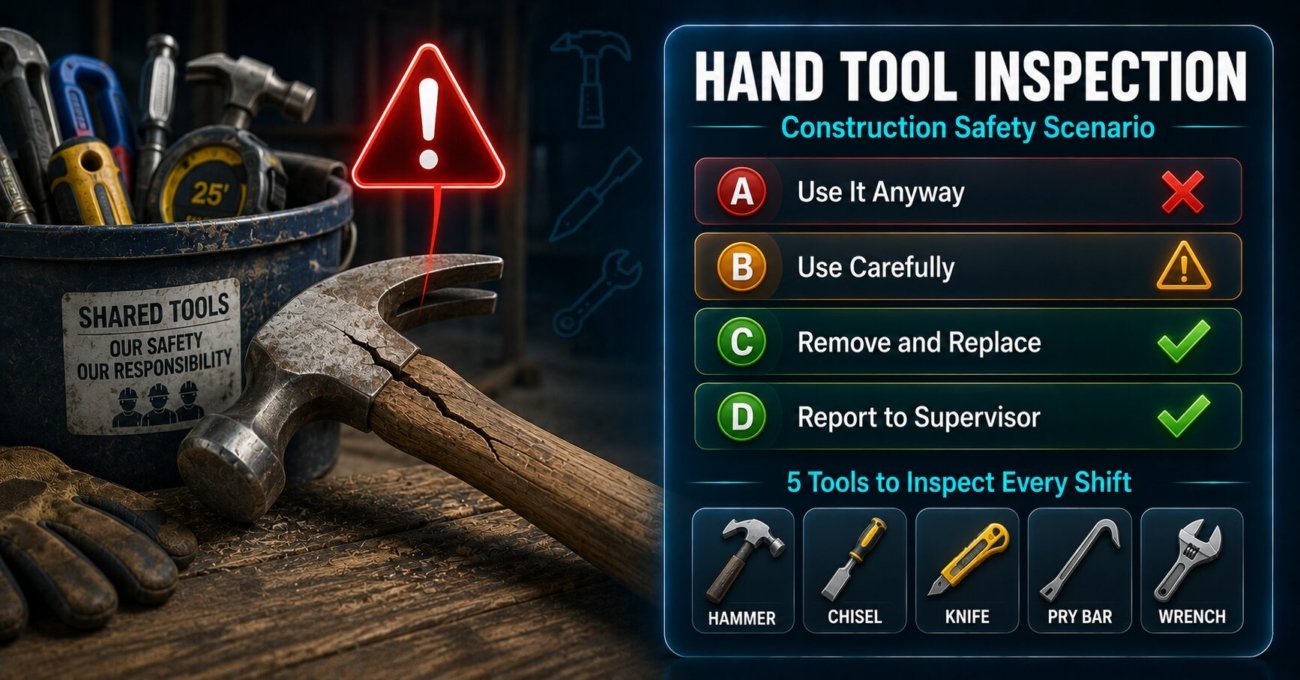
A framing carpenter reaches into a tool bucket for a hammer. He grabs it by the head and pulls it out quickly. The handle has a crack running along the grain that he did not see. Under the force of the first swing, the handle splits. The head continues forward. It strikes the stud he was nailing.
He is lucky. The head did not strike his co-worker standing two feet away.
On a different job, three weeks later, the same scenario plays out differently. The head strikes a worker in the face. Four teeth. A fractured orbital bone. Eleven days in hospital.
The hammer in both cases came from the same company bucket. Neither incident required a defective tool or exceptional bad luck. Both required only one thing: a damaged tool that was not removed from service.
Location: Residential framing site, second floor deck.
Task: Two-person crew nailing top plates on exterior framing.
Hazard: Cracked hammer handle in shared tool bucket, not inspected before use.
People involved: Carpenter using the hammer, co-worker within striking distance.
Potential outcome: Struck-by injury from a separated hammer head traveling at speed toward an adjacent worker, or hand injury from handle failure during strike.
Think about the last time you inspected a hand tool before picking it up on a job site. Not just looked at it, but actually checked the handle, the head, and the condition.
Hold that answer. We will return to it.
The Decision Point
You are working alongside a co-worker. You reach into the shared tool bucket and pull out a hammer. You notice the handle has a thin crack running along the grain, about four inches from the head. Your co-worker is two feet to your right and you need to complete this section of framing before the inspection in two hours.
What do you do?
Response A: Use the hammer. The crack looks small. You have used hammers in worse condition. You need to finish the work and you do not want to lose time searching for another tool.
Response B: Use the hammer carefully. You decide to take lighter swings and keep an eye on the crack. If it gets worse, you will stop.
Response C: Remove the hammer from service and find a replacement before starting. You tag the hammer, place it aside, and spend two minutes locating a replacement from the tool trailer.
Response D: Remove the hammer, notify your supervisor, and wait for direction. You immediately report the defective tool and wait to confirm the correct procedure before continuing.
The Best Response
Both are correct. The hammer must not be used.
Response A is the most common response on construction sites. It is also how struck-by injuries from tool failures happen. A cracked handle does not fail gradually. It fails suddenly, under load, at the moment of impact.
Response B adds a false sense of control. A lighter swing does not reduce the failure risk. It reduces the speed at which the tool performs its function while leaving the hazard fully in place.
Response C is the minimum acceptable action. Tag the tool, remove it from the bucket so no one else picks it up, and find a replacement. Under OSHA 29 CFR 1926.301(a), employers are responsible for the safe condition of all hand and power tools used by employees, including employee-provided tools. The two minutes it takes to find a replacement is not optional.
Response D adds supervisor notification, which is appropriate and often required by site safety plans. If your site has a defective tool reporting procedure, follow it.
Why This Keeps Happening
Hand tool inspection is treated as optional on most construction sites because it has never been formalised the way pre-task planning or scaffold inspection has been. Workers are trained on power tool safety. Lockout/tagout procedures for equipment are documented. But the hammer, the chisel, and the utility knife in the bucket are picked up without a second thought, shift after shift, until something breaks.
There are three patterns that explain most hand tool injuries on construction sites.
Pattern 1: Shared tools without ownership. When tools belong to a crew bucket rather than an individual, no one feels responsible for their condition. Everyone assumes someone else checked. No one did.
Pattern 2: Familiarity lowering guard. Workers who have used a tool hundreds of times do not look at it the same way they did the first time. Gradual damage accumulates across uses until a threshold is crossed. The tool looks the same as it always has, right up until it does not.
Pattern 3: Production pressure overriding the decision. Inspection takes time. Finding a replacement takes time. On a job with a two-hour deadline, those minutes feel expensive. The injured worker in the opening scenario would trade every saved minute to have taken the two minutes to find a different hammer.
On construction sites where pre-task tool inspection is included in the morning toolbox talk, even briefly, tool-related hand injuries decrease. The inspection itself is not the primary protection. Normalising the behaviour of looking at the tool before picking it up is what changes the pattern.
What the Investigation Found
Why Was the Hammer Not Inspected?
The crew shared a tool bucket that had been on the job for three weeks. Tools were added and removed by multiple workers across multiple shifts. No one owned the bucket. There was no procedure for inspecting shared tools at the start of a shift or for removing damaged tools from circulation.
The cracked handle had likely been in the bucket for several days before the incident. Multiple workers had used the hammer without noticing the crack, or had noticed it and put it back without reporting it.
What Could Have Prevented It?
Assigned tool accountability. When specific tools are assigned to specific workers, those workers have a reason to know the condition of their tools and a stake in reporting damage.
A defective tool removal system. A designated out-of-service rack or bin, clearly marked, makes it possible to remove a damaged tool without leaving it where the next person will pick it up. Without a system, the only option is to put the tool back in the bucket and hope someone else notices.
Pre-task inspection as part of the morning routine. A 60-second visual check of each hand tool before the shift starts catches most defects that develop overnight or between uses.
What to Look for When Inspecting Hand Tools
Handle: no cracks, splits, or splinters; head fits tightly and does not shift when shaken; striking face free of chips, mushrooming, or excessive rounding. Never use a hammer with a loose head.
Striking end free of mushrooming or chipping; cutting edge or tip undamaged and appropriate for the task; no cracks in the body. Mushroomed ends must be dressed with a grinder before use or discarded.
Blade guard or retraction mechanism functions correctly; blade is sharp and undamaged; handle secure and uncracked. Dull blades require more force and produce more loss-of-control events than sharp ones.
No cracks or visible deformation; working ends undamaged; no excessive corrosion that could indicate hidden weakness. Never use a pry bar as a striking tool or a striking tool as a pry bar.
Jaws not sprung or worn to the point that slippage is likely; adjustable wrench teeth engage positively; no cracks or deformation in the body. A wrench that slips drives knuckles into adjacent surfaces at full applied force.
Lessons Learned
For Workers
A tool inspection takes less time than explaining to someone why you did not do one. Before every shift, before picking up any hand tool from a shared bucket or storage area, look at it. Not for long. Just long enough to confirm the handle is sound, the head is secure, and there is no visible damage that changes how the tool will behave under load.
If you find a damaged tool, do not put it back. Tag it and set it aside so the next person cannot pick it up. Two minutes now prevents an injury later.
For Supervisors
The absence of a tool inspection procedure is a management gap, not a worker failure. If the site does not have a system for identifying and removing damaged hand tools from service, workers will default to putting damaged tools back in the bucket because there is nowhere else for them to go.
A defective tool removal system does not need to be complex. A red bin, a tag, and a clear expectation that damaged tools go in the bin and do not come back out until they are repaired or replaced is sufficient. Add a brief hand tool check to morning toolbox talks two or three times a week. The normalisation of the behaviour is more valuable than any single inspection.
Knowledge Check
Test your understanding of hand tool safety on construction sites.
He should have removed the chisel from the bucket and tagged it out of service. A mushroomed chisel head can shear metal when struck, sending fragments at high velocity. Putting it back in the bucket means the next person who reaches in may use it without knowing about the defect. The correct action is to remove it from circulation immediately, tag it as defective, and report it to the supervisor so it can be dressed with a grinder or discarded.
A serious laceration risk. A blade that does not retract fully means the guard mechanism has failed. Using his thumb to hold the blade creates a direct laceration hazard whenever the blade contacts an unexpected resistance or the work moves unexpectedly. The knife must be taken out of service. A blade guard that does not function is not a minor inconvenience. It is a defect that removes the primary protection against blade contact.
The wrench should have been inspected before continuing. A slip that results in a knuckle injury indicates either that the wrench jaws are worn or sprung, or that the wrench was not seated correctly on the fastener. Either situation requires stopping, inspecting the tool, and confirming the jaw condition before continuing. If the jaws are sprung, the wrench must be replaced. If the fit was incorrect, the setup needs to be reconsidered. Continuing immediately after a tool slip without investigating why it slipped creates the same conditions for the next injury.
Back to the Tool Bucket
Tomorrow morning, someone on your site will reach into a tool bucket and pull out a hammer, a chisel, or a wrench without looking at it first.
Whether that person gets through the shift safely depends partly on whether the damaged tools were removed from that bucket before the shift started.
That removal does not happen automatically. It happens when someone who finds a damaged tool decides to take the two minutes to tag it and set it aside instead of putting it back.
Tool injuries on construction sites are not random. They are predictable. They happen when damaged tools stay in circulation, and they stop when damaged tools are removed.
The two minutes it takes to inspect a hand tool and remove a defective one are not a cost. They are what stands between a normal shift and the kind of day nobody on the site wants to have.