

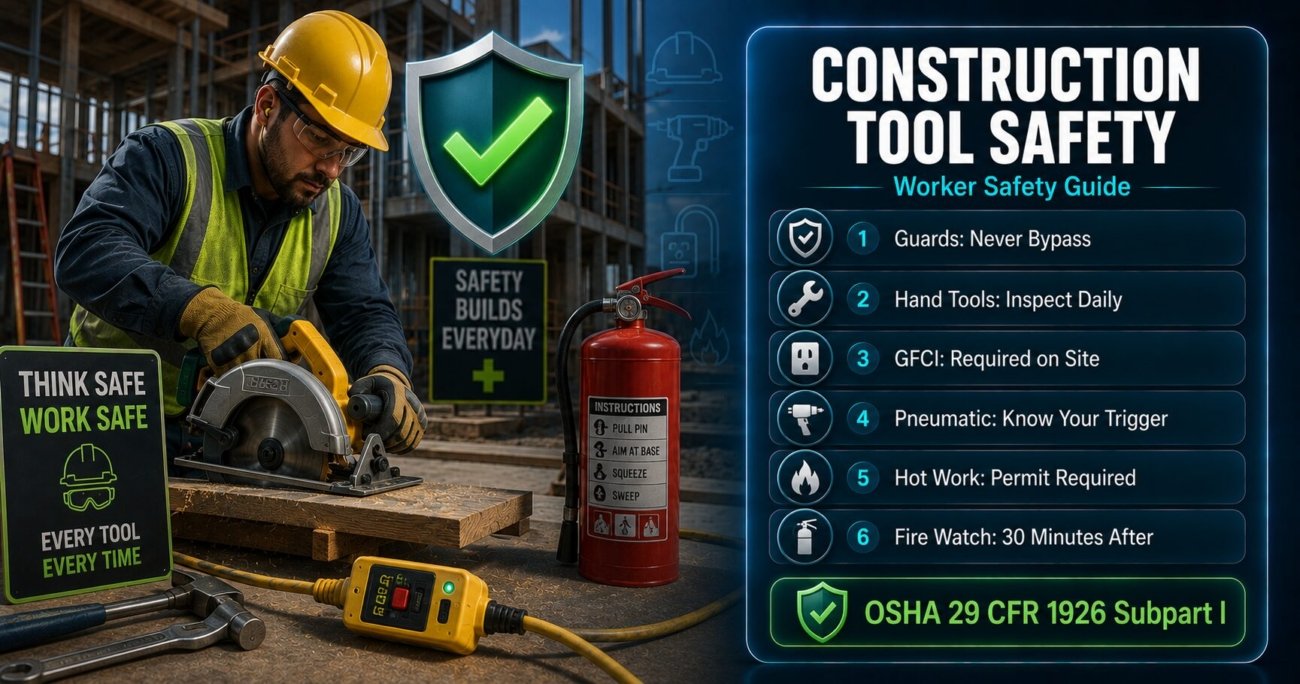
It is 7:30 in the morning on a construction site. A carpenter picks up a circular saw that was left on the job by the previous crew. The lower blade guard is in the retracted position, held back by a piece of wire someone tied around it. The cord has a small crack near the plug.
He has fifteen minutes to complete a cut before the concrete crew arrives. He plugs it in and starts work.
This situation plays out on construction sites every day. The hazards are visible. The risks are understood. The injury happens anyway because the pressure to work overrides the decision to check.
This guide covers what every construction worker needs to know about hand and power tools, in plain language, organised around the situations that cause the most injuries on the job.
Part 1: Your Tools, Your Responsibility
Under OSHA 29 CFR 1926.300, every employer on a construction site must ensure that all hand and power tools used by employees are safe. That responsibility does not end at purchasing or issuing the tool. It continues through every use.
What does this mean for you as a worker?
If you pick up a tool and it is damaged, you are allowed to refuse to use it. You are not required to use a tool you know is unsafe. If your employer tells you to use a damaged tool anyway, that instruction conflicts with federal law.
If you damage a tool during the shift, do not return it to the tool crib without reporting the damage. The next person to pick it up does not know what happened, and they will not expect the problem when the tool fails.
Before picking up any tool at the start of a shift, check: handle condition, guard presence and function, cord condition, and any unusual wear or damage. This takes less than a minute. It is the most important safety habit for tool users on any construction site.
Never Work Without Guards in Place
A guard on a power tool is not optional equipment. Under 29 CFR 1926.300(b)(1), all guards specified by OSHA must be in place when the tool is in use.
Circular saws must have an upper fixed guard that covers the blade down to the base plate, and a lower retractable guard that automatically covers the blade when the saw is lifted from the cut. If the lower guard is tied back, broken, or missing, the saw must not be used.
Grinders must have guards over the abrasive wheel. When a grinding wheel shatters, it does not produce small fragments. It produces high-velocity pieces of abrasive material that can penetrate the body. The guard is what stands between those fragments and the worker behind the tool.
If you find a tool with a guard removed or disabled, do not put it back in the tool crib and do not use it. Tag it out of service and notify your supervisor.
Guards on circular saws are sometimes removed because they make it harder to see the cut line or because they catch on materials. Neither reason justifies removal. A guard that prevents a comfortable cut is not a reason to remove the guard. It is a reason to adjust the work setup, use a different saw, or ask for help with the cut.
Hand Tool Hazards on Construction Sites
Hand tools cause more injuries on construction sites than power tools do. The reason is familiarity. Workers who would inspect a power tool before use reach for a hammer or pry bar without thinking about whether it is in safe condition.
Striking tools including hammers, mauls, and sledgehammers must have tight, uncracked handles and heads that are free from chips and mushrooming. A hammer with a loose head can fly off the handle during a swing. A chisel with a mushroomed head can send metal fragments when struck.
Cutting tools including utility knives, chisels, and snips must be sharp. Dull cutting tools require more force, which means more loss of control when the blade slips or cuts through material unexpectedly.
Wrenches must not be used when the jaw is sprung to the point that slippage occurs. A wrench that slips drives the worker’s knuckles into whatever surface is adjacent.
Hand tool inspections should be included in pre-task planning and toolbox talks, not just power tool discussions. On many construction sites, hand tool hazards receive less formal attention than power tool hazards, even though injury rates from hand tools are higher across the industry.
Part 2: Power Tools on the Construction Site
Construction sites use power tools across every trade and every phase of a project. The electrical environment on a construction site is different from a finished building. Temporary power, extension cords running across wet ground, tools used in rain, and incomplete electrical systems all create hazards that do not exist in most other work environments.
Electrical Safety: GFCI Is Not Optional
OSHA 29 CFR 1926.404(b)(1)(ii) requires GFCI protection for all 120-volt, single-phase, 15- and 20-ampere receptacle outlets on construction sites that are not part of the permanent wiring. On most construction sites, this covers virtually every power outlet you will use.
A Ground Fault Circuit Interrupter detects current leakage as small as 4 to 6 milliamps and shuts the circuit off in milliseconds. This is fast enough to prevent fatal cardiac arrest from most ground fault exposures. Without GFCI protection, a tool with a ground fault will continue to deliver current to the worker holding it until something else interrupts the circuit.
Before connecting any corded power tool, confirm that the outlet is GFCI protected. If you are not sure, use a portable GFCI adapter. Do not skip this step because the work is urgent or because you have used that outlet before without a problem.
If a GFCI trips while you are using a tool, do not simply reset it and continue. A GFCI trip means it detected a ground fault. Find out why before continuing. A tool with an internal ground fault will continue tripping the GFCI every time you use it. That tool needs to be removed from service and inspected.
Extension Cords on Construction Sites
Extension cords on construction sites take significant abuse. They are run through doorways, over sharp edges, under rolling equipment, and across wet ground. They are stepped on, driven over, and pulled by their cord rather than the plug.
OSHA requires that extension cords used outdoors be rated for outdoor use. Indoor-rated cords with two-prong plugs are not appropriate for use on construction sites. Extension cords must also be of the appropriate gauge for the tool and the cord length. An undersized cord will overheat when carrying the load of a large power tool.
Inspect extension cords the same way you inspect tools. A cord with cracked insulation, exposed conductors, or a damaged plug must be replaced, not repaired with tape, and not continued in use.
Pneumatic Tools on Construction Sites
Pneumatic nail guns are the leading cause of tool-related injuries among construction workers in the United States. Most injuries involve the operator’s hand or fingers during nailing near edges or corners, or a nail that penetrated a material and struck someone on the other side.
The trigger type on a pneumatic nail gun determines its risk profile. Contact trip triggers allow the gun to fire when the nose piece contacts a surface, whether or not the trigger has been intentionally pulled. Sequential triggers require the trigger to be depressed separately from each nose piece contact. Contact trip triggers drive nails faster but carry a significantly higher risk of unintended discharge.
Before using a pneumatic nail gun, know which trigger type you have. If you have a contact trip trigger, be especially aware of your hand and finger placement near the nose piece when moving the tool across a surface.
Never attempt to clear a nail gun jam with the air supply connected. Disconnect the air supply first, wait for pressure to release, then follow the manufacturer’s procedure for clearing the jam. Injuries from nail gun jams cleared under pressure are serious and preventable.
Hot Work: Welding, Cutting, and Grinding Near Combustibles
Any activity that produces sparks, flame, or heat capable of igniting combustible materials is hot work. On construction sites, this includes welding, torch cutting, grinding, and powder-actuated tool use near combustible materials.
Before beginning hot work, check whether the site requires a hot work permit. Most sites do. The permit process exists to ensure that someone with authority has confirmed the area is prepared for hot work before the arc is struck or the torch is lit.
Preparation means removing combustible materials from the work area, protecting combustibles that cannot be moved with fire-resistant blankets, having a fire extinguisher immediately available at the work location, and confirming that a fire watch will be in place.
The fire watch stays for at least 30 minutes after the hot work is complete. Smouldering fires from welding sparks are the most common cause of post-hot-work fires on construction sites. They develop in insulation, wood framing, sawdust accumulations, and other materials after the welder has already moved to the next task.
The fire watch is not a punishment or an extra labour cost. It is the control that prevents the most common type of fire fatality associated with welding operations. A 30-minute fire watch costs far less than the investigation, insurance, and project delay that follow a post-hot-work fire.
Daily Tool Safety Checklist for Construction Workers
✓ Visually inspect every hand tool for cracked handles, loose heads, and mushroomed striking surfaces
✓ Check every power tool for guard presence, cord condition, and switch function
✓ Confirm GFCI protection is in place before connecting any corded power tool
✓ Inspect extension cords for damage and confirm outdoor rating
✓ Know the trigger type on any pneumatic nail gun before use
✓ Disconnect pneumatic tools from air supply before changing accessories or clearing jams
✓ Obtain hot work permit before beginning welding, cutting, or grinding near combustibles
✓ Confirm fire extinguisher is immediately available at the hot work location
✓ Assign fire watch before beginning hot work and keep in place 30 minutes after completion
✓ Report any damaged tool to supervisor and remove from service before end of shift
At the start of every shift, take one minute to look at the tools you will use today. At the end of every shift, return tools to their designated location in the condition you would want to find them tomorrow morning. The worker who picks up your tools next shift deserves the same protection you do.