

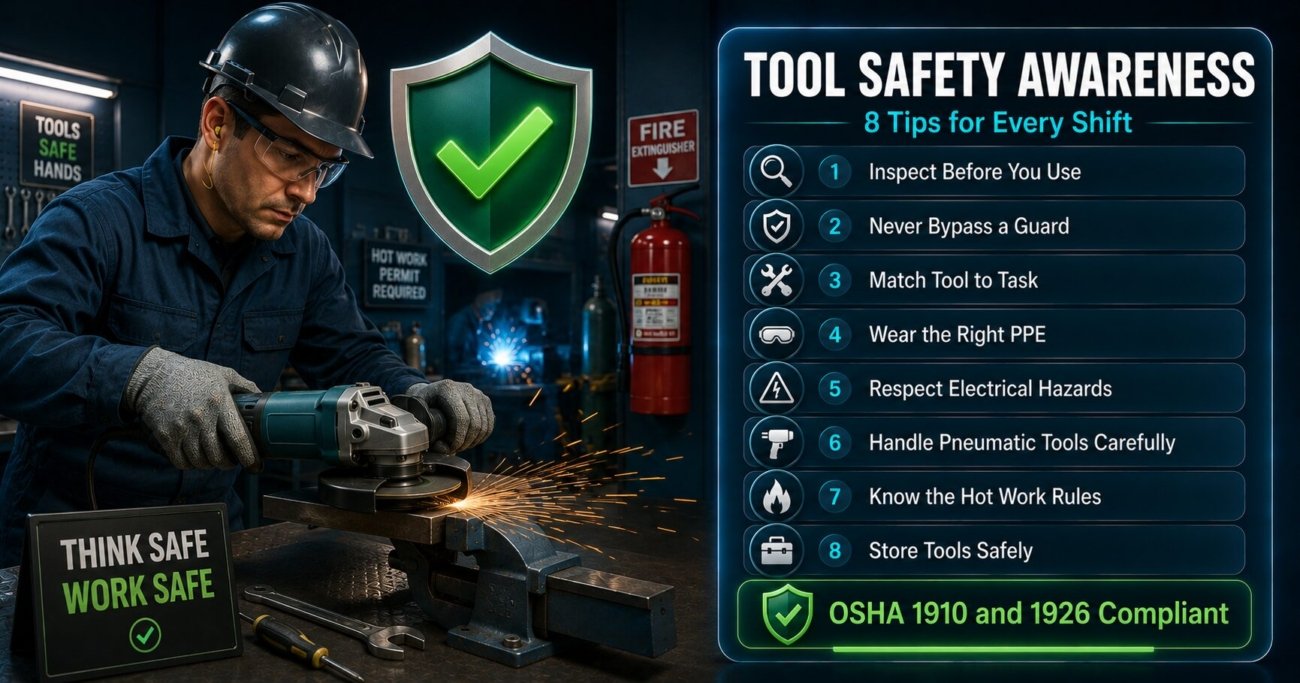
Tool-related injuries are among the most preventable in any workplace. Most hand and power tool incidents share a common element: something was overlooked before the work began. A guard was missing. The tool had not been inspected. The right PPE was not worn. The wrong tool was selected for the job.
These tips address the awareness gaps that matter most, organized for quick reading and immediate application at the start of a shift.
Tip 1: Inspect Before You Use
Before picking up any hand or power tool, take thirty seconds to inspect it. Look for cracked handles, missing guards, frayed cords, loose components, or any damage that was not there the last time you used it. A damaged tool can fail mid-task in ways that are difficult to control.
Under OSHA 29 CFR 1910.242(a), employers are responsible for the safe condition of all tools used by employees. Your inspection is the last line of defence before work begins.
Make visual tool inspection a 30-second habit before every task. Place damaged tools on a designated defective equipment rack so they cannot be picked up and used by someone else. A tag reading Do Not Use is more reliable than verbal communication.
Tip 2: Never Remove or Bypass a Guard
Guards on grinders, circular saws, and other power tools exist because the hazard they cover is capable of causing severe, immediate injury. Abrasive wheel failures without guards have sent fragments at velocities high enough to penetrate safety glasses. Circular saws without lower guards expose rotating teeth that do not stop when you do.
No production deadline, awkward work angle, or personal preference justifies removing a guard. If a guard prevents you from doing the job safely, stop and consult your supervisor. The answer is not to remove the guard.
Do: Report guards that are damaged, missing, or not functioning correctly so they can be repaired or replaced before the tool is used.
Avoid: Tying back, removing, wedging open, or otherwise defeating any guard on any tool. Under OSHA, a supervisor who permits a worker to operate an unguarded tool shares responsibility for any resulting injury.
Tip 3: Match the Tool to the Task
Using a tool for something other than its intended purpose is one of the most common causes of tool-related injuries. Screwdrivers used as chisels break and produce sharp fragments. Wrenches used as hammers slip and drive knuckles into adjacent surfaces. Chisels with mushroomed heads shed metal when struck.
Select the right tool for the task. If the right tool is not available, stop the work and get it rather than improvising with what is at hand.
If you are ever asked to use a tool in a way it was not designed for because the correct tool is unavailable, this is a situation to raise with your supervisor. Improvised tool use is a recognised precursor to injury, not a sign of resourcefulness.
Tip 4: Wear the Right PPE for the Tool and Task
Different tools create different hazard exposures. Grinders produce sparks and abrasive fragments that require face shield protection, not just safety glasses. Pneumatic nail guns operating above 85 dBA require hearing protection. Cutting operations on materials that produce dust or fumes require respiratory protection. Power tool use near combustibles requires awareness of ignition sources.
Check the tool’s operating requirements and the material being worked before selecting PPE. Default PPE selections that do not account for the specific hazard combination may provide inadequate protection.
Do: Select PPE based on the specific hazards of the tool, the material, and the work environment. A face shield over safety glasses provides better protection from grinder fragments than safety glasses alone.
Avoid: Assuming that because you are wearing safety glasses, eye protection is adequate for all tool tasks. Different tools require different levels of protection.
Tip 5: Respect Electrical Hazards with Power Tools
Electrical shock from power tools kills workers every year. Most incidents involve one of three situations: damaged cords with exposed conductors, tools used in wet or damp locations without GFCI protection, or tools used in areas with flammable atmospheres.
Before plugging in any corded tool, inspect the cord for cracks, cuts, or exposed wires. Confirm GFCI protection is in place when working outdoors, in wet locations, or on construction sites. Never use standard power tools in areas where flammable vapours, dust, or fibres may be present.
Tape is not a repair for a damaged power tool cord. A cord with exposed conductors must be replaced, not patched. If you find a damaged cord, remove it from service and tag it before someone else picks it up and uses it.
Tip 6: Handle Pneumatic Tools with Constant Awareness
Pneumatic nail guns, impact wrenches, and drills carry energy even when not actively triggered. A pneumatic nail gun with a contact trip trigger can fire whenever the nose piece contacts a surface, whether intentional or not. Disconnecting the air supply before changing accessories, clearing jams, or performing any adjustment is not optional.
Never point a pneumatic nail gun at any person, even when it appears disconnected. Never use compressed air above 30 psig for cleaning near the body. Never carry a pneumatic tool by the air hose.
If your site uses pneumatic nail guns, confirm whether they have sequential triggers or contact trip triggers. Contact trip triggers significantly increase the risk of unintended discharge. Sequential triggers require the trigger to be pulled each time a fastener is driven. Where both types are present, ensure workers know which type they are using before beginning work.
Tip 7: Know the Hot Work Rules Before You Strike an Arc
Welding, cutting, and grinding in areas where sparks or heat can reach combustible materials requires hot work controls. This means a hot work permit in most facilities, removal of combustibles from the work area, fire-resistant barriers where combustibles cannot be moved, a fire extinguisher immediately at hand, and a fire watch.
The fire watch must remain in place for at least 30 minutes after welding or cutting operations are complete. Smouldering fires from hot work sparks are the most common cause of facility fires following welding operations, and they often develop after the welder has already left the area.
Before beginning any welding, cutting, or grinding operation, look at what is above, below, and on the other side of the wall from where you are working. Sparks travel further than you expect, and hot metal conducts heat through structures. The fire watch must check all of these areas, not just the immediate work zone.
Tip 8: Store Tools Safely After Every Use
Improper tool storage causes injuries before and after the task is complete. Sharp-edged hand tools stored loosely in toolboxes create laceration hazards when workers reach in without looking. Power tools stored with guards in the retracted position are not ready for safe use the next time they are picked up. Cords wrapped tightly around tools stress the cord at the connection points and cause insulation damage over time.
Store cutting tools with edge covers or in designated holders. Hang power tools or store them in cases. Coil cords loosely and do not wrap them tightly around tool bodies.
At the end of every shift, put each tool back in its designated location with guards in the correct position, cords coiled, and any damage flagged. The next person to pick up that tool should be able to do so safely without needing to know its history from the previous shift.
Pre-Task Tool Safety Checklist
✓ Tool inspected for damage, cracks, missing guards, and frayed cords
✓ Correct tool selected for the specific task
✓ All guards in place and functioning
✓ PPE appropriate for the tool and material selected and worn
✓ GFCI protection confirmed for corded tools in wet, damp, or construction environments
✓ Air supply confirmed disconnected before adjusting or changing accessories on pneumatic tools
✓ Hot work permit obtained where required
✓ Combustibles cleared or protected in hot work areas
✓ Fire extinguisher immediately available for hot work
✓ Fire watch assigned and briefed for welding and cutting operations