

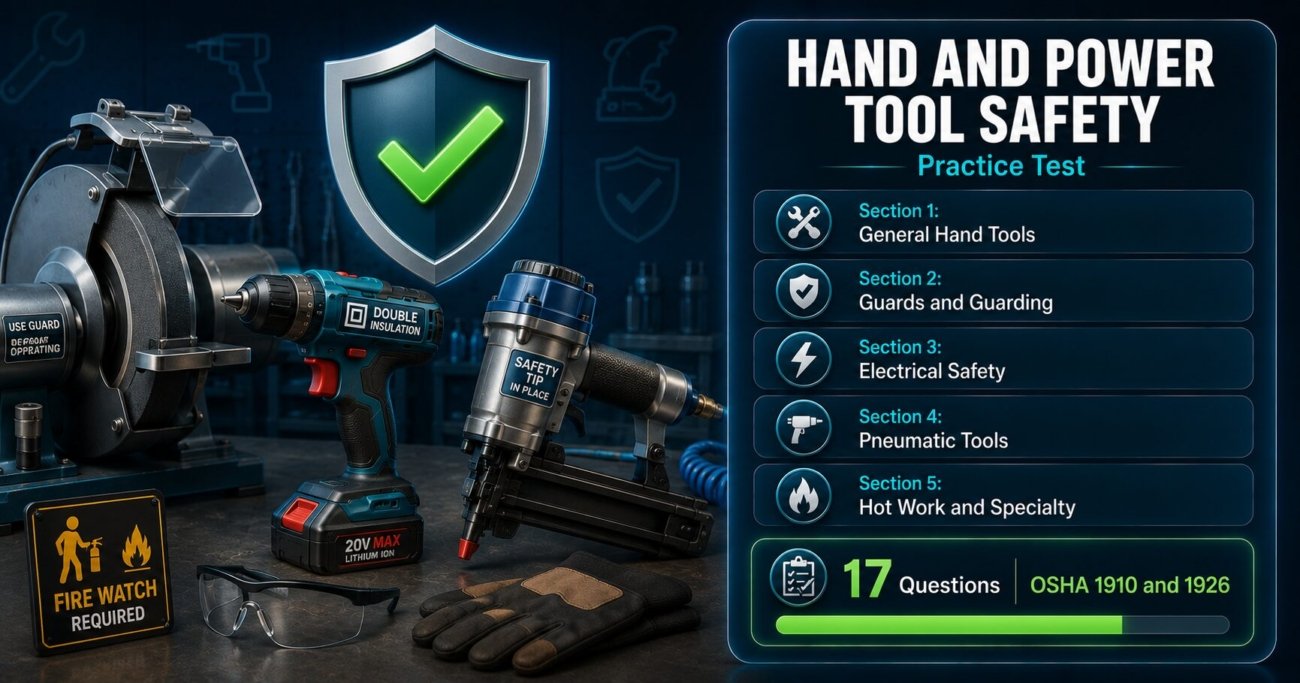
This practice test covers hand and power tool safety requirements under OSHA standards 29 CFR 1910 Subpart P (General Industry) and 29 CFR 1926 Subpart I (Construction). Questions cover hazard recognition, PPE requirements, guard requirements, electrical safety, pneumatic tools, and inspection obligations. Each answer includes a detailed explanation.
Section 1: General Hand Tool Safety
Answer: The employer.
Explanation: OSHA 29 CFR 1910.242(a) states that employers shall be responsible for the safe condition of tools and equipment used by employees, including tools and equipment which may be furnished by employees. This means that even if a worker brings their own tool to the job, the employer is still responsible for ensuring it meets safety requirements. Damaged or defective tools must be removed from service immediately.
Answer: Remove the chisel from service immediately and either dress the head or discard it.
Explanation: Mushroomed tool heads on chisels, punches, and similar struck tools are a serious hazard. When the head is struck, the mushroomed metal can shear off and become a projectile. OSHA requires that wrenches, including adjustable, pipe, end, and socket wrenches, shall not be used when jaws are sprung to the point that slippage occurs, and similarly, impact tools such as chisels, wedges, or drift pins must be free of mushroomed heads. The tool must be dressed with a grinder or discarded before return to service.
Answer: Tool misuse hazard. Using a screwdriver for prying can cause the blade to slip or snap, creating a puncture or laceration risk.
Explanation: OSHA’s general tool safety principles require that tools be used for their intended purpose. A screwdriver blade is not designed for lateral prying force. Using it as a pry tool can cause the blade to slip and strike the worker’s hand or face, or snap and become a projectile. The correct tool for prying open a container is a pry bar or paint can opener. Tool misuse is one of the most common causes of hand and finger injuries in general industry.
Answer: Appropriate personal protective equipment (PPE).
Explanation: 29 CFR 1926.301(b) requires that employees using hand and power tools, who are exposed to the hazard of falling, flying, abrasive, and splashing objects, or exposed to harmful dusts, fumes, mists, vapours, or gases, shall be provided with the particular PPE necessary to protect them from the hazard. This commonly includes safety glasses or face shields, gloves, and respiratory protection depending on the tool and material being worked.
Section 2: Power Tool Safety and Guards
Answer: Circular saws, plunge-type routers, and similar tools may use a constant ‘on’ switch in addition to the constant pressure switch.
Explanation: Under 29 CFR 1910.243(a)(1), all hand-held powered platen sanders, grinders with wheels 2 inches in diameter or less, routers, planers, laminate trimmers, nibblers, shears, scroll saws, and jigsaws with blade shanks one-quarter inch wide or less may use a latching device, but only if they also have a separate control that requires a constant pressure to keep the tool running. Circular saws must have a constant pressure control but may also have an additional lock-on control. Workers must understand which switch configuration their specific tool uses.
Answer: A violation of 29 CFR 1910.243(c), which requires that abrasive wheel machinery be equipped with safety guards.
Explanation: OSHA 29 CFR 1910.243(c)(1) requires that abrasive wheels shall be used only on machines provided with safety guards. The guard must cover the spindle end, nut, and flange projections, and must be strong enough to retain fragments in the event of wheel breakage. Abrasive wheel failures are among the most dangerous power tool incidents because fragments can travel at high velocity. Working without a guard on a grinder is a serious OSHA violation regardless of the reason.
Answer: A ring test (tap test) to check for cracks in the wheel.
Explanation: Before mounting a new abrasive wheel, it must be inspected for cracks and then given a ring test: suspend the wheel freely and tap it gently with a non-metallic object. An undamaged wheel produces a clear metallic ring. A cracked wheel produces a dull thud. A wheel that fails the ring test must not be used. Additionally, the wheel must be matched to the RPM rating of the grinder: wheels must never be used at speeds exceeding the maximum RPM marked on the wheel. Mounting a cracked or over-speed-rated wheel is a serious hazard.
Answer: Immediately stop the work, restore the guard to proper operating condition, and retrain the worker.
Explanation: OSHA 29 CFR 1910.243(a)(1) requires that all portable circular saws having a blade diameter greater than 2 inches shall be equipped with guards above and below the base plate. The lower guard must automatically return to the covering position when the tool is withdrawn from the work. Defeating a guard is a serious violation. A circular saw operating without a lower guard exposes workers to blade contact hazards that can cause severe lacerations or amputations. Supervisors who permit guarded tools to operate without guards share responsibility for any resulting injury.
Section 3: Electrical Safety for Power Tools
Answer: Double insulated tools have two independent layers of electrical insulation and do not require a separate grounding conductor (third prong).
Explanation: A double insulated tool is designed with two independent protective systems: basic insulation on the conductors and an additional layer of insulation encasing the tool’s housing. This design provides protection against electrical shock without relying on an equipment grounding conductor. OSHA accepts double insulated tools as an alternative to grounding. However, the double insulation must be inspected and undamaged. A double insulated tool with a cracked housing may have compromised protection and should be removed from service.
Answer: Remove the extension cord from service immediately. Do not use it until it is repaired or replaced.
Explanation: OSHA 29 CFR 1910.334(a)(2)(ii) requires that electrical equipment, including cords and cables, be free from recognized hazards. An extension cord with exposed conductors presents a shock hazard to anyone who contacts the exposed wire, and a fire hazard if the exposed conductors contact flammable materials. Tape is not an adequate permanent repair for exposed conductors on extension cords used in work environments. The cord must be replaced. Additionally, OSHA requires that extension cords used outdoors or in wet or damp locations be rated for outdoor use.
Answer: Whenever power tools are used in wet or damp locations, in construction, or whenever the tool is connected to a temporary power source, unless an assured equipment grounding conductor programme is implemented instead.
Explanation: Under 29 CFR 1926.404(b)(1), OSHA requires GFCI protection or an assured equipment grounding conductor programme for all construction sites. For general industry under 29 CFR 1910.304(g), GFCI protection is required in wet or damp locations and near unprotected electrical equipment. A GFCI detects current leakage as small as 4 to 6 milliamps and interrupts the circuit within milliseconds, before the current reaches a level that can cause cardiac fibrillation. In construction, GFCI protection is not optional.
Section 4: Pneumatic Tools and Compressed Air
Answer: Safety glasses or face shield, and hearing protection if noise exposure exceeds permissible levels. Safety footwear is strongly recommended in construction environments.
Explanation: Pneumatic nail guns present multiple hazards: projectile fasteners, recoil, noise above 90 dB, and the risk of double fires. Eye protection is required under 29 CFR 1926.302(b)(4) for employees using hand and power tools exposed to flying objects. Nail guns operating above 85 dBA require hearing protection under 29 CFR 1910.95. Safety footwear protects against fasteners driven through materials into feet, which is a common pneumatic nailer injury pattern. Workers should also be trained on the specific trigger type of their nail gun, as contact trip triggers significantly increase unintended firing risk compared to sequential triggers.
Answer: 30 pounds per square inch gauge (psig) when the nozzle is dead-ended against the body, and only with chip guarding and PPE.
Explanation: OSHA 29 CFR 1910.242(b) states that compressed air shall not be used for cleaning purposes except where reduced to less than 30 psi, and then only with effective chip guarding and personal protective equipment. This requirement applies when the air stream could be directed at the body. Air pressure above 30 psi can force air into the bloodstream through a break in the skin, causing an air embolism that can be fatal. Many facilities prohibit using compressed air for cleaning skin or clothing entirely, which is the safest approach.
Answer: To prevent unintentional activation. OSHA requires that power be disconnected and pressure released before adjusting, cleaning, or changing accessories on pneumatic tools.
Explanation: Under OSHA’s general machine guarding and pneumatic tool safety requirements, workers must ensure the tool is in a zero-energy state before performing any adjustment or accessory change. For pneumatic tools, this means disconnecting the air supply and releasing any residual pressure in the tool or line. A pneumatic impact wrench that activates unexpectedly during a socket change can cause severe finger, hand, or wrist injuries. This requirement parallels lockout/tagout principles applied to portable pneumatic tools.
Section 5: Inspection, Hot Work, and Specialty Tools
Answer: The operator has improperly attempted a second fire after a misfire. The correct procedure is to wait 30 seconds, keep the muzzle pointed at the work surface, then follow the manufacturer’s specific misfire procedure before unloading.
Explanation: OSHA 29 CFR 1926.302(e)(1) requires that powder-actuated tools be tested each day before use using the manufacturer’s recommended procedure. In the event of a misfire, the operator must hold the tool in the operating position for at least 30 seconds, then follow the manufacturer’s procedure for removing the cartridge safely. Pointing the tool away and re-firing is dangerous because the fastener or cartridge may still discharge unexpectedly. Powder-actuated tools must also be operated only by trained and licensed individuals in many jurisdictions.
Answer: To monitor for fires during welding or cutting operations and for at least 30 minutes after the work is completed, and to have fire extinguishing equipment immediately available.
Explanation: OSHA 29 CFR 1926.352(e) requires a fire watch wherever welding or cutting is performed in locations where fires might develop. The fire watch must be maintained for at least 30 minutes after the welding or cutting operation is complete to detect and extinguish smouldering fires. The fire watch must have suitable fire extinguishing equipment immediately available and be trained in its use. They must also be familiar with facilities for sounding an alarm and must watch for fires in all areas, including floors above and below and on the opposite side of walls from where work is performed.
Answer: The tool must be approved for use in hazardous locations if there is a risk of igniting flammable vapours, dust, or fibres. Standard power tools are not approved for use where ignitable concentrations of flammable materials exist.
Explanation: Standard power tools can produce sparks or heat that ignite flammable concentrations of vapour, dust, or fibres. OSHA 29 CFR 1910.303 and the National Electrical Code classify hazardous locations by the type and degree of hazard. In Class I (flammable gas or vapour), Class II (combustible dust), or Class III (ignitable fibre) locations, only intrinsically safe or explosion-proof equipment approved for that specific hazard class may be used. Using a standard corded drill in such an area is a serious fire and explosion hazard regardless of the operator’s experience.
Knowledge Summary
Employers are responsible for the safe condition of all tools used by employees, including employee-owned tools.
Guards on power tools must not be removed, bypassed, or defeated for any reason.
All abrasive wheels must pass a ring test before mounting and must not exceed the RPM rating marked on the wheel.
GFCI protection is mandatory in construction and in wet or damp locations for general industry.
Compressed air for cleaning is limited to 30 psi when directed near the body.
Powder-actuated tools must only be operated by trained individuals; misfires require the 30-second wait procedure.
Fire watch must be maintained for at least 30 minutes after welding or cutting operations are complete.
Recommended Study Areas
If any questions were challenging, focus review on these OSHA standards.
General Industry: 29 CFR 1910 Subpart P covers hand and portable powered tools, 1910.242 through 1910.244. Key sections include requirements for employer responsibility, portable circular saws, grinders, and pneumatic tools.
Construction: 29 CFR 1926 Subpart I covers tools for construction, 1926.300 through 1926.307. This subpart addresses hand tools, power-operated hand tools, pneumatic tools, and powder-actuated tools.
Electrical Safety: 29 CFR 1910 Subpart S and 29 CFR 1926 Subpart K cover electrical safety, including GFCI requirements, extension cord requirements, and hazardous location classifications.
Hot Work and Fire Watch: 29 CFR 1926.352 covers fire prevention in welding and cutting operations, including fire watch requirements and hot work permit programmes.