

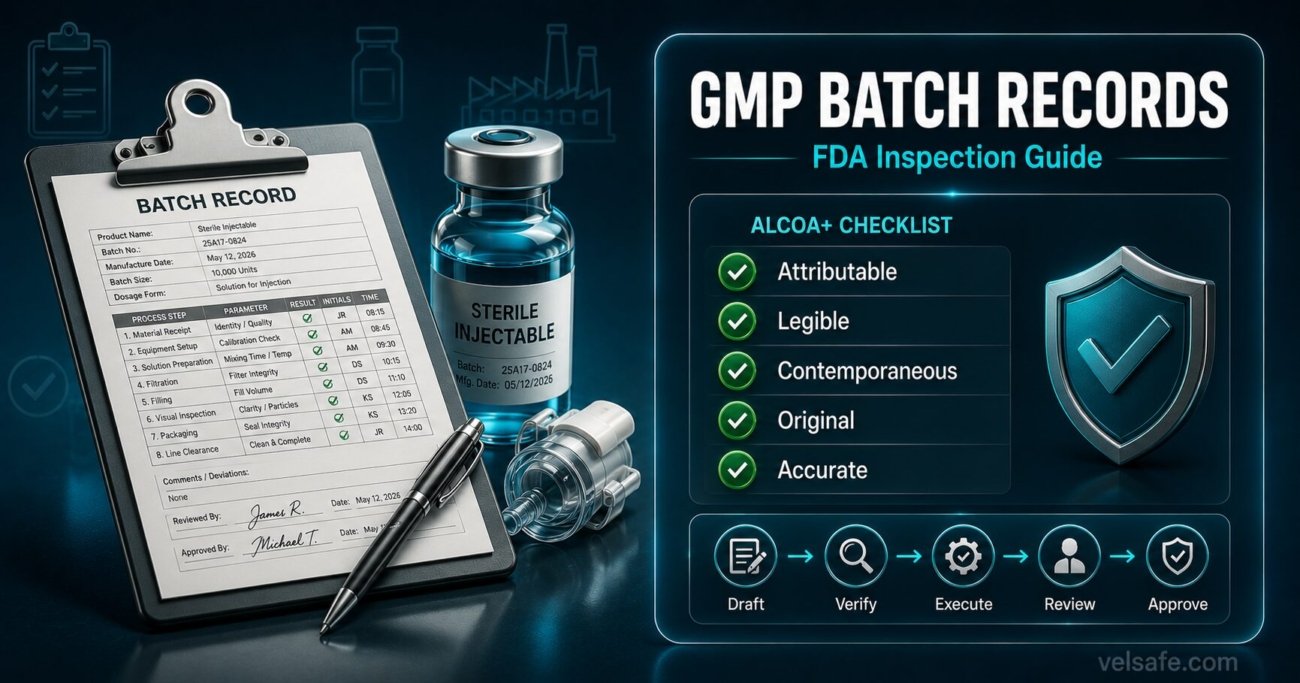
An FDA inspector opens a batch record during a routine inspection. She turns to page four. A weighing step shows the correct quantity, but the operator’s signature is missing. The next page documents a temperature deviation, noted, but with no investigation reference. By page six, the inspector has identified three documentation gaps.
The product itself may be perfectly safe. The manufacturing process may have been flawless. But the batch record tells a different story.
In GMP manufacturing, what is not documented did not happen. This guide explains how to build batch records that accurately capture what did.
What This Guide Covers
By the end of this guide, you will understand the regulatory requirements for batch records under FDA and EU GMP frameworks, the difference between master batch records and executed batch records, how to structure records that withstand inspection scrutiny, common documentation errors that trigger FDA observations, and the practical steps for building a batch record review process that catches problems before an inspector does.
This guide applies to both pharmaceutical and medical device manufacturers. While the regulatory references differ: 21 CFR Part 211 for pharmaceuticals and 21 CFR Part 820 for medical devices. The underlying GMP documentation principles are consistent.
The Regulatory Foundation
In GMP environments, the batch record is the legal proof that a product was manufactured correctly. Without it, regulatory authorities have no evidence that GMP was followed, regardless of the actual manufacturing quality.
Master Batch Record vs. Executed Batch Record
Understanding the distinction between these two documents is fundamental.
The Master Batch Record (MBR) is the approved template. It contains complete manufacturing and control instructions for a specific product and batch size. Think of it as the recipe. It is prepared, dated, signed, and independently verified. It changes only through formal change control.
The Executed Batch Record (EBR) is the completed document for a specific production run. It captures what actually happened during manufacturing, actual weights, actual temperatures, actual times, actual operator actions. It is the evidence that the recipe was followed.
Every executed batch record must be traceable back to its master. If the master says “mix for 15 minutes at 200 RPM,” the executed record must show the actual mixing time and the actual RPM recorded by the operator who performed the step.
What Goes Into a Master Batch Record
Under 21 CFR 211.186, the master batch record must include the following elements.
Product identification: name, strength, dosage form, and a description of the product.
Complete manufacturing instructions: each step of the process, including the order of operations, specific equipment to be used, process parameters (temperatures, pressures, times, speeds), and in-process controls.
Component list: the name and quantity of every component (active ingredients, excipients, processing aids), with specific reference to quality standards.
Sampling and testing procedures: what samples to collect, when, and what specifications they must meet.
Yield expectations: theoretical yield at appropriate stages, with acceptable limits for actual yield.
Special precautions: environmental controls, safety measures, cleaning requirements, or handling restrictions.
For medical devices under 21 CFR 820, the equivalent is the Device Master Record (DMR), which contains device specifications, production process specifications, quality assurance procedures, and packaging and labelling specifications.
Building a Batch Record: Step by Step
Step 1: Define the Product and Process
Before creating the batch record template, confirm that the manufacturing process is validated, all process parameters are established, equipment is qualified, and analytical methods are validated. The batch record documents a validated process. It should not be used to develop one.
Step 2: Draft the Master Batch Record
Write every instruction as if the operator has never performed the task before. Include specific quantities, specific equipment identifiers, specific parameter ranges, and specific acceptance criteria. Avoid vague instructions like “mix until homogeneous”, instead specify “mix at 200 RPM for 15 minutes and verify homogeneity by visual inspection per SOP-XXX.”
Step 3: Build In Verification Points
At every critical step, include spaces for the operator’s signature, the date and time, the actual value recorded, and a second verification signature where required. Double verification is expected for critical steps such as component weighing, material additions, and label reconciliation.
Step 4: Include Deviation Handling
Add clear instructions for what to do when something goes wrong. If a parameter falls outside the specified range, the batch record should direct the operator to stop, document the deviation, notify the supervisor, and reference the deviation investigation SOP. Never leave operators guessing.
Step 5: Review and Approve
The master batch record must be independently reviewed and approved before use. This typically involves review by production, quality assurance, and regulatory affairs. Document the review with dated signatures from each approving function.
Step 6: Control Distribution
Issue controlled copies for production use. Maintain version control. When the master is revised through change control, retrieve and destroy all previous versions. Operators should never have access to superseded batch record templates.
Common Batch Record Errors That Trigger FDA Observations
The most frequently cited error. Every step that requires an operator signature must have one. Every step that requires a verifier signature must have one. Blank signature lines tell an inspector that the step was either not performed or not verified.
When a process parameter falls outside the specified range and no deviation is recorded, the inspector sees an uncontrolled process. Every deviation, no matter how minor, must be documented, investigated, and resolved before batch disposition.
Entries must be made at the time the activity is performed, contemporaneous documentation. Records that appear to have been completed after the fact, or that show alterations without proper correction procedures (single-line strikethrough, initials, date, and reason), create serious data integrity concerns.
Instructions like “adjust as needed” or “mix until done” provide no objective criteria for the operator and no basis for the reviewer to confirm compliance. Every instruction should be specific and measurable.
Yield calculations, component quantities, and concentration adjustments must be accurate. Include the formula in the batch record so the reviewer can independently verify the calculation.
The Batch Record Review Process
Under 21 CFR 211.192, the quality control unit must review and approve all drug product batch production and control records before batch disposition. The review must confirm that the batch was produced according to the master batch record and current GMP.
An effective review process follows a structured sequence.
Completeness check: verify every page is present, every field is completed, every signature line is signed.
Accuracy check: verify actual values fall within specified ranges, calculations are correct, and yield is within acceptable limits.
Deviation review: confirm every deviation was documented, investigated, and resolved with appropriate corrective action.
In-process and finished product testing: verify all test results meet specifications.
Label reconciliation: confirm label quantities issued, used, returned, and destroyed are accounted for.
Disposition decision: approve, reject, or quarantine the batch based on the complete review.
Use a batch record review checklist. Reviewing without a structured checklist is how errors get missed. The checklist ensures every required element is verified consistently across every batch, regardless of which reviewer performs the assessment.
Data Integrity: The ALCOA+ Principle
Every entry in a batch record must satisfy the ALCOA+ criteria. This is the foundation of GMP data integrity.
The “+” in ALCOA+ adds Complete, Consistent, Enduring, and Available. Together, these principles define what regulators expect from every piece of GMP documentation.
Record Retention
Batch records must be retained for at least one year after the expiration date of the batch. For certain OTC drugs, the retention period extends to three years after distribution. All records must be readily available for authorised inspection during the retention period.
For medical devices, the DHR retention requirements are defined in 21 CFR 820.180 and must align with the expected device lifetime plus any additional regulatory requirements.
Records may be retained as originals, true copies, or validated electronic records compliant with 21 CFR Part 11.
Knowledge Check
Test your understanding before continuing.
No. The actual value of 18 minutes exceeds the specified range of 13-17 minutes. Even though the operator recorded the actual time honestly (which is correct), the out-of-specification result requires a documented deviation, an investigation, and a disposition decision. Recording the value without flagging the deviation means the out-of-specification condition was not investigated.
The operator should add their signature with the current time and date, along with a note explaining the late entry (e.g., “Late entry: step performed at [original time], signature omitted inadvertently”). Backdating the signature to the original time would be a data integrity violation. The late entry should be reviewed during the batch record review process.
The Master Batch Record (MBR) under 21 CFR 211.186 is specific to pharmaceutical manufacturing and contains production instructions for a specific drug product and batch size. The Device Master Record (DMR) under 21 CFR 820.181 is specific to medical devices and contains the complete design and manufacturing specifications for a finished device. Both serve the same fundamental purpose: defining how the product should be made. But they operate under different regulatory frameworks with different structural requirements.
Batch Record Readiness Checklist
✓ Master batch record is current, approved, and under version control
✓ All manufacturing instructions are specific and measurable
✓ Verification points are built into every critical step
✓ Deviation handling instructions are included
✓ Signature lines exist for operator and verifier at each required step
✓ Yield calculations include formulas and acceptance limits
✓ Sampling and testing instructions reference current SOPs
✓ Label reconciliation section is included
✓ Review checklist is available for QA batch record review
✓ Record retention procedures are documented and followed
✓ Electronic records comply with 21 CFR Part 11 where applicable
✓ Training records confirm operators are qualified for the documented process
Your First Practical Step
Pull the most recently completed batch record from your facility. Review it against the ALCOA+ criteria. Check every signature line. Verify every deviation was investigated. Confirm every calculation is reproducible.
If the record would satisfy an inspector reading it for the first time, with no additional explanation from production staff, it meets the standard.
If it requires verbal context to make sense, the documentation needs improvement.
The batch record should tell the complete story on its own.
Sources
- 21 CFR Part 211: Current Good Manufacturing Practice for Finished Pharmaceuticals (FDA)
- 21 CFR Part 820: Quality System Regulation / QMSR for Medical Devices (FDA)
- 21 CFR Part 11: Electronic Records; Electronic Signatures (FDA)
- FDA Guidance for Industry: Data Integrity and Compliance with Drug cGMP
- EU GMP Annex 15 and Chapter 4: Documentation
- ISO 13485:2016: Medical Devices Quality Management Systems