
A maintenance technician tells her supervisor that a guard on a conveyor belt is loose.
The supervisor nods. Thanks her for mentioning it. Moves on to the next task.
Three weeks later, another worker catches their sleeve in the same conveyor. The guard is still loose. The injury requires surgery and twelve weeks of recovery.
During the investigation, OSHA asks a simple question.
“Was this hazard reported before the injury?”
The answer, in this case, was yes. The consequences extend far beyond a single citation.
What the Law Actually Requires
Most employers understand that OSHA requires a safe workplace. Fewer understand that OSHA also requires employers to maintain systems that allow safety information to flow in both directions: from management to workers and from workers to management.
The obligation is not optional. Section 5(a)(1) of the OSH Act, the General Duty Clause, requires employers to provide a workplace “free from recognized hazards likely to cause death or serious physical harm.” A hazard that was reported by an employee and ignored by management is, by definition, a recognized hazard. The employer knew. The employer did not act.
OSHA’s Recommended Practices for Safety and Health Programs identify worker participation and open communication as core elements of an effective safety program. These are not suggestions buried in a guidance document. They represent OSHA’s stated expectations for how compliant workplaces should operate.
Employers who receive safety feedback and fail to act on it are not simply making a management mistake. They are creating a documented trail of recognized hazards and unaddressed risk.
Section 11(c): The Retaliation Rule Most Employers Underestimate
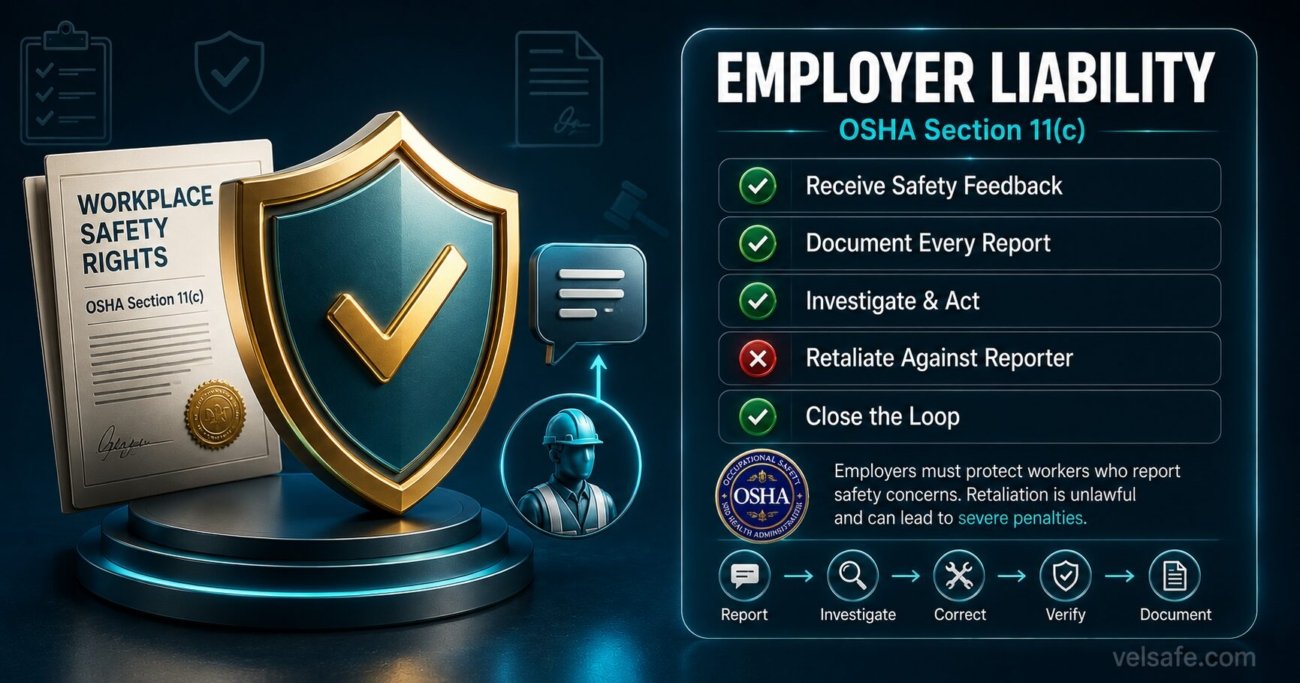
Section 11(c) of the OSH Act prohibits employers from retaliating against any employee who reports a safety concern, files a complaint, participates in an OSHA inspection, or exercises any right under the Act.
The protection is broad. It covers employees who report hazards to their supervisor, file complaints with OSHA, refuse to perform tasks they reasonably believe present a danger of death or serious injury, or even talk to coworkers about safety concerns.
The employee’s safety complaint does not need to be correct. Section 11(c) protects the act of raising the concern, regardless of whether the hazard actually existed. An employee who reports a chemical exposure concern that turns out to be unfounded is still protected from retaliation for making the report.
What Counts as Retaliation
Retaliation is not limited to termination. OSHA defines adverse action broadly.
It includes demotion, transfer to a less desirable position, reduction in hours, denial of overtime, negative performance evaluations connected to reporting activity, exclusion from training opportunities, intimidation, threats, and any other action that would discourage a reasonable employee from raising safety concerns.
The connection does not need to be explicit. If an employee reports a safety hazard in January and receives an unexplained negative performance review in March, the timing alone may be sufficient to establish a prima facie case of retaliation.
The 30-Day Filing Window
Employees who believe they experienced retaliation must file a complaint with OSHA within 30 calendar days of the adverse action. This is one of the shortest filing deadlines in federal employment law. However, employers should not rely on this tight window as a defence. State whistleblower laws often provide significantly longer filing periods and broader protections.
The Real Risk: What Happens When Feedback Channels Fail
The legal exposure from ignoring safety feedback is not limited to a single citation.
When an injury occurs at a location where a prior complaint was documented, OSHA can pursue willful violation classifications. A willful violation indicates the employer knowingly failed to correct a recognized hazard. The maximum penalty for a willful violation currently exceeds $160,000 per violation, and OSHA can apply penalties per instance.
Beyond OSHA enforcement, documented evidence that an employer received and ignored safety feedback becomes powerful material in civil litigation.
The pattern appears frequently in fatality investigations. OSHA reviews communication records, near-miss reports, maintenance requests, and employee complaints. When the investigation reveals that the hazard was previously communicated and not addressed, the enforcement response escalates significantly.
Employer Obligations for Safety Communication
OSHA expects employers to maintain communication systems that accomplish several objectives simultaneously.
Communicating Hazards to Workers
Employers must inform workers about hazards present in the workplace and the measures in place to control them. This extends to all recognized hazards, including physical, ergonomic, and procedural risks.
Operating procedures must be established, updated when conditions change, and communicated so that employees can follow safety and health requirements. Training must be provided in a language and vocabulary workers can understand.
Receiving Safety Feedback from Workers
Equally important, employers must create mechanisms for workers to report hazards, near misses, and safety concerns without fear of retaliation. OSHA’s Recommended Practices explicitly identify worker participation as essential to effective safety programs.
This means more than posting a suggestion box. Effective feedback systems include clear reporting procedures, accessible forms, timely responses to every report, documented follow-up actions, and visible accountability.
Multiemployer and Contractor Communication
On worksites with multiple employers, host employers have additional communication obligations. OSHA expects host employers to coordinate with contractors and staffing agencies to ensure that all workers on site receive consistent safety information and that hazard communication does not fall through gaps between organizations.
Documentation: The Compliance Record That Matters Most
Documentation transforms safety communication from a verbal exchange into an auditable compliance record.
Every safety concern reported by an employee should be documented. The documentation should include the date the concern was raised, who raised it, the nature of the hazard, who received the report, what investigation was conducted, what corrective action was taken, and when the corrective action was completed.
This documentation serves two purposes. During an OSHA inspection, it demonstrates that the employer takes safety feedback seriously and responds with appropriate action. During litigation, it shows that the employer’s safety management system functions as intended.
The absence of documentation creates the opposite impression. If an employer claims to have an open-door policy for safety concerns but cannot produce records of any reports received, investigated, or resolved, the credibility of the entire safety program comes into question.
What Inspectors Look For
Compliance officers frequently examine communication-related documentation during inspections.
Inspectors also interview employees. They ask whether workers feel comfortable reporting safety concerns, whether they have been trained on reporting procedures, and whether they have observed retaliation against colleagues who raised safety issues.
The gap between what employers believe their communication culture looks like and what employees actually experience during these interviews is one of the most common sources of enforcement action.
Common Compliance Mistakes
The most frequent error. Supervisors acknowledge safety concerns verbally but do not document them, investigate them, or implement corrective actions. The worker reasonably concludes that reporting is pointless. The hazard remains.
When supervisors interpret safety feedback as personal criticism, the dynamic shifts from collaborative problem-solving to defensive confrontation. Workers quickly learn which supervisors welcome feedback and which supervisors penalise it.
Many employers who retaliate against workers for raising safety concerns do not believe they are retaliating. They believe they are managing performance. The supervisor who gives a negative review to a worker who “always complains about safety” may genuinely believe the review is justified. OSHA evaluates the timing, the pattern, and the connection.
An open-door policy without documented procedures, response timelines, and accountability measures is a communication system in name only. OSHA expects structure, not slogans.
Workers who report hazards and never hear what happened next stop reporting. Closing the loop means informing the reporting worker about the investigation, the findings, and the corrective actions taken. This feedback cycle sustains a reporting culture over time.
Building a Compliant Safety Communication System
Compliance does not require complex technology. It requires consistent practice.
Establish a written procedure for reporting safety concerns. Make reporting forms accessible in the languages spoken by the workforce. Train all supervisors on how to receive safety feedback without defensiveness. Document every report, investigation, and corrective action. Set response timelines and hold managers accountable for meeting them. Include safety communication review in regular management meetings. Protect reporters from retaliation through clear policy and visible enforcement. Communicate outcomes back to the workforce so workers see that reporting produces results.
The system does not need to be perfect. It needs to be genuine, documented, and continuously improving.
Inspection Readiness Checklist
✓ Written safety communication procedures exist and are current
✓ Employees have been trained on how to report safety concerns
✓ Reporting forms are accessible in appropriate languages
✓ Documentation exists for safety concerns received, investigated, and resolved
✓ Corrective action timelines are established and followed
✓ Safety meeting minutes include employee-raised concerns and resolutions
✓ Anti-retaliation policy is documented and communicated to all employees
✓ Supervisors have received training on receiving and responding to safety feedback
✓ Workers can describe the reporting process during interviews
✓ Follow-up communication to reporting employees is documented
What Organisations Should Do Next
The legal framework is clear. Employers who build genuine, documented systems for receiving and acting on safety feedback reduce their regulatory exposure, strengthen their defence in litigation, improve hazard identification, and build the kind of safety culture where workers actively participate in preventing injuries.
The organisations that face the most significant enforcement actions are rarely those with the most hazards. They are the ones where the hazards were known, reported, and left unaddressed.
Safety feedback is not a management inconvenience. Under OSHA, it is a legal obligation, a compliance requirement, and one of the most valuable sources of hazard intelligence available to any employer.
The question is not whether workers will identify hazards. They always do.
The question is whether the organisation has built a system that listens.
Sources
- OSH Act, Section 5(a)(1): General Duty Clause (29 U.S.C. § 654)
- OSH Act, Section 11(c): Whistleblower Protection (29 U.S.C. § 660(c))
- OSHA Safety Management: Communication and Coordination
- OSHA Employer Responsibilities
- OSHA Whistleblower Protection Program: Section 11(c)
- OSHA Section 11(c) Investigator’s Desk Aid (Updated October 2024)
- OSHA Publication 3812: Protection From Retaliation
- OIG Audit: Whistleblower Protection Under Section 11(c)