

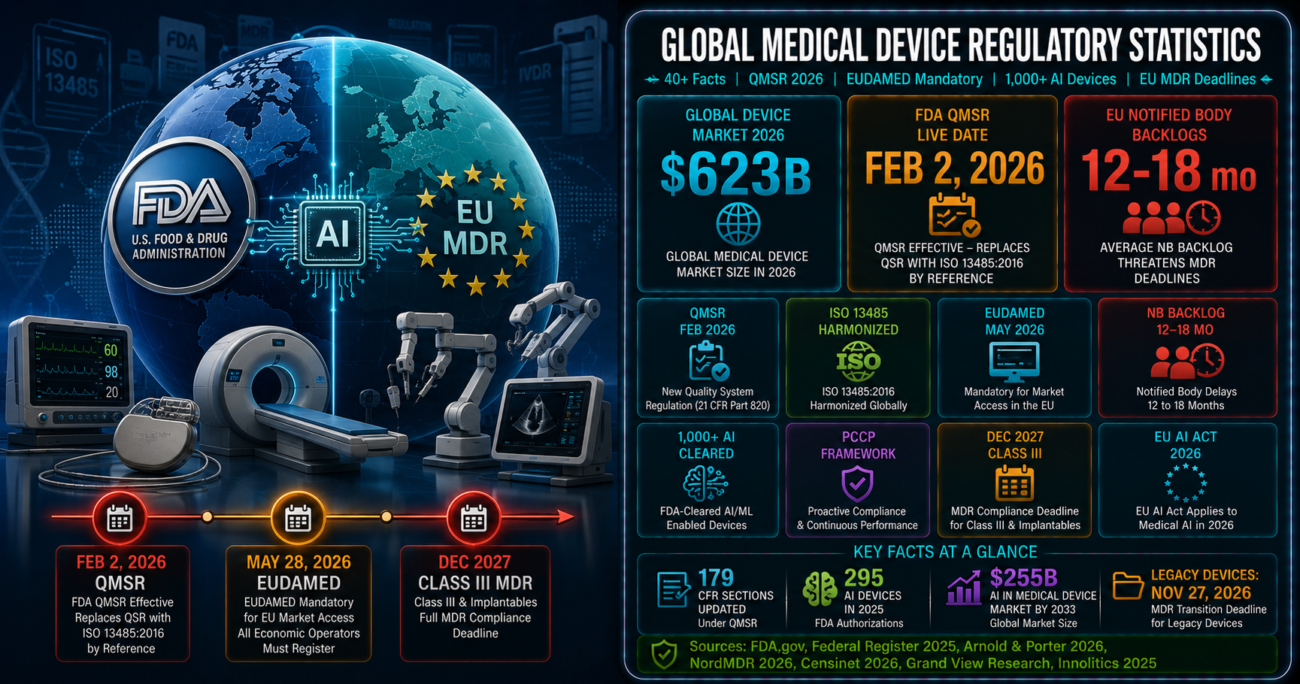
Editor's Choice: Key Global Regulatory Statistics for Medical Device Manufacturers
In the span of four months in early 2026, two of the world’s three largest medical device regulatory frameworks reached major enforcement milestones simultaneously. On February 2, 2026, FDA’s Quality Management System Regulation (QMSR) took effect, ending the Quality System Regulation (QSR) that had governed U.S. device manufacturing compliance since 1996 and replacing it with a regulation that incorporates ISO 13485:2016 by reference. FDA immediately stopped using QSIT for inspections and began using a new inspection process under Compliance Program 7382.850. On May 28, 2026, EUDAMED registration became mandatory for every entity in the EU medical device supply chain, with no registration meaning no legal EU market access, effective immediately and without a grace period.
These simultaneous milestones, combined with the FDA’s record-pace clearance of AI/ML medical devices (1,000+ cleared through early 2026, 295 in 2025 alone) and the EU AI Act’s high-risk device obligations phasing in between August 2026 and 2027, define the global regulatory strategy landscape that medical device manufacturers must navigate to remain competitive. This article compiles 40+ statistics on the QMSR transition, EU MDR/EUDAMED compliance, AI device regulation, go-to-market sequencing, and the specific 2026-2028 deadline framework that determines market access.
1. FDA QMSR: What Changed on February 2, 2026, and What It Means for Manufacturers
- The QMSR final rule was issued February 2, 2024, and became effective February 2, 2026, after a two-year transition period. FDA provided no additional grace period – full compliance with QMSR was required from the effective date. PMA and HDE applications received after February 2, 2026 must demonstrate QMSR compliance; applications received before that date under QSR requirements are evaluated under the QSR. FDA QMSR FAQ; Morgan Lewis, October 2024
- QMSR represents the most significant change to U.S. medical device quality compliance in nearly three decades. The critical compliance shift from the manufacturer’s perspective: risk-based thinking is no longer confined to design controls. Under QMSR, FDA expects risk-based decision-making to be embedded in day-to-day operations, supplier management, software validation, production controls, change management, complaint handling, CAPA, and management review – and those risk-based decisions must be provable through documented evidence. ComplianceQuest, April 2026
- On February 2, 2026, FDA simultaneously withdrew QSIT (Quality System Inspection Technique) and the documents governing the prior inspection process (7382.845 and 7383.001). All FDA inspections are now conducted under the new Compliance Program 7382.850. The 820.180(c) exceptions that previously allowed manufacturers to withhold management review records and quality audit reports from FDA inspectors are no longer operative under QMSR. FDA.gov; Federal Register, December 4, 2025
- A QMSR-specific complication for premarket submissions: FDA issued a draft guidance on October 27, 2025 describing QMS information expected in PMA and HDE submissions under QMSR. This draft guidance, cited by Alston and Bird (November 2025), signals that FDA expects manufacturers to identify gaps early, document risk-based rationales clearly, and foster structured collaboration across internal and external teams in preparation for submissions under the new framework. FDA draft guidance, October 27, 2025; Alston and Bird, November 2025
- Manufacturers already certified to ISO 13485 faced primarily documentation alignment work in the QMSR transition. Manufacturers who were compliant with QSR but not ISO 13485 faced substantially more change – particularly in risk management integration, supplier controls, and the shift from DMR/DHF/DHR documentation to the Medical Device File structure. The QMSR technical amendments published December 4, 2025 updated 179 sections across 18 parts of Title 21, reflecting the scope of the regulatory apparatus that needed to align with the new standard. Federal Register, December 4, 2025; Complizen, May 2026
2. EU MDR and EUDAMED: The May 2026 Mandatory Use Date and the Notified Body Crunch
- The European medical technology market was estimated at approximately $170 billion in 2024, representing 26.4% of the global medical device market – second only to the U.S. at 46.4%. The top five EU markets are Germany, France, the United Kingdom, Italy, and Spain. EUDAMED compliance is now the operational entry condition for participating in this market. Arena Solutions, December 2025
- For non-EU manufacturers, EUDAMED compliance requires appointing an EU Authorized Representative (EU AR) – a legal entity established in the EU who registers with EUDAMED on the manufacturer’s behalf, holds a valid SRN, and assumes co-responsibility for EUDAMED data accuracy. Arnold and Porter (February 2026) explicitly flags this: “failure to plan early for notified body engagement and certificate renewals can result in missed market opportunities.” Arnold and Porter, February 2026
- The MDR deadline framework for device class compliance: Class III and implantable Class IIb devices must hold a valid MDR certificate from a Notified Body by December 2027. Class IIa and non-implantable Class IIb transition must be complete by December 2028. Class I devices requiring a Notified Body (sterile, measuring, reusable surgical instruments) have their own timelines. With 12-18 month backlogs, manufacturers who have not yet submitted are at concrete risk of missing these mandatory windows. NordMDR, May 2026
- The UDI obligation compounds the EUDAMED registration requirement. For new MDR-compliant devices placed on the EU market on or after May 2026’s mandatory EUDAMED date, UDI/device registration must be completed before the device may be placed on the market. For legacy devices already on the market, manufacturers have until November 27, 2026 to complete registration – or the device must be withdrawn. Arena Solutions, December 2025; MDX CRO, June 2026
- The December 12, 2025 European Commission proposal introduced a draft Implementing Regulation to standardize quality management and procedural protocols for notified bodies under the MDR and IVDR – directly addressing the transparency and variability concerns raised by manufacturers navigating the NB selection and engagement process. This proposal signals continued EU regulatory evolution and adds another tracking obligation to the global regulatory calendar. Arnold and Porter, February 2026
- Article 10a (effective January 2025, introduced by Regulation EU 2024/1860) introduces a mandatory supply interruption notification obligation: manufacturers must notify authorities, economic operators, and health institutions of any interruption or discontinuation of supply that could result in serious harm. Failure to notify about an unavailable device registered as “On the Market” in EUDAMED may lead to double liability. This provision links EUDAMED data accuracy directly to supply chain legal exposure. Celegence, December 2025
3. AI/ML Medical Devices: 1,000+ Cleared, 295 in 2025, and Two New Regulatory Layers
- FDA cleared or approved over 1,000 AI/ML medical devices through early 2026, with 95-97% going through the 510(k) pathway. Radiology has consistently dominated AI clearances – accounting for approximately 75% of 2025 AI/ML 510(k) entries – but April 2026 data shows radiology’s share dropping from 79% to 56% as AI expands into cardiology, pathology, and other specialties. GE HealthCare topped FDA’s AI-enabled device authorization list for the fourth year running as of July 2025, with 100 listed authorizations. IntuitionLabs, March 2026; Censinet, June 2026; Innolitics, 2026
- FDA’s January 2025 draft guidance on AI-Enabled Device Software Functions introduced the Predetermined Change Control Plan (PCCP) – a mechanism that allows manufacturers to pre-specify anticipated algorithm changes and validation methods, avoiding the need to file a new 510(k) every time the model is retrained. As of 2025, PCCPs were included in approximately 10% of AI/ML 510(k) submissions. Censinet, June 2026; IntuitionLabs, March 2026
- Manufacturers pursuing AI device clearances face two converging regulatory layers in 2026-2027: FDA’s evolving AI/ML device framework under the 510(k) pathway, and the EU AI Act’s high-risk device obligations, which begin phasing in August 2026 and run through 2027. An AI-enabled medical device classified as high-risk under the EU AI Act must comply with both the EU MDR (CE marking) and EU AI Act (Annex III conformity assessment) requirements – adding a second conformity assessment obligation that does not exist for non-AI devices. IntuitionLabs, April 2026
- AI device safety monitoring is emerging as a gap. By mid-2025, only approximately 5% of FDA-cleared AI devices had reported adverse event data (including device malfunctions and one death). IntuitionLabs notes that post-market monitoring is still lagging behind the pace of clearances – a pattern that regulators in both the U.S. and EU are expected to address through strengthened post-market surveillance requirements. IntuitionLabs, April 2026
- The AI-enabled medical devices market was valued at $13.67 billion in 2024 and is projected to reach $255.76 billion by 2033 at 38.5% CAGR. North America holds 52.86% of the current market; Asia Pacific is the fastest-growing at 40.84% CAGR. Software dominates at 51.15% revenue share, with radiology representing the largest therapeutic area. Grand View Research, 2026
4. Market Size and Go-to-Market Sequencing: The $623B Opportunity and Three Entry Models
- The global medical devices market reached an estimated $623.37 billion in 2026 and is projected to reach $1.08 trillion by 2035 at a 6.34% CAGR. The U.S. (46.4% global share) and EU (26.4% global share) together account for nearly three-quarters of the global market – making effective simultaneous access to both markets the single highest-value regulatory strategy objective for most device manufacturers. Toward Healthcare; Market Research Future, 2026
- The QMSR transition creates a strategic harmonization opportunity: manufacturers already ISO 13485-certified now hold a QMS framework that simultaneously satisfies FDA’s QMSR (via ISO 13485:2016 incorporation by reference) and EU MDR’s quality system requirements (which reference ISO 13485 directly). A single ISO 13485-compliant QMS now genuinely serves both major regulatory frameworks, reducing the QMS compliance overhead that previously differed between U.S. and EU requirements. ComplianceQuest, April 2026; FDA.gov
- For emerging market entry, Arnold and Porter (February 2026) identifies a new dynamic in 2025-2026: “The complexity and cost of compliance have led some companies to reconsider EU launches altogether.” This represents a meaningful market access decision signal – companies that cannot afford the notified body engagement timeline and cost for EU MDR compliance are prioritizing other market entry strategies. For competitors who do complete EU MDR certification, the notified body backlog effectively creates a regulatory moat. Arnold and Porter, February 2026
- For the U.S. specifically: FDA cleared around 1,000 AI-powered medical devices from 1995 through August 2024, with the pace accelerating significantly in recent years (295 in 2025 alone). The 510(k) median clearance time for AI/ML SaMD in 2025 was 142 days, with 25% cleared in under 90 days. This pace creates a competitive dynamic where well-prepared submissions achieve market access significantly faster than poorly prepared ones – turning regulatory submission quality into a competitive differentiator. Innolitics, December 2025; Toward Healthcare, 2026
5. Post-Market Surveillance: The Expanding Obligation Across All Major Jurisdictions
- Post-market surveillance obligations have expanded materially on both sides of the Atlantic in 2025-2026. Under QMSR, FDA’s removal of the 820.180(c) exceptions means that management review records, quality audit reports, and supplier audit reports that were previously shielded from FDA inspection can now be requested and reviewed during device manufacturer inspections. This fundamentally changes what manufacturers must be prepared to show during an FDA inspection. FDA QMSR FAQ; ComplianceQuest, April 2026
- EU MDR’s post-market framework through EUDAMED adds a transparency dimension that is new to most manufacturers: the Market Surveillance module allows EU competent authorities to access real-time device registration, certificate, and incident data. Manufacturers whose EUDAMED data is inaccurate, outdated, or inconsistent with physical product in the market create regulatory exposure through the database itself – independent of product performance. Celegence, December 2025; QServe Group, February 2026
- For AI/ML devices specifically, the PCCP (Predetermined Change Control Plan) mechanism introduced in FDA’s January 2025 draft guidance is the primary tool for managing post-market algorithm changes without continuous 510(k) resubmission. PCCPs specify in advance which algorithm changes are anticipated, how they will be validated, and what performance thresholds must be maintained. Manufacturers developing AI devices who build PCCP frameworks into their initial submissions are positioning their products for faster post-market iteration than competitors who treat the initial clearance as a static endpoint. Censinet, June 2026
- Arnold and Porter (February 2026) identifies a cross-jurisdictional theme: “Every major jurisdiction is strengthening post-market surveillance, clinical follow-up, and real-world evidence requirements. Lifecycle regulation is replacing pre-market approval as the primary risk management framework.” For device manufacturers, this means that regulatory investment does not end at clearance – it becomes an ongoing operational cost with specific reporting, monitoring, and evidence generation obligations that must be resourced and budgeted throughout the device’s commercial life. Arnold and Porter, February 2026
6. Emerging Market Regulatory Trends: Formalization Beyond the U.S. and EU
- The medical devices market outside the U.S. and EU is growing rapidly. Asia Pacific’s AI-enabled device market is growing at 40.84% CAGR – faster than any other region and faster than the global average of 38.5%. For manufacturers with AI device portfolios, the regulatory strategy for Asia Pacific market access is becoming a near-term commercial priority, not a long-term consideration. Grand View Research, 2026
- IMDRF convergence creates a multiplier effect for regulatory investment: a technical dossier structured to IMDRF principles can serve as the foundation for submissions in Canada, Australia, Japan, Brazil, and South Korea with jurisdiction-specific adaptations rather than complete rebuilds. For manufacturers who build IMDRF-aligned documentation from the design stage, the marginal cost of entering each additional IMDRF-aligned market is substantially lower than for manufacturers who build jurisdiction-specific submissions sequentially. global regulatory strategy framework; IMDRF
- The QMS harmonization benefit created by QMSR is specifically relevant for global market access: ISO 13485 certification is accepted as the QMS evidence base by regulatory authorities in the EU, Canada (under MDSAP), Australia, Japan, Brazil, and the U.S. (through QMSR’s ISO 13485 incorporation). A single ISO 13485-compliant QMS with MDSAP audit coverage provides quality system evidence for all five MDSAP member jurisdictions simultaneously – eliminating the need for jurisdiction-specific QMS audits in each market. MDSAP framework; FDA.gov
7. The 2026-2028 Regulatory Calendar: Deadlines That Determine Market Access
- The convergence of QMSR (February 2026), EUDAMED mandatory (May 2026), EU AI Act high-risk obligations (August 2026 through 2027), and the NB certification deadline framework (December 2027/2028) creates the most compressed regulatory compliance calendar the medical device industry has faced in recent history. Each milestone is independently mandatory and independently penalizes non-compliance through market access loss – a missed EUDAMED registration loses EU market access; a missed NB certification deadline removes the ability to continue selling in the EU class affected. global regulatory deadline framework
- FDA is expected to release broader guidance on AI/ML-enabled software in late 2026, formalizing requirements for model performance monitoring, bias documentation, and lifecycle management that have been addressed in draft form through the January 2025 draft guidance. Manufacturers developing AI device submissions in 2026 should build lifecycle management documentation that anticipates these forthcoming finalized requirements. IntuitionLabs; Censinet, 2026
- The MDSAP (Medical Device Single Audit Program) pathway – covering simultaneous audit recognition by FDA, Health Canada, TGA (Australia), ANVISA (Brazil), and PMDA (Japan) – remains one of the highest-value single investments in global regulatory strategy for manufacturers targeting multiple IMDRF-aligned markets. A single MDSAP audit provides QMS evidence for five major regulatory authorities simultaneously, reducing the total audit burden for manufacturers with multi-jurisdictional market access objectives. MDSAP; global regulatory strategy literature
Key Takeaways for Medical Device Regulatory, Quality, and Commercial Teams
Frequently Asked Questions
Government and Regulatory Sources
Government and Regulatory Sources
- FDA / U.S. Regulatory Sources
- FDA.gov – QMSR Overview: effective February 2, 2026; ISO 13485:2016 incorporation by reference; new CP 7382.850; withdrawal of QSIT, 7382.845, and 7383.001
- FDA QMSR FAQ: no transition grace period; 820.180(c) exceptions removed; management review and audit reports now accessible; PMA/HDE submission compliance requirements
- Federal Register December 4, 2025 – QMSR Technical Amendments: 179 CFR sections amended across 18 parts; updating references from QSR to QMSR; APA notice exemption
- ComplianceQuest (April 2026) – FDA QMSR 2026: risk-based thinking across all QMS processes; Medical Device File structure; IBR force of law; spreadsheets cannot scale
- Alston and Bird (November 2025) – QMSR Transition for PMA/HDE: October 27, 2025 FDA draft guidance; QMS information for PMA submissions; gap identification and risk-based rationale
- Morgan Lewis (October 2024) – QMSR Ready? HDE/PMA cutoff; QSR vs QMSR substantial similarity; ISO 13485 transition significance
- EU Regulatory Sources
- Arnold and Porter (February 2026) – EU Medical Device Shake-Up: EUDAMED transition period; notified body oversight reform December 2025; EU Authorized Representative requirements; some companies reconsidering EU launches; lifecycle regulation
- NordMDR (May 2026) – EU MDR Deadlines 2026: EUDAMED May 28, 2026 mandatory; 12-18 month NB backlogs; Class III December 2027 / Class IIa December 2028 deadlines; no grace period; SRN required
- Celegence (December 2025) – EUDAMED Mandatory May 2026: Commission Decision EU 2025/2371 published November 27, 2025; four modules functional; six-month transition; Article 10a supply interruption notification; legacy device deadline November 27, 2026
- MDX CRO (June 2026) – EUDAMED Mandatory Timelines: UDI/Device registration must be completed before new devices placed on market; 12-month transition for legacy devices; Q1 2026 UDI-DI now mandatory
- Arena Solutions (December 2025) – EU UDI Deadlines: $170B European MedTech market (2024); 26.4% global market share; May 28, 2026 new device registration mandatory; November 27, 2026 legacy deadline
- QServe Group (February 2026) – EUDAMED at the Tipping Point: Regulation EU 2024/1860; OJEU publication November 27, 2025; four-module validation; vigilance/PMS modules still in development
- AI Devices and Market Data
- Grand View Research (2026) – AI-Enabled Medical Devices Market: $13.67B (2024) to $255.76B (2033); 38.5% CAGR; North America 52.86%; Asia Pacific 40.84%; software 51.15%; radiology largest therapeutic area
- Innolitics (December 2025) – 2025 AI/ML 510(k) Year in Review: 142-day median clearance; 150-day average; 25% cleared under 90 days; radiology dominance; PCCP in 10% of submissions
- Censinet (June 2026) – AI Medical Devices FDA Approval Process: 1,000+ cleared through early 2026; 95-97% via 510(k); January 2025 draft guidance; PCCP mechanism explained
- IntuitionLabs (March 2026) – FDA AI Medical Device Tracker: 295 authorizations in 2025; radiology share declining from 79% to 56%; PCCPs in 10% of submissions; ~5% adverse event reporting by mid-2025
- Toward Healthcare (May 2026) – Global Medical Devices Market: $623.37B in 2026; $1.08T by 2035 at 6.34% CAGR; GE HealthCare 100 AI authorizations; ~1,000 AI devices from 1995 to August 2024
- Market Research Future (2026) – Medical Devices Market: $688.18B in 2025; $1.38T by 2035; J&J $15B+ annual R&D; Siemens Healthineers/Philips partnership March 2025