


Disclaimer: This article provides general information about OSHA formaldehyde requirements and is not legal or medical advice. Requirements may vary based on specific workplace conditions, industry sector, and applicable state plans. Consult a qualified safety or legal professional for guidance on your specific situation.
Formaldehyde is a colorless, flammable gas with a pungent odor classified by the International Agency for Research on Cancer (IARC) as a Group 1 human carcinogen. In US workplaces, it appears in building materials, adhesives, resins, embalming fluids, tissue preservatives, and as a by-product of combustion. Workers in healthcare, funeral services, construction, wood products manufacturing, and laboratory settings face the highest routine exposure risk.
OSHA’s Formaldehyde Standard at 29 CFR 1910.1048 establishes legally binding exposure limits, monitoring requirements, medical surveillance obligations, engineering controls, PPE standards, and recordkeeping requirements for employers whose workers may be exposed. This guide covers what the standard requires, who it applies to, and what penalties apply when it is violated.
Overview: What the Standard Requires
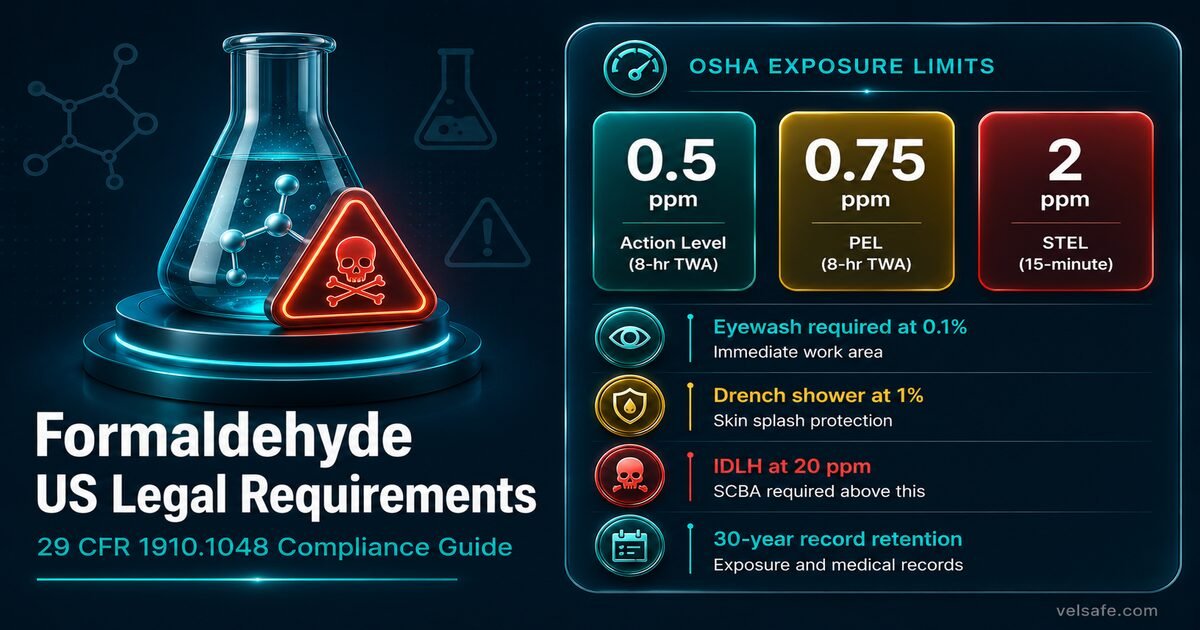
Permissible Exposure Limits
Exposure Monitoring Requirements
Every employer covered by the standard must conduct initial monitoring to determine whether any employee may be exposed at or above the action level or STEL. Initial monitoring must be repeated whenever there is a change in production, equipment, process, personnel, or control measures that may result in new or additional exposure, or whenever an employee reports signs or symptoms of formaldehyde-related conditions.
Periodic monitoring may be discontinued when results from two consecutive sampling periods at least 7 days apart show all exposures below both the action level and the STEL. The employer must notify employees of monitoring results in writing within 15 working days of receiving results.
Regulated Areas
A regulated area must be established in any work area where airborne formaldehyde concentrations exceed the PEL or STEL. Only authorised personnel who have been trained to recognise the hazards of formaldehyde may enter regulated areas. All entrances and access ways to regulated areas must be posted with signs reading:
FORMALDEHYDE
MAY CAUSE CANCER
CAUSES SKIN, EYE, AND RESPIRATORY IRRITATION
AUTHORIZED PERSONNEL ONLY
Key Requirements
Engineering Controls
OSHA requires employers to use engineering and work practice controls to reduce and maintain employee exposure at or below the PEL and STEL, even where respirators are also used. Engineering controls include local exhaust ventilation at points of generation, general dilution ventilation, and process enclosures. Respiratory protection alone is not sufficient where engineering controls are feasible. The standard establishes a clear hierarchy: engineering controls first, then administrative controls, then PPE including respirators.
Medical Surveillance
Medical surveillance must be made available to employees exposed at or above the action level, at or above the STEL, or who develop signs or symptoms of formaldehyde exposure. The surveillance program must include:
Required for all employees who will be assigned to work where exposure may be at or above the action level or STEL. Must be performed before the assignment begins.
Annual medical exams for employees exposed at or above the action level or who develop signs or symptoms. Focuses on respiratory and dermatological health.
Required for employees exposed in emergency situations. Must be conducted as soon as possible after the emergency exposure event.
The cost of medical surveillance is borne by the employer. The examining physician must provide a written opinion to the employer covering fitness for work with formaldehyde, any detected conditions, recommended limitations, and whether additional testing is needed.
PPE and Emergency Equipment
Training and Hazard Communication
All employees exposed to formaldehyde at concentrations at or above 0.1 ppm must be trained at the time of initial assignment and whenever a new exposure to formaldehyde is introduced into the work area. Annual refresher training is required for employees in workplaces where concentrations meet or exceed 0.1 ppm. Training must cover:
Compliance Requirements
Recordkeeping
Employers must maintain exposure monitoring records for at least 30 years. Medical records must be maintained for the duration of employment plus 30 years. The 30-year retention period for exposure monitoring records reflects formaldehyde’s classification as a carcinogen — latent health effects may not manifest until decades after exposure. All records must be made available to employees, former employees, and OSHA upon request.
Housekeeping
For operations involving formaldehyde liquids or gas, employers must conduct a program to detect leaks and spills, including regular visual inspections. Spills must be cleaned up promptly with materials appropriate for the task. Eating, smoking, and drinking must not be permitted in regulated areas.
Penalties and Consequences
Up to $163,939 per violation (2024 adjusted maximum). A willful violation is one where the employer knew about the requirement and intentionally disregarded it or showed plain indifference to employee safety.
Up to $16,394 per violation. Applies where there is substantial probability that death or serious physical harm could result from the condition, and the employer knew or should have known of the hazard.
Workers who develop cancer or serious respiratory illness following documented formaldehyde exposure in a non-compliant workplace have grounds for civil action. Criminal referrals are possible where a wilful violation causes a worker’s death.
Practical Implementation
Formaldehyde is present in many products where it is not immediately obvious: pressed wood products, adhesives, coatings, embalming fluids, tissue preservatives, and as a combustion by-product. Review Safety Data Sheets for all chemicals and materials in use. Occupational hygiene surveys can identify unexpected sources.
Exposure levels vary significantly by task, ventilation, and work practice. Do not assume that because a product contains only a small percentage of formaldehyde, air concentrations will be below the action level. Conduct actual industrial hygiene monitoring and document results.
Local exhaust ventilation at the point of formaldehyde generation is the most effective control. General dilution ventilation, process enclosures, and substitution of lower-formaldehyde-releasing products are also appropriate engineering approaches. Respirators are a last resort, not a primary control strategy.
Medical surveillance must be available before employees begin work that may expose them at or above the action level. Arrange a relationship with an occupational medicine provider experienced with chemical exposure assessments, and ensure physicians receive the required written information about the employee’s formaldehyde exposure and any relevant OSHA standards.
Build records management for formaldehyde exposure data and medical surveillance into your occupational health and safety management system from the first day of operations involving formaldehyde. Do not assume that records kept in a paper binder or on an individual’s computer will survive company transitions, system migrations, or office moves over three decades.
Frequently Asked Questions
Yes. Healthcare workers in pathology labs, anatomy labs, and clinical settings who work with formalin-fixed tissue or embalming fluids are covered by 29 CFR 1910.1048. Eyewash stations are required wherever there is any possibility of eye contact with solutions containing 0.1% or more formaldehyde, which includes standard formalin concentrations used in tissue preservation.
Yes. OSHA’s formaldehyde standard classifies formaldehyde as a potential occupational carcinogen. The International Agency for Research on Cancer (IARC) classifies formaldehyde as a Group 1 human carcinogen. The National Toxicology Program lists it as a known human carcinogen. This classification drives the 30-year record retention requirement and the mandatory “MAY CAUSE CANCER” warning on regulated area signs.
Yes. 29 CFR 1910.1048(d)(2)(ii) provides an exception to initial monitoring where the employer can demonstrate, using objective data such as SDS information, historical monitoring data, or scientifically valid modelling, that the presence of formaldehyde in the workplace cannot result in airborne concentrations that would cause any employee to be exposed at or above the action level or STEL. The objective data and the documentation supporting the determination must be maintained for the duration of the employer’s reliance on it.
NIOSH has established an Immediately Dangerous to Life or Health (IDLH) value of 20 ppm for formaldehyde. At or above the IDLH, only supplied-air respirators or self-contained breathing apparatus (SCBA) in positive-pressure mode are acceptable for respiratory protection. The IDLH is relevant primarily in emergency response and spill scenarios rather than routine occupational exposure situations.
References
Sources
- OSHA, “29 CFR 1910.1048: Formaldehyde”
- OSHA, “Formaldehyde Fact Sheet” (2011)
- OSHA, “Standard Interpretation: Applicability of OSHA standards to formaldehyde exposures in laboratories” (2017)
- OSHA, “Standard Interpretation: Emergency eyewash protection when exposed to 0.1 percent or greater formaldehyde” (2024)
- eCFR, “29 CFR 1910.1048: Formaldehyde”
- Elchemy, “Formaldehyde Exposure Limits for Manufacturing: US Compliance Requirements” (2026)
