

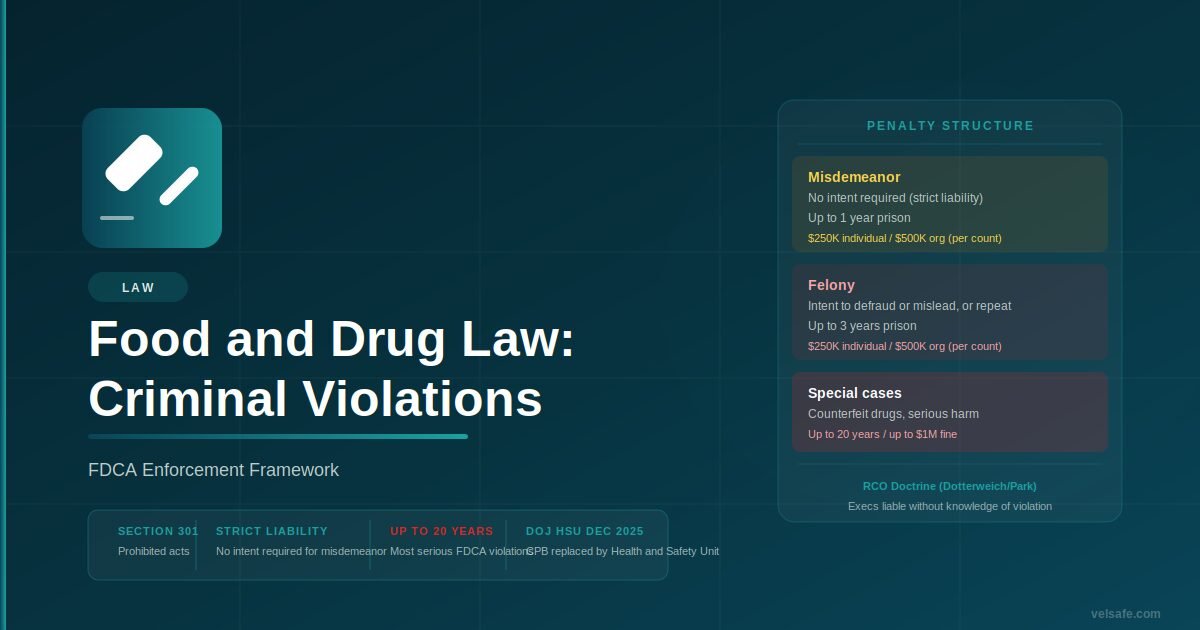
The Federal Food, Drug, and Cosmetic Act (FDCA) contains a criminal enforcement framework that is unusual in US law: it allows conviction for certain offenses without proof of intent. A corporate executive can be found guilty of a federal crime because a regulatory violation happened at a facility under their responsibility, even if they had no knowledge of it. This principle, established by the Supreme Court and applied consistently for over 75 years, defines the minimum exposure for anyone operating in food, drug, or medical device industries.
This article covers the criminal provisions of the FDCA: the prohibited acts under Section 301, the penalty structure under Section 303, the strict liability standard and the Responsible Corporate Officer doctrine, the 2025 executive order reshaping enforcement, the December 2025 DOJ restructuring, and recent enforcement cases through 2025.
The Legal Framework: FDCA Sections 301 and 303
The FDCA’s criminal enforcement architecture operates through two sections. Section 301 (21 U.S.C. Section 331) identifies the prohibited acts. Section 303 (21 U.S.C. Section 333) provides the penalties for violating them.
The Penalty Structure Under Section 303
Section 303 creates a two-tier penalty structure based on intent and recidivism.
Fines are per count. A company charged with multiple counts of introducing adulterated product into commerce faces multiplied exposure. In large-scale enforcement actions, criminal fines under the FDCA have reached into the billions when combined with False Claims Act liability and forfeiture.
The Strict Liability Standard: The Dotterweich Doctrine
The most distinctive and consequential feature of FDCA criminal enforcement is the strict liability standard established in United States v. Dotterweich (1943) and elaborated in United States v. Park (1975). The Supreme Court held that corporate executives can be convicted for FDCA misdemeanor violations even without proof that they knew about, participated in, or intended the violation.
A corporate officer who has the authority and responsibility to prevent or correct a violation of the FDCA can be criminally convicted for that violation even without personal knowledge of it. The key question is not whether the executive knew — it is whether they had the power to prevent the violation and failed to do so.
The government must show that a prohibited act occurred; that the defendant was a corporate officer or responsible party in a position to prevent the violation; and that the violation was not the result of an exercise of reasonable care. The defendant does not have to be shown to have acted with knowledge or intent for misdemeanor liability.
A CEO, plant manager, quality director, or other officer in a food, drug, or medical device company can be charged with a federal crime based on what happened at their facility — even if they personally took no action toward the violation. The defense is demonstrating that they exercised reasonable care, not that they were unaware.
The Enforcement Landscape: 2025 Changes
Executive Order 14294: Fighting Overcriminalization
On May 9, 2025, President Trump issued Executive Order 14294, “Fighting Overcriminalization in Federal Regulations,” which explicitly states that criminal enforcement of strict liability regulatory offenses is “generally disfavored.” The order directs agencies to consider civil or administrative enforcement rather than criminal prosecution for strict liability offenses, calls for clear mens rea (intent) requirements, and requires agencies to inventory criminal regulatory offenses within one year.
EO 14294 does not change the underlying law. The FDCA’s strict liability provisions remain in effect. What the EO signals is an enforcement priority shift: the current administration will prefer civil and administrative tools over criminal prosecution for no-intent regulatory violations. This matters significantly in practice — FDA misdemeanor referrals to DOJ have historically been the primary vehicle for holding executives accountable without proving intent. If DOJ declines more of these referrals, the practical deterrent effect of the RCO doctrine will diminish, even though the legal standard has not changed.
DOJ Restructuring: December 2025
On December 2, 2025, the DOJ disbanded its Consumer Protection Branch (CPB), which had historically investigated and pursued most FDCA misdemeanor cases. Criminal FDCA functions were transferred to the Criminal Division’s Health and Safety Unit (HSU) within the Fraud Section, established on the same date. Civil FDCA functions moved to the Civil Division’s Enforcement and Affirmative Litigation Branch.
DOJ characterized the HSU’s priorities as criminal actions against companies and individuals who fail to maintain sanitary facilities, distribute adulterated or misbranded food or drug products, conceal safety-related information from the FDA, or make significant misrepresentations to the public.
The practical effect of this restructuring on enforcement volume and strategy remains uncertain as of mid-2026. The CPB had built standardized compliance templates for deferred prosecution agreements over many years; whether HSU continues to use these templates is an open question.
Recent Enforcement Cases
Three former executives pleaded guilty in connection with concealing a malfunction in lead testing devices that produced inaccurately low results. Magellan itself previously pleaded guilty to misdemeanor FDCA charges and entered a deferred prosecution agreement on felony charges. This case demonstrates continued DOJ willingness to pursue individual executive liability for concealment of safety defects.
AIS agreed to pay $38.5 million as part of a civil settlement and non-prosecution agreement to resolve allegations of introducing two adulterated medical devices into commerce without proper FDA clearance, due to a former employee’s fraud. The former AIS employee pleaded guilty to one felony count of violating the FDCA and was sentenced to one year in prison and one year of supervised release.
A former McKinsey senior partner pleaded guilty to an obstruction charge in connection with the federal investigation into McKinsey’s role in opioid marketing. This case set a notable precedent as the first known instance of the government alleging that an advisory firm’s advice in connection with a medical product constituted aiding and abetting a conspiracy to violate the FDCA.
What FDCA Criminal Liability Means in Practice
The practical implications of the FDCA’s criminal framework for companies and executives operating in regulated industries:
The FDA Inspection as the Gateway to Criminal Referral
Criminal FDCA enforcement begins with FDA’s inspection and investigation authority. The FDA regularly inspects food producers, pharmaceutical manufacturers, medical device facilities, and other regulated entities. When inspections reveal violations, FDA issues Form 483 observations and, for more serious violations, warning letters. When voluntary compliance is not achieved and FDA determines that criminal prosecution is warranted, it refers the matter to DOJ.
Common Compliance Failures That Lead to Criminal Referral
Food facility sanitation violations are one of HSU’s stated priorities. Repeated CGMP deficiencies in a food production facility, particularly following prior 483 observations, are among the most common triggers for criminal referral in the food sector.
Concealment of known defects, failures, or adverse events — as in the Magellan case — converts potential misdemeanor strict liability into felony prosecution. Obstruction and making false statements to federal investigators add additional criminal exposure beyond the FDCA itself.
Introducing a medical device or drug into commerce without required FDA clearance or approval is a strict liability prohibited act under Section 301. No intent to violate the law is necessary for prosecution.
These are the core prohibited acts. Adulteration covers product contamination, subpotent or superpotent drugs, insanitary manufacturing conditions, and many other quality failures. Misbranding covers false or misleading labeling, inadequate directions, and omission of required warnings.
Obstructing or refusing an FDA inspection is itself a prohibited act under Section 301. Beyond the FDCA, obstruction of a federal agency proceeding carries additional criminal exposure under 18 U.S.C. Section 1505.
Sources
- FDA, “FD&C Act Chapter III: Prohibited Acts and Penalties (21 U.S.C. 331, 333)”
- Congress.gov CRS Report, “Enforcement of the Food, Drug, and Cosmetic Act: Select Legal Issues”
- Ropes and Gray, “FDA Enforcement Review: Looking Back at 2025” (January 2026)
- Sidley Austin, “Strict Liability in the Crosshairs: EO Reshapes FDCA Criminal Enforcement” (March 2026)
- FDLI, “2025 Significant Settlements” (June 2026)
- Federal Lawyer, “FDA Fines and Penalties: An Overview”
- Cooley, “Proceed With Caution: Federal Courts Uphold Criminal FDCA Convictions” (2024)
- White House, “Executive Order 14294: Fighting Overcriminalization in Federal Regulations” (May 9, 2025)