

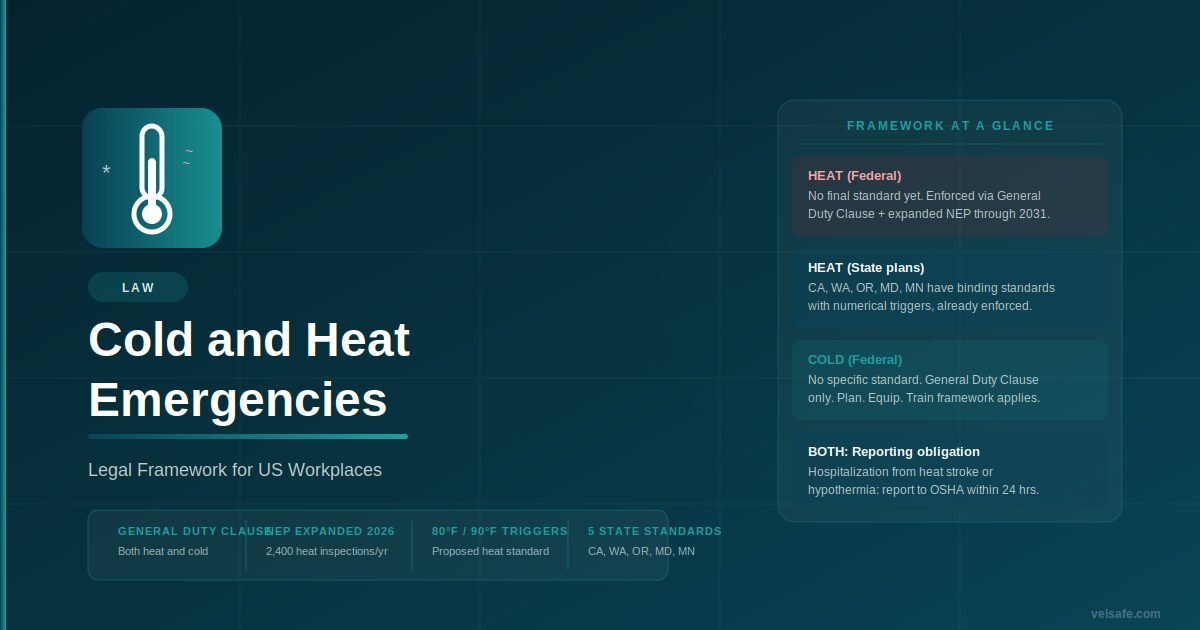
OSHA has never set a specific temperature that is federally “illegal” to work in. For both heat and cold, the legal framework operates through the General Duty Clause rather than a specific numerical standard. That is changing on the heat side, where a federal Heat Injury and Illness Prevention Standard was proposed in August 2024 and enforcement intensity has increased dramatically through an expanded National Emphasis Program. For cold stress, the General Duty Clause remains the sole federal mechanism — but state plans in several jurisdictions have created binding cold exposure requirements.
This article covers the current legal framework for both cold and heat emergencies in US workplaces: the General Duty Clause obligations, the status and key requirements of the proposed heat standard, the enforcement landscape as of 2026, state-specific requirements, and the first aid and recordkeeping obligations that apply when a temperature-related injury occurs.
The Core Legal Mechanism: The General Duty Clause
Neither heat nor cold has a dedicated OSHA standard at the federal level that specifies numerical temperature thresholds for general industry or construction. Both are regulated under Section 5(a)(1) of the OSH Act, known as the General Duty Clause:
“Each employer shall furnish to each of his employees employment and a place of employment which are free from recognized hazards that are causing or are likely to cause death or serious physical harm to his employees.”
Heat stroke, hypothermia, frostbite, and trench foot are recognized hazards. They are documented in OSHA guidance, cited in enforcement actions, and covered in occupational health literature. A workplace condition that creates a genuine risk of any of these outcomes — regardless of whether the temperature exceeds any specific threshold — triggers the employer’s General Duty Clause obligation to abate the hazard.
For a General Duty Clause citation to be upheld, OSHA must demonstrate four elements: the hazard exists in the workplace; the hazard is recognized by the employer or the industry; the hazard is causing or likely to cause death or serious physical harm; and a feasible means of abatement is available. All four are satisfied for heat illness and cold stress across a wide range of industries.
The Heat Side: A Rapidly Evolving Enforcement Landscape
The Proposed Federal Heat Standard
On August 30, 2024, OSHA published a Notice of Proposed Rulemaking for Heat Injury and Illness Prevention in Outdoor and Indoor Work Settings. The proposed standard would apply to all employers conducting outdoor and indoor work in general industry, construction, maritime, and agriculture.
The NPRM was published in August 2024, public hearings concluded by late 2025, and the post-hearing comment period closed on October 30, 2025, but no finalization date has been set, and the rule is not a current administration priority. Employers should not plan around an imminent federal standard.
The proposed standard would also require a written Heat Injury and Illness Prevention Plan, designation of responsible persons, and acclimatization procedures for new employees and those returning after 14 or more days away. It excludes short-duration exposures, emergency response activities, work at indoor sites kept below 80°F, telework, and indoor sedentary work.
The Expanded National Emphasis Program: Current Enforcement Reality
OSHA’s original Heat National Emphasis Program expired April 8, 2026, and was replaced two days later with a revised, expanded NEP effective through April 2031. Heat inspections have increased from roughly 200 per year to approximately 2,400 per year, now accounting for about 6% of all OSHA inspections. Even without a final rule, the enforcement risk is at an all-time high.
State Heat Standards: Actively Enforced Now
Nevada (April 2025), Maryland (September 2024), and California (July 2024) have all enacted heat standards that are actively enforced, with more states expected to act ahead of any federal rule.
The Cold Side: General Duty Clause Only at the Federal Level
Although OSHA does not have a specific standard that covers working in cold environments, under the OSH Act of 1970, employers have a duty to protect workers from recognized hazards, including cold stress hazards, that are causing or likely to cause death or serious physical harm in the workplace.
Cold stress is a recognized hazard. It is documented in OSHA’s Cold Stress Safety and Health Guide, referenced in NIOSH criteria documents, and covered in ACGIH Threshold Limit Values for work-warming schedules. A General Duty Clause citation for inadequate cold protection is sustainable.
What Cold Stress Encompasses
Cold stress occurs by driving down the skin temperature, and eventually the internal body temperature. Types of cold stress include trench foot, frostbite, hypothermia, and chilblains.
Core body temperature drops below 95°F. Can occur above 40°F if the worker is wet from rain or sweat. Early sign: uncontrollable shivering. Progressive: loss of coordination, slurred speech, confusion, cardiac event.
Freezing of skin and underlying tissue. Primarily affects extremities. Severe cases require amputation. Do not rub or rewarm before medical care; rewarming followed by refreezing causes greater damage.
Caused by prolonged exposure to wet, cold conditions above freezing. Does not require freezing temperatures. Common in outdoor workers with wet footwear. Can cause chronic nerve and tissue damage.
What OSHA Expects Employers to Do for Cold Stress
OSHA’s “Plan. Equip. Train.” framework for cold stress outlines three categories of employer obligation:
Written cold weather protection plan covering hazard assessment by job task, warming area locations, work-rest schedule protocols, buddy system procedures, and emergency response steps for hypothermia and frostbite. Monitor wind chill, not just air temperature. Schedule demanding tasks during the warmer part of the day where possible.
Appropriate PPE for cold environments: layered clothing, waterproof outer layers, insulated footwear, gloves, face protection. Warming stations or access to heated indoor areas. Warm sweetened beverages (no alcohol). Engineering controls to shield work areas from wind. Two-way communication between workers and supervisors.
Training on recognition of cold stress symptoms (shivering, numbness, slurred speech, confusion, frostbite signs), appropriate PPE selection and use, work practice controls, buddy system responsibilities, and emergency first aid response. Acclimatization for new workers or those returning after extended absence.
First Aid Obligations for Temperature Emergencies
When a heat or cold injury occurs, OSHA’s first aid requirements under 29 CFR 1910.151 apply. The first aid program must address temperature-related emergencies as foreseeable hazards where work is performed in extreme temperature conditions.
Recordkeeping and Reporting Obligations
The Recordkeeping regulation (29 CFR 1904) requires employers to record certain work-related injuries and illnesses. If a worker sustains a work-related injury or illness and receives days away from work, restricted work activity, or medical treatment beyond first aid, the case will need to be recorded. On the other hand, if a worker is only instructed to drink fluids for relief of heat stress, the case is not recordable.
Under 29 CFR 1904.39, employers are required to report to OSHA all work-related fatalities within eight hours, and all work-related inpatient hospitalizations within twenty-four hours. This reporting requirement includes occupational heat-related events such as heat illness, heat stroke, kidney injury, and rhabdomyolysis that result in death or inpatient hospitalization. The same reporting obligation applies to cold-related injuries including hypothermia and frostbite that result in hospitalization.
Common Compliance Gaps
OSHA inspectors under the expanded heat NEP specifically look for a written plan. The absence of one is itself an indicator of inadequate program design.
The majority of heat fatalities occur in the first days of work in a hot environment. New employees and those returning after more than 14 days away require gradual acclimatization with increased workload over 7 to 14 days.
Hypothermia can occur above 40°F with wet and windy conditions. Cold stress risk assessment must consider wind chill and moisture exposure, not just air temperature.
California, Washington, Oregon, Maryland, and Minnesota all have active heat standards with binding numerical triggers and specific employer obligations that go beyond the General Duty Clause. Failure to comply is directly citable.
Field rewarming of a frostbitten extremity that subsequently refreezes causes significantly greater tissue damage than leaving it frozen until medical care. This is an explicit OSHA first aid guidance point and is relevant to employer liability if incorrect instructions are given.
Heat stroke and hypothermia resulting in inpatient hospitalization are mandatory OSHA reports under 1904.39. Missing the 24-hour reporting window adds a separate violation to any underlying heat or cold program deficiency found during the follow-up inspection.
Sources and Regulatory References
- OSHA, “Heat Injury and Illness Prevention: NPRM (August 30, 2024)”
- OSHA, “Heat Exposure Standards”
- OSHA, “Winter Weather: Cold Stress”
- OSHA, “Cold Stress Emergency Preparedness Guide”
- OSHA, “29 CFR 1904.39: Reporting Fatalities, Hospitalizations, Amputations”
- Federal Register, “Heat Injury and Illness Prevention NPRM” (August 30, 2024)
- AlertMedia, “OSHA Heat Regulations: What Employers Need to Know (2026)”
- LegalClarity, “What Temperature Is Illegal to Work In” (April 2026)