

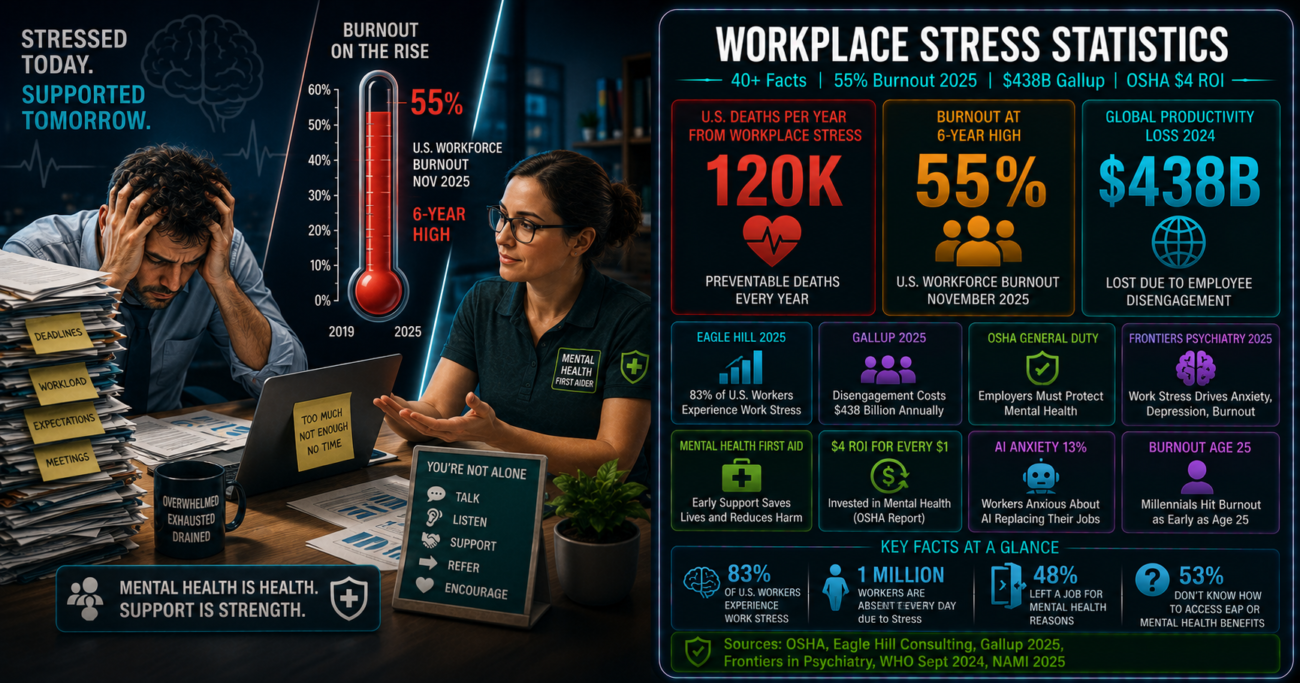
Workplace stress is not a soft issue. OSHA lists 120,000 annual U.S. deaths attributable to workplace stress, primarily through cardiovascular disease. A systematic review of 31 observational studies published in Frontiers in Psychiatry (August 2025) covering 323,978 participants from 17 countries found significant associations between job strain, long hours, shift work, and increased risk of hypertension, ischemic heart disease, and cardiometabolic disorders. The WHO’s September 2024 fact sheet on mental health at work identified depression and anxiety as costing the global economy $1 trillion per year in lost productivity. And Gallup’s 2025 report found global employee engagement dropped to 21% – with the cost of that disengagement reaching $438 billion.
Against this backdrop, the first-aid response to workplace stress has evolved significantly. Mental Health First Aid (MHFA) – an evidence-based training program now recognized by OSHA as a training resource – teaches employees to identify, understand, and respond to signs of mental health and substance use disorders before they escalate. OSHA explicitly notes that for every $1 spent on mental health concerns, employers see $4 back in productivity gains. Below we compile 40+ statistics on the scale, causes, physical consequences, economic cost, and first-aid response framework for workplace stress through 2025.
Editor's Choice: Key Workplace Stress Statistics for 2024-25
1. The Scale of Workplace Stress in 2025: Incidence, Burnout, and Generational Patterns
- Eagle Hill Consulting’s November 2025 workforce survey found that 55% of the U.S. workforce is currently experiencing burnout – a six-year high. This represents a reversal of partial improvements seen in 2023-2024 and reflects compounding pressures including workload intensification, economic uncertainty, and AI-related job anxiety. (Eagle Hill Consulting, November 2025; Springworks, June 2026)
- Gallup’s 2024 global data found that 41% of employees worldwide experience “a lot of stress”, with global employee engagement falling to 21% in 2024 – down two percentage points from 2023 and near a decade low. The cost of that disengagement in lost productivity reached $438 billion globally. (Gallup State of the Global Workplace 2025)
- The generational divide is striking. Gen Z (68%) and millennials (73%) report the highest burnout rates, with the peak age of burnout now at 25 – a full 17 years earlier than the average American’s peak burnout age of 42, according to research compiled by The Interview Guys (May 2026). (HRStacks; The Interview Guys, May 2026)
- Two-thirds of employees (66%) reported feeling burned out in some way during the past year. About 85% of workers in 2025 reported experiencing burnout or exhaustion at some point, with 47% forced to take time off for mental health issues directly. (Moodle 2025; Wellhub, 2025)
- A new driver emerged in 2025-2026 data: AI anxiety now accounts for 13% of burnout, attributable to fear of job displacement by artificial intelligence – a cause that did not appear in burnout data from prior years and reflects the specific stress profile of the current technological transition. (Moodle 2025; Springworks, June 2026)
- Work-life boundary erosion affects a growing share of the workforce: 26% of salaried workers are working outside business hours regularly, and 83% of workers report losing sleep over work stress, per Wellhub’s 2024 State of Work-Life Wellness report. (Wellhub 2024 report; OSHA.gov)
2. Workplace Stress and Physical Health: 120,000 Deaths and the Cardiovascular Evidence
- OSHA’s workplace stress pages report that workplace stress has been reported to cause 120,000 deaths in the U.S. each year, primarily through cardiovascular disease, burnout-driven health decline, and the downstream effects of chronic stress on the immune and metabolic systems. (OSHA.gov; Wellhub, November 2025)
- A systematic review published in Frontiers in Psychiatry (August 21, 2025) analyzed 31 observational studies (15 cohort, 13 cross-sectional, 3 case-control) covering 323,978 participants from 17 countries and found that the key occupational stressors – long working hours, night shifts, and high job strain – were significantly associated with increased risk of hypertension, ischemic heart disease, and cardiometabolic disorders. Study quality ranged from fair to good, indicating low risk of bias. (Alhajaji et al., Frontiers in Psychiatry, August 21, 2025)
- The American Institute of Stress notes that increased levels of work stress have been associated with increased rates of heart attack and hypertension in multiple large-scale studies. Frontiers in Cardiovascular Medicine (September 2024) published an editorial on cardiovascular disease prevention in the workplace identifying stress alongside smoking, poor sleep, and physical inactivity as direct CVD risk factors in the occupational context. (American Institute of Stress; Frontiers in Cardiovascular Medicine, September 2024)
- 83% of workers report losing sleep over work stress (Wellhub 2024 State of Work-Life Wellness). Sleep disruption is a secondary pathway through which chronic workplace stress generates cardiovascular damage – inadequate sleep independently elevates blood pressure, cortisol, and inflammatory markers. (Wellhub 2024; stress physiology literature)
- The WHO’s September 2, 2024 fact sheet on mental health at work identified that stress can be a risk factor for various cardiovascular diseases – a statement that aligns with OSHA’s own positioning of workplace stress as a recognized occupational health hazard under the General Duty Clause. (WHO Mental Health at Work, September 2024; OSHA.gov)
3. The Economic Cost of Workplace Stress: $300 Billion in the U.S., $438 Billion Globally
- Workplace stress costs U.S. businesses more than $300 billion per year in absenteeism, turnover, productivity loss, and medical costs combined. The WHO estimates $322 billion annually in burnout-related productivity loss alone, with healthcare costs related to burnout adding another $125-190 billion. (WHO; Springworks, June 2026; The Interview Guys, May 2026)
- Gallup’s State of the Global Workplace 2025 report found that global employee disengagement cost $438 billion in lost productivity in 2024 – as engagement fell to 21%. This figure represents the aggregate economic loss from employees who are physically present but mentally depleted. (Gallup, 2025; Worktime, 2026)
- For a single 1,000-person organization, disengagement driven by burnout can cost up to $5 million annually in combined lost productivity, turnover, and absenteeism – before accounting for healthcare premium increases driven by stress-related chronic conditions. (Worktime, 2026)
- Approximately 1 million workers are absent on any given workday due to stress-related conditions – representing ongoing daily lost output that compounds across the year into the multi-billion dollar aggregate figures. (Wellhub; Worktime, 2026)
- Employees experiencing burnout are 63% more likely to take a sick day and 2.6 times more likely to actively seek a new job than non-burned-out colleagues. This turnover-acceleration effect makes burnout a business continuity risk, not merely a health issue. (HRStacks, 2026)
- Deprioritizing mental health creates a measurable productivity gap. 34% of employees felt their productivity suffered in 2024 because of mental health. In workplaces with mental health resources, only 21% reported productivity suffering – versus 38% in workplaces without resources. The 17-percentage-point difference is a direct return-on-investment signal. (NAMI 2025; Growtherapy, 2025)
4. The Five Leading Causes of Workplace Stress in 2025-26
- Management quality is the most powerful lever for stress reduction that employers control. Employees with supportive managers are 70% less likely to experience burnout; those in companies with ineffective management are nearly 60% more likely to experience stress than those in well-managed environments. (Gallup 2024 Global Report; HRStacks, 2026)
- Burnout risk is 2.6 times higher in employees who feel unfairly treated at work. Lack of recognition, poor communication, and perceived inequality are major triggers independently of workload. Fairness perception functions as a burnout multiplier across all other stressors. (HRStacks, 2026)
- A 2024 Slack experiment forcing regular breaks instead of continuous work found that productivity increased 21% and employees’ ability to manage stress increased 230% when structured rest breaks were mandated. The intervention cost zero dollars beyond scheduling adjustments. (Slack 2024 study; Wellhub, 2025)
- AI anxiety is an emerging cause: 13% of burnout in 2025-2026 data is now attributable to fear of job displacement by artificial intelligence. This is a new cause category that did not appear in burnout research prior to 2023, and its growing share of the burnout burden reflects how quickly AI-driven workplace change has generated stress at scale. (Moodle 2025; Springworks, June 2026)
5. Mental Health First Aid in the Workplace: Training, Recognition, and Response
- OSHA’s Training Resources page for workplace stress explicitly lists Mental Health First Aid, QPR Gatekeeper Training, and Stress First Aid as recognized training programs. OSHA notes that “more than 85% of employees surveyed in 2021 by the APA reported that actions from their employer would help their mental health” – establishing employee demand for employer action as a documented fact. (OSHA.gov/workplace-stress/training-resources)
- Mental Health First Aid teaches an eight-step action plan: assess for risk of suicide or harm, listen nonjudgmentally, give reassurance and information, encourage appropriate professional help, encourage self-help strategies, along with recognition of warning signs, how to safely approach a colleague in distress, and how to refer to professional services. It does not require the responder to diagnose or treat. (National Council for Mental Wellbeing; OSHA)
- A significant barrier to mental health support access: only 53% of employees know how to access mental health care through their employer, despite the majority of employers offering some form of EAP (Employee Assistance Program). Awareness campaigns about existing resources are among the lowest-cost employer interventions available. (NAMI 2025, cited in Growtherapy)
- Stigma remains a barrier despite rising awareness. While 72% of workers report being comfortable supporting a coworker’s mental health, 42% still refrain from discussing their own mental health concerns – meaning the social environment for disclosure is improving faster than the individual willingness to use it. (NAMI 2025; Growtherapy)
- Flexible work policies produce measurable stress reduction: organizations implementing them report 33% reduction in perceived stress levels. Employees with access to mental health resources are significantly less likely (21% vs. 38%) to report productivity suffering from mental health. (HRStacks, 2026; NAMI 2025)
6. OSHA's Regulatory Framework for Workplace Stress: What Employers Are Required to Do
- OSHA explicitly states on its workplace stress pages that “OSHA can cite employers for failing to mitigate job-related risks that contribute to workplace stress” under the General Duty Clause. While no specific stress standard exists, the General Duty Clause covers recognized hazards – and chronic, documented workplace stress in high-demand environments qualifies. (OSHA.gov; Wellhub, November 2025)
- OSHA’s own return-on-investment statement is unusually direct: “For every $1 spent on ordinary mental health concerns, employers see a $4 return in productivity gains.” This framing from a regulatory agency – not just a wellness vendor – positions mental health investment as a compliance and business case simultaneously. (OSHA.gov/workplace-stress)
- The National Institute for Occupational Safety and Health (NIOSH) defines job stress as “the harmful physical and emotional responses that occur when the requirements of the job do not match the capabilities, resources, or needs of the worker.” This definition creates a measurable gap standard that employers can use to assess whether specific roles or environments are generating hazardous stress levels. (NIOSH; OSHA.gov)
- OSHA’s framework for addressing workplace stress follows a hierarchy of controls approach: redesign jobs to reduce stressors (engineering controls), improve management practices and communication (administrative controls), and provide EAP access and training (individual controls) – in that priority order. Individual-level interventions without organizational change produce only temporary symptom relief. (OSHA.gov/workplace-stress/understanding-the-problem)
7. What the Evidence Shows Works: Effective Employer Interventions
- The single highest-ROI intervention is also the simplest: structured break programs. The 2024 Slack experiment produced 21% productivity gains and 230% improvement in stress management ability just by mandating breaks – with no additional investment. Scheduling policy changes alone outperform most wellness app subscriptions in measured outcomes. (Slack 2024; Wellhub)
- Manager training on stress recognition and supportive communication is the highest-leverage organizational intervention. Employees with supportive managers are 70% less likely to experience burnout. Management quality explains more variance in burnout rates than any other organizational variable across Gallup’s research. Training managers – not just employees – is the mechanism by which organizational culture change reduces stress outcomes. (Gallup; HRStacks, 2026)
- EAP utilization rates remain low despite rising investment. Only 53% of employees know how to access mental health care through their employer – meaning that in any average organization, nearly half the workforce has no idea how to use benefits that may already be paid for. Awareness campaigns about existing resources before adding new ones are the minimum effective intervention. (NAMI 2025)
- Workplace-level job redesign – reducing unmanageable workloads, clarifying roles, and improving communication channels – addresses the three of the top five burnout causes simultaneously: workload, poor communication, and management quality. Organizations that approach stress only through individual wellness interventions (apps, meditation, resilience training) without addressing organizational stressors are treating symptoms while leaving the cause in place. (OSHA framework; stress management literature)
- Mental Health First Aid certification programs create in-house first-responder capacity for mental health events before they escalate to clinical crisis. The National Council for Mental Wellbeing’s MHFA program teaches employees to recognize warning signs, approach colleagues in distress, and connect them to professional services – filling the gap between awareness and clinical intervention. (OSHA.gov/workplace-stress/training-resources; National Council for Mental Wellbeing)
Key Takeaways for EHS, HR, and Safety Professionals
Sources
Government and Regulatory Sources
- OSHA – Workplace Stress Overview: 120,000 annual deaths; 83% U.S. workers stressed; 54% stress affects home life; $4 return per $1 mental health investment; 65% cite work as significant stressor
- OSHA – Understanding the Problem: General Duty Clause applicability; stress as CVD risk factor; comprehensive approach framework; 85% APA survey finding
- OSHA – Training Resources: Mental Health First Aid (NCMW), QPR Institute, Stress First Aid, employer train-the-trainer options
- WHO – Mental Health at Work Fact Sheet (September 2, 2024): $1 trillion global annual cost; depression and anxiety as leading productivity drains; 4:1 ROI for mental health investment
Research and Industry Sources
- Alhajaji et al. Frontiers in Psychiatry (August 21, 2025) – 31 studies, 323,978 participants, 17 countries: long hours, night shifts, job strain linked to hypertension, ischemic heart disease, cardiometabolic disorders
- Frontiers in Cardiovascular Medicine (September 6, 2024) – Cardiovascular disease prevention in the workplace: stress as direct CVD risk factor alongside smoking, poor sleep, and inactivity
- Growtherapy (2025) – 45+ workplace mental health statistics: $438B Gallup 2025, 48% left job for mental health, 66% burned out in past year, 34% productivity loss 2024, NAMI 53% access awareness
- Springworks (June 2026) – 40 workplace stress statistics 2025-26: 55% burnout six-year high; $300B+ U.S. cost; 13% AI anxiety burnout; five leading causes and proportions
- Wellhub (November 2025) – U.S. Work-Related Stress 2025: 120,000 deaths; 1 million absent daily; 83% lose sleep; 49% daily stress; OSHA General Duty citation framework
- HRStacks (2026) – Workplace Stress Statistics 2026: 68%/73% Gen Z/millennial burnout; 70% less burnout with supportive managers; 60% more stress with ineffective management; 33% flex work stress reduction; 2.6x sick day rate for burned-out employees
- The Interview Guys (May 2026) – State of Workplace Burnout 2025: peak burnout age 25 (vs. 42 average); $322B WHO burnout cost; $125-190B healthcare costs; 82% tech employees close to burnout
- Worktime (May 2026) – Employee Burnout Statistics: 1 million absent daily; $5M annual disengagement cost per 1,000-person company; $438B global engagement cost (Gallup 2025)
- American Institute of Stress – Workplace Stress: heart attack and hypertension associations; Headspace 2024 Workforce State of Mind report; 52% burnout rate (Indeed)