

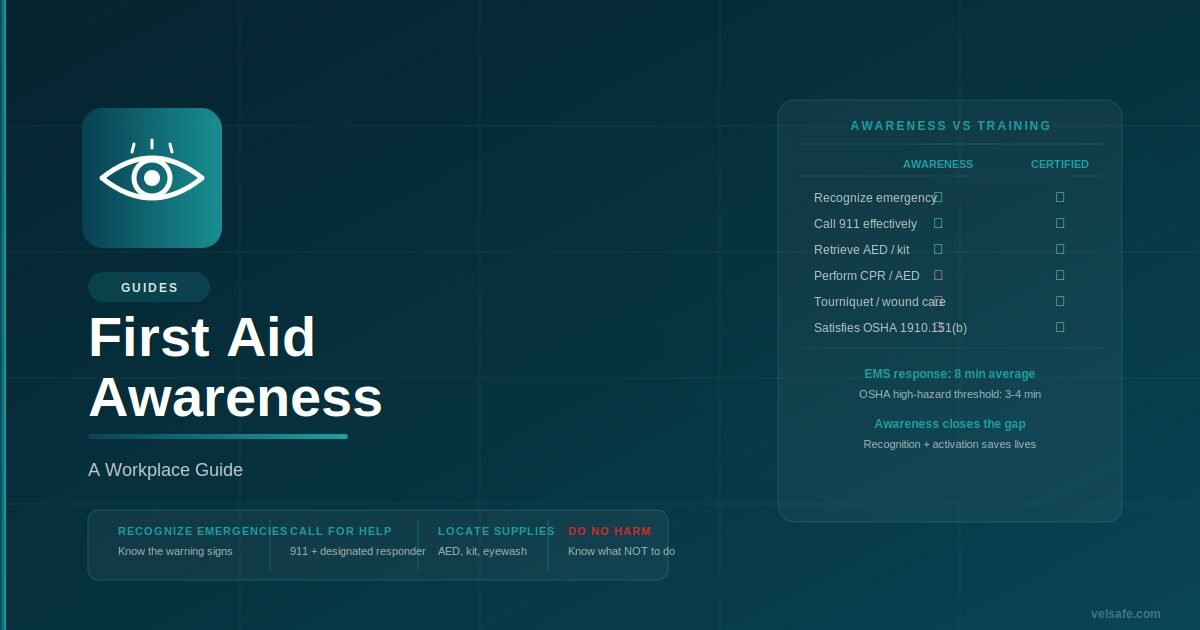
First aid awareness is not the same as first aid training. Awareness gives employees the knowledge to recognize that an emergency is happening, understand what the immediate response should be, know when and how to call for help, and take basic protective actions while trained help arrives. It is the foundation on which a first aid program rests, even for employees who are not designated first aid responders.
This guide covers what first aid awareness includes, how it differs from formal first aid certification, why it matters in terms of OSHA compliance and workplace outcomes, and how it applies across different work environments including office, construction, manufacturing, and remote work settings.
Who This Guide Is For
This guide is for any employee or employer who wants to understand first aid awareness as a baseline workplace safety competency. It is not a substitute for hands-on first aid training and does not provide instruction in clinical first aid techniques. It covers what everyone in a workplace should know — not as a trained responder, but as a person who may be present when something goes wrong.
What First Aid Awareness Covers
First aid awareness at the workplace level encompasses several distinct competencies. None of these require certification; all of them are learnable through orientation, posted materials, and short microlearning sessions.
First Aid Awareness vs. First Aid Training
There is a meaningful difference between awareness and certification, and it matters for compliance and liability purposes.
Why First Aid Awareness Matters Even When Trained Responders Are Present
Even in workplaces with fully compliant first aid programs and designated certified responders, the gap between when an emergency occurs and when a trained responder reaches the scene is where awareness-level employees play a critical role.
An awareness-level employee who recognizes an emergency, immediately directs a specific person to call 911, sends someone to retrieve the AED, and keeps others back from the scene has done exactly what the situation requires while the designated responder is in transit. Recognition and activation are the two most time-sensitive actions in any emergency, and they do not require clinical skills.
Hands-only CPR (continuous chest compressions without rescue breaths) is effective and requires no equipment. Research consistently shows bystander CPR — even by people without formal training — significantly improves cardiac arrest survival. Awareness training that includes hands-only CPR instruction provides meaningful clinical benefit without requiring full certification.
In post-incident reviews of workplace cardiac events, the consistent finding is not that no trained responder was available. It is that 60 to 90 seconds elapsed between collapse and any action by bystanders who were present. In every case, those bystanders had some general knowledge that CPR was something that happened in emergencies — but they did not know how to initiate it, they were waiting for someone else to act, or they did not recognize the collapse as cardiac arrest. Awareness training specifically addresses the gap between “knowing CPR exists” and “beginning compressions when someone collapses.”
First Aid Awareness Across Work Environments
The content of first aid awareness training should reflect the hazards of the specific work environment. A one-size-fits-all awareness program is better than nothing, but a hazard-specific awareness program is meaningfully better.
Core awareness plus recognition of cardiac events (the primary serious medical emergency in sedentary environments), awareness of where the AED is located, and knowledge of how to call the designated first aid responder. Stroke recognition (FAST) is particularly relevant for office environments with older worker populations.
Scene safety awareness is critical here — understanding not to enter a trench that has partially collapsed, not to touch a worker who may be in contact with live electrical equipment, and not to move an injured worker before spine assessment. Awareness of the signs of heat illness and the 3 to 4 minute OSHA response time threshold is also relevant.
Awareness of the location of emergency eyewash stations and how to initiate them for a chemical splash, awareness of the signs of severe bleeding that require immediate tourniquet application (not just a standard dressing), and atmospheric hazard awareness (do not enter a space where a worker has collapsed without confirmed safe atmosphere).
Remote workers need to know their local EMS response time, how to direct emergency services to their specific location, and the basics of self-assessment after a workplace injury. For remote workers performing physical tasks, first aid awareness should include the employer’s expectation for maintaining a personal first aid kit and the process for reporting a work-related injury that occurs at a home location.
The EMS Response Gap: Why Awareness Cannot Wait for the Ambulance
Metropolitan EMS services use an 8-minute response time standard. For high-hazard workplaces, OSHA interprets its “near proximity” standard as a 3 to 4 minute response time. The gap between these two numbers — 4 to 5 minutes in ideal conditions, significantly longer in many locations — is the window during which awareness and first aid make the difference between a survivable outcome and one that is not.
For cardiac arrest, survival probability declines by approximately 7 to 10% for every minute without defibrillation. Awareness-level knowledge that connects an observed collapse to an immediate 911 call and AED retrieval — before a trained responder arrives — is clinically significant in that window.
For severe bleeding, the same logic applies. A workplace laceration that severs an artery can be fatal in under 10 minutes. An awareness-level employee who knows to apply direct pressure immediately, call 911, and get the first aid kit while doing so is providing meaningful intervention, not waiting passively.
Building First Aid Awareness into the Workplace Program
First aid awareness is most effective when it is integrated into the workplace rather than delivered as a standalone event. Practical integration points include:
FAQs
Does first aid awareness training satisfy OSHA’s first aid requirements? No. OSHA 29 CFR 1910.151(b) requires that a person or persons be adequately trained to render first aid, meaning hands-on certified training. Awareness training is a supplement to, not a replacement for, formal first aid certification for designated responders.
Is hands-only CPR considered part of first aid awareness? Yes. Hands-only CPR (continuous chest compressions without rescue breaths) can be introduced in awareness-level training and is effective as a bystander intervention in adult cardiac arrest. It does not require full CPR certification but should be practiced with some hands-on component, even a brief one using a mannequin.
Do remote workers need first aid awareness training? Yes, if their work involves any meaningful physical risk. OSHA 1910.151 applies to work locations, and the employer’s obligation to ensure prompt first aid availability extends to where remote work is performed.
What is the difference between first aid awareness and mental health first aid (MHFA)? First aid awareness covers physical medical emergencies. Mental Health First Aid (MHFA) is a separate certification program that covers recognition and first response to mental health challenges and crises. Both are relevant to workplace first aid programs and complement rather than overlap each other.
Sources
- OSHA, “29 CFR 1910.151: Medical Services and First Aid”
- OSHA, “Best Practices Guide: Fundamentals of a Workplace First-Aid Program” (Publication 3317)
- AHA, “Hands-Only CPR”
- AHA/Red Cross, “2024 First Aid Guidelines” (Circulation, 2024)
- ANSI/ISEA Z308.1-2021: Minimum Requirements for Workplace First Aid Kits
- Mental Health First Aid USA