
29 CFR 1910.151, the OSHA standard governing workplace first aid in general industry, is fewer than 100 words long. It covers three distinct obligations in three short sentences. Despite its brevity, more than 60 OSHA Letters of Interpretation have been issued clarifying what it requires — which tells you something about how often employers get it wrong and what the gaps between the text and the compliance reality actually look like.
This article covers the full legal framework for workplace first aid in the US: the text and meaning of 1910.151 and 1926.50, the role of ANSI Z308.1, what “near proximity” actually means in enforcement, the penalties for non-compliance, and the documentation obligations that OSHA inspectors expect to see.
The Two Primary Standards
Workplace first aid in the US is governed by two standards depending on the industry sector. Both share the same basic framework but differ in specificity.
The Full Text of 29 CFR 1910.151
The standard is short enough to quote in its entirety. Understanding exactly what each sentence requires is the starting point for compliance analysis.
“The employer shall ensure the ready availability of medical personnel for advice and consultation on matters of plant health.”
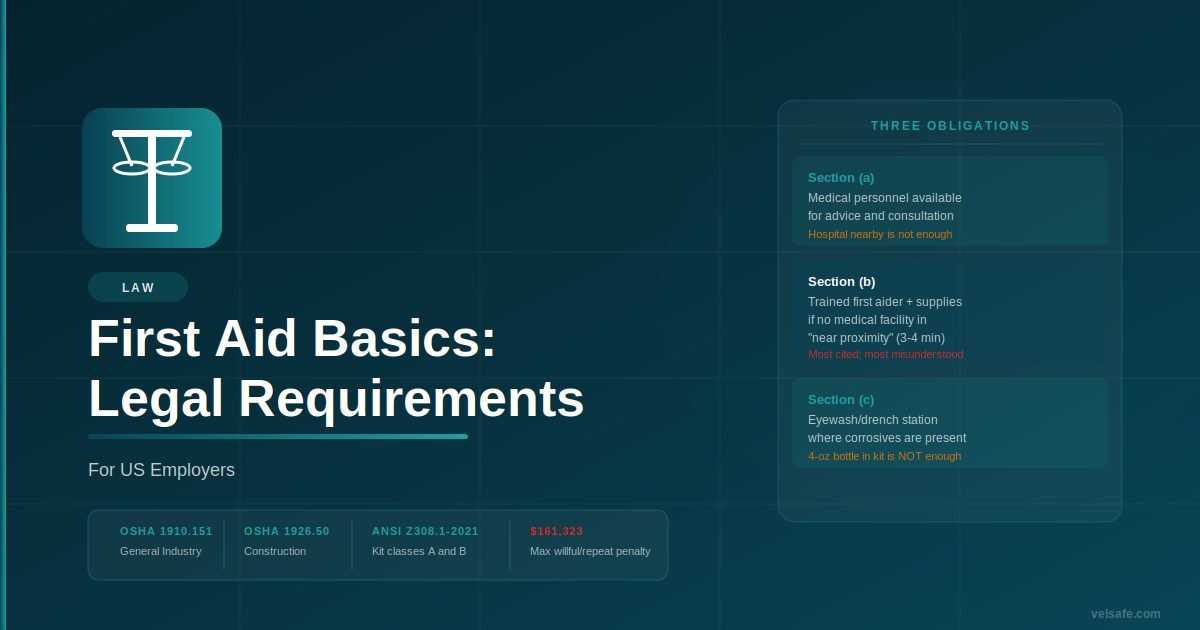
What this requires: Access to a physician or occupational health professional who can advise on workplace health matters. This does not require an on-site physician; a consulting arrangement or access to an occupational health service satisfies the obligation. A hospital across the street does not automatically satisfy this requirement; the employer must verify the arrangement provides actual access for advice and consultation.
“In the absence of an infirmary, clinic, or hospital in near proximity to the workplace which is used for the treatment of all injured employees, a person or persons shall be adequately trained to render first aid. Adequate first aid supplies shall be readily available.”
What this requires: A trained first aid responder on site and adequate supplies, unless a medical facility in “near proximity” is available. This is the most-cited subsection. OSHA’s interpretation of “near proximity” is 3 to 4 minutes EMS response time for high-hazard workplaces — not a hospital a mile away. Computer-based first aid training alone does not satisfy the training requirement; OSHA requires instructor observation of hands-on skills.
“Where the eyes or body of any person may be exposed to injurious corrosive materials, suitable facilities for quick drenching or flushing of the eyes and body shall be provided within the work area for immediate emergency use.”
What this requires: An eyewash station or emergency drench shower within the immediate work area when corrosive chemicals are present. “Immediate emergency use” means within 10 seconds of travel time from the exposure point per ANSI Z358.1. A portable 4-oz eyewash bottle in a first aid kit does not satisfy this requirement for corrosive exposures; it only satisfies the kit contents standard.
What "Near Proximity" Actually Means
The phrase “near proximity” in 1910.151(b) has generated more OSHA interpretation letters than any other element of the standard. The operative interpretation is specific and more demanding than most employers assume.
ANSI/ISEA Z308.1-2021: The Kit Contents Standard
ANSI Z308.1 provides detailed information regarding the requirements for first aid kits; OSHA has often referred employers to ANSI Z308.1 as a source of guidance for the minimum requirements for first aid kits. The 2021 edition defines two kit classes that apply to different workplace risk profiles.
Designed for common workplace injuries in lower-risk environments: offices, retail, light commercial, schools. Covers cuts, abrasions, minor burns, blisters, and sprains. Does not include tourniquet, wound packing material, or hemostatic dressing. Sufficient for low-hazard general industry sites under approximately 25 employees.
Designed for higher-risk environments with expanded injury potential: manufacturing, construction, utilities, warehousing, chemical handling. Includes larger quantities of wound care items, tourniquet, and materials suited to more serious traumatic injuries. Required where lacerations, machinery entanglement, falls, or chemical exposures are foreseeable.
A chemical plant must stock burn treatment supplies; a sawmill must stock wound closure materials appropriate for laceration depth; a warehouse must address struck-by injuries. The ANSI kit classes set a floor, not a ceiling. Employers in high-hazard environments must supplement standard kit contents based on their specific hazard profile.
In first aid program audits conducted before OSHA inspections, stocking a Class A kit in a high-hazard environment is the most common single compliance gap. The employer purchased a standard commercial first aid kit, placed it in a cabinet, and has not revisited whether its contents match the hazard profile of the site. A fabrication shop with metal shears operating daily needs at minimum a Class B kit supplemented with a tourniquet and hemostatic dressing. Class A is not adequate and will not satisfy an OSHA compliance officer who reviews the kit following a laceration incident.
Training Requirements: What Satisfies the Standard
A training program must include instructor observation of hands-on skills, along with written performance assessments, and nationally accepted and medically sound first aid programs meet the requirements of 1910.151. It cannot be all computer-based.
The standard does not specify how many employees must be trained or mandate a renewal interval for general industry. However, instructor-led retraining for life-threatening emergencies should occur at least annually. The American Red Cross recommends CPR renewal annually and first aid renewal every two years.
Eyewash and Drench Facilities: The Section (c) Obligation
Section 1910.151(c) is triggered whenever employees may be exposed to corrosive materials. The compliance standard is ANSI Z358.1, which requires:
Required for continuous corrosive chemical exposure. Must deliver tepid water at the eye for at least 15 minutes. Must be within 10 seconds of travel from the exposure point. Requires weekly activation test and annual plumbing inspection.
Acceptable where plumbing is not available (construction sites, remote locations). Must still provide 15-minute flow. Solution expires and must be replaced on schedule. Still must be within 10 seconds of travel.
A 4-oz eyewash bottle in a first aid kit does not satisfy 1910.151(c) for corrosive exposures. It satisfies the kit contents requirement but not the immediate drench access requirement. An OSHA inspector will cite both deficiencies separately.
Penalties for Non-Compliance
Penalty amounts are adjusted annually for inflation. Current OSHA penalty maximums as of 2024:
Actual penalties depend on employer size, good faith, violation history, and gravity of the hazard. Small employers and those who demonstrate good faith during inspection typically receive reductions. Willful violations following an employee fatality can trigger criminal referral under Section 17(e) of the OSH Act.
Documentation: What OSHA Inspectors Look For
While 1910.151 does not explicitly require a written first aid program, an OSHA inspector following up after an incident will look for documentation that demonstrates the employer had an adequate program in place before the injury occurred.
State Plan Variations
Twenty-nine states and territories operate their own OSHA-approved State Plans, which must be at least as effective as federal OSHA but may be more stringent. Notable examples:
Employers in state-plan states should verify their state’s specific requirements directly, as state plans frequently add requirements that go beyond the federal standard without advance notice to out-of-state employers.
Common Compliance Mistakes
The standard requires verified response time, not distance. A hospital 0.5 miles away with a 9-minute EMS response does not satisfy the 3-4 minute threshold for high-hazard worksites.
Class A is designed for low-risk environments. Construction sites and manufacturing facilities require Class B at minimum, supplemented by hazard-specific items.
OSHA requires instructor observation of hands-on skills. Purely computer-based training does not satisfy 1910.151(b) for responders expected to perform CPR or use an AED.
The compliance obligation exists whenever work is being performed. Night and weekend shifts without a trained responder present are out of compliance.
A portable eyewash bottle satisfies the kit contents requirement but not 1910.151(c)’s requirement for immediate flushing capability when corrosive chemicals are present. Both are separately citable.
In an OSHA inspection following an injury, the compliance officer will ask for these records. “We do inspect the kit” without a log to show it is not a defensible position.
Sources and Regulatory References
- OSHA, “29 CFR 1910.151: Medical Services and First Aid”
- OSHA, “29 CFR 1926.50: Medical Services and First Aid (Construction)”
- OSHA, “1910.151 Appendix A: First Aid Kits (Non-Mandatory)”
- OSHA, “Best Practices Guide: Fundamentals of a Workplace First-Aid Program” (Publication 3317)
- OSHA, “Standard Interpretation: Near Proximity and First Aid Response Times” (2007)
- ANSI/ISEA Z308.1-2021: Minimum Requirements for Workplace First Aid Kits
- ANSI Z358.1-2014: Emergency Eyewash and Shower Equipment
- WC Safety, “OSHA First Aid Kit Requirements: 29 CFR 1910.151 and ANSI Z308.1” (May 2026)