
A construction worker drinks from what he thinks is a water bottle left near his toolbox. It is not water. Within a minute he realizes the liquid has an acrid chemical taste, and he immediately spits out what he can. He is now sitting on the ground, anxious, with a burning sensation in his mouth and throat. No one on site can immediately identify what was in the bottle.
This scenario covers the decisions that must be made in the first two minutes, the role of Poison Control in guiding the response, the most dangerous errors a first aider can make with ingestion poisoning, and the OSHA violations this situation reveals.
The Scenario
Location: A commercial construction site, ground floor of a partially completed building. The toolbox area has several workers’ personal belongings and a collection of unlabeled containers of varying sizes. Some contain drinking water; others contain chemicals used on site including concrete cleaner, pipe cement, and a rust inhibitor.
The people: – Ray, the worker who ingested the unknown substance, now sitting on the ground with burning in his mouth and throat – Sandra, a site foreman with first aid training, who has just arrived – Kevin, a co-worker, who was standing nearby and saw Ray drink from the bottle – The site supervisor, who is on the far side of the building
What is known: The bottle is a standard 500ml clear plastic bottle with no label. Kevin says he saw someone pour something into it from a red container earlier this morning but does not know what it was. Ray says he drank approximately two to three mouthfuls before realizing something was wrong. He spat the remainder out. He has burning in his mouth and throat, is anxious, and his eyes are watering.
Decision Point
Sandra arrives and has 60 to 90 seconds to make the key decisions. What should she do first?
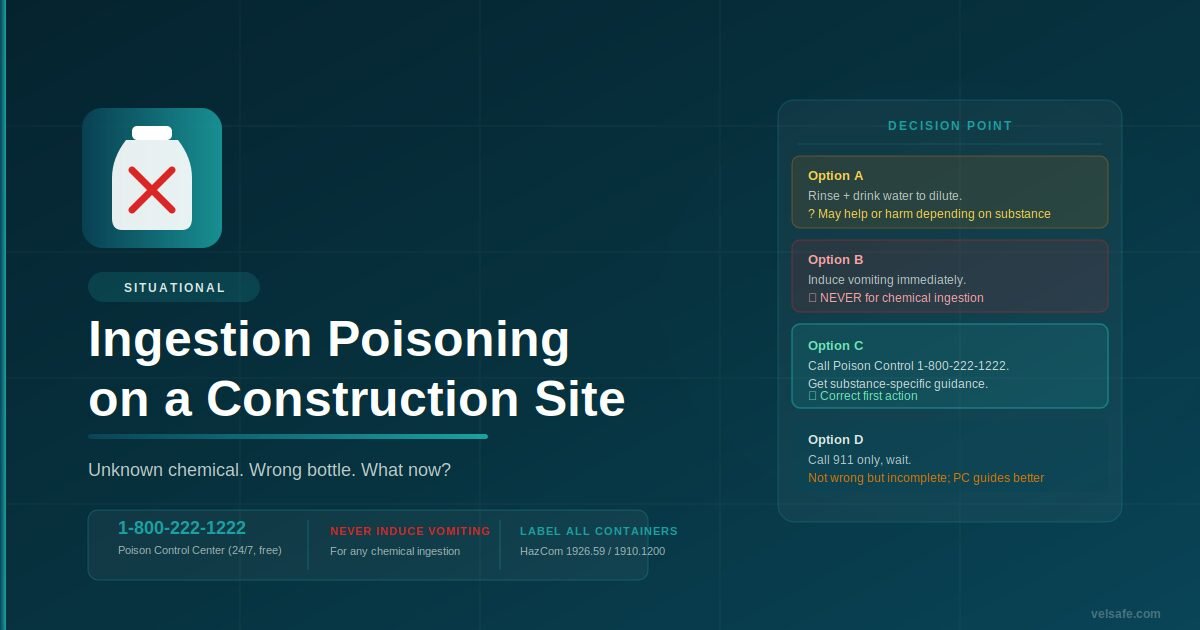
Option A: Have Ray rinse his mouth and drink two large glasses of water to dilute the substance.
Option B: Have Ray induce vomiting immediately to get the substance out of his body before it is absorbed.
Option C: Call Poison Control at 1-800-222-1222 immediately, describe the situation and what is known about the substance, and follow their guidance while gathering more information about what was in the bottle.
Option D: Call 911 immediately and wait for EMS without doing anything else.
What is the correct first action?
Analysis: Why Option C Is Correct as the First Action
The Poison Control Center (1-800-222-1222) provides immediate, substance-specific guidance from toxicologists who can assess severity, direct initial first aid measures, and advise whether EMS is needed based on the actual substance and amount ingested. This guidance is not available from a standard 911 dispatcher. For an ingestion where the substance is unknown but a description is possible, Poison Control is the highest-value first call.
For some ingested chemicals, mouth rinsing with water is appropriate. For others, it causes additional chemical spread. For some, vomiting is absolutely contraindicated because the substance causes additional esophageal injury on the way back up. For others, activated charcoal may be indicated. None of these decisions can be made correctly without knowing what was ingested, and Poison Control is best positioned to guide that decision in real time.
If Poison Control determines the substance and exposure are serious, they will direct Sandra to call 911 immediately and will often remain on the line to relay information. If the exposure is lower risk, they will provide home care guidance and a monitoring protocol. This avoids unnecessary EMS responses for low-risk exposures while ensuring high-risk ones get the appropriate response.
Why Options A and B Are Wrong
Option A (rinse and drink water to dilute) may be appropriate or completely wrong depending on the substance. Rinsing the mouth is generally safe and helpful for many chemical exposures. Drinking large amounts of water is the correct first aid for some ingested chemicals but is specifically contraindicated for others, including strong acids and alkalis, where the water-plus-acid interaction can cause additional injury and vomiting. Without knowing the substance, initiating dilution treatment could make things worse. Poison Control guides this decision.
Option B (induce vomiting) is one of the most dangerous errors in ingestion poisoning response and is never appropriate as a first aid action. Vomiting is contraindicated for strong acids (re-exposure to the acid on the esophagus during vomiting causes additional injury), strong alkalis (same mechanism), petroleum products and solvents (aspiration risk during vomiting is extremely high and causes chemical pneumonia), and corrosive cleaning products. The product in this scenario has caused burning of the mouth and throat, which is consistent with a corrosive substance. Inducing vomiting in the presence of a corrosive ingestion can cause severe esophageal damage and aspiration injury.
Option D (call 911 and wait) is not wrong in itself, but it should not be the first and only action. Poison Control and 911 are not mutually exclusive. Calling Poison Control first for a known or suspected ingestion while a colleague calls 911 simultaneously is the most effective parallel response. If Sandra is alone, Poison Control first is the right call because their guidance shapes everything else that follows.
What Sandra Must Do: Step by Step
The OSHA Violations This Incident Reveals
This scenario is not just a first aid failure. It is the downstream consequence of a series of regulatory compliance failures on the construction site.
Chemical containers must be properly labeled with the product name and hazard information. An unlabeled container of chemicals in a shared work area is a direct HazCom violation. The SDS for every chemical on site must be accessible to workers.
Construction sites must have a person trained in first aid on site and a first aid kit available. The first aid program must address foreseeable emergencies, which on a site with chemical products includes chemical ingestion and skin or eye exposure.
Unlabeled chemical containers stored alongside drinking water containers in a shared worker area is a recognized hazard that creates foreseeable risk of accidental ingestion. The employer’s failure to control this hazard is a General Duty Clause violation regardless of whether a specific OSHA standard explicitly covers this exact configuration.
Learning Points
For chemical ingestion where the worker is conscious and stable, Poison Control provides the most specific guidance fastest. The number is 1-800-222-1222, free, 24/7, and they will direct whether 911 is needed based on the actual substance.
Current guidelines from Poison Control and the AHA do not recommend induced vomiting as a first aid measure for any chemical ingestion. For corrosive substances, it can cause severe additional injury. Wait for Poison Control guidance before any treatment decision.
Storing chemicals in unlabeled containers alongside drinking water containers is a HazCom violation. This incident would be found preventable in any OSHA investigation. Chemical container labeling is a daily operational requirement, not a one-time setup task.
In construction site safety walkthroughs, unlabeled or mislabeled chemical containers appear on the majority of active job sites we assess. The pattern is consistent: workers decant chemicals into smaller containers for convenience without transferring the label. Over the course of a shift, especially at the end of a day when containers are set down and not immediately returned to storage, these unlabeled containers become invisible hazards in shared spaces. A single rule enforced consistently, that chemical containers keep their original label or are immediately discarded after use, would prevent a large proportion of these incidents.
Poison Control Reference
Related Resources
- Poison Control Center: 1-800-222-1222 (24/7, free)
- OSHA, “29 CFR 1926.59: Hazard Communication (Construction)”
- OSHA, “29 CFR 1910.1200: Hazard Communication (General Industry)”
- OSHA, “29 CFR 1926.50: Medical Services and First Aid (Construction)”
- AHA/Red Cross, “2024 First Aid Guidelines” (Circulation, 2024)
- CDC, “Chemical Emergencies: Ingestion Exposure”