

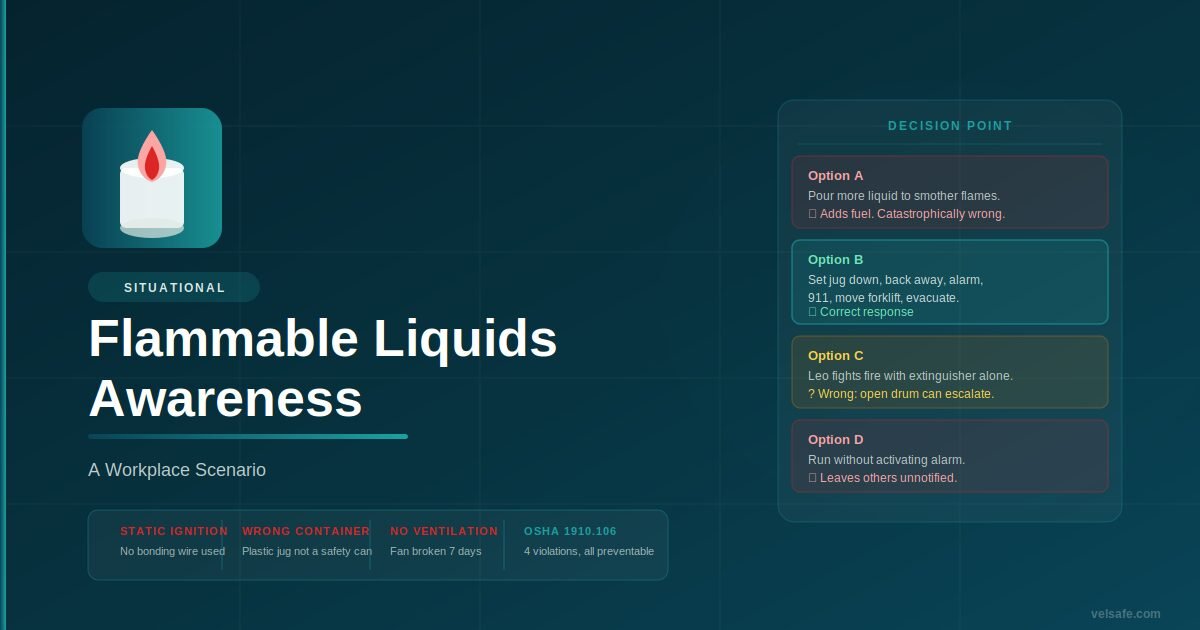
A maintenance technician at a distribution warehouse is decanting mineral spirits from a 55-gallon drum into a standard plastic fuel jug to use for parts cleaning. The work area has been used for this task regularly over the past two years without incident. There is no bonding wire. The container is plastic. The ventilation fan has been broken for a week. A forklift with an electric motor is operating 15 feet away. As liquid flows into the jug, a small flash fire ignites at the pour point.
This scenario works through what happened, why it happened, the decisions that must be made in the next 60 seconds, and the compliance failures that the incident reveals. Each element of this scenario is drawn from the documented pattern of workplace flammable liquid incidents in OSHA case files.
The Scenario
Location: Maintenance area, distribution warehouse. The area contains: – A 55-gallon drum of mineral spirits (Category 3 flammable liquid, flash point approximately 104°F) – A standard plastic fuel jug (not an OSHA-compliant safety can) – No bonding wire between containers – No grounding connection to earth – A broken ventilation fan (inoperable for 7 days) – An electric forklift operating nearby
The people: – Leo, the maintenance technician performing the transfer – Dana, a warehouse supervisor who is walking through the area – Tomek, the forklift operator
What happened: As Leo poured mineral spirits from the drum into the plastic jug, a static discharge at the pour point ignited the vapor above the jug opening. A small flame appeared immediately. Leo pulled the jug away from the drum, spilling additional liquid onto the floor. The spilled liquid is now burning. The drum is still open. Dana is shouting. Tomek has stopped the forklift.
Decision Point
Leo is standing next to a burning spill with an open 55-gallon drum of mineral spirits 2 feet away. He has the jug in his hand. Dana is 8 feet away. A Class ABC dry chemical fire extinguisher is mounted on the wall 20 feet away. The warehouse fire alarm is on the wall 15 feet away. A floor drain is 6 feet from the spill.
What should happen in the next 20 seconds?
Option A: Leo uses the jug to try to smother the flames by pouring more liquid over them.
Option B: Leo sets the jug down immediately, backs away from the drum, Dana activates the fire alarm and calls 911, Tomek moves the forklift away from the area.
Option C: Leo grabs the extinguisher and attempts to fight the fire himself while Dana watches.
Option D: Everyone runs out of the building immediately without activating the alarm or calling 911.
Analysis: Why Option B Is Correct
The open 55-gallon drum is the primary hazard. If heat from the burning spill reaches the drum, the consequences scale dramatically. Leo must not pour more liquid. He must not attempt to cap the drum with his hands. He must not try to move the drum. He should put the jug down, move away from the drum, and get clear of the immediate fire area.
The fire alarm notifies all occupants to evacuate and dispatches the fire department. For a fire involving an open drum of flammable liquid, the fire department is the appropriate response resource — not a single worker with a portable extinguisher. Dana does both: activates the alarm and calls 911 to give the location and nature of the fire.
An electric forklift near a flammable liquid fire is a secondary ignition and fuel risk. Moving it away from the fire area reduces both hazards. Tomek should move the forklift and then evacuate.
Why the Other Options Are Wrong
Option A (pour more liquid to smother the flames) is catastrophically wrong. Adding more flammable liquid to a burning spill increases the fuel available to the fire and the area of the burn. There is no scenario in which pouring mineral spirits on a mineral spirits fire helps.
Option C (Leo grabs the extinguisher alone) may be appropriate for a very small, contained fire where the worker has been trained, has a clear exit behind them, and the fire has not reached the drum or created a risk of explosion. In this scenario, the open drum is 2 feet away and the fire could reach it. A portable extinguisher fight is not appropriate when escalation to the drum is possible. OSHA’s fire response framework is: sound the alarm, call the fire department, evacuate. Attempting to fight a fire that could spread to 55 gallons of flammable liquid is not a one-person job with a portable extinguisher.
Option D (everyone runs without activating the alarm) fails other occupants. The fire alarm exists to notify everyone in the building. Leaving without activating it leaves other workers unaware of the fire and delays the fire department response.
What Caused This: The Compliance Failures
Every element of this scenario is a documented, citable compliance failure. The fire did not happen because of bad luck. It happened because a series of required controls were absent.
1910.106 requires that when transferring Category 1 or 2 flammable liquids, or Category 3 liquids with flash points below 100°F, containers must be bonded to each other. Mineral spirits with a flash point of approximately 104°F is at the margin. Many facilities treat this as a Category 2 task given the variability in mineral spirits formulations. No bonding wire was present. The static discharge at the pour point was the ignition source.
A plastic fuel jug is not an OSHA-compliant safety can. Safety cans have a flame arrester in the pour spout that prevents flashback from the mouth of the container to the liquid inside. A standard plastic jug has no such protection. When vapor at the pour point ignited, it flashed back to the jug opening without resistance.
1910.106 requires adequate ventilation in areas where Category 1 and 2 flammable liquids are used or stored. A broken ventilation fan that has not been repaired for a week allowed vapor concentration to build to flammable levels in the work area. The vapor cloud above the jug was the fuel that ignited.
Even with bonding, grounding to earth is required to dissipate static charge buildup in the system. Without it, both containers can build a shared charge that discharges when the liquid stream makes contact. Grounding removes this risk by providing a continuous path to earth.
The "It Never Happened Before" Problem
This transfer had been performed in the same way for two years without incident. This is the most common statement made in the aftermath of flammable liquid fire investigations.
Static discharge is not a predictable event that happens every time or follows a consistent pattern. The conditions for ignition — sufficient vapor concentration, sufficient static buildup, a discharge path at the right moment — are probabilistic. A transfer operation that has been performed hundreds of times without incident can produce ignition on the next attempt if any of the conditions shift: a drier day increasing static buildup, a slightly different pour rate, a different mineral spirits formulation with a lower flash point, or ventilation that has been compromised. “It never happened before” means the probability was low, not zero. The control measures exist to reduce the probability to near zero on every transfer, not to respond after the ignition that eventually occurs.
Fire Response Framework for Flammable Liquid Fires
When a flammable liquid fire occurs in a workplace, the response sequence should follow OSHA’s fire response hierarchy and the facility’s emergency action plan.
For flammable liquid fires, the correct extinguisher is Class B rated: CO2, dry chemical (BC or ABC), or foam. Water and water-based extinguishers must never be used on flammable liquid fires.
Learning Points
Static discharge is invisible and unpredictable. Bonding and grounding eliminate the risk systematically. They are required by OSHA for Category 1 and 2 transfers. Many facilities add them for Category 3 as well given the variability in formulations.
A broken ventilation fan in a flammable liquid work area is not a maintenance backlog item. It is a live hazard that makes every transfer operation more dangerous. Work involving Category 1 or 2 liquids should not continue when required ventilation is inoperable.
The flame arrester in a safety can’s pour spout would have prevented flashback from the ignited vapor to the liquid in the jug. This is exactly what safety cans are designed for. Using a hardware-store plastic jug removed this protection entirely.