
Flammable and combustible liquids are present in virtually every workplace that performs manufacturing, maintenance, cleaning, painting, or vehicle fueling. The two primary hazards associated with flammable liquids are explosion and fire. What makes these hazards particularly dangerous is that the liquid itself does not burn — the vapors do. A container of flammable liquid can release ignitable vapors at room temperature, and those vapors can travel to an ignition source across a room before anyone realizes there is a risk.
This article covers the OSHA regulatory framework under 29 CFR 1910.106, the classification system workers need to understand, the most commonly violated storage and handling requirements, and the fire prevention practices that prevent the incidents that occur with high frequency in facilities that treat these liquids as routine.
The Regulatory Framework
The Occupational Safety and Health Administration standard for flammable liquids, found in 29 CFR 1910.106, establishes minimum safety requirements for handling, storing, and using these materials in the workplace. The standard applies to any employer that stores, uses, or handles liquids with a flash point below 200 degrees F. That includes solvents, paints, fuels, adhesives, cleaning agents, and many coatings.
The primary basis of this standard is the National Fire Protection Association’s publication NFPA 30, Flammable Liquids Code. NFPA 30 is incorporated by reference into 1910.106 and 1926.152. Where they conflict, the OSHA standard prevails for worker protection. NFPA 30 is more current (2024 edition) and is operationally where most storage design decisions are made.
Classification: Flash Point Drives Everything
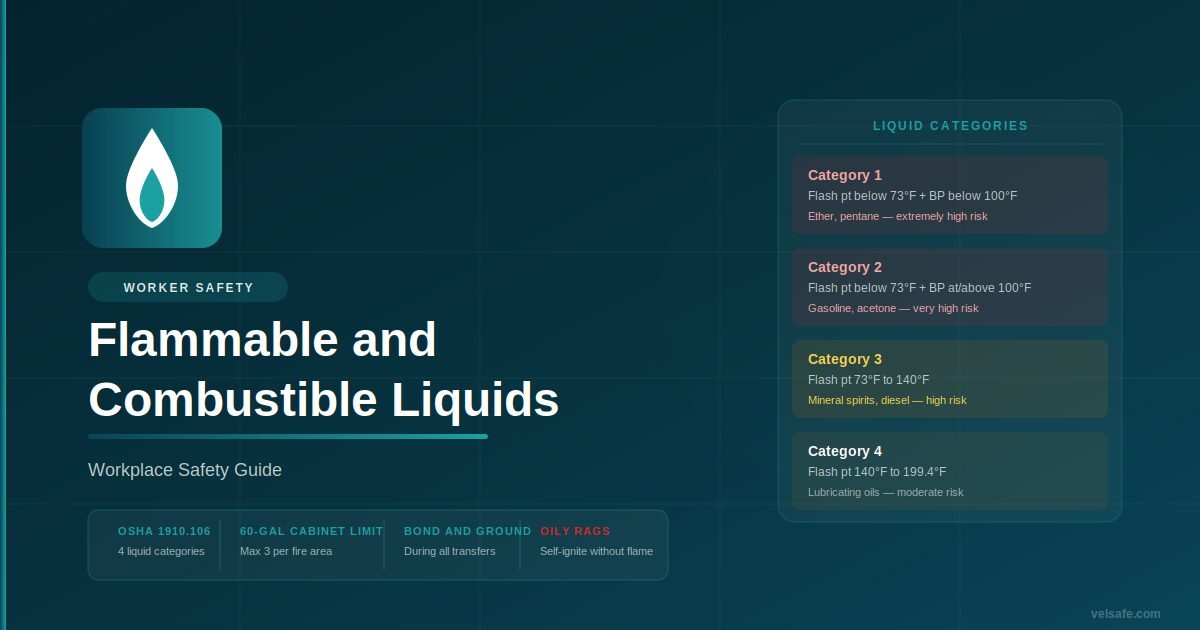
OSHA defines a flammable liquid as any liquid with a flash point at or below 199.4°F (93°C) — the lowest temperature at which it produces enough vapor to ignite in the presence of an ignition source. This definition, reflecting the Globally Harmonized System (GHS), now encompasses what was previously classified as both flammable and combustible liquids.
Storage Requirements
Safety Cabinets
A single cabinet can hold up to 60 gallons of Class I or Class II flammable liquids, or up to 120 gallons of Class III combustible liquids. You can have up to three cabinets in the same fire area. Beyond three, cabinets must be separated by at least 100 feet.
Storage cabinets shall be conspicuously labeled “Flammable — Keep Fire Away.” The bottom, top, door, and sides of metal cabinets shall be at least No. 18 gauge sheet metal and double-walled with 1.5-inch air space. The door shall be provided with a three-point lock, and the door sill shall be raised at least 2 inches above the bottom of the cabinet.
Inside Storage Rooms
Inside storage rooms must feature mechanical or gravity exhaust ventilation providing at least six air changes per hour to prevent vapor accumulation. Aisles of at least 3 feet in width shall be maintained to access doors, windows, or standpipe connections.
Openings to other rooms or buildings shall be provided with noncombustible liquid-tight raised sills or ramps at least 4 inches in height, or the floor in the storage area shall be at least 4 inches below the surrounding floor.
Container Limits
Containers are limited to 60 gallons of Category I, II, or III flammables, or 120 gallons of Category IV, per FM-approved cabinet. No more than three cabinets in a single storage area without additional separation.
The Safety Can Requirement
A safety can has a spring-loaded lid, a flame arrester in the pour spout, and a pressure relief mechanism. These features prevent flashback, contain vapors, and vent safely in a fire. A regular gas can has none of these. Using a standard gas can for workplace flammable liquid storage is a citable OSHA violation.
Static Bonding and Grounding During Transfer
One of the most overlooked fire hazards with flammable liquids is static electricity during transfer operations. When a flammable liquid flows from one container to another, friction between the liquid and the container generates static charge. If that charge builds up and discharges as a spark near flammable vapors, ignition occurs.
When transferring Category 1 or 2 flammable liquids, or Category 3 liquids with a flash point below 100°F (37.8°C), the dispensing nozzle and the receiving container must be electrically interconnected. This process, known as bonding, equalizes the electrical potential between the two objects, preventing static sparks. The liquid container must also be grounded through a conductive path to dissipate static charge buildup.
Static spark from non-bonded transfer is a documented ignition source in numerous OSHA fatality investigations.
Oily Rags and Spontaneous Combustion
One of the most frequently overlooked flammable liquid hazards involves rags and waste materials soaked with drying oils (linseed oil, tung oil, varnishes) or certain solvents. These materials can undergo spontaneous combustion without any external ignition source.
Oily rags from drying oils like linseed oil can self-ignite through spontaneous combustion in just a few hours. Letting waste accumulate overnight in a non-rated container is asking for trouble. Oily waste must be stored in self-closing metal waste cans. Waste cans must be emptied daily or at the end of each shift.
Ventilation Requirements
Areas using Category 1 or 2 flammable liquids must be ventilated at a rate of at least one cubic foot per minute per square foot of solid floor area. Ventilation systems must be arranged to include all floor areas or pits where heavy flammable vapors are likely to collect.
Flammable vapors are typically heavier than air and accumulate at floor level, in pits, and in low-lying areas. Ventilation that exhausts only at ceiling height may fail to capture vapor that accumulates at the floor. Low-level exhaust points are more effective than high-level ones for most flammable vapor categories.
Hot Work Near Flammable Liquids
Hot work — welding, cutting, grinding, brazing — near areas where flammable liquids are stored or have been recently used is a leading cause of workplace fires. The hot work permit system exists specifically to ensure that ignition sources and flammable atmospheres are not introduced simultaneously.
Fire Extinguisher Selection for Flammable Liquid Fires
Flammable liquid fires are Class B fires. Using the wrong extinguisher type on a flammable liquid fire can spread the burning liquid and worsen the situation.
CO2 extinguishers, dry chemical (ABC or BC rated), and foam extinguishers. The extinguisher must be rated for Class B fires. CO2 is preferred for areas with electrical equipment because it does not leave residue.
Water or water-based extinguishers. Water can spread burning flammable liquids and cause the fire to grow rapidly. A water extinguisher on a fuel fire is a documented cause of fire fatalities.
Common Violations Found During OSHA Inspections
In facility safety audits, the most consistently found flammable liquid violations are: standard gas cans used instead of safety cans, storage cabinet quantities exceeding the 60-gallon limit, flammable liquids stored outside approved cabinets or storage rooms, missing or non-functional bonding and grounding equipment at transfer stations, oily rags left overnight in non-metal containers, and flammable liquid storage in areas without adequate ventilation. These are not exotic compliance failures; they are the routine operational decisions of facilities that have never formalized their flammable liquid handling procedures.
A hardware-store gas can lacks flame arrester, spring-loaded lid, and pressure relief. It is a citable 1910.106 violation and a fire hazard.
Adding a fourth cabinet to a storage area without 100-foot separation is a direct 1910.106 violation. Cabinet limits are per fire area, not per cabinet.
Static discharge during uncontrolled transfer is a documented ignition source. Required for Category 1, 2, and Category 3 liquids with flash points below 100°F.
Rags soaked in drying oils can self-ignite in hours. Self-closing metal waste cans, emptied every shift, are required.
Category 1 and 2 liquid areas require at least 1 CFM per square foot of floor area, with exhaust arranged to capture floor-level vapors.
Sources
- OSHA, “29 CFR 1910.106: Flammable Liquids”
- OSHA, “29 CFR 1926.152: Flammable Liquids (Construction)”
- LegalClarity, “OSHA 1910.106 Requirements for Flammable Liquids” (December 2025)
- US Made Supply, “OSHA 1910.106: Flammable Liquid Storage and Cabinet Rules”
- Triangle Safety Consulting, “Understanding the Four Categories of Flammable Liquids”
- SmartQHSE, “Flammable Liquid Storage OSHA 1910.106 2026 Compliance Guide”
- NFPA 30, Flammable and Combustible Liquids Code (2024 edition)