

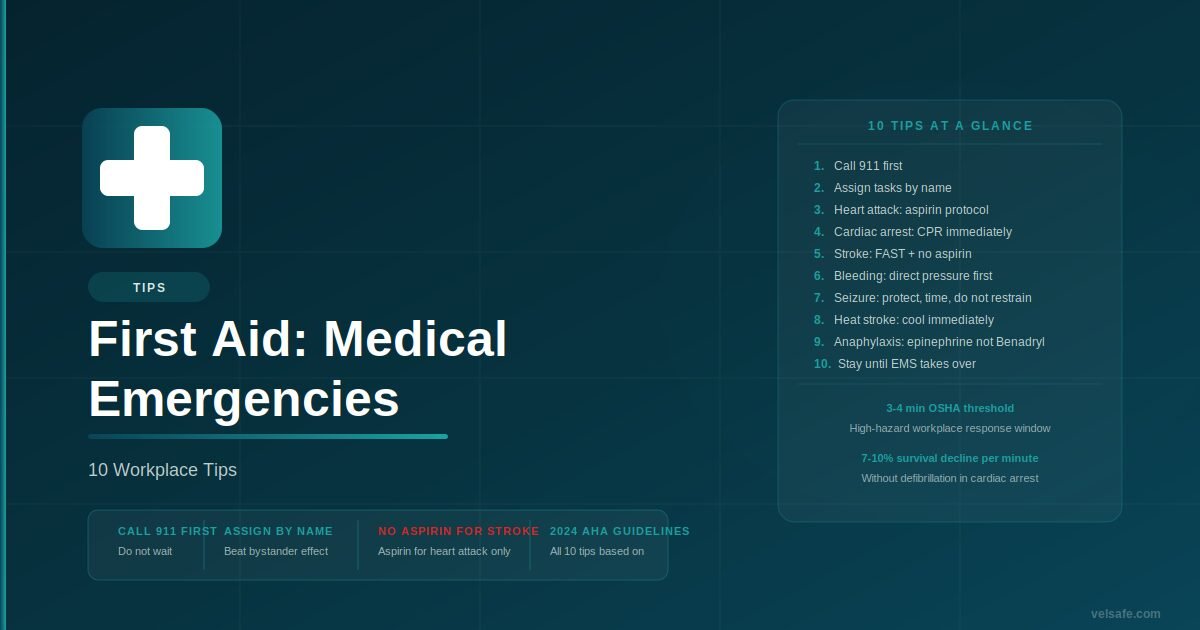
Medical emergencies in the workplace — cardiac events, strokes, severe bleeding, seizures, and heat stroke — are time-critical by definition. The outcome for a worker in cardiac arrest is shaped almost entirely by what happens in the first four minutes, long before an ambulance arrives. These 10 tips cover the first aid decisions that matter most in a medical emergency at work, grounded in the 2024 American Heart Association and American Red Cross First Aid Guidelines.
These tips are designed for any worker who may be a bystander when a medical emergency occurs, not just designated first aid responders. Knowing what to do, what to say to a 911 dispatcher, and what not to do is competency every worker in every environment should have.
1. Call 911 First — Do Not Wait to See If Things Improve
The most consistent error in workplace medical emergencies is delay. A worker has chest pain and says “let me just sit for a minute.” A colleague notices someone is pale and sweating but does not want to overreact. Fifteen minutes later, the situation is far worse and the critical treatment window has closed.
2. Assign Tasks by Name, Not to the Group
When a medical emergency occurs in a shared space and multiple people are present, the bystander effect is the primary risk. In a group, each person assumes someone else has already called for help, retrieved the AED, or begun CPR. The result is that no one acts.
3. Heart Attack: Aspirin Protocol and When It Applies
If a conscious, alert worker has signs of a suspected heart attack (chest pain, pressure, or tightness; pain radiating to the jaw, left arm, or back; shortness of breath; sweating), and they are not allergic to aspirin and have no active bleeding concerns, offering one regular aspirin (325 mg) or two low-dose aspirins (162 mg each) to chew is supported by the 2024 AHA/Red Cross guidelines as a first aid measure.
4. Cardiac Arrest: Start CPR Without Waiting for Anything
If a worker is unresponsive and not breathing normally (no breathing, or only gasping), cardiac arrest is the working assumption. Begin chest compressions immediately. Do not wait for the AED. Do not wait for a more qualified person. Do not check for a pulse first if you are not trained to do so reliably.
In post-incident reviews of workplace cardiac arrest cases, the average delay between collapse and first compression is 60 to 90 seconds — even when multiple people were present. The delay is not ignorance. Workers know CPR exists. The gap is between knowing and initiating. Awareness training that specifically addresses “what you do in the first 10 seconds” reduces this delay more effectively than any other intervention.
CPR mechanics: push hard (at least 2 inches deep) and fast (100 to 120 compressions per minute) on the center of the chest. Allow the chest to fully recoil between compressions. If trained, give 30 compressions then 2 rescue breaths. If not trained in rescue breaths, continuous chest compressions alone are effective and recommended.
5. Stroke: FAST Recognition and the Aspirin Rule
FAST is the recognition tool for stroke: Face drooping on one side when the person tries to smile. Arm weakness when both arms are raised. Speech slurred or cannot be understood. Time — call 911 immediately and note when symptoms started.
Note the exact time symptoms began. Clot-dissolving medications can be given within 4.5 hours of stroke onset. Every minute matters — the time you report to EMS shapes which treatment options are available at the hospital.
6. Severe Bleeding: Direct Pressure First, Tourniquet If Needed
Severe bleeding from a wound can become fatal within minutes. The response sequence is: expose the wound, apply firm direct pressure with the cleanest material available, hold and do not release to check, add more material on top if it soaks through, and escalate to a tourniquet for limb wounds if direct pressure is not controlling the bleeding.
Push hard directly on the wound. Do not check under the dressing. If material soaks through, add more on top. Use gloves from the first aid kit (bloodborne pathogen protection).
Apply 2 to 3 inches above the wound. Not over a joint. Tighten until bleeding stops. Note the exact time applied. Do not remove once applied. Tell EMS the time.
7. Seizure: Protect, Time, Do Not Restrain
A worker having a seizure needs space, protection, and observation — not restraint, not mouth intervention, not food or water.
After the seizure ends, place the worker on their side in the recovery position to protect the airway, and stay with them until they are fully alert.
8. Heat Stroke: Cool Immediately — Do Not Wait for EMS to Start
Heat stroke is the only emergency in this list where the first aid intervention (cooling) must happen as fast as possible, concurrent with calling 911, not after EMS arrives. A body temperature above 103°F with confusion or unconsciousness is heat stroke until proven otherwise. Every minute of delay in cooling increases the risk of permanent organ damage and death.
9. Anaphylaxis: Epinephrine Is the Treatment, Not Antihistamines
When a worker has signs of a severe allergic reaction — hives plus breathing difficulty, throat tightness, or circulatory signs such as faintness or a rapid weak pulse — this is anaphylaxis. Call 911 immediately. If an epinephrine auto-injector (EpiPen) is available and the worker cannot self-administer, assist them per their prescription or training: inject into the outer thigh, can be given through clothing, hold for 10 seconds.
10. Stay Until EMS Assumes Care
A first aid responder’s job is not finished when EMS arrives at the building. It is finished when they have given a verbal handoff to the paramedic taking over the patient’s care. The handoff should include: what happened, when it happened, the worker’s condition on arrival, what first aid was performed (CPR started at what time, tourniquet applied at what time, aspirin given), any SAMPLE history collected, and changes in condition since first contact.
In incident investigations, the handoff from first aider to EMS is the most information-dense moment in the entire chain of response and is frequently handled poorly. The paramedic who takes over a cardiac arrest patient needs to know how long CPR has been running, whether the AED has delivered a shock and when, and what the worker’s baseline condition was before the event. A first aider who has been documenting on their phone (time of collapse, first compression, first shock, any changes) provides information that shapes the first 10 minutes of hospital treatment.
Common Mistakes
For cardiac arrest, stroke, severe bleeding, and heat stroke, delay destroys the treatment window. Call first, then act.
Aspirin for heart attack; not for stroke. Hemorrhagic stroke is worsened by aspirin. No field assessment can distinguish the two types.
Compressions must start immediately. Send someone else for the AED; do not stop or delay compressions to retrieve it yourself.
Antihistamines do not reverse life-threatening anaphylaxis. Epinephrine and 911 are the first-line response.
Restraint increases injury risk without shortening the seizure. Clear the area and protect the head.
The verbal handoff to EMS is part of the first aid response. The time of CPR start, AED shocks, and medication given are critical information for hospital treatment decisions.