

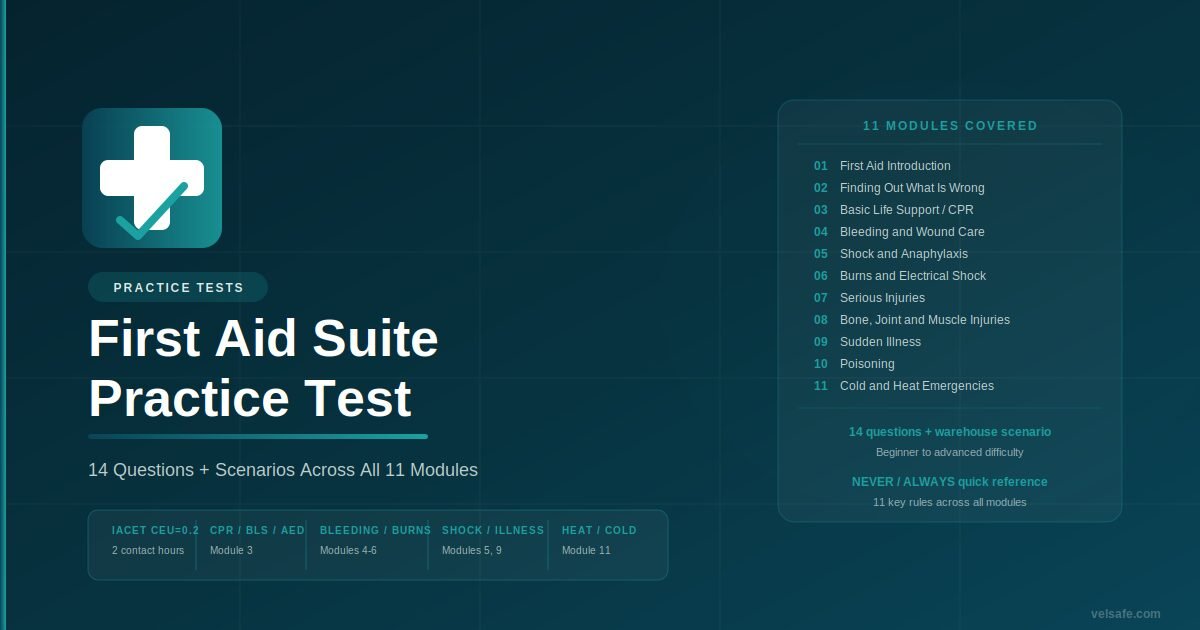
This practice test covers the full US workplace first aid curriculum: patient assessment, basic life support, bleeding and wound care, burns and electrical shock, shock and anaphylaxis, serious injuries, bone and joint injuries, sudden illness, poisoning, cold and heat emergencies, and mental wellness first aid. Questions span beginner to advanced difficulty and include scenario-based application.
This test is suitable for workers preparing for first aid certification renewal, supervisors checking their first aid knowledge baseline, and anyone completing a first aid awareness program. It is not a substitute for hands-on training with a qualified provider.
Module 1: First Aid Introduction and Program Basics
Question 1 | Beginner
Under OSHA 29 CFR 1910.151, what does “near proximity” mean for a high-hazard workplace when determining whether an on-site first aid responder is required?
- A) Within 5 miles of a hospital or clinic
- B) EMS response time of 3 to 4 minutes to the specific worksite address
- C) A medical facility visible from the job site
- D) Within the same zip code as the nearest urgent care center
OSHA has interpreted “near proximity” through multiple Letters of Interpretation as a 3 to 4 minute EMS response time for workplaces where serious injuries (cardiac arrest, severe bleeding, electrocution, suffocation) are possible. Geographic distance is not the measure; verified response time to the specific address is. An employer who cannot document that EMS can reach their worksite within this window must have a trained on-site first aid responder present on every shift.
Question 2 | Intermediate
A first aid kit at a construction site has not been restocked after several incidents over the past month. It now contains only three bandages and one pair of gloves. Which OSHA standards does this violate?
- A) 29 CFR 1926.50 only
- B) 29 CFR 1910.151(b) and 29 CFR 1926.50
- C) Only ANSI Z308.1-2021
- D) No OSHA standard; kit contents are not regulated
29 CFR 1926.50 (construction) requires that first aid supplies be maintained and inspected before each job and at least weekly during the job. 29 CFR 1910.151(b) (general industry) requires adequate first aid supplies be “readily available” at all times. A depleted kit fails both the adequacy standard and the maintenance obligation. ANSI Z308.1-2021 defines what adequate contents look like, but OSHA compliance officers evaluate against it during inspections.
Module 2: Finding Out What Is Wrong
Question 3 | Beginner
A worker is found unconscious near electrical equipment. What is the correct first step?
- A) Tap the worker’s shoulder and check for breathing
- B) Begin CPR immediately
- C) Confirm the power source is off before approaching or touching the worker
- D) Roll the worker away from the equipment
Scene safety is always the first step. A worker who may still be in contact with a live electrical source will conduct current to anyone who touches them. Confirming the power is off — or that a specialist has isolated it — must happen before any physical contact. Touching an electrically connected victim creates a second victim and worsens the outcome for both.
Question 4 | Intermediate
During a secondary survey, you ask a conscious worker the SAMPLE history questions. The “E” stands for:
- A) Evaluation of vital signs
- B) Events leading up to the incident
- C) Emergency contacts
- D) Extremity check
SAMPLE: Signs and Symptoms, Allergies, Medications, Past Medical History, Last Oral Intake, and Events. The Events question asks what the worker was doing when the incident began, whether they felt any warning symptoms, and what led up to the collapse or injury. This information determines whether the cause may still be present (atmospheric hazard, chemical exposure) and shapes EMS triage.
Module 3: Basic Life Support
Question 5 | Beginner
A co-worker collapses and is unresponsive. You confirm she is not breathing normally. You are alone. What is the correct order of actions for an adult?
- A) Begin CPR for 2 minutes, then call 911
- B) Call 911 first, then begin CPR immediately and retrieve the AED
- C) Retrieve the AED first, then call 911, then begin CPR
- D) Wait for a trained responder before starting CPR
For an adult victim when alone: call 911 first (or activate the emergency response system), then begin CPR immediately. For a child, give 2 minutes of CPR before calling 911. The AED should be retrieved as soon as possible without significantly interrupting compressions — if another person is available, they retrieve it; if alone, start CPR and get the AED only if it is immediately accessible.
Question 6 | Advanced
During CPR on an adult, what compression rate and depth are required per 2024 AHA guidelines?
- A) 60 to 80 compressions per minute; 1 inch depth
- B) 100 to 120 compressions per minute; at least 2 inches depth, no more than 2.4 inches
- C) 80 to 100 compressions per minute; at least 1.5 inches depth
- D) 120 to 140 compressions per minute; at least 2.5 inches depth
The 2024 AHA guidelines specify 100 to 120 compressions per minute with a depth of at least 2 inches (5 cm) and no more than 2.4 inches (6 cm) for adults. Full chest recoil must be allowed between compressions. Leaning on the chest between compressions reduces coronary perfusion pressure. The compression-to-breath ratio is 30:2 for trained rescuers; hands-only (continuous compressions) is appropriate for untrained bystanders.
Module 4: Bleeding and Wound Care
Question 7 | Intermediate
A worker has a severe laceration to the forearm. Direct pressure with a bulky dressing has been applied but blood is soaking through rapidly. What is the next step?
- A) Remove the soaked dressing and apply a fresh one
- B) Add more material on top of the existing dressing and continue pressure; do not remove
- C) Apply a tourniquet 2 to 3 inches above the wound immediately
- D) Elevate the arm above the head and wait for EMS
When a dressing soaks through, add more material on top without removing the original. Removing the dressing disrupts any clot that is forming and can significantly worsen bleeding. If bleeding continues to be life-threatening and cannot be controlled with direct pressure, a tourniquet is the next step for limb wounds — applied 2 to 3 inches above the wound, not over a joint, tightened until bleeding stops, and the time noted. Answer C would also be appropriate if direct pressure is clearly failing, but B is the immediate next step before escalating to tourniquet.
Module 5: Shock and Anaphylaxis
Question 8 | Beginner
A worker was stung by a bee 5 minutes ago and now has hives, is having difficulty breathing, and feels faint. She says she has a known bee sting allergy but does not carry an EpiPen. What is the correct first aid response?
- A) Give her an antihistamine (Benadryl) and monitor her for 30 minutes
- B) Call 911 immediately; position appropriately; do not give antihistamines in place of emergency care
- C) Have her lie flat with her legs elevated and give her water to drink
- D) Apply a cold pack to the sting site and wait to see if symptoms improve
This presentation — hives, difficulty breathing, faintness after a known allergen exposure in someone with a known allergy — is anaphylaxis until proven otherwise. Call 911 immediately. Antihistamines do not reverse bronchospasm, vasodilation, or cardiovascular collapse in anaphylaxis; administering them instead of emergency care delays the only effective treatment. If an epinephrine auto-injector were available, it should be used, but without one the priority is immediate EMS activation. Position: sitting upright if breathing is the primary symptom; flat with legs elevated if faintness or low blood pressure is primary.
Module 6: Burns and Electrical Shock
Question 9 | Beginner
A worker spills a hot liquid on her forearm. The skin is red, painful, and blistered. What is the correct immediate first aid?
- A) Apply butter or cooking oil to soothe the burn and cover with a bandage
- B) Apply ice water or ice packs directly to the burn to cool it quickly
- C) Cool with running cool water for 10 to 20 minutes; do not pop blisters; cover loosely
- D) Pop the blisters to reduce pressure, then apply an antibiotic ointment
Red, painful, blistered skin is a second-degree burn. Cool running water for 10 to 20 minutes is the correct intervention — not cold water, not ice. Ice causes additional tissue injury through vasoconstriction. Butter and oil trap heat and increase infection risk. Blisters protect the wound; breaking them exposes it to contamination. Cover loosely with a clean, non-adherent dressing. Seek medical evaluation for second-degree burns larger than 3 inches or on the face, hands, feet, or joints.
Module 7: Serious Injuries
Question 10 | Advanced
A construction worker falls 20 feet from scaffolding. She is conscious, says her back hurts, and is trying to sit up. Bystanders are supporting her arms to help. What should you do?
- A) Let her sit up if she feels better in that position; it is safer than lying flat
- B) Gently lower her back to the floor and hold her still; direct everyone to stop moving her
- C) Have her walk to a shaded area nearby to be more comfortable while you call 911
- D) Ask her to rate her pain on a scale of 1 to 10 and proceed based on her answer
A 20-foot fall with reported back pain is a high-mechanism injury with a strong suspicion for spinal injury. Movement — sitting up, walking, being repositioned — risks converting an incomplete spinal cord injury into a complete one. Tell her clearly not to move, stop the bystanders from helping her up, and maintain spinal precautions until EMS arrives with immobilization equipment. Pain score does not change this calculus; severe spinal injuries can initially present with surprisingly tolerable pain.
Module 8: Bone, Joint and Muscle Injuries
Question 11 | Beginner
After splinting a suspected forearm fracture, what is the correct post-splint check?
- A) Ask the worker to bend their elbow to confirm mobility is preserved
- B) Check circulation, sensation, and motor function (CSM) at the fingertips
- C) Apply ice directly to the splint to reduce swelling
- D) Remove the splint after 30 minutes to see if the pain has reduced
CSM (Circulation, Sensation, Motor function) must be checked distal to the splint — at the fingertips — immediately after application and periodically until EMS arrives. Check: skin color and warmth (pale or cool suggests compromised circulation), capillary refill under 2 seconds, whether the worker can feel light touch on their fingertips, and whether they can wiggle their fingers. If any of these worsen after splinting, the splint is too tight and must be loosened immediately.
Module 9: Sudden Illness
Question 12 | Intermediate
A diabetic worker is confused, pale, sweating, and shaking. He says he feels “strange.” He is conscious and able to swallow. What is the most likely condition and the correct first aid?
- A) Hyperglycemia; call 911 and do not give food or water
- B) Hypoglycemia; give a fast-acting carbohydrate such as 4 oz of juice or regular soda
- C) Heat exhaustion; move him to a cool area and give cool water
- D) Stroke; apply FAST assessment and call 911
Pale, sweating, shaking, and confusion with rapid onset in a diabetic worker is a classic presentation of hypoglycemia (low blood sugar). Fast-acting carbohydrates — 4 oz of fruit juice, 4 oz of regular (not diet) soda, glucose tablets, or a tablespoon of sugar — are the correct first aid when the worker is conscious and can swallow safely. Hyperglycemia presents more gradually with warm dry skin and sometimes a fruity or sweet breath odor. Call 911 if the worker loses consciousness, does not improve after one dose of glucose within 15 minutes, or if you are uncertain of the cause.
Module 10: Poisoning
Question 13 | Beginner
A worker accidentally ingests a chemical cleaning product. What is the most important first action?
- A) Induce vomiting to remove the chemical before it is absorbed
- B) Give the worker large amounts of milk to neutralize the acid
- C) Call Poison Control at 1-800-222-1222 for substance-specific guidance
- D) Apply activated charcoal if available in the first aid kit
Poison Control (1-800-222-1222, free, 24/7) provides immediate, substance-specific guidance from toxicologists. Inducing vomiting is specifically contraindicated for corrosive substances, petroleum products, and many cleaning chemicals because the substance causes additional esophageal damage on the way back up and aspiration risk during vomiting is high. Milk and other neutralizing agents are not recommended in current guidelines. Activated charcoal is a hospital-administered treatment, not a first aid kit item. Follow Poison Control guidance exactly and call 911 if the worker loses consciousness.
Module 11: Cold and Heat Emergencies
Question 14 | Intermediate
A construction worker on an outdoor site in July has hot, dry skin, is confused, and has a body temperature of 104°F. What does this indicate and what is the correct first aid?
- A) Heat exhaustion; move to a cool area and give cool fluids
- B) Heat stroke; call 911 immediately and begin aggressive cooling (ice packs to neck, armpits, and groin; or cold water immersion)
- C) Dehydration; give water and rest in shade for 30 minutes
- D) Sunburn; apply sunscreen and move to a shaded area
Hot dry skin, confusion, and a core temperature above 103°F is heat stroke — a life-threatening emergency. Call 911 immediately. Begin aggressive cooling without delay: apply ice packs to the neck, armpits, and groin (where major blood vessels are close to the surface), or immerse in cold water if available. The 2024 AHA/Red Cross guidelines support immediate cooling as the first priority, concurrent with calling 911. Heat exhaustion presents with heavy sweating, cool/clammy skin, and normal mental status. The absence of sweating and the presence of confusion are the key distinguishing signs of heat stroke.
Scenario-Based Learning
Scenario: The Warehouse Morning
At 8:15 AM, two workers are in a receiving bay at a food distribution warehouse. One of them, a 47-year-old man named Deon, is unloading a pallet. He suddenly stops, grabs his chest, says “I don’t feel well,” and sits down heavily on the floor. He is pale and sweating. His co-worker Amara is the only other person in the bay. A first aid kit is on the wall 30 feet away. The AED is in the main corridor 60 feet away. The warehouse is 0.7 miles from the nearest hospital; average EMS response is 7 minutes.
Q1: What should Amara do in the first 30 seconds?
Check responsiveness immediately (tap shoulders, call his name loudly). If Deon responds, have him stop all activity, sit or remain still, loosen tight clothing, and call 911. Tell the dispatcher: the address, that a worker has chest pain and is pale and sweating, his approximate age, and that she is with him. Do not leave him alone while calling. She can use her cell phone while staying with him.
Q2: Does this warehouse meet OSHA’s near proximity standard for a high-hazard workplace?
No. A 7-minute EMS response time does not meet OSHA’s 3 to 4 minute threshold for workplaces where cardiac events are foreseeable. A food distribution warehouse — with physical labor, forklift traffic, and the age profile of a mixed workforce — is a setting where cardiac events are foreseeable. The employer should have a trained first aid responder on every shift and a documented EMS response time verification on file.
Q3: Deon becomes unresponsive and stops breathing normally while Amara is on the phone with 911. What does she do?
Tell the dispatcher that he has become unresponsive and is not breathing. Follow the dispatcher’s instructions. Begin chest compressions immediately: position herself beside him, place the heel of one hand on the center of his chest, place the other hand on top, and push hard and fast at 100 to 120 per minute. If a second person is available, send them for the AED. If alone, begin compressions and only retrieve the AED if it can be done in under 10 seconds without stopping CPR.
Q4: If Deon had been having a stroke instead of a cardiac event, what would the FAST assessment show?
Facial drooping on one side when asked to smile. Arm weakness (one arm drifts lower when both are raised). Speech slurred, confused, or unable to repeat a simple sentence. Time to call 911 immediately and note the exact time symptoms began. The key distinction for first aid: do not give aspirin for suspected stroke (aspirin is appropriate for suspected heart attack). Aspirin worsens hemorrhagic stroke, and no field assessment can distinguish hemorrhagic from ischemic stroke.
Quick Reference: NEVER / ALWAYS
Sources
- AHA/Red Cross, “2024 First Aid Guidelines” (Circulation, 2024)
- OSHA, “29 CFR 1910.151: Medical Services and First Aid”
- OSHA, “29 CFR 1926.50: Medical Services and First Aid (Construction)”
- Poison Control Center: 1-800-222-1222
- American Heart Association, “2024 CPR and ECC Guidelines”
- ANSI/ISEA Z308.1-2021: Minimum Requirements for Workplace First Aid Kits