


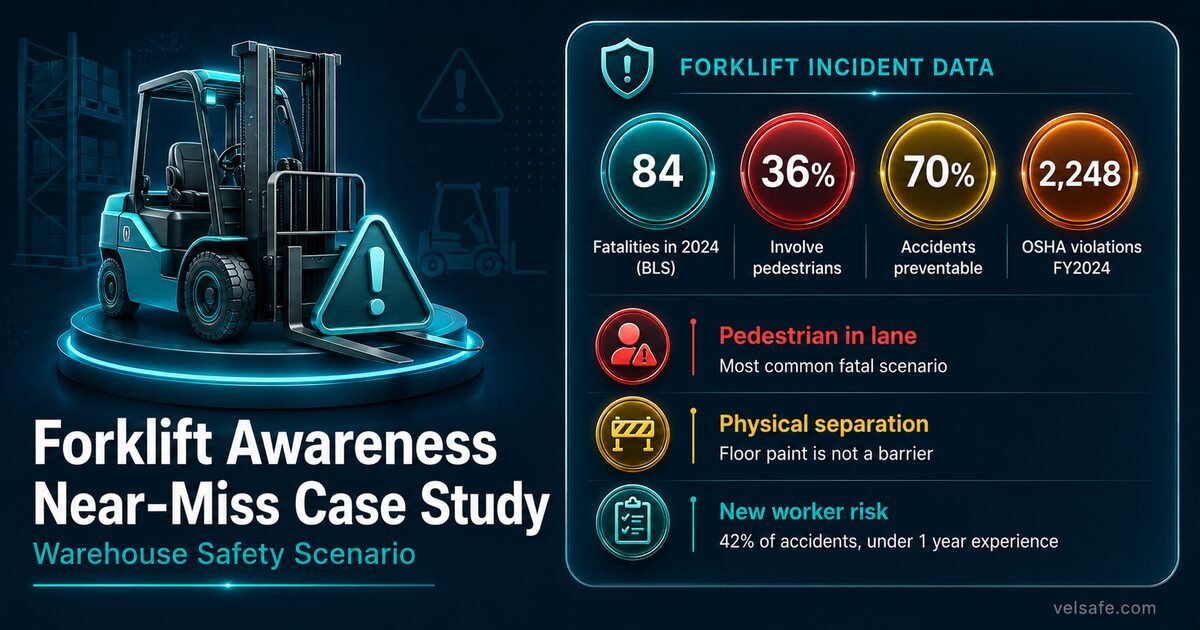
It is a Thursday afternoon at a large regional distribution centre. The floor is busy: three forklifts are running regular stock-rotation routes, a fourth is staging outbound pallets near the loading dock, and foot traffic is high because the afternoon shift change is 20 minutes away. Marcus, a picker on his third week on the job, cuts through Aisle 7 on his way back from the break room, eyes on his phone checking a text message.
He steps directly into the designated forklift travel lane, which is marked with yellow floor paint, just as a loaded forklift turns the corner from the cross-aisle at the far end. The operator, Janelle, spots Marcus at approximately 40 feet and begins braking. Marcus has not yet looked up. This scenario works through what happens next, why it happens regularly enough to drive one in three forklift fatalities, and what the facility and Marcus should each have done before this moment arrived.
The Scenario
Decision Point
What happens next, and who is responsible for resolving it safely?
Janelle continues braking and relies on Marcus to hear the horn and step aside before the forklift reaches him. She assumes he will move in time.
Janelle brakes to a complete stop, sounds the horn continuously, and waits for Marcus to become aware of her presence and clear the lane before proceeding.
Janelle brakes to a complete stop. A nearby colleague or supervisor who can be seen by Marcus physically signals him to stop and step back, since the horn may not be heard over ambient noise.
Janelle steers around Marcus into the pedestrian lane to avoid contact, since the pedestrian lane is currently clear.
Analysis
Relying on a pedestrian who has not looked up to react to a horn in a noisy environment is not a safety control: it is a gamble. A forklift weighing up to 9,000 pounds cannot stop instantly, and a loaded forklift has reduced sightlines. Janelle cannot know whether Marcus will move in time or in which direction. Continuing to approach an inattentive pedestrian while hoping they react is the scenario that produces the 36 percent of forklift fatalities involving pedestrians. The assumption that “he’ll move” is the last thought many fatally injured bystanders were near when they did not.
Braking to a complete stop and sounding the horn continuously is the correct immediate action for Janelle. OSHA’s forklift safety standard (29 CFR 1910.178) requires operators to slow and sound the horn at cross aisles and when pedestrians are in the path. Stopping completely and waiting for the pedestrian to clear removes the immediacy of the danger. However, in a high-noise environment, the horn alone may not reach Marcus, so this is a correct but incomplete resolution if communication fails.
Option C combines stopping with a secondary communication channel — a visible physical signal from someone who is already in Marcus’s line of sight, or who can enter it. This accounts for the real ambient noise conditions on the floor and does not rely solely on a horn Marcus has not yet responded to. Having a nearby colleague step into Marcus’s sightline and signal him to stop is a practical, immediately deployable backup. Supervisors and experienced workers on a busy floor should develop the habit of acting as secondary safety checks precisely in this kind of situation.
Steering a loaded forklift into the pedestrian lane to avoid a pedestrian in the forklift lane introduces a new hazard: any pedestrian who enters that lane from any direction while Janelle is in it. Pedestrian lanes are not designed or load-rated for forklift traffic, and an unexpected forklift in a pedestrian zone is exactly the condition that creates the next near-miss. The correct response is to stop the forklift in the travel lane, not to redirect it into a zone designed for foot traffic.
What Should Have Happened Before This Moment
The near-miss in this scenario did not begin when Marcus stepped into Aisle 7. It began when several systems that should have prevented this situation were absent or bypassed.
Yellow floor paint is a visual cue, not a barrier. A pedestrian distracted by a phone will not register paint. Physical barriers (bollards, rails, or a raised pedestrian walkway) that prevent entry into the forklift lane provide protection regardless of attention level.
Marcus is in his third week. OSHA’s most frequently cited forklift violation in FY2024 was safe operation (531 violations). New worker orientation for pedestrians in forklift-operating facilities should cover travel lane identification, horn signals, and the rule that phones and other distractions must not be used while moving through active areas.
A designated pedestrian walkway existed 6 feet to Marcus’s left. He was not using it. Facilities with active forklift operations should enforce pedestrian route compliance, not just mark the routes, particularly during high-traffic transition periods like shift changes.
Learning Points
OSHA requires forklift operators to yield to pedestrians. There is no production target, delivery timeline, or aisle-clearance urgency that overrides this. A stopped forklift waiting for a pedestrian to clear the lane is exactly what should happen. A moving forklift approaching a pedestrian who has not yet reacted is a fatality in progress.
Floor markings rely on all pedestrians being alert at all times. Physical separation (bollards, barriers, raised walkways, or doors that require a deliberate entry action) protects workers who are distracted, tired, or simply not yet familiar with the facility. The hierarchy of controls applies here: engineering controls outperform administrative controls consistently.
42 percent of forklift accidents occur in workers with less than one year of experience. Marcus is in his third week. General safety onboarding is not sufficient in an active forklift environment: new workers need explicit, site-specific instruction on travel lane boundaries, horn signals, what to do if they hear a horn while crossing an aisle, and the rule that phones are not to be used while moving through active areas.
Foot traffic peaks around shift changes, while forklift operations continue. This is the period when the highest number of pedestrians are moving through the facility at the same time as forklift traffic remains active. Facilities should consider reduced forklift speed during shift change windows, additional supervisory presence on the floor, and explicit shift-change pedestrian routing procedures.
What happened in Aisle 7 did not result in an injury. That does not make it a non-event. Near-misses that are not reported and investigated become the incidents that do result in injuries on the next occurrence. The near-miss report is the mechanism that allows the facility to identify that physical barriers are needed in Aisle 7, that Marcus needs additional pedestrian safety orientation, and that phone use while walking through active areas needs to be addressed explicitly in policy.
Related Resources
- OSHA’s Powered Industrial Trucks standard (29 CFR 1910.178) sets operator training, daily inspection, and pedestrian safety requirements for general industry forklift operations.
- A tips guide on forklift safety covering pre-operation inspection, load handling, and pedestrian interaction protocols is available in the Tips section.
- A Worker Safety overview of powered industrial truck hazards by industry is available in the Worker Safety section.
- OSHA, “Powered Industrial Trucks (Forklifts)”
- NSC Injury Facts, “Forklifts” (2024 data)
Sources
- National Safety Council / Bureau of Labor Statistics, “Forklifts: 2024 Fatality Data”
- OSHA, “Powered Industrial Trucks: 29 CFR 1910.178”
- OSHA, “Summaries of Selected Forklift Fatalities”
- OSHA FY2024 Top 10 Citations, Powered Industrial Trucks (#6, 2,248 violations)
- Warehouse Wiz, “OSHA Forklift Accident Statistics” (2024)
- McCue, “Forklift Accident Statistics” (2025)
