

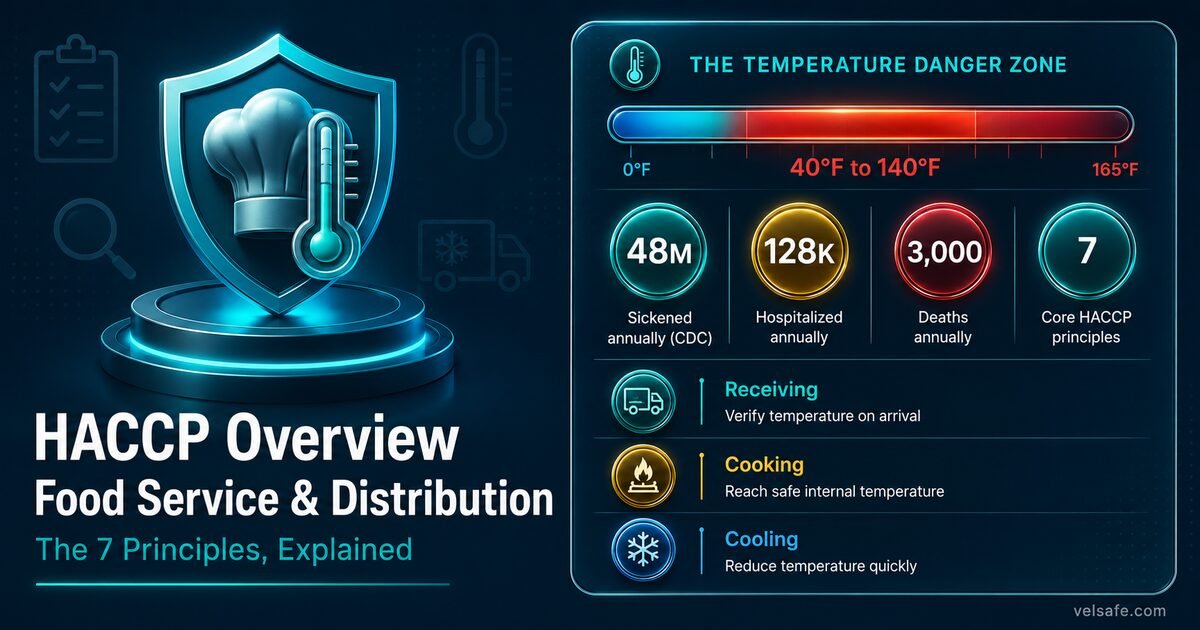
Every year, an estimated 48 million people in the United States get sick from a foodborne illness, 128,000 are hospitalized, and 3,000 die, according to CDC estimates. Most of these illnesses are preventable. The system designed to prevent them is Hazard Analysis and Critical Control Points (HACCP): a science-based framework that identifies where contamination risks exist in food production and service, and builds specific controls into those exact points rather than relying on inspection of the finished product.
This guide covers what HACCP is, the seven principles that define it, how critical control points work in a food service or distribution setting, and what workers need to understand to keep the system functioning as intended.
What HACCP Actually Does
HACCP is a systematic, preventive approach to food safety. Instead of testing the finished product and hoping problems are caught at the end, HACCP identifies every step in a food production or handling process where a biological, chemical, or physical hazard could be introduced, and builds a specific, measurable control into that step.
The 7 Principles of HACCP
List every step in the process and identify where significant biological, chemical, or physical hazards are reasonably likely to occur. A justification for including or excluding each hazard is documented.
A CCP is a step at which control can be applied and is essential to prevent, eliminate, or reduce a food safety hazard to an acceptable level. Common CCPs include cooking, cooling, and receiving steps.
A maximum or minimum value (typically temperature or time) that must be met at a CCP to keep the hazard controlled. For example, cooking poultry to an internal temperature of 165°F.
A planned sequence of observations or measurements to confirm a CCP is under control. This includes who checks, how often, and what equipment is used (typically a calibrated thermometer).
The specific steps taken when monitoring shows a critical limit has not been met (a deviation). Corrective actions exist to ensure that potentially unsafe food does not reach a customer.
Activities, other than monitoring, that confirm the HACCP system is working as designed. This can include reviewing records, calibrating thermometers, and periodic internal audits.
Accurate, contemporaneous records of monitoring, corrective actions, and verification. If a critical limit was met and no record exists, the system cannot demonstrate it for an inspector, an auditor, or in the event of an investigation.
Critical Control Points in Practice
A Critical Control Point is any process step where control can be applied for the prevention or elimination of a food safety hazard, or to reduce it to an acceptable level. A breach or loss of control at a CCP can directly cause unsafe food to reach a customer. The number of CCPs in a given operation depends entirely on the processing steps involved.
Verifying the temperature and condition of incoming raw materials before they enter storage. A delivery that arrives outside safe temperature range should be rejected, not accepted and corrected later.
Heating food to a specific internal temperature for a specific time, sufficient to destroy pathogens. This is one of the most common and most consequential CCPs in any kitchen.
Reducing hot food temperature quickly enough that it does not spend extended time in the range where bacteria multiply rapidly. Improper cooling is one of the most frequently cited contributing factors in foodborne illness outbreaks.
The Temperature Danger Zone
A critical limit tied to the Danger Zone is one of the most common CCPs across food service and distribution operations: cold holding at or below 40°F, hot holding at or above 140°F, and limiting total cumulative time in the Danger Zone during preparation and transport.
Why HACCP Matters: The Scale of the Problem
CDC estimates that norovirus is the leading cause of domestically acquired foodborne illness, while Salmonella is the leading cause of foodborne illness resulting in death. Most foodborne illness outbreaks trace back to a small number of recurring failures: food not held at the correct temperature, cross-contamination between raw and ready-to-eat items, and poor personal hygiene among food handlers. HACCP is designed specifically to address these recurring failure points before they reach the consumer.
The Worker's Role in Keeping HACCP Functioning
HACCP only works if the people performing the monitoring step do it consistently and document it honestly. A HACCP plan that exists as a binder on a shelf, disconnected from what workers actually do at each station, does not protect anyone.
A worker checking a cooler temperature or a probe thermometer reading on a cooked product is not performing an administrative task. They are the live control mechanism for a critical control point. If the reading is outside the critical limit, the corrective action procedure must be followed immediately, not noted and addressed later. The record of that check, and what was done about it, is what allows the system to demonstrate it actually worked.
Frequently Asked Questions
HACCP is legally required for specific categories such as seafood, juice, and meat and poultry processing under FDA and USDA regulation. For most retail and food service establishments, FDA endorses voluntary implementation, often incorporated through local health department food code adoption. Many large food service and distribution operators implement HACCP voluntarily as their core food safety management system regardless of strict legal mandate.
A hazard is the biological, chemical, or physical agent that could cause harm. A critical control point is the specific process step where a control can be applied to prevent, eliminate, or reduce that hazard. Identifying the hazard (Principle 1) comes before identifying where to control it (Principle 2).
Yes. A cooking step, for example, can simultaneously control multiple biological hazards if it reaches a temperature and time sufficient to destroy them all. In some cases, more than one CCP is needed to fully control a single hazard across different stages of the process.
Sources
- FDA, “HACCP Principles & Application Guidelines”
- FDA, “Managing Food Safety: A Manual for the Voluntary Use of HACCP Principles for Operators of Food Service and Retail Establishments”
- CDC, “Estimates of Foodborne Illness in the United States”
- CDC, “Estimates: Burden of Foodborne Illness in the United States”
- USDA FSIS, “Foodborne Illness and Disease”
- OSHA, “Foodborne Disease: Hazard Recognition”