
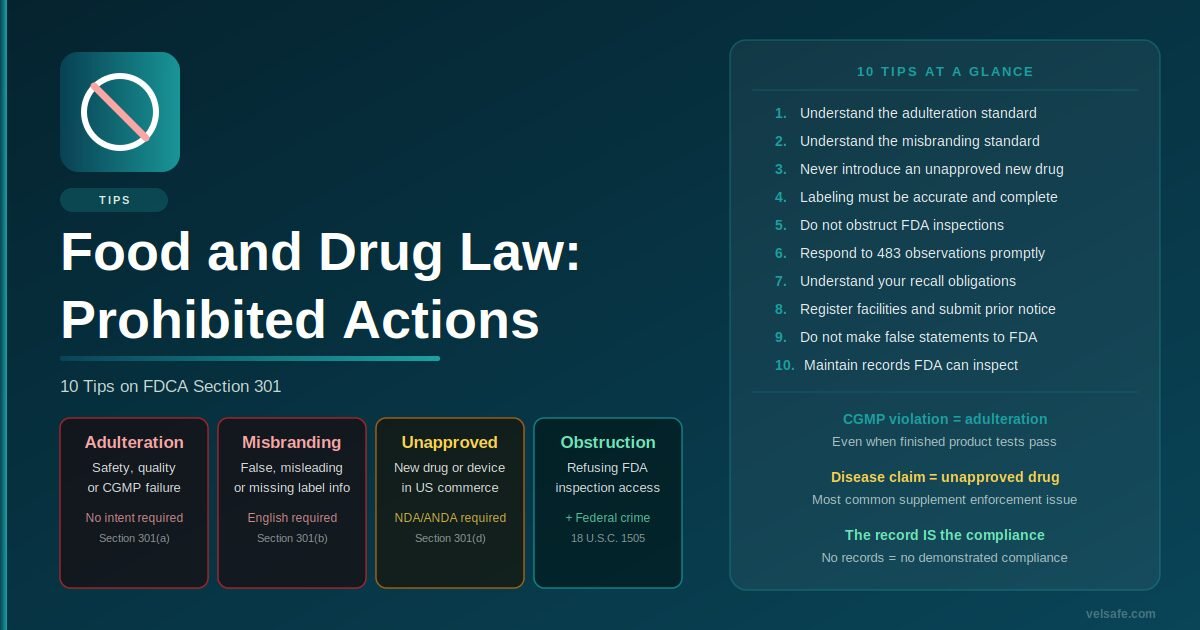
Section 301 of the FDCA (21 U.S.C. Section 331) lists the prohibited acts — the specific conduct that triggers FDA enforcement authority. The list is long, but the core prohibited acts fall into recognizable categories: adulteration, misbranding, distribution of unapproved products, and obstruction of FDA oversight. Understanding what is prohibited, why it is prohibited, and how violations are typically discovered is foundational compliance knowledge for anyone working in a food, drug, device, or cosmetic company.
These 10 tips cover the most practically significant prohibited actions, the compliance practices that prevent them, and the common errors that lead to FDA enforcement action.
1. Understand the Adulteration Standard
2. Understand the Misbranding Standard
Misbranding covers a wider range of conduct than most regulated entities realize. Beyond false label claims, misbranding includes:
Any statement on the label that is false or misleading in any particular. Omissions that make true statements misleading are covered. Technically accurate statements that create a false impression are covered.
Name and address of the manufacturer, packer, or distributor; net quantity of contents; adequate directions for use; required warnings; ingredient labeling. Missing any required element makes the product misbranded.
Marketing an approved product for a use not included in its approved labeling (“off-label promotion”) is misbranding for the manufacturer. This is distinct from a physician’s decision to prescribe a product for an off-label use, which is not regulated by FDA.
3. Never Introduce an Unapproved New Drug into Commerce
A “new drug” under the FDCA is any drug that is not generally recognized as safe and effective for its labeled use. Most prescription drugs require FDA approval through the NDA or ANDA process before they can be introduced into interstate commerce. Introducing an unapproved new drug is a prohibited act under Section 301(d) regardless of whether the drug is actually unsafe.
In dietary supplement enforcement, the most common unapproved new drug violation involves products that make disease claims. A supplement that says “supports immune health” is generally positioned as a structure/function claim. The same product with a label that says “treats influenza” or “cures diabetes” has made a drug claim, and without FDA approval, the product is an unapproved new drug subject to seizure, injunction, and criminal referral. The line between structure/function and disease claims is FDA’s primary supplement marketing enforcement focus.
4. Labeling Must Be Accurate, Complete, and in English
5. Do Not Obstruct FDA Inspections
Refusing to permit an FDA inspection, or obstructing an investigator during an inspection, is itself a prohibited act under Section 301(f). Separately, obstruction of a federal agency proceeding is a federal crime under 18 U.S.C. Section 1505. The practical effect is that obstruction adds criminal exposure on top of any underlying FDCA violation.
6. Respond to FDA 483 Observations Promptly and Substantively
A Form 483 is not a citation or a violation finding. It is a list of observations that the investigator believes may constitute violations. The company has the opportunity to respond in writing within 15 business days. The quality of this response significantly affects whether the matter escalates.
In FDA enforcement pattern analysis, the cases that escalate from a 483 to a warning letter to a consent decree almost always include a common thread: inadequate 483 responses. A response that says “we are aware of the observation and will take corrective action” without specifics on what will be done, by whom, and by when is treated as non-responsive. A substantive 483 response includes: acknowledgment of the specific observation, root cause analysis, immediate corrective actions taken before the response was submitted, long-term systemic corrective actions with timelines, and a commitment to follow-up verification.
7. Understand Your Recall Obligations
Recalls can be voluntary (initiated by the company) or mandated by FDA (for certain food and device categories). Either way, once a recall is underway, the company has significant obligations around notification, product removal, effectiveness checks, and documentation.
Company-initiated. FDA classifies the recall (Class I, II, or III based on health risk). FDA monitors through effectiveness checks. Class I (most serious) requires reaching 100% of consignees. FDA expects recall strategy submission and regular status reports.
Available for infant formula, biologics, certain medical devices, and (under FSMA) food products. FDA can order a mandatory recall if the company does not voluntarily recall when FDA determines there is a reasonable probability of serious adverse health consequences.
Continuing to distribute a product known to be violative while delaying or refusing to recall is the fastest path from administrative enforcement to criminal referral. Concealment of product defects while products remain in distribution has resulted in felony charges.
8. Register Facilities and Submit Prior Notice for Food
Under FDCA Section 415 and FSMA, food facilities must register with FDA every two years. Foreign facilities that export food to the US must also register. Prior notice of incoming food shipments must be submitted before arrival at US ports. Failure to register or submit prior notice are both prohibited acts.
9. Do Not Make False Statements to FDA
Making false statements to FDA investigators — whether during an inspection, in a submission, or in response to a formal inquiry — is a federal crime under 18 U.S.C. Section 1001, entirely separate from and in addition to any FDCA violation. False statements carry up to five years in federal prison per count.
In FDA enforcement, this provision is most commonly invoked for: falsifying batch records or laboratory results; forging FDA clearance letters or approval documents; making false representations in submissions to FDA; and providing misleading information to investigators during inspections. In each of these scenarios, the underlying FDCA violation may be a misdemeanor, but the false statement adds a much more serious felony exposure.
10. Maintain Records FDA Has Authority to Inspect
FDA has statutory authority to inspect records related to food safety (under FSMA’s records access authority), drug manufacturing (under CGMP records requirements), device manufacturing (under quality system regulations), and many other product categories. Failure to maintain required records or to make them available to FDA upon request can itself be a prohibited act.
Common Mistakes
CGMP non-compliance creates adulteration even when finished product testing passes. FDA’s position is that testing alone cannot assure quality when manufacturing processes are inadequate.
A supplement with a disease claim becomes an unapproved new drug. This is the most common dietary supplement enforcement issue and results in warning letters, seizures, and injunctions.
Vague 483 responses that acknowledge observations without specific corrective action plans are treated as non-responsive and accelerate escalation to warning letters.
Obstruction is itself a prohibited act and a federal crime. Delaying access, hiding records, or escorting investigators away from problem areas creates additional exposure beyond the underlying violation.
The company that introduces the product into commerce is responsible for compliance, regardless of who manufactured it. Outsourcing manufacturing does not outsource regulatory responsibility.