

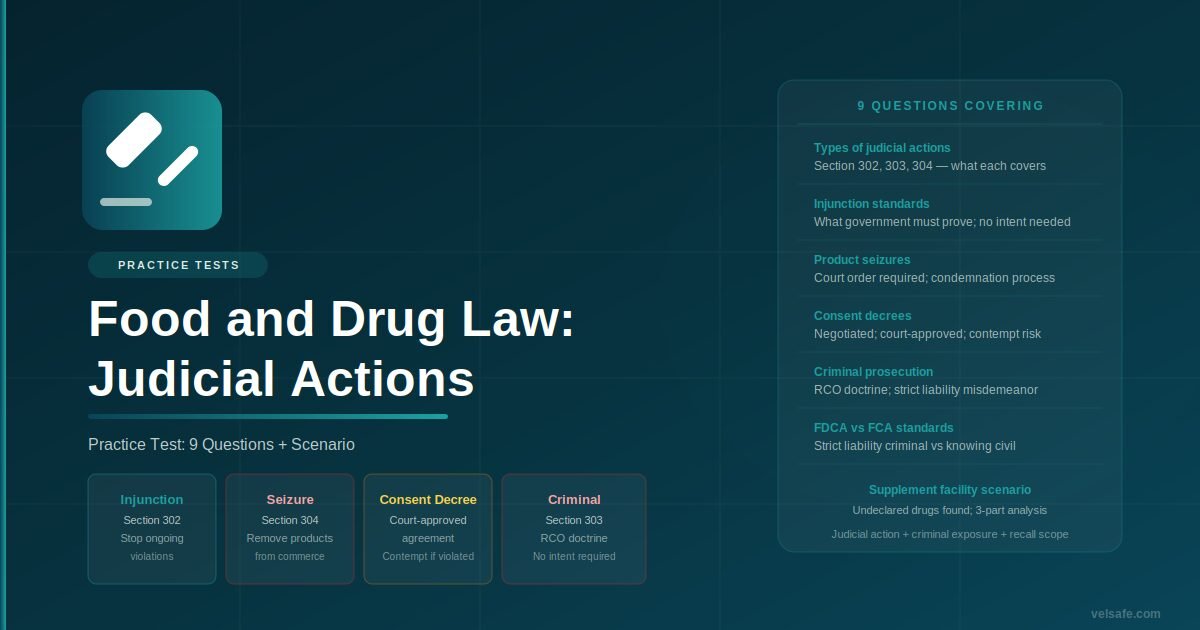
FDA’s enforcement authority reaches its most consequential expression in judicial actions — cases where the agency and the Department of Justice take matters to federal court. Injunctions can shut down entire manufacturing operations. Seizures remove products from commerce. Consent decrees bind companies to compliance obligations enforceable by contempt. Criminal prosecution can result in fines in the hundreds of millions and individual imprisonment.
This practice test covers the types of judicial actions available under the FDCA, the legal standards that apply to each, the procedural steps that precede them, and the real-world enforcement patterns that regulated entities need to understand. Questions range from foundational to advanced.
Section 1: Types of Judicial Actions
Question 1 | Beginner
Which of the following is NOT a judicial action available to FDA under the FDCA?
- A) Injunction
- B) Seizure of products
- C) Civil monetary penalty (general enforcement)
- D) Criminal prosecution
FDA’s primary judicial enforcement tools under the FDCA are injunctions (to stop ongoing violations), product seizures (to remove violative products from commerce), and criminal prosecution. The FDCA does not contain a general civil monetary penalty provision for most violations — unlike agencies such as OSHA or the FTC. Some specific FDCA provisions (food facility registration, device quality system requirements) carry civil monetary penalties, but these are exceptions. Most FDCA enforcement that does not escalate to criminal prosecution uses administrative tools (warning letters, import alerts) or judicial tools (injunctions, seizures).
Question 2 | Beginner
Under FDCA Section 302, FDA can seek an injunction against a company. What must the government demonstrate to obtain a permanent injunction?
- A) That the company intended to violate the FDCA
- B) That the company is currently violating the FDCA and is likely to continue doing so without court intervention
- C) That the company has caused actual harm to consumers
- D) That the company has received and ignored at least three warning letters
To obtain a permanent injunction under FDCA Section 302 (21 U.S.C. Section 332), the government must demonstrate that a violation is occurring and that there is a reasonable likelihood that it will continue without court intervention. Intent is not required. Actual consumer harm is not a prerequisite — the appearance of a violation and likelihood of its continuation are sufficient. There is also no legal requirement for a specific number of warning letters before seeking an injunction, though as a practical matter FDA typically exhausts administrative remedies before seeking judicial relief. An injunction can be sought quickly when there is an imminent public health risk, even without prior warning letters.
Question 3 | Intermediate
A pharmaceutical manufacturer has received two warning letters over three years for the same CGMP deficiencies. FDA conducts a follow-up inspection and finds the deficiencies persist. What judicial action is most likely to follow?
- A) FDA will issue a third warning letter before seeking judicial relief
- B) FDA will refer the matter to DOJ to seek a consent decree of permanent injunction
- C) FDA will impose an administrative fine of $1 million
- D) FDA will revoke the company’s operating license
When a company has received multiple warning letters for the same violations and failed to achieve sustained compliance, FDA typically refers the matter to the Department of Justice to seek a consent decree of permanent injunction. A consent decree is a court-approved agreement that specifies what the company must do to achieve compliance, typically including third-party expert oversight, specific corrective action timelines, and significant financial penalties for non-compliance. There is no legal requirement for a specific number of warning letters before seeking a consent decree. FDA does not have a general operating license to revoke, and the FDCA does not contain a general administrative fine mechanism for CGMP violations.
Section 2: Product Seizures
Question 4 | Beginner
Under FDCA Section 304, FDA can seize products. What happens to products that have been seized?
- A) They are automatically destroyed within 48 hours of seizure
- B) They are held under court order; the owner can contest the seizure or consent to condemnation and destruction
- C) They are transferred to another facility for reconditioning without court involvement
- D) FDA sells them at auction to recover enforcement costs
Under FDCA Section 304 (21 U.S.C. Section 334), seized products are held under a court order (writ of seizure). The claimant (typically the product’s owner) can contest the seizure in court. If no one contests the seizure or the government prevails, the court issues a decree of condemnation and the products are destroyed under court supervision. Alternatively, the claimant may apply to the court for permission to recondition or relabel the products to bring them into compliance, under bond and FDA supervision. Products are never automatically destroyed on seizure and are never sold at auction.
Question 5 | Intermediate
What is the key legal basis FDA uses to seize a product without waiting for a court hearing?
- A) FDA can always seize products administratively without court involvement
- B) FDA must first obtain a warrant or civil seizure order from a federal district court
- C) FDA can seize products only after a criminal conviction
- D) FDA can only request CBP to detain imports, not seize domestic products
FDA seizures of domestic products require court involvement. FDA cannot unilaterally seize domestic products; it must work through DOJ to obtain a civil seizure order (writ of seizure) from a federal district court. US Marshals execute the seizure. FDA does have some authority to administratively detain certain food products (under FSMA’s administrative detention authority) for a limited period without a court order when there is credible evidence that the food poses a serious threat to humans or animals, but formal seizure for condemnation requires a court order.
Section 3: Consent Decrees
Question 6 | Intermediate
What distinguishes a consent decree from a simple court injunction in FDA enforcement?
- A) A consent decree requires proof of criminal intent; an injunction does not
- B) A consent decree is a negotiated agreement approved by the court; an injunction can be contested and litigated
- C) A consent decree applies only to food companies; injunctions apply to drug and device companies
- D) A consent decree is temporary; an injunction is permanent
A consent decree is a negotiated agreement between the government and the defendant that is approved and entered by the court as a court order. The defendant consents to its terms, typically to avoid protracted litigation. Because it is a court order, violations of a consent decree can be punished as contempt of court, which carries significant additional penalties. An injunction can be contested and litigated. In practice, most FDA permanent injunction cases are resolved through consent decrees because litigation is expensive and time-consuming for both parties, and the company typically cannot manufacture or distribute while a case is pending.
Question 7 | Advanced
A pharmaceutical company subject to a consent decree begins manufacturing a new product at a facility covered by the decree. The new product was not in commercial production when the decree was entered. Is the company required to comply with the consent decree’s provisions for this new product?
- A) No, because the decree applies only to products that existed when it was signed
- B) Yes, if the decree covers the facility or manufacturing operations broadly; consent decrees typically apply to all products made at the covered facility
- C) No, because new products are automatically exempt from prior consent decrees
- D) Only if FDA issues a new warning letter specifically about the new product
Consent decrees in FDA enforcement typically apply to manufacturing operations or facilities broadly, not just to specific products that existed at the time the decree was entered. A company cannot use a consent decree as a basis to create a two-tier system where covered products are manufactured under court-supervised compliance requirements while new products at the same facility are not. Companies subject to consent decrees must generally comply with the decree’s provisions for all manufacturing operations at covered facilities, including new products. Attempting to circumvent a consent decree by introducing new products at a covered facility without the required third-party oversight would risk a contempt finding.
Section 4: Criminal Prosecution
Question 8 | Intermediate
Under what circumstances can FDA pursue criminal charges against an individual corporate officer without proving that person knew about the violation?
- A) FDA cannot pursue criminal charges without proving individual knowledge
- B) Under the Responsible Corporate Officer (RCO) doctrine, officers who had authority and responsibility to prevent a violation can be criminally charged even without personal knowledge
- C) Criminal charges without knowledge are only available for food companies, not drug or device companies
- D) The RCO doctrine was overturned by the Supreme Court in 2023
The Responsible Corporate Officer (RCO) doctrine, established in United States v. Dotterweich (1943) and clarified in United States v. Park (1975), allows criminal prosecution of corporate officers for FDCA misdemeanor violations without proof of personal knowledge or intent. The officer must have had the authority and responsibility to prevent or correct the violation and failed to do so. The RCO doctrine remains valid law and was applied in 2025 enforcement actions including the Magellan Diagnostics executive prosecutions. Executive Order 14294 (May 2025) signals policy preference against strict liability criminal enforcement but does not change the underlying law.
Question 9 | Advanced
A company is charged with both a criminal FDCA violation and a False Claims Act (FCA) violation arising from the same conduct. How do the legal standards differ?
- A) Both require proof of intent beyond a reasonable doubt
- B) The FDCA misdemeanor is strict liability (no intent required); the FCA requires proof of knowing or reckless conduct, and uses a civil preponderance standard
- C) The FCA requires proof beyond a reasonable doubt; the FDCA misdemeanor uses a civil standard
- D) Both use a preponderance of evidence standard and neither requires intent
FDCA misdemeanor violations are strict liability offenses — the government does not need to prove intent. They are criminal charges governed by the “beyond a reasonable doubt” standard. The False Claims Act (FCA) is a civil statute that imposes liability on persons who knowingly submit false claims to government programs. The FCA requires proof of knowing or reckless conduct (not strict liability) but uses the civil preponderance of evidence standard, not the criminal beyond-a-reasonable-doubt standard. FCA cases typically involve treble damages plus per-claim civil penalties. Many FDA enforcement matters involve both FDCA charges (strict liability criminal) and FCA claims (knowing conduct civil) when government healthcare programs are involved.
Section 5: Scenario-Based Learning
Scenario: The Contaminated Supplement Facility
A dietary supplement manufacturer has received warning letters in 2021 and 2023 for persistent CGMP violations including inadequate identity testing of raw materials, failure to maintain batch production records, and insanitary conditions. In 2025, an FDA inspection finds the same violations persist. Laboratory analysis of finished products from the facility reveals the presence of undeclared pharmaceutical drugs in three supplement products.
Q1: What is the most likely judicial action FDA and DOJ will pursue?
Given the history of persistent violations and the finding of undeclared pharmaceutical drugs (which makes the products both adulterated and misbranded, and potentially adulterated new drugs), FDA is most likely to refer the matter to DOJ for a consent decree of permanent injunction. The consent decree would likely halt manufacturing operations at the facility until compliance can be demonstrated, require third-party expert oversight, mandate a complete product recall, and impose significant financial obligations on the company.
The undeclared drugs finding elevates this above a routine CGMP matter. Products containing undeclared pharmaceutical ingredients are both adulterated and misbranded under the FDCA, and the presence of active drugs in products marketed as supplements without FDA approval also raises the prospect of criminal referral.
Q2: What criminal exposure exists for the company’s executives?
Under the Responsible Corporate Officer doctrine, executives who had authority and responsibility over manufacturing operations can be charged with FDCA misdemeanor violations regardless of whether they knew about the contamination. The fact that warning letters were previously issued and the same violations persisted creates a strong evidentiary record that the executives failed to exercise reasonable care despite documented notice.
If the government can prove that the undeclared drug contamination was intentional — that someone at the company deliberately added pharmaceutical ingredients — this becomes a felony FDCA charge (intent to defraud or mislead), which carries up to three years imprisonment per count. If the contaminated products caused consumer harm, additional charges under Section 333(b) could apply.
Q3: What does the recall obligation look like?
All products manufactured at this facility during the period of CGMP non-compliance may be subject to recall, not just the three products where undeclared drugs were found. CGMP violations create a presumption that all products from the facility may be adulterated, because it is not possible to establish retrospectively which specific batches were affected by insanitary conditions or inadequate testing. This is the “CGMP compliance = product compliance” principle that FDA applies in pharmaceutical and supplement enforcement.
Quick Reference
Sources
- FDCA Section 302 (21 U.S.C. 332): Injunctions
- FDCA Section 304 (21 U.S.C. 334): Seizures
- FDCA Section 303 (21 U.S.C. 333): Criminal Penalties
- United States v. Park, 421 U.S. 658 (1975)
- FDA, “Regulatory Procedures Manual: Judicial Actions”
- Ropes and Gray, “FDA Enforcement Review: Looking Back at 2025” (January 2026)
- White House, “Executive Order 14294: Fighting Overcriminalization” (May 9, 2025)