

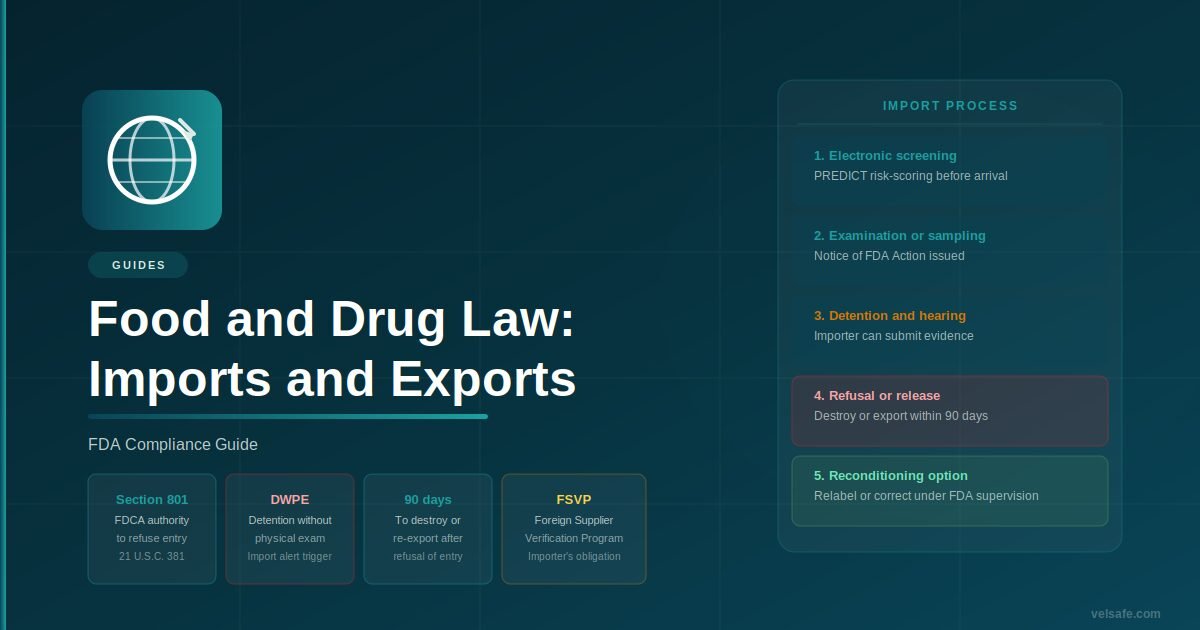
All FDA-regulated products imported into the United States must meet the same laws and regulations as domestic goods. There is no lower standard for imported products. A food product manufactured in another country and offered for import at a US port of entry is subject to the same adulteration and misbranding standards as one manufactured in New Jersey. A drug or device must be safe and effective. Cosmetics must be safe and properly labeled. Labeling must be in English.
This guide covers the FDA import framework under Section 801 of the FDCA, the enforcement tools available to FDA at the port of entry, the Foreign Supplier Verification Program, prior notice requirements for food, import alerts and what they mean for importers, and the export requirements for FDA-regulated products.
The Legal Authority: FDCA Section 801
Section 801 of the Federal Food, Drug, and Cosmetic Act (21 U.S.C. Section 381) is the primary statutory basis for FDA’s import enforcement authority. It authorizes FDA to refuse admission to products that appear to be in violation of the FDCA. The key word is “appear” — FDA does not need to prove a violation definitively to refuse entry. The appearance of a violation is sufficient.
The Import Process: How FDA Reviews Shipments
All FDA-regulated products are electronically screened before physical entry. FDA and US Customs and Border Protection (CBP) work together through CBP’s Automated Commercial Environment (ACE) system, through which importers and their brokers submit entry data before arrival.
Import Alerts: Detention Without Physical Examination
An import alert is one of FDA’s most powerful import enforcement tools. Import alerts inform FDA field staff that there is enough evidence to allow for Detention Without Physical Examination (DWPE) of products from a specific firm, country, or product category.
In compliance reviews of import operations, the most consistent gap is in the pre-screening of foreign suppliers. Companies that source from multiple foreign facilities often discover an existing import alert on a supplier only when a shipment is detained at the port. Checking the FDA import alert database before contracting with a foreign supplier, and on a regular basis thereafter, is basic supply chain risk management. The FDA publishes import alert updates publicly and searchable by firm, country, and product type.
Prior Notice for Food
Under the Bioterrorism Act of 2002 and implemented through FSMA, importers of food for human and animal consumption must provide prior notice to FDA before the food arrives at the US port of entry. Prior notice must be submitted electronically through FDA’s Prior Notice System Interface (PNSI) or through CBP’s ACE system.
The Foreign Supplier Verification Program (FSVP)
FSMA’s Foreign Supplier Verification Program (FSVP), implemented in 21 CFR Part 1 Subpart L, requires US importers of food for human and animal consumption to perform risk-based activities to verify that their foreign suppliers are producing food in a manner that provides the same level of public health protection as FDA’s domestic requirements.
Conduct hazard analysis for each food; evaluate supplier performance and food safety; conduct approved supplier verification activities such as audits, sampling, or review of supplier records; and maintain FSVP records for 2 years.
No written FSVP program; failure to conduct hazard analysis; FSVP records not maintained for 2 years; supplier verification activities not performed on the required schedule; qualified individual not identified for FSVP activities.
Facility Registration: Required Before Importing
Any facility that manufactures, processes, packs, or holds food for human or animal consumption in the United States, including foreign facilities that export food to the US, must be registered with FDA under FDCA Section 415. The registration must be renewed every two years during the October-December registration period. FDA can suspend a facility’s registration if there is a reasonable probability that food from the facility could cause serious adverse health consequences or death.
Export Requirements for FDA-Regulated Products
Export requirements differ from import requirements in one important way: the legal standard that applies to an exported product depends on the destination country, not necessarily on US standards. Section 802 of the FDCA and Section 801(e) set out the conditions under which products that do not meet US requirements can be exported.
Import for Export (IFE)
A specific and frequently misunderstood entry type is Import for Export (IFE). This allows a product that does not meet US requirements to be imported into the US for further processing or incorporation into another article, and then exported — without the product entering US commerce. IFE entries are exempt from FDA refusal, but they are not exempt from detention.
The IFE exemption applies only to drugs or their components, devices or their components, food additives, dietary supplements, color additives, and biological products. Standard foods and cosmetics cannot be entered as IFE. The importer must declare the IFE affirmation of compliance code at the time of entry — FDA does not accept IFE declarations after the entry has been submitted. If IFE articles are distributed into US commerce rather than exported, this is a prohibited act under FDA law.
Common Import Compliance Failures
Import alert status is publicly available and searchable. Discovering an alert at the port when a shipment is detained is preventable due diligence.
FSVP is mandatory for most importers of human and animal food. “We rely on our supplier’s certifications” is not an adequate FSVP program. The importer must conduct its own hazard analysis and verification activities.
Prior notice must be submitted and confirmed before arrival — not on arrival. Late or missing prior notice is a direct refusal basis that delays the entire shipment at the importer’s cost.
Introducing an unapproved drug or device into US commerce is a prohibited act under Section 301, subject to refusal, seizure, and potentially criminal referral.
Incorrect information in ACE entry data (wrong product description, wrong manufacturer, wrong country of origin) can result in penalties and increased scrutiny of all future entries from that filer. FDA conducts routine filer evaluations and compares entry documents against electronically submitted data.
Sources
- FDA, “Laws, Regulations and Policies Applicable to Imports and Exports”
- FDA, “Actions and Enforcement: Import Program”
- FDA, “Import Basics”
- FDA, “Import Alerts”
- FDA, “Importing Food Products into the United States”
- FDA, “Export Requirements for Unapproved Drugs”
- FDA, “Foreign Supplier Verification Programs (FSVP) Rule”
- FDCA Section 802 (21 U.S.C. Section 382): Export of Certain Unapproved Products