
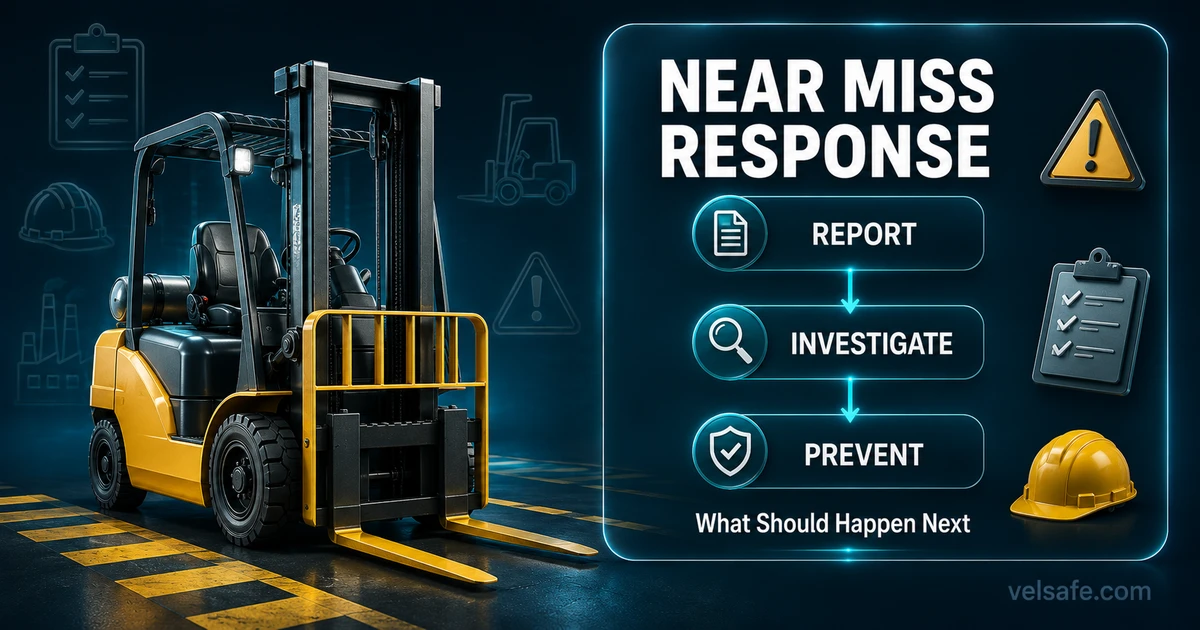
A forklift rounds a blind corner at the end of Aisle 7.
A pedestrian steps out from behind a pallet rack at the same moment. The operator hits the brakes. The forklift stops less than a metre from the worker. The loaded pallet shifts forward on the forks but holds.
Nobody is hurt. Nothing is damaged. The whole event is over in three seconds.
Most facilities move on with the day.
That is exactly where the real risk begins.
Situation Snapshot
Location: Intersection of two aisles in a mid-sized manufacturing facility, where the receiving area connects to the production staging zone.
Task: A forklift operator was transporting a loaded pallet. A machine operator was walking to retrieve materials from a nearby storage rack.
Hazard: Blind intersection with no convex mirrors, no floor markings, no traffic signals, and no designated pedestrian crossing.
People involved: Forklift operator, pedestrian (machine operator), one witness.
Potential outcome: Struck-by injury. At the speed and weight involved, the consequences could have included crushing injuries, fractures, internal trauma, or a fatality.
What Happened
It is 10:15 AM on a Tuesday. The facility is running a normal production schedule.
The forklift operator is experienced. He has driven this route dozens of times. The loaded pallet sits on the forks at a height that partially blocks his forward view, but this is standard for the load type. He has learned to compensate by leaning to the side and scanning ahead.
At the same time, a machine operator finishes a task at her workstation. She needs a component from a storage rack located across the aisle. She steps into the intersection without pausing, without checking for traffic. This is also normal. She has walked this path hundreds of times without encountering a forklift.
The operator sees her. He brakes hard. The forklift stops. The pallet shifts but stays on the forks.
“Whoa. Didn’t see you.”
“Sorry. Didn’t hear you coming.”
A nearby worker watches the exchange. All three pause for a moment. Then each returns to work.
By lunchtime, the event is a story shared between a few people on the floor. By tomorrow, it will be forgotten entirely.
But here is the part that matters.
Nothing about the intersection has changed. The same blind corner. The same missing mirrors. The same unmarked crossing. The same shared aisle. The forklift will pass through again this afternoon. Another pedestrian will step out tomorrow morning.
The only thing that prevented an injury was timing.
Stop for a moment.
If this happened at your facility, what would you do next? Not what should happen according to a safety manual. What would actually happen?
Hold that answer. We will return to it.
The Decision Point
Imagine you witnessed this event. The forklift has stopped. Both workers are unharmed. The moment is passing.
You have four realistic options.
Response A: Say nothing.
The event is over. Nobody was hurt. Reporting it might slow down production, create paperwork, or draw attention to colleagues who would rather move on. The forklift operator might worry about being blamed. The pedestrian might feel embarrassed.
Response B: Mention it casually.
You tell a coworker during break. They agree it was dangerous. The conversation ends there. No documentation. No investigation. No corrective action.
Response C: Report the near miss formally.
You complete a near-miss report, notify your supervisor, and ensure the event is documented. The report triggers a proper investigation.
Response D: Report the near miss and immediately secure the area.
You report the event and take immediate steps to warn others about the hazard. You place a temporary warning at the intersection, alert nearby workers, and request that forklift traffic be rerouted until the area is assessed.
The Best Response
Response D.
Reporting creates a record. Securing the area addresses the hazard right now, before the next forklift passes through the same intersection in fifteen minutes.
Response C is responsible and far better than silence. But it misses the window to prevent the same near miss from recurring within the hour.
Response B is common. It is also useless. Conversations without documentation produce no corrective action. Within a week, the details fade. Within a month, the event is forgotten.
Response A is the most frequent response to near misses across every industry.
It is also the most dangerous.
Why Near Misses Go Unreported
Before investigating this specific event, it is worth understanding a broader pattern. Because the real failure in this scenario did not happen at the intersection. It happened in the silence that followed.
Fear of blame is the most common barrier. In facilities where every incident is treated as someone’s fault, workers learn to stop sharing safety information. Reporting feels like confessing.
Production pressure plays a role. Stopping to fill out a report takes time. In environments where output targets receive more emphasis than safety reporting, workers learn to prioritise speed over documentation.
Perceived insignificance is another factor. Nobody was hurt. The event feels minor. Workers may not connect a three-second close call with a future fatality.
One pattern appears repeatedly across investigations into serious manufacturing injuries. The hazard was known. Workers had experienced near misses at the same location before. Nobody reported them. The injury that eventually occurred was not the first warning. It was the last.
The Investigation
The investigation begins within 24 hours. Not because a regulation requires it for near misses, but because details fade quickly. Witnesses forget. Circumstances change. The quality of an investigation depends heavily on speed.
OSHA does not legally require employers to report or investigate near misses. The agency does, however, strongly recommend treating them with the same investigative rigour as actual incidents. OSHA’s Recommended Practices for Safety and Health Programs identify near-miss reporting as a fundamental component of effective worksite analysis. OSHA’s Voluntary Protection Programs (VPP) go further, explicitly requiring participants to investigate all near misses and maintain written investigation reports.
The reason is straightforward. Near misses and injuries share the same root causes. The only difference is outcome.
Applying the 5 Whys
The 5 Whys is one of the simplest and most effective investigation tools. It works by asking “why” repeatedly until the systemic cause surfaces.
Applied to this scenario:
Why did the forklift nearly strike the pedestrian?
Because neither could see the other before entering the intersection.
Why could they not see each other?
Because the intersection has no mirrors, warning signals, or visibility aids.
Why does the intersection lack visibility aids?
Because the facility’s traffic management plan does not include this intersection.
Why was this intersection not included?
Because the traffic management plan has not been updated since the facility rearranged the storage layout six months ago.
Why was the plan not updated after the layout change?
Because there is no procedure requiring a traffic safety review when floor layouts are modified.
The root cause is not the forklift operator’s speed.
It is not the pedestrian’s inattention.
It is a missing management process. The facility has no requirement to reassess traffic safety when physical layouts change. Every future layout modification carries the same risk until this gap is closed.
The Fishbone Perspective
For investigations that involve multiple contributing factors, a Fishbone (Ishikawa) diagram helps organise the analysis across categories.
Mapping these factors reveals something investigations focused on individual behaviour would miss. Five separate system gaps contributed to this near miss. Fixing the pedestrian’s behaviour addresses one. Fixing all five makes the intersection fundamentally safer.
What Should Change
Vague recommendations do not prevent recurrence. “Be more careful” is a reminder, not a corrective action. The investigation should produce specific, measurable changes grouped by the hierarchy of controls.
Engineering Controls
Install convex mirrors at the intersection to restore visibility from both directions.
Add floor markings or painted crosswalk lines to designate pedestrian crossing zones.
Install a warning light or audible signal activated when a forklift approaches the intersection.
Where physically possible, separate pedestrian and forklift routes entirely.
Administrative Controls
Establish a written right-of-way policy for all shared traffic areas in the facility.
Create a procedure requiring traffic safety review whenever floor layouts are modified.
Implement a formal near-miss reporting system with accessible forms and a non-punitive reporting policy.
Include near-miss review as a standing agenda item in weekly safety meetings.
Training
Brief all forklift operators and pedestrian workers on the new intersection controls.
Include near-miss reporting expectations in new employee orientation.
Conduct a facility-wide refresher on pedestrian safety in forklift operating zones.
Engineering solutions are more reliable than administrative reminders. A convex mirror works every shift. A reminder about checking for traffic works until the next deadline.
Lessons Learned
Immediate Lessons
The intersection hazard was known informally. Workers had experienced close calls before. The absence of a reporting system meant those warnings never reached anyone with the authority to fix the problem.
Securing the area immediately after the near miss would have prevented the same hazard from recurring during the same shift. Reporting alone, without immediate action, leaves a window of risk.
Supervisor Lessons
The supervisor’s response to the first near-miss report sets the tone for every future report. If the response is blame, workers will stop reporting. If the response is gratitude and action, the flow of safety intelligence increases.
“Let’s stop the job” is one of the most important sentences a supervisor can normalise.
Investigations that stop at “the worker should have been more careful” have not investigated anything. They have assigned blame and called it a finding.
Organisational Lessons
Layout changes create new hazards. This is predictable. Any time racks are moved, production zones shift, or traffic patterns change, the risk profile of the facility changes with it. A standing procedure to review pedestrian and vehicle safety after layout modifications is a simple, high-value control that most facilities do not have.
Near-miss reporting is safety intelligence. Facilities that actively collect and analyse near-miss data identify hazards earlier and experience fewer serious incidents. Herbert Heinrich’s analysis of over 75,000 accident reports found approximately 300 near misses for every major injury. Frank Bird’s later study of 1.7 million reports across nearly 300 companies confirmed a similar pattern.
The numbers vary by study and industry. The principle does not. Near misses are not random. They are warnings.
Training Lessons
Workers cannot report events they do not recognise as significant. Training should help workers understand that a near miss is not a lucky break. It is evidence that the current conditions can produce an injury when timing and position align differently.
Reporting procedures should be as simple as possible. If the form takes longer than five minutes, participation drops. OSHA provides a free near-miss incident report form that can serve as a starting point.
Knowledge Check
Test your understanding of this scenario before continuing.
The supervisor acknowledged the report, which is positive. However, taking no further action defeats the purpose of reporting. The hazard that caused the near miss remains in place. The same intersection will produce the same close call, or worse, under slightly different circumstances. An investigation should follow every near-miss report, and corrective actions should address the root cause. A supervisor who receives reports but never acts on them will eventually stop receiving reports altogether.
No. The investigation has identified a contributing factor, not a root cause. Stopping at human behaviour misses the systemic failures underneath. Why was there no mirror? Why were pedestrians and forklifts sharing the same route? Why was no right-of-way established? Root cause analysis should continue asking ‘why’ until it reaches a management system gap that, once corrected, prevents recurrence regardless of individual behaviour.
A maintenance and inspection schedule for the safety controls themselves. Engineering controls only work when they are maintained. Including mirror inspections in routine housekeeping audits, and assigning clear ownership for keeping mirrors clean and visible, ensures the fix continues to function long after the investigation is closed.
Back to Aisle 7
Tomorrow morning, a forklift will turn into the same intersection.
Whether the outcome changes depends entirely on what happens today. Not next quarter. Not during the next safety audit. Today.
If the near miss was reported, investigated, and acted upon, the intersection now has mirrors. Floor markings. A right-of-way rule. A process that catches the next blind corner before it produces the next close call.
If it was not reported, everything remains exactly the same. The same blind corner. The same missing mirrors. The same shared aisle. The same dependence on timing and luck.
Every unreported near miss is a decision to leave the hazard in place and hope the outcome stays the same.
Hope is not a safety strategy.
Sources
- OSHA Near Miss Reporting Policy Template
- OSHA Near Miss Incident Report Form
- OSHA Incident Investigation Overview
- OSHA Field Safety and Health Management System Manual, Chapter 2
- OSHA Voluntary Protection Programs Policies and Procedures Manual, CSP 03-01-005
- NIOSH Case Study: Learning from Workers’ Near-miss Reports (PMC, 2020)