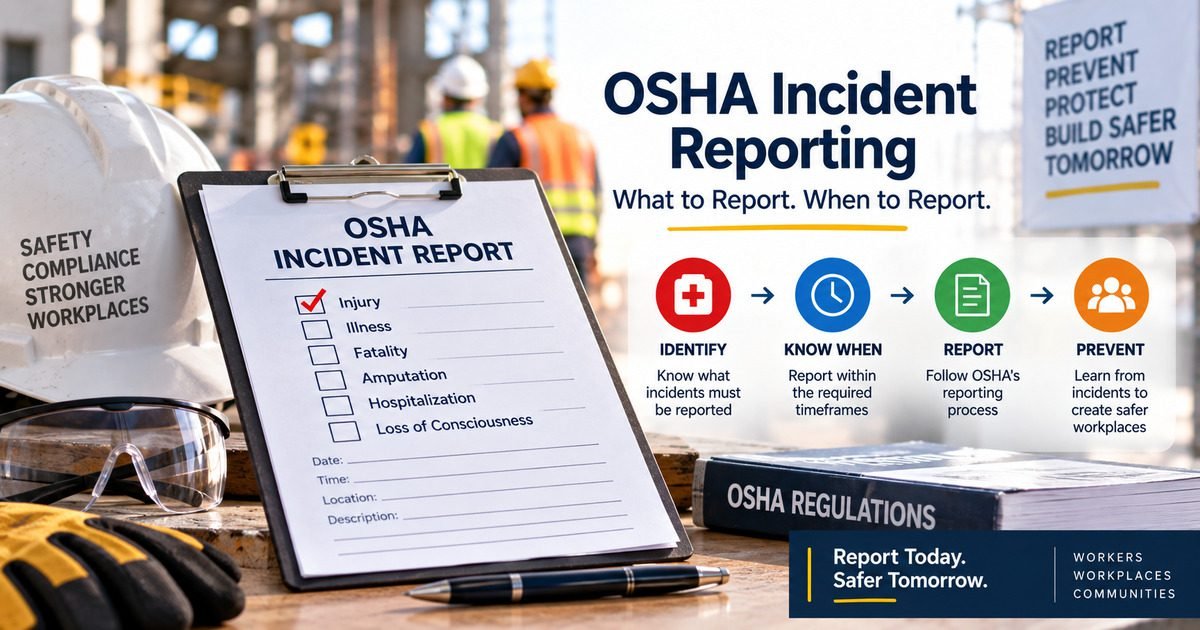
LAW: OSHA Incident Reporting Requirements
OSHA Incident Reporting: What Must Be Reported,
When, and What Happens If You Miss the Deadline
At 7:42 AM a worker falls from scaffolding and is hospitalised. The site supervisor calls the owner. The owner calls the insurance broker. By 9:00 AM, no one has called OSHA. Under 29 CFR 1904.39, that call was legally required within 24 hours of learning about the hospitalisation. By the time the employer reports at day’s end, the deadline has passed. The late report is a separate violation carrying a penalty of up to $16,131. This scenario is not exceptional, deadline failures in OSHA incident reporting are among the most common and most avoidable compliance violations in regulated workplaces. This article covers exactly what must be reported, when the clock starts, what exemptions do not apply, and the penalty consequences of getting it wrong.
8 hours
Fatality Reporting Deadline Under 29 CFR 1904.39(a)(1)
Every work-related fatality must be reported to OSHA within 8 hours of the employer learning of the death. This includes deaths that occur at the worksite and deaths that occur in hospital within 30 days of the work-related incident. The clock starts at employer notification, not at the time of the incident. A death reported in hour 9 is a late report and a separate violation.
29 CFR 1904.39(a)(1)
24 hours
Deadline for Hospitalisation, Amputation, or Eye Loss
In-patient hospitalisation of one or more employees, any work-related amputation, and work-related loss of an eye must each be reported to OSHA within 24 hours. The clock starts when the employer learns of the event. An employer who learns of a Friday-night hospitalisation on Saturday morning must report by Saturday morning plus 24 hours, not by Monday morning.
29 CFR 1904.39(a)(2)
$16,131
Maximum Penalty Per Late or Missed Report (2025 Rates)
OSHA treats a late or missed incident report as a serious violation carrying a maximum penalty of $16,131 per event. Willful or repeated reporting failures can reach $161,323 per violation. The late report penalty is independent of any penalties for the underlying safety violation that caused the incident, an employer can receive both simultaneously.
OSHA: Penalty Amounts (2025)
OSHA Incident Reporting Requirements: Law Summary
29 CFR 1904.39 is the OSHA regulation that requires employers to report four categories of work-related incidents to OSHA within fixed timeframes. The obligation is distinct from the OSHA 300 Log recordkeeping requirement in 29 CFR 1904.29. Recordkeeping and reporting are parallel obligations with different triggers, different deadlines, and different exemption structures. An employer may be exempt from OSHA 300 Log recordkeeping (if they have 10 or fewer employees or operate in a low-hazard industry) but no employer covered by OSHA is exempt from the reporting obligation under 1904.39. Reporting applies to every OSHA-covered employer from the first day of operation, regardless of size, industry, or prior citation history.
The critical operating principle for all reporting deadlines is that the clock starts when the employer learns of the event, not when the event occurred. A worker may be injured at 6:00 PM Friday and hospitalised overnight. If the employer is not notified until 8:00 AM Saturday, the 24-hour reporting clock starts at 8:00 AM Saturday, not at 6:00 PM Friday. OSHA investigators will ask for documentation of when the employer was first notified. Employers who cannot demonstrate the notification timeline are at greater risk of a late-report finding even when they filed on time.
Reporting is not an admission of liability
OSHA’s reporting requirement is a notification obligation, not a confession. Filing a report does not mean the employer violated a safety standard or caused the incident. The incident investigation that follows a report determines whether violations occurred. The absence of a timely report, however, is itself a violation, and evidence that the employer failed to respond appropriately. Employers who delay reporting out of concern it will be used against them are trading a $0 timely report for a $16,131 late-report penalty plus the inference that the delay was intentional.
OSHA Incident Reporting: Compliance Table
| Reportable Event |
Regulation |
Deadline |
Clock Starts |
Exemptions |
| Work-related fatality |
29 CFR 1904.39(a)(1) |
8 hours |
When employer learns of the death |
None |
| In-patient hospitalisation of one or more employees |
29 CFR 1904.39(a)(2) |
24 hours |
When employer learns of the admission |
None |
| Work-related amputation |
29 CFR 1904.39(a)(2) |
24 hours |
When employer learns of the amputation |
None, includes fingertip amputations without hospitalisation |
| Work-related loss of an eye |
29 CFR 1904.39(a)(2) |
24 hours |
When employer learns of the loss |
None, includes loss without immediate enucleation |
What Each Category Requires: Definitions and Edge Cases
Fatalities: The 30-Day Rule and Heart Attacks
A work-related fatality must be reported within 8 hours. The 30-day rule: if a worker is injured at work and dies in hospital from those injuries within 30 days of the incident, the death is reportable within 8 hours of the employer learning of the death, even if the incident was already reported as a hospitalisation. The subsequent death is a separate reportable event. If the death occurs more than 30 days after the incident, it is not reportable under 1904.39, though it may need to be recorded on the OSHA 300 Log.
Heart attacks at work are reportable if the employer has reason to believe the event was work-related. OSHA will determine work-relatedness during the investigation. The employer’s obligation at the reporting stage is to notify, not to adjudicate. When in doubt, report. An unreported work-related cardiac fatality is a more serious compliance failure than a report that OSHA ultimately determines was not required.
In-Patient Hospitalisation: Admission Required, ER Visit Not Enough
In-patient hospitalisation means the employee is formally admitted to the hospital for overnight or longer care. An emergency room visit where the employee is treated and released, even for a serious injury, is not a reportable hospitalisation under 29 CFR 1904.39. The ER visit must be evaluated for OSHA 300 Log recording (which has a lower threshold: any injury requiring medical treatment beyond first aid is recordable). The distinction between ER-and-released and admitted-for-care is the reporting trigger. A worker taken to the ER, treated, and discharged at 11:00 PM is not a reportable event under 1904.39. The same worker, evaluated further and admitted at midnight, becomes reportable from the time the employer learns of the admission.
Amputations: Hospitalisation Not Required
OSHA’s definition of amputation includes the traumatic loss of a limb or other external body part, including fingertip amputations with or without bone loss, partial amputations, and avulsions. A worker who loses a fingertip in a press and is treated and released from the ER has still suffered a reportable amputation. The test is the nature of the injury, not whether the employee was admitted to hospital. Employers who apply the hospitalisation test to amputation decisions will miss reportable amputations. The 24-hour deadline applies from when the employer learns of the amputation, regardless of the medical disposition. Source: 29 CFR 1904.39(a)(2)
Loss of an Eye: Enucleation Not Required
Work-related loss of an eye is reportable within 24 hours. Loss of an eye includes traumatic enucleation (physical removal) and cases where the eye is permanently lost or permanently non-functional as a result of the work-related injury, even if not immediately removed at the time of the incident. A chemical splash that results in permanent blindness in one eye without enucleation is a reportable loss of an eye. A chemical splash that causes temporary eye irritation, treated and resolved, is not reportable under 1904.39 (though it may be recordable).
How to Report: Three Accepted Methods
OSHA 24/7 Hotline
1-800-321-OSHA (6742), available at any hour including nights, weekends, and holidays. For fatalities (8-hour deadline) and for any event where the deadline may expire outside business hours, this is the only method that guarantees timely filing. Every employer and every supervisor must have this number posted and accessible before any incident occurs.
Local OSHA Area Office
Call the nearest OSHA area office during normal business hours. Contact information for all area offices is at osha.gov/contactus/bystate. This method is suitable only when the deadline will not expire outside business hours. For a Saturday or Sunday incident, the local office is not reachable, use the hotline.
Online Reporting
OSHA’s online reporting form is available at osha.gov/incident-report and is available at any time. It requires internet access and sufficient information to complete the form. All three methods produce the same legal result, what matters is that the report is filed before the deadline expires.
What you must have ready when you report
Employer name and address
Name of the injured or ill employee
Date and time of the incident
Location where the incident occurred
Type of incident (fatality, hospitalisation, amputation, eye loss)
Brief description of what happened
Name and phone number of the employer contact
Time the employer was first notified of the event
Penalties: What a Late or Missed Report Costs
| Violation Type |
Maximum Penalty (2025) |
What Triggers It |
Stacks With |
| Serious, late or missed report |
$16,131 per event |
Report filed after deadline, or not filed at all, for a fatality, hospitalisation, amputation, or eye loss |
Yes, penalties for the safety violation that caused the incident are separate and additional |
| Willful, intentional failure to report |
$161,323 per event |
Employer knew of the reporting obligation and intentionally failed to comply |
Yes, stacks with underlying violation penalties and investigation findings |
| Repeated, same violation within 5 years |
$161,323 per event |
Prior citation for a reporting failure exists within the previous 5-year window |
Yes, stacks with underlying violation penalties |
Common Failures: What Triggers Reporting Violations
Delaying the report until the incident investigation is complete
The reporting deadline does not pause for investigation. OSHA expects immediate notification with whatever information is available, not a completed investigation summary. File the initial report with the information at hand, the nature of the event, the employee name, the location, and when it occurred. Supplement with additional details as the investigation progresses. An employer who waits 48 hours to report because they needed to determine whether the incident was work-related has missed the deadline and created a second violation on top of the original incident.
Assuming the ER visit is not reportable without checking for admission
Many employers correctly know that an ER visit without admission is not reportable. The failure occurs when the employer stops tracking after the initial ER transport and does not follow up to confirm whether the employee was subsequently admitted. A worker evaluated in the ER and discharged at 9:00 PM is not reportable. The same worker re-evaluated and admitted at 11:00 PM is reportable from the time the employer learns of the admission. The supervisor who assumes discharge without confirming it creates a reporting gap that OSHA’s investigation will expose.
Applying the hospitalisation test to amputations
Amputation is reportable regardless of hospitalisation. An employer who sees that a worker was treated and released from the ER and concludes “not reportable” has made a correct determination for hospitalisation but may have missed a reportable amputation. A fingertip amputation where the bone is exposed, treated, and the worker sent home is a reportable amputation. The correct question for amputations is: did the worker lose a limb or external body part, in full or in part? If yes, report within 24 hours regardless of medical disposition. Source: 29 CFR 1904.39
Assuming small employers or low-hazard industries are exempt
No employer covered by OSHA is exempt from the reporting obligation under 29 CFR 1904.39. The partial recordkeeping exemption for employers with 10 or fewer employees and for employers in low-hazard industries applies to OSHA 300 Log maintenance only. It does not reduce or eliminate the reporting obligation. An employer with 5 employees in a retail bookshop who has a worker hospitalised after a slip-and-fall must report to OSHA within 24 hours. The size and industry exemptions in 29 CFR 1904.1 and 1904.2 are recordkeeping exemptions. They have no application to reporting under 1904.39. Source: 29 CFR 1904.39(b)(3)
Employer Responsibilities: Reporting vs Recording
| Obligation |
What It Requires |
Deadline |
Exemptions |
| Reporting (29 CFR 1904.39) |
Notify OSHA of fatalities, in-patient hospitalisations, amputations, and eye loss |
8 hours (fatality); 24 hours (all others) |
None, applies to all OSHA-covered employers |
| Recording (29 CFR 1904.29) |
Maintain OSHA 300 Log of all work-related injuries and illnesses meeting recordability threshold |
7 calendar days from when the employer learns of the recordable case |
Partial exemption for employers with 10 or fewer employees (29 CFR 1904.1) and for low-hazard industries (29 CFR 1904.2) |
Special case: multiple employees injured in one incident
If multiple workers are hospitalised, lose limbs, or lose eyes in a single incident, each qualifying injury must be reported separately. The 24-hour clock runs from when the employer learns of each employee’s qualifying event, which may differ if workers are transported to different facilities or if the severity of individual injuries becomes clear at different times. Do not bundle multiple injuries into a single report if different deadlines apply to different workers.
Special case: death occurring after a previously reported incident
If a worker is injured at work and dies in hospital from those injuries within 30 days, the death must be reported within 8 hours of the employer learning of the death, even if the original injury was previously reported as a hospitalisation. The death is a separate reportable event under 29 CFR 1904.39(a)(1). An employer who reported the hospitalisation and then does not report the subsequent death has a second reporting failure.
Legal Disclaimer
This article provides educational information about OSHA regulations and legal requirements. It does not constitute legal advice. Requirements vary by industry, jurisdiction, and specific workplace conditions. Consult a qualified safety professional or employment attorney for guidance specific to your workplace obligations under 29 CFR Part 1904.
Key Takeaways
The clock starts when the employer learns of the event, not when it occurred
This is the single most operationally important rule in OSHA incident reporting. An employer who believes the 8-hour fatality clock started when the incident occurred, not when they were notified, may believe they have time remaining when they are already past the deadline. Every supervisor and safety lead must understand that notification triggers the clock. Document the time of notification in your incident records as the first step, before any other action.
No employer is exempt from reporting, not small employers, not low-hazard industries
The partial recordkeeping exemptions in 29 CFR 1904.1 and 1904.2 are limited to the OSHA 300 Log obligation. They do not apply to reporting under 29 CFR 1904.39. An employer with 3 employees in a florist shop who has a worker hospitalised after a delivery vehicle accident must report to OSHA within 24 hours. The size and industry of the employer are irrelevant to the reporting obligation. Any OSHA-covered employer that fails to report a qualifying event is in violation from the moment the deadline expires.
The late-report penalty stacks on top of penalties for the underlying violation, filing late is always more expensive than filing on time
An employer who has a worker hospitalised due to a fall protection violation faces two citation categories: the fall protection violation (up to $16,131 per serious violation) and any late-report penalty if the hospitalisation was not reported within 24 hours (up to $16,131). These are separate, stackable penalties. An employer who files on time and cooperates with the investigation eliminates the reporting violation and limits exposure to the underlying safety citation only. An employer who files late adds the reporting penalty to whatever the investigation finds, and signals to the investigator that the employer’s response to the event was inadequate. The 24-hour window is enough time to file a complete report. Use it.
Frequently Asked Questions
Does filing an OSHA incident report mean the employer admits fault?
No. OSHA’s reporting requirement is a notification obligation under 29 CFR 1904.39, not an admission of liability or fault. The report notifies OSHA that a qualifying event occurred. The subsequent investigation determines whether any safety standards were violated and whether the employer bears responsibility. The absence of a timely report, however, is itself a violation, and may be used in litigation as evidence that the employer failed to respond appropriately. Employers who delay reporting out of concern about liability exposure are creating additional violations rather than reducing them. Source: 29 CFR 1904.39
A worker is taken to the ER and released. Is this reportable?
An emergency room visit without in-patient admission is not a reportable hospitalisation under 29 CFR 1904.39. However, two steps are required: (1) confirm the worker was actually discharged, if they were subsequently admitted, the reporting clock starts from when the employer learns of the admission; (2) evaluate the injury for OSHA 300 Log recordability, any injury requiring medical treatment beyond first aid is recordable, even if not reportable. Recordability has a lower threshold than reportability. An ER visit that results in prescription medication, sutures, or further medical treatment beyond first aid is recordable on the OSHA 300 Log within 7 days.
Is a fingertip amputation reportable even if the worker was treated and released?
Yes. Amputation under OSHA’s definition includes fingertip amputations with or without bone loss, partial amputations, and avulsions. The test for reportability is the nature of the injury, not the medical disposition. A worker who loses a fingertip, is treated in the ER, and goes home the same day has suffered a reportable amputation. The 24-hour reporting clock starts when the employer learns of the amputation. Applying the hospitalisation test to amputations is one of the most common OSHA reporting errors. Source: 29 CFR 1904.39(a)(2)
A worker is injured Friday evening and the supervisor finds out Saturday morning. When is the report due?
The 24-hour clock starts Saturday morning when the employer (through the supervisor) learned of the hospitalisation. If the supervisor learned at 9:00 AM Saturday, the report must be filed by 9:00 AM Sunday, regardless of the fact that this falls on a weekend. For weekend incidents, use the OSHA 24/7 hotline at 1-800-321-OSHA (6742). The local OSHA area office will not be reachable on a Sunday. The hotline is the only method that guarantees a timely weekend report. Do not wait until Monday morning.
Our company has 8 employees in a low-hazard office. Are we exempt from OSHA incident reporting?
No. The partial recordkeeping exemptions in 29 CFR 1904.1 (for employers with 10 or fewer employees) and 29 CFR 1904.2 (for employers in low-hazard industries) apply only to the OSHA 300 Log maintenance obligation. They do not affect the reporting obligation under 29 CFR 1904.39, which applies to all OSHA-covered employers regardless of size or industry. If one of your 8 employees is hospitalised for an in-patient stay following a work-related injury, you must report to OSHA within 24 hours. Source: 29 CFR 1904.39(b)(3)
We already reported a hospitalisation. The worker died three weeks later. Do we need to report again?
Yes. If a worker dies within 30 days of a work-related incident, the death must be reported to OSHA within 8 hours of the employer learning of the death, even if the original injury was previously reported as a hospitalisation. The subsequent death is a separate reportable event under 29 CFR 1904.39(a)(1). An employer who reported the hospitalisation and then assumes no further action is needed when the worker dies has a second, separate reporting failure. If the worker dies more than 30 days after the incident, the death is not reportable under 1904.39, though it must be recorded on the OSHA 300 Log.
Does filing an incident report automatically trigger an OSHA inspection?
Not automatically. OSHA triages incoming reports and allocates inspection resources based on severity, industry, establishment history, and available staff. Certain events typically do result in an inspection, fatalities and incidents involving multiple hospitalisations almost always trigger one. Hospitalisations, amputations, and eye loss incidents are evaluated individually. OSHA may conduct a phone or email investigation rather than an on-site inspection for lower-severity incidents. Filing a timely, accurate report with complete information is the best position to be in if OSHA does open an inspection, the employer demonstrates that it responded appropriately and knows its obligations. Source: OSHA: Severe Injury Reporting
Sources
Government and Regulatory Sources
- 29 CFR 1904.39, Reporting Fatalities, Hospitalisations, Amputations, and Losses of an Eye: the primary regulation establishing the four reportable event categories, the 8-hour and 24-hour deadlines, the three reporting methods, and the employer coverage scope at 1904.39(b)(3).
- 29 CFR 1904.1, Partial Exemption for Employers with 10 or Fewer Employees: the recordkeeping exemption that does not apply to reporting; source for the distinction between recording and reporting obligations.
- 29 CFR 1904.2, Partial Exemption for Establishments in Certain Industries: the low-hazard industry recordkeeping exemption that does not apply to reporting under 1904.39.
- OSHA: Penalty Amounts (2025 Rates): source for the current maximum serious violation penalty of $16,131 and the willful/repeated violation maximum of $161,323 per violation.
- OSHA: Report a Fatality or Severe Injury: OSHA’s official reporting page with the online reporting form, the 24/7 hotline number, and instructions for each reporting method.
- OSHA: Injury and Illness Recordkeeping and Reporting Requirements: OSHA’s recordkeeping guidance page covering both the 300 Log obligation and the reporting obligation, and the distinctions between them.
Related VelSafe Articles
Law
OSHA Compliance Law Library
Explore VelSafe’s full OSHA law library for plain-language analysis of OSHA standards, penalty structures, and employer obligations across construction, general industry, and healthcare.
Guides
OSHA Compliance Guides Library
Complete programme-level guides covering OSHA recordkeeping, incident investigation, safety programme development, and regulatory compliance for EHS teams and operations managers.
Insights
OSHA Enforcement Insights and Trend Analysis
Data-driven analysis of OSHA enforcement trends, citation patterns, and penalty levels across industries, context for understanding how the reporting obligations in this article are applied in practice.
OSHA COMPLIANCE LAW LIBRARY
More OSHA Reporting and Recordkeeping Law
Explore VelSafe’s OSHA law library for plain-language regulatory analysis covering incident reporting, recordkeeping, penalty structures, and employer obligations under 29 CFR Part 1904.
Explore All Law Articles