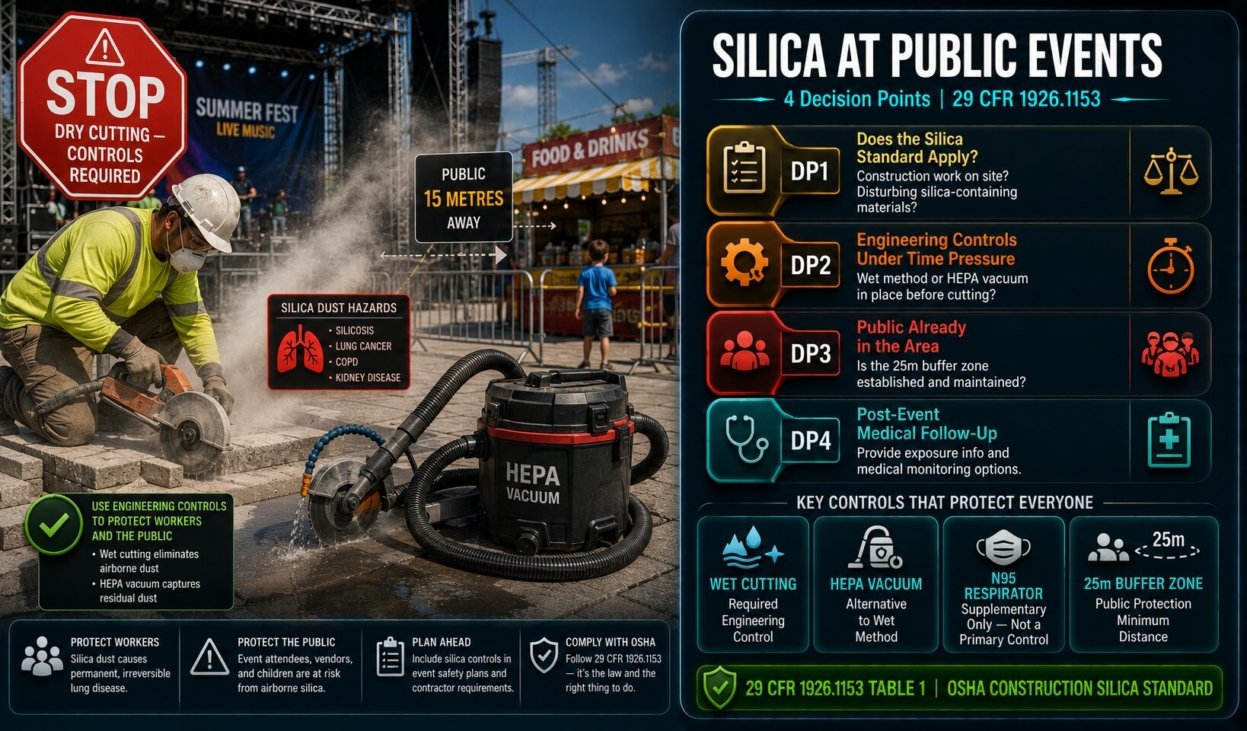
SITUATIONAL: Silica Exposure at Public Events
Silica Exposure at Public Events: Safety for Temporary Stages and Construction Zones
Crystalline silica hazards in construction are well understood. What gets missed is when the same cutting and grinding activities happen during event setup, temporary stage installation, or public space renovation where non-workers are metres away and no silica controls are in place. This article examines how that gap operates, what OSHA’s construction silica standard requires regardless of project duration, and what should have been done differently.
Note on This Scenario
The scenario below is illustrative, constructed from documented patterns in OSHA enforcement records and published occupational health literature on silica exposure in temporary construction and event setup contexts. It does not describe a single named incident. Exposure risks, regulatory obligations, and corrective measures described are factual.
50mcg
OSHA Construction PEL
OSHA’s permissible exposure limit for respirable crystalline silica in construction is 50 micrograms per cubic metre as an 8-hour TWA. Dry cutting of concrete without controls routinely produces airborne silica concentrations many times this level at the operator’s breathing zone.
2.3M
Workers Exposed (OSHA)
OSHA estimates approximately 2.3 million workers in the US are exposed to respirable crystalline silica on the job. Construction accounts for the largest share. Event setup crews performing masonry or concrete cutting fall under the construction standard regardless of project duration.
Table 1
Compliance Shortcut
OSHA’s Table 1 in 29 CFR 1926.1153 specifies required engineering controls for common construction tasks involving silica. Employers who implement Table 1 controls do not need to perform air monitoring to demonstrate compliance for those tasks. Dry cutting without Table 1 controls is not compliant.
Situation Overview
A four-day outdoor music festival is scheduled in a city park. During setup on the day before opening, a crew begins cutting concrete pavers to level the temporary stage foundation. The work uses an angle grinder with a diamond blade, dry cutting, no water suppression or vacuum attachment. Vendor stalls are being assembled 15 metres from the cutting area. No barriers separate the cutting zone from the vendor setup area. No silica risk assessment has been conducted. The crew members cutting are not wearing respiratory protection.
By mid-morning, vendors setting up adjacent stalls notice visible dust settling on their equipment and products. Two crew members report dry coughs. The festival’s event safety officer, who was briefed on crowd management and fire safety but not on construction silica hazards, is not sure what their obligation is or whether the activity is regulated.
What Was Present
Angle grinder with diamond blade. Concrete pavers being cut dry. No water suppression. No vacuum-equipped tool. No respiratory protection on cutting crew. No barriers between work zone and vendor area. No silica risk assessment. Public access to adjacent areas from mid-morning.
What Was Missing
Written Exposure Control Plan per 29 CFR 1926.1153. Table 1 engineering controls for concrete cutting with a handheld grinder (water delivery or vacuum with HEPA filter required). Respiratory protection for cutting crew. Public exclusion zone. Event safety officer briefed on construction silica obligations.
Workplace Background
Event setup and temporary construction share a characteristic that creates compliance gaps: the work is brief, the environment is mixed-use, and the organiser’s safety planning is typically focused on crowd safety, fire egress, and stage rigging rather than occupational health hazards from construction activities. In many cases, the cutting and grinding work is subcontracted to a crew that falls outside the event organiser’s direct safety briefing chain.
OSHA’s construction silica standard at 29 CFR 1926.1153 does not have a duration threshold. It applies to any construction work involving tasks that generate respirable crystalline silica exposure, including work that lasts one day. The Table 1 approach, which specifies required controls for common tasks like handheld grinder use on concrete, was designed partly for exactly this type of short-duration work where air monitoring before starting is not practical.
The event safety officer’s uncertainty in this scenario reflects a genuine knowledge gap. Most event safety training covers crowd management, fire safety, electrical safety, and temporary structure loads. Silica from construction activities during setup is rarely included, even when the setup involves masonry cutting that is objectively regulated under a federal OSHA standard.
Incident Timeline
7:00 AM
Crew arrives to begin stage foundation work. Concrete paver cutting starts using a handheld angle grinder with a diamond blade. No pre-task silica risk assessment. No water or vacuum controls applied. Crew not wearing respiratory protection.
9:00 AM
Vendor crews begin assembling stalls 15 metres from the cutting zone. No barriers or signage mark the cutting area. Visible concrete dust is present in the air around the work area. Vendors working nearby are not wearing respiratory protection and have not been informed of the hazard.
10:30 AM
Two crew members report persistent dry coughs during a break. One mentions eye irritation. A food vendor complains to the event coordinator that visible dust is settling on equipment and surfaces in the vendor area. The event safety officer is contacted.
11:00 AM
Event safety officer arrives and observes the cutting operation. Uncertain whether OSHA’s silica standard applies to temporary event setup work, they do not order the work to stop. Cutting continues for another two hours. No respiratory protection is issued to the cutting crew or nearby vendors.
1:00 PM
Concrete cutting is completed. Crew sweeps the area dry, resuspending settled dust. Public access to the festival grounds begins two hours later with no clean-up of silica-contaminated surfaces in the vendor area.
Following Day
A vendor reports the incident to OSHA. OSHA opens an investigation. The event organiser is asked to produce the written Exposure Control Plan, air monitoring records, and training records for workers performing the concrete cutting. None of these documents exist.
What Went Wrong
No pre-task silica assessment
No one identified concrete cutting as a silica-generating task before work began. The hazard identification step that would have triggered all subsequent control requirements was skipped entirely. In temporary construction contexts, pre-task hazard identification is frequently the weakest link in the control chain.
Table 1 controls not applied
OSHA Table 1 for handheld grinders operated on concrete or masonry requires either integrated water delivery or a vacuum system with a HEPA filter rated for 25 CFM or greater at the blade guard. Neither was used. This is not a judgment call; it is a specific engineering control requirement for this exact task.
No public exclusion zone
Vendors and their staff were working within 15 metres of active concrete cutting with no barriers, signage, or dust suppression. While OSHA’s construction silica standard is directed at employers of construction workers, the dust generated does not stop at the employer-employee boundary. Vendor staff and members of the public were exposed to airborne silica they had no reason to expect and no ability to protect themselves from.
Event safety officer not briefed on construction silica
The safety officer who could have stopped the work did not act because they were uncertain whether the standard applied to temporary event work. That uncertainty reflects a gap in their training scope, not a genuine legal ambiguity. The construction silica standard applies without a duration threshold.
Investigation Findings
Finding
Standard Violated
Severity
No written Exposure Control Plan
29 CFR 1926.1153(f)
Serious
Dry cutting without Table 1 controls
29 CFR 1926.1153(c) Table 1
Serious
No respiratory protection for cutting crew
29 CFR 1926.1153(e)
Serious
No silica hazard training for workers
29 CFR 1926.1153(i)
Serious
Dry sweeping of silica-contaminated surfaces
29 CFR 1926.1153(g) Housekeeping
Serious
Root Cause Analysis
Contributing Factors by Weight
No hazard identification before work began
Primary
The absence of any pre-task silica risk assessment meant that all downstream controls were also absent. In temporary construction, no one assigned responsibility for silica hazard identification during the event setup planning phase.
Subcontractor not integrated into event safety plan
Primary
The cutting crew was a subcontractor whose scope of work included construction tasks regulated under a separate federal standard. The event organiser’s safety plan covered event-specific hazards but did not address the construction phase or verify that the subcontractor had a compliant silica program.
Event safety officer’s training scope did not include construction standards
Contributing
The safety officer present during the work was trained in event safety, not construction safety. Their uncertainty about whether OSHA’s construction silica standard applied to temporary event setup work was a direct result of a training gap, not a legal ambiguity.
No separation between construction activity and public access areas
Contributing
Event planning did not sequence the construction and public-access phases with adequate buffer. Vendor setup began while construction cutting was still underway with no barrier between the two activities.
Corrective Actions
1
Stop all dry cutting of concrete or masonry immediately
No concrete or masonry cutting in the vicinity of public or vendor areas without Table 1 controls in place. This is the immediate corrective action and it requires no assessment or planning: dry cutting stops until engineering controls are implemented.
2
Implement Table 1 controls before resuming
For handheld grinders on concrete: use a grinder equipped with a shroud and vacuum system rated at 25 CFM minimum with HEPA filtration, or use integrated water delivery. Issue minimum APF 10 half-face respirator with N95 filter to all cutting crew while controls are being set up.
3
Establish a physical exclusion zone
Erect temporary fencing or barrier tape establishing at minimum a 10-metre exclusion zone around any concrete cutting operation. Post OSHA-compliant silica hazard signage at the zone perimeter. No vendor access, public access, or non-essential workers permitted inside the exclusion zone while cutting is active.
4
Develop and implement a written Exposure Control Plan
Document all silica-generating tasks in the project scope, the controls required for each task per Table 1, the designated competent person responsible for the plan, and the procedures for housekeeping and respiratory protection. This document must be available at the worksite.
Lessons Learned
The standard applies regardless of how short the work is
The most common misconception in event setup and temporary construction is that brief work duration reduces or eliminates the regulatory obligation. It does not. 29 CFR 1926.1153 applies to any construction operation generating silica exposure. A two-hour concrete cutting job during event setup is regulated exactly the same as a two-week project.
Subcontractors doing construction work bring construction standards into the event
When an event organiser hires a subcontractor to perform masonry, concrete, or any construction work during event setup, they are bringing a regulated construction operation into their site. The event organiser’s site plan must account for the regulatory requirements that apply to those operations, including silica controls, regardless of whether the subcontractor manages their own compliance. OSHA’s multi-employer citation policy is relevant here.
Dry sweeping resuspends settled silica
The housekeeping step that occurred in this scenario, dry sweeping of silica-contaminated surfaces after cutting, is explicitly prohibited by the standard. Dry sweeping resuspends fine silica particles that have settled, creating a secondary exposure event for anyone in the area. Wet methods or HEPA-equipped vacuums must be used for cleanup of silica-contaminated surfaces.
Prevention Checklist
Pre-Event Planning
Identify all construction tasks in the setup scope that involve concrete, masonry, or stone
Require subcontractors performing silica-generating work to provide their written Exposure Control Plan before mobilising
Schedule all concrete and masonry cutting before vendor and public access areas are established nearby
Brief the event safety officer on construction silica standards and Table 1 controls
During Construction Activities
Verify Table 1 controls are in place before any concrete or masonry cutting begins
Maintain physical exclusion zone with barrier tape or fencing around all cutting operations
Ensure cutting crew wears at minimum an N95 half-face respirator while Table 1 controls are set up or where required by exposure level
Stop work if exclusion zone is breached by non-authorised personnel
Housekeeping and Closeout
Use wet methods or HEPA-equipped vacuum for all cleanup of silica-contaminated surfaces
Never use compressed air or dry sweeping to clean up concrete cutting dust
Allow adequate time after cleanup before permitting public or vendor access to the area
Document cleanup activities and surface decontamination as part of the site record
Key Takeaways
Table 1 is the practical compliance tool for short-duration silica work
OSHA’s Table 1 approach was designed for exactly the kind of short-duration construction tasks that occur during event setup. Employers who implement the specified engineering controls for their task do not need to perform air monitoring. For handheld grinder work on concrete, Table 1 requires a shroud and HEPA vacuum system at 25 CFM minimum, or integrated water delivery. These controls are available on widely rented equipment. The compliance path is straightforward once you know to look for it.
Public exposure is a separate harm from worker exposure
In this scenario, vendor staff and members of the public were exposed to airborne silica they could not see clearly, could not identify as hazardous, and had no means to avoid. OSHA’s standard protects construction workers. It does not directly regulate bystander exposure. But the event organiser has both a duty of care to people on their site and a practical liability exposure when a foreseeable hazard from their operation reaches non-workers. Controlling the construction activity protects both groups.
Frequently Asked Questions
Does OSHA’s construction silica standard apply to event setup work?
Yes. 29 CFR 1926.1153 applies to all construction work, including temporary construction during event setup, regardless of duration. If the work involves cutting, grinding, drilling, or crushing concrete, stone, or masonry, the standard applies. The fact that the project lasts one day rather than one year does not reduce the obligation. OSHA has cited employers for silica violations on short-duration construction projects including event infrastructure work.
What does Table 1 require for a handheld grinder used on concrete?
Table 1 in 29 CFR 1926.1153 specifies two compliant control options for handheld grinders used on concrete or masonry: a shroud equipped with a vacuum system that provides 25 CFM or greater of airflow at the shroud intake with a HEPA filter, or integrated water delivery that continuously applies water to the blade. Both options eliminate the need for air monitoring for that specific task. Dry cutting without either control is not Table 1 compliant and exposes the employer to citation.
Who is responsible for silica compliance when a subcontractor performs the cutting work?
Both the subcontractor and the controlling employer (the event organiser or general contractor who manages the site) can be cited under OSHA’s multi-employer citation policy. The controlling employer is expected to exercise reasonable care to prevent or detect violations on the site, including verifying that subcontractors performing construction work have compliant silica programs. A subcontractor’s non-compliance does not automatically shield the controlling employer from citation.
What respirator is required for workers cutting concrete?
When Table 1 engineering controls are in place, a half-face air-purifying respirator with an N95 filter is required for the specified tasks unless the employer has objective data demonstrating that exposure remains below 25 micrograms per cubic metre (the action level). Without Table 1 controls, or where exposure is expected to exceed the PEL after controls, a higher-APF respirator is required. Any respirator use requires a written respiratory protection program, medical evaluation of the worker, and fit-testing under 29 CFR 1910.134.
Government and Regulatory Sources
Related VelSafe Articles
Applying These Lessons to Event and Temporary Construction Planning
The compliance failures in this scenario are each individually fixable and none of them required significant resources. A vacuum-equipped grinder is widely available for rental. Written Exposure Control Plans for a single-task operation can be a one-page document. Scheduling cutting work before vendor setup begins costs nothing. What these fixes require is someone with authority over the site who knows that OSHA’s construction silica standard applies and what Table 1 requires for the specific tasks being performed. Find more workplace safety resources at velsafe.com.