LAW: Heat Stress Compliance
Heat Stress Regulations: Employer Obligations and Compliance Requirements
Heat illness kills dozens of US workers each year and hospitalises hundreds more. OSHA has pursued heat illness citations under the General Duty Clause for years and a federal heat injury and illness prevention standard is now under active rulemaking. This article explains what the law currently requires, what employers must do to comply, and what is changing.
Legal Disclaimer
This article provides educational information about heat stress regulations and employer obligations. It does not constitute legal advice. Regulatory requirements vary by state and industry. Consult qualified legal counsel or a licensed EHS professional for guidance specific to your situation.
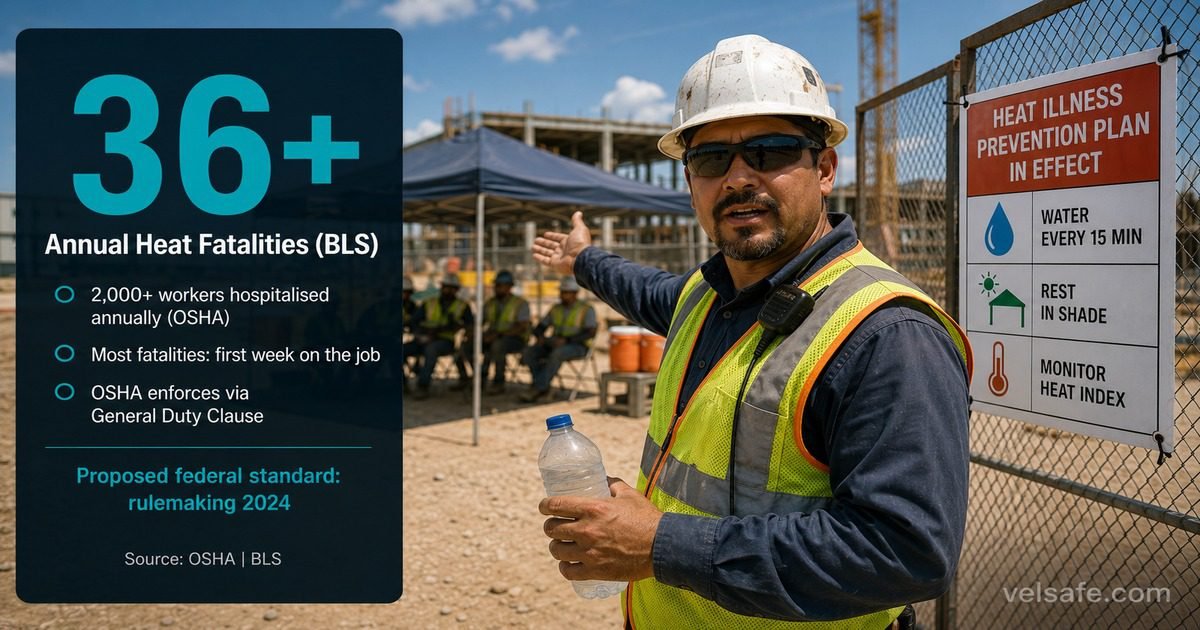
36+
Annual Heat Deaths (BLS)
The Bureau of Labor Statistics records an average of more than 36 occupational heat fatalities annually in the US. OSHA and public health researchers consider this figure a significant undercount due to heat as a contributing rather than primary cause on many death certificates.
2,000+
Annual Heat Illnesses (OSHA)
OSHA estimates more than 2,000 workers are hospitalised for heat illness each year. Outdoor workers in construction, agriculture, and landscaping account for the majority of serious cases, but indoor workers in foundries, bakeries, and manufacturing also face significant risk.
GDC
Current Legal Basis
No federal heat-specific OSHA standard currently exists for general industry or construction. OSHA cites heat illness cases under the General Duty Clause (Section 5(a)(1) of the OSH Act), which requires employers to address recognised hazards likely to cause serious harm.
Law Summary: What the Current Framework Requires
As of 2026, there is no federal OSHA standard that specifically and exclusively governs heat illness prevention in general industry or construction. That is the most important thing for employers to understand, because the absence of a specific standard does not mean the absence of legal obligation.
OSHA cites heat illness cases under the General Duty Clause, which requires every employer to provide a workplace free from recognised hazards causing or likely to cause death or serious physical harm. Heat is a recognised hazard. OSHA has successfully used the GDC to cite employers following heat fatalities for decades. A proposed federal Heat Injury and Illness Prevention Standard was published for public comment in 2024 and rulemaking remains ongoing as of mid-2026.
Current Federal Standard
No dedicated federal heat standard for general industry. OSHA enforces heat obligations through the General Duty Clause (OSH Act Section 5(a)(1)). Agriculture has a separate framework under the field sanitation standard (29 CFR 1928.110).
Proposed Federal Standard (Under Rulemaking)
OSHA’s proposed Heat Injury and Illness Prevention Standard would establish mandatory trigger temperatures, acclimatisation requirements, water and rest provisions, and emergency response protocols. Check OSHA’s rulemaking docket for current status.
State Standards
California, Washington, Minnesota, Colorado, and Oregon have enacted state-specific heat illness prevention standards that exceed the federal GDC floor. Employers in those states must comply with state requirements regardless of federal rulemaking status.
High-Risk Sectors
Construction, agriculture, landscaping, roofing, oil and gas, warehousing, foundries, bakeries, and commercial kitchens. Both outdoor and indoor heat environments are covered under GDC enforcement.
Who Must Comply
Under the General Duty Clause, every employer covered by the OSH Act must address heat as a recognised hazard when conditions create a risk of serious heat illness. This applies regardless of industry, facility size, or whether work is performed indoors or outdoors. There is no minimum temperature threshold written into law that triggers GDC obligations. OSHA looks at the totality of conditions: temperature, humidity, radiant heat sources, physical workload, acclimatisation status, and worker susceptibility.
Employer Type
Applicable Framework
Key Obligation
General Industry (all states)
OSHA General Duty Clause
Provide feasible controls when heat poses a recognised serious risk
Construction (all states)
OSHA General Duty Clause
Provide water, rest, shade, and acclimatisation for outdoor workers
Agriculture (field operations)
29 CFR 1928.110 (Field Sanitation)
Potable water, toilet facilities, handwashing within specific distances
California employers
Cal/OSHA Title 8 CCR 3395
Written Heat Illness Prevention Plan, mandatory shade and water provisions, acclimatisation program
Washington employers
WAC 296-62-095
Trigger temperatures for mandatory controls, cool-down periods, training requirements
Applicable Standards and Regulatory Basis
For most US employers, the primary legal basis for heat illness enforcement is the General Duty Clause. But “no specific standard” does not mean “no specific guidance.” OSHA’s Heat Illness Prevention campaign, published enforcement guidance, and inspection targeting criteria establish what OSHA considers to be feasible and appropriate controls. Employers are expected to know and implement these controls regardless of whether they are codified in a standard.
Key Regulatory References
OSH Act Section 5(a)(1): General Duty Clause. Primary enforcement basis for heat illness citations in states without specific standards.
29 CFR 1928.110: Field Sanitation standard. Applies to agricultural employers with 11 or more workers at one time. Requires water, toilets, and handwashing facilities within prescribed distances of field workers.
Cal/OSHA Title 8 CCR 3395: California’s Heat Illness Prevention regulation. One of the most comprehensive state heat standards in the country. Covers both outdoor and, in some circumstances, indoor workplaces.
OSHA Proposed Rulemaking (2024): A federal heat standard for general industry, construction, agriculture, and maritime is in development. Monitor the OSHA rulemaking docket at regulations.gov for current status and implementation timelines.
Key Definitions
Heat Exhaustion
A heat-related illness characterised by heavy sweating, weakness, cold or pale clammy skin, a fast or weak pulse, nausea or vomiting, and possible fainting. Body temperature may be normal. Heat exhaustion requires immediate removal from the heat environment and medical evaluation if symptoms do not improve quickly.
Heat Stroke
A life-threatening emergency. Body temperature at or above 103 degrees F (39.4 degrees C), hot and red skin (dry or damp), rapid and strong pulse, possible unconsciousness. Heat stroke requires calling 911 immediately and cooling the person rapidly by any available means while waiting for emergency services.
Acclimatisation
The physiological adaptation that occurs when a worker is gradually exposed to increasing levels of heat over 7 to 14 days. Acclimatised workers develop improved cardiovascular efficiency, increased sweat rate, and reduced core body temperature response to heat stress. New and returning workers who have not acclimatised are at the highest risk of heat illness.
Wet Bulb Globe Temperature (WBGT)
The measurement most widely used in occupational heat stress assessment. WBGT accounts for temperature, humidity, radiant heat from the sun or hot surfaces, and air movement. It is a more accurate indicator of heat stress risk than air temperature alone and is the basis for NIOSH and ACGIH recommended exposure limits.
Employer Responsibilities
Under the GDC framework, OSHA expects employers with heat-exposed workers to implement what are commonly referred to as the three Ws: water, rest, and shade. These are the foundational controls that OSHA looks for when investigating heat illness incidents. But they are the floor, not the ceiling. A comprehensive heat illness prevention program includes additional elements that OSHA considers when assessing whether an employer took reasonable steps to protect workers.
Provide cool potable water close to the work area at no cost to workers. Ensure that workers can take rest breaks when needed, particularly when experiencing symptoms of heat stress. Provide shaded areas for rest that are large enough to accommodate all workers taking breaks at the same time. For outdoor work, shade must be accessible, not just available on request.
2
Acclimatisation Program
New employees and workers returning from more than one week away must be acclimatised gradually to heat conditions. OSHA guidance recommends starting at 20 percent of typical heat exposure on day one and increasing over 7 to 14 days. Most heat fatalities involve workers in their first few days on the job. An acclimatisation schedule is one of the most important things an employer can document.
Train all workers on recognising the signs of heat exhaustion and heat stroke, first response procedures, the importance of drinking water before feeling thirsty, and how to report symptoms. Train supervisors on monitoring workers for early signs of heat illness, how to respond to an emergency, and their responsibility to allow rest when workers need it.
4
Emergency Response Plan
Maintain a written emergency response plan for heat illness that includes: contacting emergency services, first aid measures for suspected heat stroke, the location of the nearest emergency medical facility, and who is responsible for each step. OSHA investigators look for this document following heat fatalities. Its absence is evidence that the employer did not take the hazard seriously.
Employee Rights
Workers have specific rights related to heat illness protection that employers cannot limit or retaliate against. Under the OSH Act, workers have the right to report heat illness symptoms without fear of disciplinary action. The right to refuse work in conditions that pose an imminent danger applies to extreme heat situations where there is a real danger of death or serious physical harm and the worker has no reasonable alternative.
Workers Have the Right To
Employers Cannot
Access cool water during their shift at no cost
Charge workers for water or limit water access during hot conditions
Take rest breaks when experiencing symptoms of heat illness
Discipline workers for requesting rest or reporting heat illness symptoms
Report heat hazards and symptoms to their supervisor
Retaliate against workers for reporting heat concerns or filing OSHA complaints
File a confidential OSHA complaint if employer fails to address heat hazards
Terminate or discipline a worker for exercising OSH Act rights in good faith
Common Violations and What OSHA Looks For
OSHA’s heat illness inspection targeting program focuses on industries with the highest heat exposure risk, particularly during summer months and heat waves. When inspecting following a heat illness incident, investigators look for documentation of what the employer had in place before the event. The absence of written plans, training records, and acclimatisation schedules is treated as evidence that the employer did not recognise or address the hazard.
Most Frequently Cited Heat Illness Deficiencies (GDC Enforcement)
No written heat illness prevention plan
Most common
California and Washington explicitly require written plans. Under the GDC, OSHA expects employers to have documented procedures. A verbal policy is difficult to defend following a fatality.
No acclimatisation program for new workers
Strongly associated with fatalities
OSHA data consistently shows that a large proportion of heat fatalities occur in the first week of employment or return from absence. Acclimatisation program documentation is one of the first things investigators request.
Inadequate or inaccessible water and shade
Frequently cited
Water that requires a significant walk to access, or shade that exists but requires supervisor approval to use, does not meet OSHA’s expectations under the GDC. The standard is that controls are accessible and workers know they can use them without fear of repercussion.
No supervisor training on heat illness recognition
Common in fatality investigations
Supervisors who cannot recognise early heat illness symptoms or who have not been trained to call for emergency services cannot provide the first-line protection that prevents heat exhaustion from progressing to heat stroke. Supervisor training is a specific expectation in OSHA’s enforcement guidance.
Penalties and Consequences
GDC citations for heat illness violations are classified as serious or willful depending on the circumstances. A serious citation carries a maximum penalty of $16,550 per violation as of 2024. A willful citation, issued when OSHA determines the employer knew about the hazard and deliberately failed to address it, carries penalties up to $165,514 per violation. Following a fatality, OSHA investigations frequently result in multiple citations across several standards, with total penalties that can reach hundreds of thousands of dollars.
Civil liability is separate from OSHA penalties. Families of workers who die from heat illness may pursue wrongful death claims. Documentation of what the employer knew, when they knew it, and what they failed to do is typically central to those cases. The same documentation that OSHA requests during an inspection is what plaintiffs request in discovery.
Compliance Checklist
Program Foundation
Written heat illness prevention plan in place and current
Acclimatisation schedule documented for new and returning workers
Emergency response procedures written and accessible to all supervisors
State-specific requirements checked and incorporated where applicable
Controls in Place
Cool potable water accessible near work areas at no cost to workers
Shaded rest areas large enough for all workers on break simultaneously
Rest break schedule or policy allowing workers to cool down when needed
Engineering controls assessed where feasible (fans, cooling, scheduling)
Training and Monitoring
All workers trained on heat illness signs, symptoms, and reporting
Supervisors trained on heat illness recognition and emergency response
Heat index or WBGT monitoring in place during high-risk periods
Training records retained and available for OSHA review
Key Takeaways
No specific standard does not mean no obligation
The GDC applies when heat poses a recognised risk of serious harm. OSHA has a consistent record of successful heat illness citations under the GDC, and the absence of a specific standard has not prevented significant penalties following heat fatalities. Employers who wait for a specific rule to protect workers from heat are operating on the wrong side of the legal and moral line.
Acclimatisation is where most fatalities are preventable
The concentration of heat fatalities in workers’ first days on a job is not a coincidence. The body takes 7 to 14 days to adapt to heat stress. Employers who treat new workers as fully acclimatised from day one, and who have no documented schedule for gradual exposure, are creating the conditions that produce preventable deaths. The schedule does not need to be complex. It needs to exist.
State standards may be stricter than federal GDC expectations
If you operate in California, Washington, Oregon, Minnesota, or Colorado, the federal GDC is not the relevant standard for your compliance program. Those states have specific, detailed heat illness prevention requirements with defined trigger temperatures, mandatory shade and water distances, and written plan requirements. A program built only around the federal GDC floor will not satisfy state requirements.
Frequently Asked Questions
Does OSHA have a specific heat illness prevention standard?
Not yet for general industry or construction at the federal level. OSHA currently enforces heat illness obligations through the General Duty Clause. A proposed federal Heat Injury and Illness Prevention Standard was published for comment in 2024 and rulemaking is ongoing. California, Washington, Oregon, Minnesota, and Colorado have enacted their own specific state standards that are currently in effect.
What temperature triggers OSHA’s heat requirements?
There is no specific temperature written into the federal GDC trigger. OSHA assesses the totality of conditions: air temperature, humidity, radiant heat sources, workload, acclimatisation status, and worker susceptibility factors such as age and medications. NIOSH recommends using WBGT thresholds aligned with workload level. State standards in California and Washington do specify temperature triggers, ranging from 80 to 95 degrees F depending on the specific requirement.
Are indoor workers covered by heat illness requirements?
Yes. The GDC applies to indoor workplaces where heat poses a recognised serious risk. Foundries, commercial kitchens, bakeries, laundries, warehouses without adequate ventilation, and manufacturing facilities with radiant heat sources have all been subject to OSHA heat illness enforcement. California’s regulation specifically extends to indoor work environments under certain conditions.
What documentation should employers maintain for heat illness compliance?
Written heat illness prevention plan. Acclimatisation schedule and training records for new and returning workers. Records of heat index or WBGT monitoring during high-risk periods. Emergency response procedures. Supervisor training records. Any incident reports related to heat illness, including near-misses. These documents are the first things OSHA investigators request following a heat-related incident or complaint.
Government and Regulatory Sources
Related VelSafe Articles
Building Your Heat Illness Prevention Program
Water, rest, and shade are the starting point, not the complete program. Employers who have those three elements in place but lack a written plan, a documented acclimatisation schedule, trained supervisors, and an emergency response procedure have an incomplete program by OSHA’s own published enforcement criteria. The time to build that documentation is before a heat season, not after an incident. Find more workplace safety compliance resources at velsafe.com.